Infinite appetite for distractions

“…reality, however utopian, is something from which people feel the need of taking pretty frequent holidays….”

Brave New World is one hell of a book. I am so impressed with it, I barely know where to start. This book made me understand why people write fiction. Until now, fiction always seemed lyrical – and only accessible to those with a particularly creative rather than an analytical mind. For example, poetry always made more sense to me than fictional prose – because it doesn’t usually require one to conjure up things that have never happened, but rather seeing things that others mightn’t see in what did happen. Huxley strikes me as analytical – but well able to articulate his analysis through an elaborate metaphor that is Brave New World. The story line didn’t flow and felt contrived to me. However, the descriptions and the dialogue more than made up for it.

The book came out in 1931. Interestingly, it was banned in Ireland “for being anti-family and anti-religion.”

The beauty of the book is that we aren’t strongly drawn to side with one side over the other. While one side is infinitely more familiar and natural, the other eerily makes a lot of sense. Hence, it isn’t just a praise of our “old” values, but an insightful examination. I don’t know that Huxley meant it that way – but that’s how it reads to me today. Consider this, for example. Opposing the brave new world, we have John, a boy who grew up in a close-knit tribe and whose morals are deeply aligned with those of Shakespeare’s heroes. So far – so good. However, he had a troubled mother and grew up without a father. This clearly left a mark on him – and would never have happened in the brave new world. He also self-flagellates. Minutes after confessing his endless love to a woman, he violently disowns her – for wanting to have sex with him. He ultimately commits suicide. Not so good. John is implicitly compared to Shakespeare’s tragic heroes, nearly all of them – Hamlet, Macbeth, Othello, Lear and Romeo as he is pensive, ambitious, proud and impulsive.

While there are lots of insights to be derived from this book, I am not convinced of how new this brave new world really is. Is this regime really much different to what we have had before?

Most of all, for me, this book is a distilled vision of how human nature shows up when people are put into a very particular set of circumstances.

Brave New World meaning

Highlights

The biggest highlight is Chapter 16. The Controller, the man who runs this new world, is a tyrannical yet highly intelligent and calm person. He is the one who makes the rules of the brave new world. He reveals how he made his decisions. Ironically, it reminds me of the last chapter of every Harry Potter book – where we always find out the real behind-the-scenes from Dumbledore.

/I really need to read more. But while we’re here, could the fact that Dumbledore’s first name is Albus be an allusion to Aldous Huxley’s first name – as J.K.R. took on some of the structure, (even though it’s not necessarily unique to Huxley)?/

What’s interesting is that, on a certain level, the arguments presented by the Controller seem both logical and humanitarian. Here are some highlights:

On the subjected of happiness versus grand feats:

“Civilisation has absolutely no need of nobility or heroism.These things are symptoms of political inefficiency. In a properly organised society like ours, nobody has any opportunities for being noble or heroic […] [In this society] People are happy; they get what they want, and they never want what they can’t get. They’re well off; they’re safe; they’re never ill; they’re not afraid of death; they’re blissfully ignorant of passion and old age; they’re plagued with no mothers or fathers; they’ve got no wives, or children, or lovers to feel strongly about; they’re so conditioned that they practically can’t help behaving as they ought to behave. […] The greatest care is taken to prevent you from loving any one too much. […] you’re so conditioned that you can’t help doing what you ought to do. And what you ought to do is on the whole so pleasant, so many of the natural impulses are allowed free play, that there really aren’t any temptations to resist.”

“Actual happiness always looks pretty squalid in comparison with the overcompensations for misery. And, of course, stability isn’t nearly so spectacular as instability. And being contented has none of the glamour of a good fight against misfortune, none of the picturesqueness of a struggle with temptation, or a fatal overthrow by passion or doubt. Happiness is never grand.”

On the subject of social order:

John asks: Why don’t you make everybody an Alpha Double Plus while you’re about it? For those who haven’t read the book, Alpha Double Plus is a genetically superior person who is educated (“conditioned” – and I believe that’s a fair word) to be aware of their individuality.

“We believe in happiness and stability. A society of Alphas couldn’t fail to be unstable and miserable. Imagine a factory staffed by Alphas that is to say by separate and unrelated individuals of good heredity and conditioned so as to be capable (within limits) of making a free choice and assuming responsibilities… An Alpha-decanted, Alpha-conditioned man would go mad if he had to do Epsilon Semi-Moron work – go mad, or start smashing things up.

Alphas can be completely socialised – but only on condition that you make them do Alpha work. Only an Epsilon can be expected to make Epsilon sacrifices, for the good reason that for him they aren’t sacrifices; they’re the line of least resistance. His conditioning has laid down rails along which he’s got to run. He can’t help himself; he’s foredoomed.”

The Controller cites the Cyprus experiment, where Cyprus was cleared and populated with Alphas – resulting in civil war. While this is obviously not a real reason to substantiate Huxley’s assertion that a caste system – whether deliberate or not – makes society more stable, it shows that the Controller didn’t make this decision out of pure tyranny – but instead out of a rather unethical overuse of science. Yes, we usually say it is unethical to experiment on humans – at least in a social way, but perhaps it is also unethical to live in ignorance. Plus, in our real new world, it happens. Notably, Facebook experimented with our moods by adjusting our feeds – without letting us know, of course.

Brave New World philosophyOn the subject of the necessity of stupid work:

“Seven and a half hours of mild, unexhausting labour, and then the soma ration and games and unrestricted copulation and the feelies. What more can they ask for?”

… This reminds me terribly of the life of the graduate intake of a corporation. Soma, “a holiday from the facts”, is described as alcohol without a hangover – I think most people wished for that at some point. The feelies are terribly reminiscent of VR. Earlier on in the book there was a reference to conditioning people to love expensive outdoor sports (rather than simply loving nature – as this alone doesn’t generate economic activity). Fancy sports is also a corporate favourite. There are reasons why that is besides a Huxley-themed conspiracy theory, but it’s interesting to note.

Another (thought)-experiment to back this:

“Technically, it would be perfectly simple to reduce all lower-caste working hours to three or four a day. But would they be any the happier for that? No, they wouldn’t. The experiment was tried, more than a century and a half ago. The whole of Ireland was put on to the four-hour day. What was the result? Unrest and a large increase in the consumption of soma; that was all. Those three and a half hours of extra leisure were so far from being a source of happiness, that people felt constrained to take a holiday from them. The Inventions Office is stuffed with plans for labour-saving processes. Thousands of them… We don’t want to change. Every change is a menace to stability.”

On the subject of the natural instinct to believe there is a god: 

“You might as well ask if it’s natural to do up one’s trousers with zippers,” said the Controller sarcastically. “You remind me of another of those old fellows called Bradley. He defined philosophy as the finding of bad reason for what one believes by instinct. As if one believed anything by instinct! One believes things because one has been conditioned to believe them. Finding bad reasons for what one believes for other bad reasons–that’s philosophy. People believe in God because they’ve been conditioned to.”

Indeed, the premise of effective “hypnopaedia” (repeating statements to children in their sleep for the purpose of teaching them) is that one doesn’t need to understand ethical statements to be able to use them (unlike science – where hypnopaedia fails). It seems that that’s true to me: groups of people tend to have similar values because everyone around them has those values. Most people’s values aren’t derived from first principles, they are adopted through repetition. There are, of course, many reasons for this, e.g. it is a survival strategy and the basis of any community, but… it’s still a dangerous instrument. A particular aspect of hypnopedia seems quite realistic: people are convinced that their caste (a proxy for position in life) is the happiest place they could be. While gratitude is a virtue, it has gotten quite compulsive these days, much like in the book. Every self-respecting Instagram user reminds us of it daily. Then again, before Instagram & co., we had other sources who told us to be grateful – they know who they are. The author also talked about god in Chapter 17, very elaborately with lots of references to philosophy. I don’t think I can dissect that even to the same standard as above. I did very much enjoy his look at Edmund, Gloucester’s illegitimate son from King Lear. The Edmund of the brave new world would have been chilling with the ladies and “looking at the feelies” – not being killed off by the gods as in Shakespeare. Huxley’s argument that this mindless chilling is as good (as bad?) as death – it just depends what standard one holds themselves to.

brave new world analysis

On the subject of truth:

“I’m interested in truth, I like science. But truth’s a menace, science is a public danger.” … We […] carefully limit the scope of researches. […] We don’t allow it to deal with any but the most immediate problems of the moment.”

This applies today. The usual argument is economic necessity determines whether research should be carried out. Indeed, Huxley believes so too, but in a rather twisted way: he says that truth and beauty don’t lead to economic growth. Economic growth, however, is the ultimate value: the goal is to be a “happy, hard-working, goods-consuming citizen”. Brrr.

Knowledge was the highest good, truth the supreme value; all the rest was secondary and subordinate… Universal happiness keeps the wheels steadily turning; truth and beauty can’t… Our Ford himself did a great deal to shift the emphasis from truth and beauty to comfort and happiness.”

Huxley also points out that there is real science – and then there are applications of that knowledge for the good of society – that may have little to do with the bona fide scientific method. Indeed, the fact that Ford is a god in the brave new world is scary. While in the real world, we don’t have a conveyor belt mania to the extent that Huxley feared, we have indeed sanctified phenomenally successful people. While countless people still look to god for guidance, we have seen humongous growth in these business school types (or just, types) who “study successful people.”

On the subject of love:

The indoctrination concerning love is particularly chilling. Perhaps the most likeable character, Helmholtz, who belongs in the brave new world explains what he thought of Romeo and Juliet:

The mother and father […] forcing the daughter to have some one she didn’t want! And the idiotic girl not saying that she was having some one else whom (for the moment, at any rate) she preferred!

It’s chilling because it’s not wrong. It is robotic. Helmholtz acknowledges that Shakespeare wrote in a way that provokes strong emotions and admired his craft, but Helmholtz wasn’t able for any empathy. Lenina, John’s romantic interest, however, seemed to have some real feelings for him. Her friends though thought that she was unwell.

Amusing Ourselves to Death

Neil Postman said:

“What Orwell feared were those who would ban books. What Huxley feared was that there would be no reason to ban a book, for there would be no one who wanted to read one.”

I think this has happened even during my own lifetime. Even among the most educated people I know, coming out with interest and knowledge in some obscure subject often provokes the question why do you know this?  Was your primary degree in X?  I am pretty certain that knowledge acquisition has lost a lot of its perceived value during my lifetime – now that we have Google. The deeper layer, of course, is that the process of acquiring knowledge yields much more than just the knowledge. At the same time, I wonder, has it ever been different? At the end of the day, if nobody wanted to read books or write down their thoughts, why is blogging such a big thing these days? I wonder if back when this book was written – writing – and especially reaching an audience – was primarily the province of those who had gone to Oxford and could afford to not have a day job?

“Orwell feared those who would deprive us of information. Huxley feared the truth would be drowned in a sea of irrelevance.”

Welcome to social media. This, I think, is quite unique to our age. Furthermore, in the brave new world, people are never alone – leading to the distractions that perpetuate lack of insight.

Brave New World Revisited

Huxley later wrote in a non-fiction reflection of where the world is now in relation to his Brave New World that we “failed to take into account man’s almost infinite appetite for distractions.” Indeed, he even sees religion as part of this distraction:

“’The religious sentiment will compensate us for all our losses.’ But there aren’t any losses for us to compensate; religious sentiment is superfluous. And why should we go hunting for a substitute for youthful desires, when youthful desires never fail? A substitute for distractions, when we go on enjoying all the old fooleries to the very last? What need have we of repose when our minds and bodies continue to delight in activity? of consolation, when we have soma? of something immovable, when there is the social order?”

As a concluding remark, if I could, I would definitely make this mainstream in schools. I know in some places it is, but not everywhere. 1984 is a much bigger deal in most places -perhaps as it served a political purpose. This book deserves more attention, I feel. Most school kids struggle to understand Hamlet and King Lear through generating their own insights, but I think they would be able to relate to this much more.

And Happy Christmas, of course.

You may also like:

A review of Kurt Vonnegut’s Slaughterhouse-five

Cognitive curiosities: best quotes from books on the mind

brave new world essay personal response

Inside a bilingual mind

My mother is in the throes of learning a foreign language – and I am doing my best to help. I am bilingual in English and Russian. There are definitely lots of people more talented at languages than I, but I am always surprised at how exceedingly rare people with near-perfect grammar and pronunciation in two languages actually are. Indeed, it is one of the things that stops me from wanting to learn another language – knowing how hard it is to get to proficiency.

In my attempt to help out with my mam’s progress, I found a lecture from this polyglot on the psychology of learning a language. He made a very interesting point:

in order to speak a different language you need to mentally switch wavelength and adopt a new persona. He argues that a language has a certain emotional state associated with it.

I don’t think it’s as literal as “happy vs sad”, but it’s more like a feeling you get when you speak a language. To be blunt about it, I imagine if I tried to speak Italian I would be more laid back and extroverted than if I tried to speak German. Indeed,

a few of my close friends remark that my mannerisms, tone and timbre all change when I switch between my two native languages. I had zero insight into this until I was told about it.

On reflection, I realised that a friend of mine who is fluent in German and English does something similar. He kind of seems to look at his shoes more when he speaks German – and seems generally less approachable.

what it's like to be bilingual

I also feel quite different when I am speaking English vs Russian. This is going to sound like I’ve lost the plot, but I can think of no better way to describe it.

In English, things are slick – like an iPhone. In Russian, things are deep and meaningful – like Dostoevsky.

I like to listen to podcasts. I realised that listening to a good podcast in Russian made me see the speaker as being intelligent, whereas a good podcast in English made me feel that the speaker is competent. The difference is subtle and so cliché! It gets worse. The Russian speaker always seems a little too direct – though not aggressive – and the English speaker seems a little sales-pitchy. I mean that’s just caricature-worthy  – but also true.

It looks like I am susceptible to the “national stereotype” biases even though I am well able to play for both sides and understand that these are just biases.

Much as I hate to admit it, I think I am also more polite when I speak English – and probably more tolerant. At the same time, I would also tend to oversimplify things more when speaking English.Perhaps having to speak English as a lingua franca has changed the world. The Financial Times has an interesting published an article portraying the ultimate beneficiaries of this arrangement as its victims here, arguing that China and Russia understand the USA and UK much better than they understand the rest of the world.

English is a language that doesn’t really allow for long sentences because there aren’t sufficiently complex noun and adjective endings, verb conjugations, etc to show what belongs where in a long sentence. For example, a typical German sentence is longer – because they do have the necessary grammatical framework.

In order to make sense in English, sentences have to be short and declarative – and by proxy, so do one’s thoughts.

All in all, there is definitely a persona-migration that happens in my head when I switch languages.

But that, as usual, got me thinking.

Adopting a persona to do any task at all is a thing. It’s not limited to languages. It’s a bit like having an implicit role model. It’s a dangerous game to play though.

On the one hand, it seems to make things easier. If one imagines themselves as a competent surgical trainee from Gray’s Anatomy, studying for medical finals get that little bit easier. However, isn’t this a departure from reality? I really like the point brought up in Steven Pressfield’s War of Artimagining yourself as a poet/artist/programmer/whatever – is only a vanity project. The point isn’t to define oneself as a poet/artist/programmer/whatever, the point is to make poems/art/code/whatever. Acting in a role, faking it until you make it is well and good, but travelling too far out into the world of alter-egos, be they Italian or surgical, should be done with a lot of insight.

A religion for people who, in troubled times, don’t want any trouble

Breakfast of Champions was completely different to my first encounter with Vonnegut – Slaughterhouse-five. Breakfast is vehemently anti-American – in a way that is could be anti-any nation and is disturbingly relevant today. Vonnegut has a way of stripping away the sugar coating. He speaks of the slave-trade as buying and selling agricultural machines. This comparison is brought back every time he mentions the social problems of those whose ancestors were slaves: he compares them to actual metal machines and explains that the latter are cheaper leaving the former jobless. Plain, cynical and sobering.

The book is largely centred around the concept of free will. As a medic, I recall learning about free will in physiology. Back in the 1980s, Libet et al did a clever experiment showing that the brain initiates a movement before we are aware of wanting to carry out the movement. Subjects were asked to sit in front of a clock. They were told to move at will – and note the time when they decided they were going to move . An EEG was recorded. Essentially, the EEG showed that the impulse to move occurred around a second before subjects became aware that we’re going to move. Libet and colleagues said:

“cerebral initiation of a spontaneous, freely voluntary act can begin unconsciously, that is, before there is any (at least recallable) subjective awareness that a ‘decision’ to act has already been initiated cerebrally.”

This is a good review of the subject free will in physiology. In short, awareness of volition occurs in parallel to actual agency. Whether volition is causal to movement – nobody knows. Our story-telling machine brains do like to think that it is causal of course.

As a person fascinated by mindfulness, I was curious about Vonnegut’s reference to transcendental meditation. Bunny, one of the characters, used TM. Vonnegut described the procedure in Breakfast. Vonnegut doesn’t hide his scepticism.

I appreciate that absolutely everything that involves a financial transaction can be called a scam. Some people think it is insane that the seemingly skill-less abstract art is sold for millions. Some people trust in banks, corporations, governments – and others are swayed by the evidence that these institutions cannot be trusted. Appreciating this subjectivity, my impression of transcendental meditation is that there is a big scam element to it. There are also some elements of religion in it. While I am interested in learning about the ancient tradition of this particular kind of meditation, the TM organisation and its specific take on the technique smacks of danger to me. I would certainly stay well away.

kurt vonnegut free will transcendental meditation breakfast of champions

Kurt Vonnegut’s wife and daughter were practitioners of TM. He said: “Nothing pisses them off anymore. They glow like bass drums with lights inside.” So far, so good. He later said about TM:

“a very good religion for people who, in troubled times, don’t want any trouble.”

This really resonates with me.

Much like positive thinking, transcendental meditation promises the world via some very simple thing that you have to do compulsively – and preferably attend expensive seminars. It’s very important to never doubt the high priests of these respective philosophies – otherwise, it won’t work. I mean, come on.

It also makes sense that TM and positive thinking has worked for some trustworthy high-profile people. It’s because what they call TM and what they call positive thinking is different to what the seminar-selling folk mean. They take a common sense approach – not a “I will take everything literally and follow all instructions” approach that the gullible people these things attract take.

Escaping the cr*p never really works. Transcending into an imaginary ocean of perpetual calm is a form of cheap escapism that only works for seconds. On that note, I recall having a really bad stomach pain. Without any set purpose, my mind wandered and I imagined getting a shot of morphine. I immediately felt much better. However, I still had to go to hospital to make sure it was nothing serious. One simply has to acknowledge their pain and deal with it. Thinking magically won’t resolve it.

The proper, non-commercial, non-popularised practice of TM is a form of mindfulness -and I have every faith that it works well. It’s not my weapon of choice, but I recommend that people try it. Om is a always a good mantra to start with. I don’t see the value in getting mystical with “personalised” mantras. The point remains: if it walks and talks like a scam, it probably is. The other point is that Breakfast of Champions is another worthwhile book.

transcendental meditation scam kurt vonnegut breakfast of champions

Here we are, trapped in the amber of this moment

“And I asked myself about the present: how wide it was, how deep it was, how much was mine to keep.”

Kurt Vonnegut is a genius – and it turns out he is a real connoisseur of the present moment – but he never stood a chance. I heard phenomenal quotes by him: ”We are what we pretend to be”, and rave reviews from a lot of well-read people. Reddit told me that Slaughterhouse-Five was a good place to start – and so I did. His examination of Christianity is excellent. The aspect of his book that left me feeling let down is the whole antiwar piece. He preemptively defends his attempt to write an antiwar book in Chapter 1 by acknowledging that its most likely a pointless affair – but still, his antiwar manifesto seems to lack depth.

“How nice – to feel nothing, and still get full credit for being alive.”

Vonnegut’s reflections on religion are certainly striking. He seems to strip down all the bells-and-whistles. He makes this interesting point: Jesus was a man like the rest of us. The fact that he is glorified makes it OK for us to not strive to be like him – because we couldn’t possibly. However, an appreciation of Jesus as a nobody would allow people to take responsibility for their actions much more. It strangely reminds me of the G.O.P. philosophy and what a well-off Republican might say about the poor in the context of the American dream – just swap the concepts of morality and money around.

Kurt Vonnegut Slaughterhouse 5 meaning
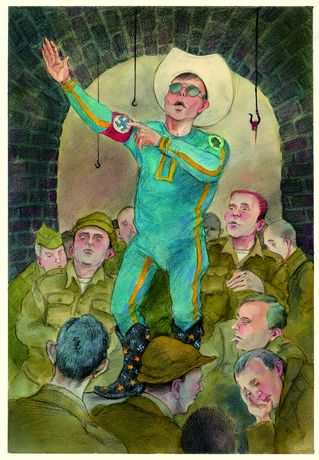
This is what an American Nazi looks like – illustrated by John Holder

“All moments, past, present and future, always have existed, always will exist.”

Vonnegut’s descriptions of women are hilarious. He’s a Dostoevsky-level psychologist. The emotion Vonnegut creates most masterfully is that he-gets-it feeling most of us yearn for. You’d definitely go for a pint with Kurt. For me, when he said that Lot’s wife looking back “was so human” elevated Vonnegut into the “can-do-no-wrong” status. Reading about her in this context tempts me to identify her as the first ever case of PTSD – before it had a name.

“People aren’t supposed to look back. I’m certainly not going to do it anymore.”

His uncomplicated sentences and the absence of excess linguistic ornaments really add to Vonnegut’s main point – war is war. While it is tempting – and indeed seduces most, there’s no use in getting caught up in the ideology or the methodology of war at the expense of understanding the plain reality of it.

“I think you guys are going to have to come up with a lot of wonderful new lies, or people just aren’t going to want to go on living.”

At the start, the frequent remark “So it goes” is gratifying. It occurs anytime somebody or something dies. It has an interesting effect – for me it breaks the forth wall and lets me, as the reader, know that the author and I are on the same page. However, as the book progresses, it becomes compulsive, matter-of-factly and annoying. His use of symbolism is a little too overbearing in general. His overly physiological remarks and “toilet humour” took away from the work for me.

Kurt Vonnegut Slaughterhouse 5 essay
Absurd and relatable. Illustration by John Holder.

“If I am going to spend eternity visiting this moment and that, I’m grateful that so many of those moments are nice.”

The non-linear nature of the narrative emphasises the senselessness of war – but again, towards the end of the book it just seems to be happening for its own sake. There are lots of non-linear compositions that benefit from this structure. My favourite examples are the films Once Upon A Time In America and Pulp Fiction. I think Vonnegut overdid it.

“Why you? Why us for that matter? Why anything? Because this moment simply is.”

The fatalist aspect of the Tralfamadorian philosophy and the recurring quote about having the wisdom to know if you can change something, the courage to change it – and all that – seem to conflict. In a sense, Christianity is fatalist. The “So it goes” reprise has a memento mori quality to it.

“No art is possible without a dance with death, he wrote.”

Vonnegut doesn’t have a very clear philosophical message, but he seems to be convinced there is very little free will if any. The irony of the main character surviving the war despite having absolutely no survival instinct adds to this. Billy seems to have little insight into his own suffering. He escapes reality by travelling in time. Vonnegut doesn’t really offer us an opinion on whether that’s a form of madness – or real life. My impression is that Vonnegut’s outlook is that life in general appears pretty random and not worth sweating over.

“Well, here we are, Mr. Pilgrim, trapped in the amber of this moment. There is no why.”

There is a lot of criticism in the above review, but actually I loved the book. My next stop is Breakfast of Champions.

Addicted to headphones

As soothers are to toddlers, headphones are to anyone who has given up their soother. As someone who’s trying to incorporate as much mindfulness as possible into my life, I was wondering why listening to music is so addictive. Anytime I leave the house I get a little rush – mmm, headphone time! The gym is great for listening to music too. Weights seem lighter and the treadmill moves in slow motion to David Guetta.

addicted-to-headphones

Having learnt about the rush on dopamine that’s associated with anticipation and how it makes our daydreams addictive, I’ve become intrigues as to what behaviours of mine are affected by this. I think my craving for the bass to drop is the same.

It all began when I started exercising. As well as being phenomenally good for me, it has turned into an exercise in escapism. When I hear my favourite tracks, my mind always wonders to the good times I had with my friends and all those associated daydreams. Essentially, listening to music has become an augmented day dream for me.

It seemed near impossible to leave my phone behind as I went for my evening walk. It genuinely felt like saying goodbye at the airport as your best friend is leaving for Australia (that would be a remote location relative to me!) I did. And it was a very nice walk. I noticed the shops that I passed by, I noticed some cool constellation – still no idea what it is – and I even helped someone with directions. Most of all, however, I was able to think more clearly. 

My yearning for the headphones is a case of classical conditioning. Once the music is on, my thoughts are off to a nice place – away from here. They go in a circle and never reach anything. This time – walking without headphones was different – I was more aware of what was around me – and in my own head. I came home and wrote some interesting notes down about a question that had been bothering me before hand. All of these occurred while I was walking – in relative silence.

I would argue that it is good to give up the headphones once in a while. Maybe even most of the time. Listening to music is different for different people, but for me it is a way to run away from my current state into a safe place. It’s necessary sometimes, but most of us probably overdo it.

Why daydreaming is so addictive

I only became interested in mindfulness as it enhances my ability to get insight into reality. It wasn’t to treat a condition such as depression. It wasn’t because I belong to a subculture where mindfulness is considered cool. It was the realisation that constantly being carried away in thought is a way to ignore reality.

why am i addicted to daydreaming

It is a well known fact that dopamine (one of the many normal brain chemicals that makes us happy) gets released as soon as we anticipate something good, not when something good actually happens. It really is about the journey, not the destination. The more unpredictable the reward – the more dopamine is released in anticipating it. Robert Sapolsky in Stanford did a lot of interesting commentary on that. Apparently, when you’ve practiced a certain pathway/belief enough, it doesn’t matter how far away into the future the reward is. It doesn’t have to be immediate. He explains how this is the basis of gambling and, half-jokingly, says it may even play a role in how we think about religion!

At one point today, I noticed how I reached for the phone to check Instagram wondering if my friend posted more pictures of her exciting trip through Asia. I felt the rush when I picked up the phone, not when I saw the picture. Mindfulness at work. The other crazy thing I realise about my behaviour is that… the reward isn’t really all that rewarding. I mean, ok, I get to see a picture and vaguely feel connected to my friend.

So what about this theory? Getting carried away in thought – daydreaming – is similar to anticipating something. Whether we are obsessing about a person we have crush on, or worrying about the future – it is a form of anticipating something. Our brains clearly learnt that in the past there was a reward associated with this anticipation – we got to kiss our crush or avoid some fail through worrying about it enough at some point in the past. Furthermore, the reward isn’t predictable – you win some and you lose some. Not every crush is going to result in a wonderful experience and not every bout of worrying is going to result in avoiding peril. It is possible that our favourite day dreams cause a release of dopamine.

Mindfulness prevents getting carried away in thought, thus, I hypothesise that it prevents anticipation – and the accompanying dopamine rush. This is why it feels like more work than sliding into a day dream.

When I put it like that, it makes me realise just how addictive day dreaming is. I mean I kind of knew it already, but this little theory of mine helps me think about how I want to control it – not be controlled by it. Is mindfulness the cure? It is literally the opposite to day dreaming, but I don’t think in and of itself it will help with this particular addiction.

Assuming that everything is a habit – cue, action, reward – mindfulness can be slotted in instead of the day dream. In other words, whatever causes you to day dream (boredom?) has to be caught early, responded to with practicing mindfulness instead of day dreaming – and a chocolate bar, or whatever floats your boat, as a reward to stabilise the habit.

What patterns can you think of where anticipation is everything and the reward is meaningless? Would it be good for you to replace them?

Mindfulness and fear of failure

What is dealing with losing like for people? I am not talking about dealing with rejection. When other people are involved – that’s different. Losing, failure. This kind of thing.

I think the practice of mindfulness has taught me something really valuable on this front: we shouldn’t be quick to judge. In reality, calling something a success or a failure is quite closed-minded. It was easy back in school and college: if you get an A you’ve won, anything else – you’ve lost. If you score a goal, you’ve won – and so on. It’s not that clear cut in academics and sport in the medium term, and it certainly isn’t clear cut in life – because its a long game. I won’t really know what was a success and what was a failure until I am on my deathbed.

fear of failure mindfulness

Looking back, things that seemed like overwhelming successes in the past lead me down pathways I soon abandoned. Being the best at something, winning competitions – the conventional definition of success – often leads to a tree of really tough choices and pressure of other people’s expectations. Success brings it’s own set of challenges, hence it is difficult to sustain it.

On the other hand, what seemed like giving into my weaknesses turned out to be huge wins. Giving up on relationships – huge relationships that really mattered in my life – at the time it seemed like shameful quitting, like a black mark that I could never wash away – yet I am liberated by my choices everyday. Getting invested into other relationships without knowing where it is going, uncovering my vulnerabilities – that felt like it could only end it tears, but in reality it turned out to be the biggest gift. Career pivots felt like controlled failure. Nasty people judge you, and nice people pity you. Of course, knowing what you want makes it all irrelevant, but nobody likes to feel that lonely.

The other things that matters when thinking about fear of failure is what do we actually fear? Who is the toughest judge? The career pivots were experiences in my life when other people felt I was failing whereas I knew I wasn’t. That taught me something: I fear not trying more than I fear letting irrelevant people down. I think a lot of people worry about letting people they care about down: their family and significant others. We make this erroneous assumption that we can make other people happy without doing what’s right for ourselves in the long run. 

Martyrdom is a hiding place. Hiding from judgement; hiding from the accountability that going after our dreams brings. It’s a way to blame others for not doing what’s really hard. The most ironic thing is that it will probably come as no surprise to the people we are trying to please that we’re not happy, but they will never even suspect the weight and severity that we assigned to their opinion. There’s nothing malicious in this. In fact, the harm is done by ourselves: assuming that the people who are meant to care about us simply won’t understand. There’s a way to present our troubles in a way that is open and vulnerable rather than an acid test. Chances are that the people who care will come around to see our reasons.

Mindfulness is the best way to uncover our assumptions, that’s why I love it so much. No amount of reading or soul-searching will help to understand what’s going on inside unless we practice. Reflection to mindfulness is like stretching is to exercise. They go incredibly well together, but let’s not skimp on our practice either.

Technology and human interaction

Some worry, even fear, that technology may surpass human interaction. This is exactly what I would call a Promethean fear: the fear that a new technology will somehow lead to our demise or change human nature. Human nature seems robust. Things like running water, central heating – even money and fame – only expose and amplify what was there to begin with. There’s no significant change in human nature during any person’s lifetime. We live like the royalty of a thousand years ago, but still believe that we don’t have enough. We still crave the same things: love, meaning, safety, exploration and growth. When I see a guy sitting across from a girl in Starbucks looking at his phone – that’s boredom that has become socially acceptable whereas it wasn’t quite as “normal” before. It is the fundamentals of their relationship exposed – and it is obvious that something isn’t right. In days gone by it would have been a yawn – or simply staring into space. Now this is emptiness filled up with the instant gratification of likes and shares on social media and the lovely cats on YouTube. The ancient Egyptians would be proud.

It’s not that things don’t change. They change gradually. Human nature appears to remain fairly constant. What if technology gets a sprinkle of human nature when it comes to artificial intelligence. When machines can properly learn and execute without our approval – that can get scary. We may fall in love with AI – the way that was shown in the film Her. Something interesting happened today when I went running. Naturally enough, I procrastinated right up to the point of when it became dark as I was finishing my run. I went to turn on the flashlight on my iPhone only to realise that the latest update has changed the layout of the place that the flashlight button is normally in. It took some fiddling, but I found it. For about three minutes I was let down and disappointed by Apple – stranded in the dark. I was afraid that I’d step on something. In a way, that’s kind of the fear of AI: they will sabotage us by taking control. It’s happening already, in 2016. I never asked for my phone to move the flashlight button. Have my interactions changed? I don’t think so. In the 1990s, parents were terrified of adding phone lines into their kids rooms – because that would finish them. Video games. TV. Radio – before that. Nothing has really changed the fundamental needs we have. Do people actually spend less time in the pub? I think they do. However, they are spending more time at festivals – taking snaps of their tents and dirty boots – and surely to God, they are interacting with other people.

What did people do before the radio? Before this so called technology? After all, we are still using electromagnetic waves to communicate, so the radio is a closer relative of modern technology than it might initially appear. They read books and newspapers. Is it really that different that reading something online? For sure, there’s no instant feedback, but you are still finding out what people did miles and years away from where you are. I think that reading a book by Seneca or Tolstoy is a human interaction. It is deep, meaningful – it is life changing. Sometimes it is like getting advice from a grandfather you never had. To further emphasise that point, I remember having a brief imaginary love affair with Prince Andrei from War and Peace. Am I that different from the poor chap in Her? I have a bit more insight, that’s all. Human nature will drive us to find answers in whatever place is available – nature, books or social media. We seek and find human interaction no more and no less than we did before.

I honestly can’t be sure what the world was like before the printing press. I guess people were just bored more. I guess they craved each other’s company more. I am not sure that they had that luxury as going back even 200 years ago putting food on the table was a real struggle. Is it possible that people interacted more in the past? Possibly. However, if that is the case – that ship has sailed a long time ago.

If anything I would argue that my mother in her 50s has the opportunity to be connected to her classmates that she hadn’t seen in 30 years – an option she would never have had had she been born 30 years earlier. Technology gives us opportunities to be social or to hide from human interaction. The choice is down to human nature – the nature of any given human. It is tempting to blame technology. We all know that it’s not the development of advanced weapons that leads nations to be more aggressive. It’s not the development of social networks that causes people to give terrible anonymous comments. It’s the other way around. The problem is that blaming technology is just another way to hide from our own choices.

technology and human interaction