Best guided meditations for beginners

I don’t really use guided meditations anymore. They get  little “interrupty” after a while. I am at that point now that in any troubling situation, my mind goes straight to mindfulness. Tired? Mindfulness. Don’t know what to do next? Mindfulness. Want to check email for the 25th time today? Mindfulness. I don’t mean a full on session with all the (unnecessary) bells and whistles – I mean taking a few minutes to ground myself in the situation through conventional mindfulness techniques – breathing is a good one for me. I’m not giving up this habit any time soon.

best app for mindfulness review

Having said all this, I would consider guided meditations the best starting point to get into mindfulness. Most of these are free or have a free trial. Here are some recommendations:

1. Relaxing visualisation

This relaxing visualisation to bring stress levels down is narrated by a very talented practicing clinical psychologist from Trinity College Dublin Angie McLoughlin. It’s free and a good place to start. It get you to visualise a place you like. Angie speaks in a, I don’t know, Scottish or maybe Northern Irish accent? Showing my ignorance here. She trained in San Francisco, and so

I am primed to always think of the San Fran Pacific coast and sitting under a pine tree in Presidio when I listed to it.

This grounding exercise for anxiety is also narrated by Angie. More suitable for acute stress.

2. Headspace

Headspace: there’s a free trial that then leads into a subscription at about 70 euro per year. This app sends push notifications to practice for 10 minutes a day. It has some animations. The meditations are a little bit too preachy for my liking: it is almost like the narrator is trying to sell the concept. “You will feel the benefit of x, y, z…”

I found the animation about taming one’s mind like a horse by tying it to a stake using a long rope and shortening the rope every day disturbing.

I think their analogies are a little too crude, but to be fair they probably have been able to reach more people that way. It’s narrated by a man in a British accent.

3. Calm

Calm. Calm and Headspace are direct competitors. Calm is marginally cheaper. The difference is that Calm has no animations and is more psychology-driven. For example,

the narrator would deconstruct the beliefs that often underlie stress and anxiety – or goes through the cognitive processes behind judgement and self-esteem.

It’s more intelligent and less preachy than Headspace. It’s narrated by a woman in an American accent. The exact intonations are a little bit overemphatic at times – but that’s probably just an American thing. There are also a ton of “soothing ocean sound” type settings that can be nice on occasion as a kind of white noise that somehow automatically leads to more present moment awareness. I found it easier to stick with Calm than Headspace because it goes into the reasons behind feelings, allowing for relevant questions and insights.

4. Tara Brach

Tara Brach is a bit of a meditation-guru. She brings the whole Buddhist vibe in – if you’re into that. I once heard her story – it is very interesting. A few dodgy things happened to her at the hands of yogis, but she didn’t run away.  For me, Buddhism is endlessly interesting but not something I want to commit to. If you are different, Tara will be great for you.

She has a very gentle manner and doesn’t take herself very seriously, which is so endearing.

I’ve never met her, but I imagine that if I did, it would completely change how I felt for the day. She kind of radiates this feminine loving-kindness-acceptance vibe. She speaks in a very non-grating American accent.

5. UCLA

UCLA Mindful Awareness Research Center meditations are free and complete.

UCLA probably cover the lion’s share of what Calm and Headspace cover – but they are less personable.

They are more clinical, kind of like the safety instruction on a plane. They are narrated by a woman in an American accent. They are also available in Spanish.

There a lot of meditations on YouTube. I’ve bumped into a few too many dodgy ones, so I would recommend sticking with the tried and tested above.

6. Simple Habit

Simple Habit is much like Calm. However, it is 5 minutes every time. There are a variety of speakers and styles, so it’s a great starting point.

For the sake of balance, I include this FT article that reflects the limitations of mindfulness apps. Apps and internet resources are a great starting point. However, really, it’s not just a ritual. It’s about being in the moment in our daily lives.

You may also like:

Beginner mistakes in mindfulness and how to avoid them

Mindfulness changes brain structure

Mindfulness colouring sheets

calm-review-headspace-review-mindfulness-exercises.jpg

The pain of dreaming big

Every commencement speech tells you to dream big. I want to clarify that dreaming big specifically relates to who you become – not what you have. Fantasising about Ferraris doesn’t count. In this model, they are a possible side effect of delivering something valuable to the world.

Dreaming big comes naturally to those who are ambitious, but some people don’t. Why don’t they? Freud is my friend here. Not dreaming big is less painful than dreaming big. Big accomplishments come with increased responsibility, hassle and resentful friends. Nobody likes those things. I think every human being can relate to this. At the same time, convincing yourself that something that is out of reach isn’t worth it has a name. In Ancient Rome, they called it sour grapes. Literally, the expression comes from this: you cannot reach the grapes, so you convince yourself that they are sour – so you don’t have to keep reaching. It’s a form of nihilism: “it’s not worth it anyway.” Personally, I never suffered from this. Grapes are yummy. However, I have another issue.

is it better to dream big or be realistic

Dreaming big focuses on the future. It stretches you. It sets a vision on what should be in your head. However, when you snap out of the big dream – it really hurts. Looking at reality will inevitably cause you to question what is responsible for the discrepancy. This may be another reason that stops people from dreaming big. Furthermore, even if you have the audacity to dream big, feeling bad about yourself in this manner hampers your chances of achieving your dream.

Happiness is most certainly a function of expectations, not reality. In fact, to make it nice and mechanical, let’s (over)simplify: Happiness = reality – expectations.

It is easy to be happy if you have no sense of entitlement. This is a nice way of saying it. It is stoicism in a sentence. Let’s try this: it is easy to be happy if you have low expectations. Hmmm. This calls into question the idea of dreaming big. It seems that reality hurts more when you have big dreams as happiness becomes a negative “number”. While there is technically a difference between a dream and an expectation, but I think for anyone who really believes in their dreams, it is kind of the same thing.

The only solution I can think of is patience. Patience means that you don’t expect is all and expect it now. I recall dreaming of being a doctor. I knew no bigger dream at the time. It didn’t hurt so much when I was 17 and on track – though the dream was still only a dream. It becomes more complex when you are an adult. When you see others who achieve humongous things at an exceptionally young age, when you start comparing yourself to others – your patience seems to die a sudden death. For me, thinking about Mark Zuckerberg or the chap who came up with Snapchat makes me feel like I am already late to the party.

is it better to dream or not

Another bit of common wisdom comes to mind – don’t not compare yourself to others. Is it good advice? Comparing yourself to others is part of understanding reality. I believe that self-awareness and awareness of reality are paramount – hence my interest in mindfulness. So comparing yourself to others it’s at least in part useful. However, it has to be balanced with feeling good about yourself – I don’t think anyone ever achieved anything through hating themselves. In fact, comparing yourself to others could even be pleasant – look at you doing better than some of your classmates. Twisted, but true. Apparently, that’s the same mechanism behind people watching the Kardashians being ridiculous. I don’t know. I’ve never gone there. Looking up to a role model – our fundamental way of learning – is a form of comparing yourself to others, only here you strongly believe that one day you can become a version of this person.

I think it is good advice in the sense that in the long run, you’re only ever fighting against your former self. If you are trending upwards, it doesn’t really matter where you rank in the short term.

Lastly, it is important to get good at dealing with failure. It is my rule that if something hurts too much – a rejection, a failure, whatever – I am taking it personally. The only way to approach this is like a game. A sort of hobby. The moment you begin to take it personally, you lost. There is a temptation, especially among overachievers, to bet their self-esteem on achievements. Bad idea. Just like in negotiating – you should never put yourself in a situation where you can’t walk away from a deal. The way to do that when it comes to expectations is to remember that you are distinct from your mission – no matter how much you love it.

After all, dreaming big is about who you become. Winning is a long game, so big dreams, patience and a good understanding of reality will be required.

To-solve list, not to-do list

As an ENTP, I abhor repetitive tasks. The reason I say this now is that I am writing up solutions to an Economics exam for my education venture. It is taking forever. Every distraction seems like a lifeboat out of this gloom. I usually only deal with English – that’s how the whole thing started. I love English because it is creative. I love Maths because it requires hard logic and open-mindedness – which is kind of like being creative, though a little different. Having said that, school Maths puts a cap on how creative you need to be. English doesn’t. You can write an essay on Hamlet that’s the best in the world. However, a quadratic equation is just that. School Maths doesn’t ask hard enough questions. Even still, most other school subjects are even more repetitive – case in point here with Economics. Obviously, real life economics is as complex  and interesting as anything, but school has a way of putting creativity in a cage. The good news is that English seems to be exempt from this rule.

to solve list not to do list

This got me thinking about how to handle repetitive tasks, or anything nagging in general. I try to have a to-do list to put some kind of structure on my day, it feels like a warden watching over me. I just don’t like the feeling. When I don’t cross something off the list on the day it was meant to be done, it reappears the next day like a zombie-stalker. It’s an even worse feeling. I certainly don’t feel enticed to do this to-do.

The key to a to-do list is to find the leading domino. What is the most important task? What task will make the biggest difference to the future? What task will the make the other tasks irrelevant? Clearly, a to-do list requires more than execution – it requires judgement if you are going to do it well. Furthermore, to-do’s are just fragments of bigger plans. Their relevance deteriorates faster than than the value of a brand new car. Obviously, the to-do’s arise from a plan on how to solve problems and achieve goals. However, whether they address the problem today – isn’t always clear. To-do lists, unless used with care, can be a right recipe to be super busy while you are getting nowhere fast.

I think there is something to be said for playing to your strengths. On that note, how about have a list of problems to solve, not things to do? After all, to-do’s come easily, once you know what you are focusing on. It makes you think, solve, be creative – and be in control. Motivation is all about control. After that you can actually do – execute. This to-solve approach helps with the feeling that you are the powerless servant of a relentless unforgiving to-do list that knows that you should be doing better than you do. 

Why daydreaming is so addictive

I only became interested in mindfulness as it enhances my ability to get insight into reality. It wasn’t to treat a condition such as depression. It wasn’t because I belong to a subculture where mindfulness is considered cool. It was the realisation that constantly being carried away in thought is a way to ignore reality.

why am i addicted to daydreaming

It is a well known fact that dopamine (one of the many normal brain chemicals that makes us happy) gets released as soon as we anticipate something good, not when something good actually happens. It really is about the journey, not the destination. The more unpredictable the reward – the more dopamine is released in anticipating it. Robert Sapolsky in Stanford did a lot of interesting commentary on that. Apparently, when you’ve practiced a certain pathway/belief enough, it doesn’t matter how far away into the future the reward is. It doesn’t have to be immediate. He explains how this is the basis of gambling and, half-jokingly, says it may even play a role in how we think about religion!

At one point today, I noticed how I reached for the phone to check Instagram wondering if my friend posted more pictures of her exciting trip through Asia. I felt the rush when I picked up the phone, not when I saw the picture. Mindfulness at work. The other crazy thing I realise about my behaviour is that… the reward isn’t really all that rewarding. I mean, ok, I get to see a picture and vaguely feel connected to my friend.

So what about this theory? Getting carried away in thought – daydreaming – is similar to anticipating something. Whether we are obsessing about a person we have crush on, or worrying about the future – it is a form of anticipating something. Our brains clearly learnt that in the past there was a reward associated with this anticipation – we got to kiss our crush or avoid some fail through worrying about it enough at some point in the past. Furthermore, the reward isn’t predictable – you win some and you lose some. Not every crush is going to result in a wonderful experience and not every bout of worrying is going to result in avoiding peril. It is possible that our favourite day dreams cause a release of dopamine.

Mindfulness prevents getting carried away in thought, thus, I hypothesise that it prevents anticipation – and the accompanying dopamine rush. This is why it feels like more work than sliding into a day dream.

When I put it like that, it makes me realise just how addictive day dreaming is. I mean I kind of knew it already, but this little theory of mine helps me think about how I want to control it – not be controlled by it. Is mindfulness the cure? It is literally the opposite to day dreaming, but I don’t think in and of itself it will help with this particular addiction.

Assuming that everything is a habit – cue, action, reward – mindfulness can be slotted in instead of the day dream. In other words, whatever causes you to day dream (boredom?) has to be caught early, responded to with practicing mindfulness instead of day dreaming – and a chocolate bar, or whatever floats your boat, as a reward to stabilise the habit.

What patterns can you think of where anticipation is everything and the reward is meaningless? Would it be good for you to replace them?

Mindfulness: must I practice acceptance?

The concept of acceptance has been a tough one for me to grasp when it comes to mindfulness – for a long time. The term acceptance is hugely common in guided mediations and among yoga practitioners. Accept reality, accept how you feel, accept how others treat you, etc.

Maybe I am a finished type A, but I am not about raw acceptance, I said. I want things to be better, I said. There’s more to life than just accepting what’s there in front of me. To me human nature is all about agency, about having a direction and doing things that I feel will be good for those around me. Acceptance and growth seemed at odds. It’s some kind of nihilistic concept that Nietzsche’s last man would appreciate. I am much more about Nietzsche’s will to power. Will to power is another misnomer. It sounds like something a megalomaniac would be after. In actual fact, it is the will to overpower yourself and your circumstances in order to do something meaningful. I think we will all agree that’s a pretty important force. In a sense though, we are resisting reality rather than accepting it when we are moving in a chosen direction.

mindfulness meditation acceptance meaning

I think I am not the only one misunderstanding the term acceptance. In fact, it nearly put me off the whole mindfulness thing. I don’t want to wallow in the sometimes pathetic present with no prospect of things being better. I had this anxiety that if I accept things, I will lose my drive to grow. From what I gather, that’s a very common thing among people who are driven to achieve. Then I figured it out.

It’s an order problem. You need to accept things before you can figure out what you want to do about it. Frankly, I think acknowledge is a better term. You need to acknowledge reality before you can change it. Mindfulness is all about being closer to reality. It’s about breaking down assumptions and models and coming back to the hard data of what’s around us.

Our desire for things to be a certain way may cloud our perception of how things actually are. The point isn’t tolerating bad things and hoping that the universe will put things right. The point is being fearless to examine reality and not run away from it. To see the wood and the trees. To not take it personally when you realise that things aren’t perfect.

I am not sure that’s how Buddhists approach acceptance. However, it doesn’t really matter. I am not here to practice a religion or do things as instructed by some high priest – no matter how en vogue they may be. I am much more interested in figuring it out for myself – and for the rest of us who are trying to make a change for the better.

Mindfulness: am I doing it right?

Being a beginner in mindfulness is hard – because you’ve no idea what to aim for. It is a personal journey and it is hard to imitate someone, which is how we normally learn.

Many take up mindfulness to relax, to not judge one self as harshly or to get rid of some anxiety. It can be a double edged sword: if you are used to judging and getting anxious we will do so indiscriminately, even in relation to mindfulness. “It’s not working for me”, “Why can’t I do this right”, “I am never going to feel better”… This can be very upsetting. Here you are trying this wishy washy new age thing, feeling like a fool – and it’s making things worse.

mindfulness am i doing it right

In reality, it is about managing your expectations. It’s like doing a burpee, or learning to drive – entirely counterintuitive at the start, but also entirely achievable and useful. The first rule is to just show up. Don’t set a crazy standard like: I will get up earlier and meditate for 20 minutes every morning and 20 minutes right before bed. Start with 5 minutes a session. It’s much more achievable. Developing new habits is all about the small wins that allow you to build momentum.

The goal isn’t to sit there for 5 minutes with absolutely no thoughts. The goal is to bounce back from any thoughts as soon as they show up. Yes, that sounds strange, but it really is the truth. Your experience can be serene and enjoyable or it can be like a game of whack-a-mole. Both are entirely legitimate and valuable. Why? Because you are training that same pathway of staying centred on one thing.

It’s like going to the gym. Some days you feel like you have killed it, you’ve done your new personal record in 2 different things, you feel unstoppable. Other days, for no apparent reason at all, it feels like you’re hungover and your whole body seems to be resisting the gym session. While the first one feels like winning, it is probably facilitated by the second. The good days are made possible by the struggle of the tough days. And how do you feel at the end of a tough session on a tough day: kind of not great, but also kind of proud for showing up. That’s exactly how you should approach the whack-a-mole days in mindfulness practice.

So what does it actually feel like to do mindfulness? There’s nothing esoteric: you can hear the noises around you, smell the smells. You don’t levitate or enter parallel universes.

It is something like this:

  • make a conscious effort to take a deep breath and feel it
  • focus on feeling it wherever you feel it most: maybe in your chest or in your nostrils
  • now the game of whack-a-mole begins: you hear some harmless noise – a car door closing in the distance
  • you consciously acknowledge that this is a noise and rather than going down the rabbit hole of wondering who it is that’s getting into the car, where they are going and where you should be going  – and God know what else – you say to yourself: back to the breath
  • phew, breathing again and focusing on it
  • now a memory comes in
  • you consciously acknowledge the memory. You try really hard to not concentrate on it, but it just seems to unfold and carry you with it. You feel tempted to relive the memory. You even feel like it could be a better use of time to think about that memory. However, you remind yourself that you made a commitment to focus on your breath for 5 minutes. After all, you can always come back to that memory after the 5 minutes are done. You direct everything you’ve got to the breath and the memory fades
  • again, you’re breathing and focusing on the sensation in your nostrils. All is going well
  • until you suddenly find yourself amid your to-do list. You didn’t even notice how it snuck up on you and now you are figuring out whether it is best to collect the kids first and then go to pick up the new photographs, or do it in reverse. You may feel kind of disappointed that you’ve been duped by your own mind – here you are trying to do mindfulness and drawing a to-do list instead without knowing it. You may be even judging yourself for not being strong enough to sustain the focus. Still, you find the perseverance to go back to the breath
  • and just as you are calmly resting in a state of awareness, your chime goes off – it’s been 5 minutes already

mindfulness meditation am i doing it right

There are plenty of reasons to give out to yourself for not being perfect. The point is though that mindfulness is like an audit: it shows you how well you are able to focus. I guess it’s better than an audit because it teaches you to focus better. But the point remains. Even if you become frustrated with mindfulness and just go on about your daily life without practicing mindfulness, all of these processes that you were able to observe insightfully will continue. Mindfulness is our chance to get insight and make change. To diagnose and treat. To strengthen to the good habits and weaken the bad ones. It gets better over time, or rather – you get better over time with practice. The trick is to acknowledge reality before judging. There is this expression in psychology: the tyranny of the shoulds. It really is a tyranny. It doesn’t mean that you can’t set goals and aspire to be better. It means that you need to take stock of what’s going on before you decide what you should do. Observe what happens while you are practicing mindfulness, acknowledge it – and work to change it if that’s what you want. Judging as a first step only clouds our ability to think clearly. In order to change something, to learn something or to get better, we need to first acknowledge our realities.

What having no idea about psychiatry is like

In all my time in medicine, psychiatry was certainly the steepest and most unexpected learning curve.

The truth is that I started off as a pro nerd who wanted to be a surgeon. When they said medicine is an art and a science, I was just waiting for them to stop. In medical practice, choosing an antihypertensive drug is not an art. Perhaps, looking for new mechanisms of action is more creative, but not the practice of prescribing. There are scientifically rigid algorithms on how it should be done as of today, and the rest is harmful heresy – not art.

a medical student's journey through psychiatry

When I was in first, second and third year of medicine, I was convinced I wanted to do general surgery. Possibly paediatric. I took serious steps to that effect. I found a family friend who was a surgeon, and aged 19, I was spending my summers doing 36 hour shifts of shadowing surgeons. Scrubbing in on critical abdominal aortic aneurism ruptures, appendectomies, cholecystectomies, you name it. I learnt much faster in those 3 months of summer than surgical trainees in their cursus honorum residency.

At that time, I was shaping up to become a pragmatic and practical surgeon. We all know the kind of culture that is prevalent among surgeons – especially 10 years ago. Needless to say, it rubbed off on me too and I was expecting psychiatry to be a wishy washy waste of time. There was no stigma, no prejudice, no resistance – just an expectation of something I will have no interest in.

Then my college experience of psych began. I recall being late to the first lecture and sitting down at the back with one purpose only: make sure I am signed it. I wasn’t expecting to learn anything other than a bunch of genetics concerning schizophrenia and Alzheimers and be lectured on good communication skills.

I was so wrong.

My attention was instantly captivated by the lecture. It had nothing to do with the lecturer: he was ok, but it’s not like he was ultra captivating, charismatic or whatever. It was the substance of what he was saying. The lecture was on something called phenomenology (the study of subjective experiences). So for example, I learnt what the difference is between an illusion and a hallucination. What knight’s move is. Perseveration. Running commentary.

It was fascinating. It was like a parallel universe just opened up to me. I was entirely unfamiliar with all of these things. No portrayal of these phenomena in films comes close to actually considering what it is like, never mind meeting a person who suffers from such a thing. Maybe A Beautiful Mind is a place to start. But still, it barely, I mean barely, scratches the surface. I was in the industry, I was top of my class and yet until I went and properly exposed myself to it – I was so so ignorant. It is important to realise that the general population, no matter how educated, has absolutely no idea what a person with a severe and enduring mental health problem goes through. Zero.

psychiatry as an art

As a fervent advocate of the scientific method, I would like to point out the role of art in this. It’s not art in some kind of mystical, deeper meaning sense. It is art in the sense that it is creative. Surgery is creative – but in a practical sense. It’s just a more conservative field.

Psychiatry is cognitively creative. It’s not algorithmic like most of medicine. Much of it has never been done before. The DSM differs so much edition on edition, that it is clear that we haven’t even come close to understanding what’s really going on. Paradoxically, the actual practice of psychiatry is quite intuitive 90% of the time.

Ten percent of the time, though, psychiatry requires a doctor to think outside the box in another dimension. Because you cannot MRI someone’s brain and say – this is mercury poisoning, not dementia. This isn’t depression, this is catatonic schizophrenia. You really need to not just think, but rely on something less tangible – does it feel like this person is depressed or does it feel like it’s EUPD? Freud tried putting all kind of names on these intangible feelings. It’s just a first attempt. Is it possible that both of these diagnoses are missing the point of what’s really going on beneath the surface and in another 20 years the DSM will have neither of those in it? If House solves puzzles, this is solving puzzles when you have no idea what the resulting picture is going to be.

Should we avoid losing?

Freud is famous for all kinds of weird reasons. I believe it is more of a reflection on society than it is on Freud. He got some stuff right and some stuff wrong. One of the things that he managed to articulate incredibly well is this simple concept: we are driven by wanting pleasure and avoiding pain. In this simple equation, avoiding pain is much more important. In other words, we will forego pleasure in order to avoid pain. I remember learning that lesson when I was 7: I am sure I’ve done a lot to learn it through my own mistakes, but what got really etched into my brain was my cat’s behaviour. My lovely cat, she was probably about 5 months old then, got on top of the kitchen counter while no one was looking. I may have been an accomplice in her trespassing. She speedily made her way to the divine smelling milk that was getting heated up on the hob. As she put her pus into the pan, she must have burnt herself off the edge of the pot. She jumped right down with a loud meow. She didn’t get seriously hurt. What fascinated me though is that she never went near the hob again. Ever. Even if I put her regular cat food bowl on the switched off cold hob. She would just proudly sit there and wait for me to put it back where it belongs. My cat made a decision – and it was final. Avoiding pain is key.

mindfulness fear of failure losing

If you come to associate something with pain, you will probably fear it to some extent. So the question is: should you be afraid of losing and associate it with pain? On the one hand, it means that you will avoid losing. Is that the bottom line though? Winning isn’t the same as never losing.

I don’t know whether losing in some shape or form is part of the obstacle course. Maybe you can just get through a life of poetry in motion without ever losing. I don’t think I can think of any examples of it though. It is important to remember that the people we think of when we think of success generally have some control of what is put out in the world about them. So we are looking at a highlight reel. However, considering some really famous actors, politicians and business people – it is easy to think of things that were outright flops. Cringy films, awkward public statements, bad investments, a personal life that could be on Jeremy Kyle – it all seems part of everyone’s journey.

As somebody who has a clear sense of agency and whatever control that humans can have over their own lives, I envisage life as a series of option trees. Every time there is a fork in the road – that’s when life is shaped. Moments of choice are what shapes that part of our lives that we can control. However, I have been making the assumption that if I make the right choices, I will never experience losing. Hence, losing equals bad choice – my bad choice. I am starting to question that assumption. 

It is important to take a step back and consider what we call losing. What do we call failure? Is failing simply falling short of our expectations? In that case, for anybody who likes philosophy and mindfulness, it is immediately obvious that losing happens in our heads – not in real life. Expectations are great, but a dose of humility can be a real treat when we get so carried away so as to believe that we are owed our preferences at all times.

Not to sugar coat it – because it is true – but losses now can mean large gains later. While that’s a metaphor for our experience, it is quite literally a description of an investment: debit now for credit later. To continue with the investment analogy what really matters is how you compound it. Does a loss mean new learning and information that adds to your overall game or does it mean debilitating poison that stops you from carrying on? It is clear that the latter option is better. So maybe being afraid of losing in and of itself is damaging. I don’t know for certain that losing is unavoidable. A consultant psychiatrist I used to work with and revere used to use this metaphor: if you want to box, prepare to get punched. 

It’s not easy though, to find a balance. If you focus too much on being OK with losing, you will get too comfortable with low standards. This seems to logically make sense. There’s an interesting analogy I would like to draw. I have discussed the Stoic attitude to death in this article. Essentially, not fearing death is one of the most liberating things that a person can do. This goes against all logic: surely, if you stop fearing death you are more likely to die? Yes and no. It seems that literal life-or-death situations are thankfully exceedingly rare for most people. Unless you actively seek out dangerous situations, you are unlikely to die prematurely because you adopt this belief. However, you are more likely to take small risks – as now, they are framed in this bigger perspective and seem not that huge at all. So could it be that by de-vilifying failure, it is possible to make better decisions rather than worse ones? 

If you focus too much on always winning, losing becomes too scary to deal with. I don’t think it is better to assume that losing is inevitable than to assume it is possible to avoid it. Assuming anything is always risky business though necessary to simplify things. Sometimes we will lose because the timing isn’t right, sometimes it will be completely beyond our control – but we have to keep our eyes on that part of it that is within our control. I think the key is to not think of losing as detracting from your final wins – that are surely ahead of us. Winning is a long game and losing is just a lesson that refines our approach and let’s us know how to do better next time. Failure is a form of constructive criticism or a reflection of conditions beyond our control. Should we be afraid of failure? All in all, I think it is too high a price to pay as it constricts our ability to get to the big wins. Should we avoid losing? I don’t even know if that’s completely necessary. It’s not the actual end result. If you make a P&L statement analogy, high costs don’t mean no profit.

In medical ethics, they often talk about an act of commission and acts of omission. In other words, to act and to not act are equally consequential. In the medical context it is something like this: you cannot euthanise a person by actively injecting potassium chloride in their veins, but you can allow someone to die by choosing to not instigate active treatment (in most parts of the world). In our culture, we have come to see failure as a negative consequence of an act of commission. Doing something outside of what is prescribed is an act of commission, meaning it takes more deliberation and implies more responsibility. It is much more likely to cause strong emotions if it doesn’t go right than ending up with the same result from doing nothing. So what about acts of omission? The definition of failure has to allow for acts of omission. I think failing to invest in something worthwhile or to tell someone you love them is as bad as investing with poor returns or being rejected. However, if we only concentrate on avoiding losing, we are bound to miss out.

Moving from Freud to Frankl, it’s important to consider the meaning of failure. I think the visceral fear of failure comes from the meaning people have been conditioned to attach to failure: you are failing because you aren’t good enough. I mean you may as well take a gun and shoot your sense of self. What is enough? Enough is completely in our heads. Maybe you are failing because you aren’t that good yet. It’s describing the same facts, but the way it makes you feel is completely different. A much better question to ask would be: how can I use this? Looking at failure from more than one angle instead of fixating on a bunch of assumptions is going to help. If you can make use of it, then there’s nothing to be afraid of.

Our brains are somehow wired to move towards the thing we think about the most. Those who survive car accidents tell how they could only think about the thing that they crashed into – rather than thinking of the gap that they may have been able to drive through safely. Budgeting for the downside is good, but once a decision is made, it has to be a fleeting thought at the back of your mind. You can’t focus on avoiding failure and expect success. Even in those forms of financial investments where avoiding losses is the foundation of all success, the game is to put yourself in situations where losses are least likely – rather than trying to predict them, e.g. in trading. In venture capital, it’s the opposite – you only need one smashing success. While we can’t be completely unaware of our surroundings, the focus has to simply be on winning.

I think it is time to start letting go of the fear of losing because that way we’re risking missing out on something really great. Losing requires humility to accept our own mistakes non-judgementally and use them. Only this way, we have a chance of winning in the long term.

Mindfulness and fear of failure

What is dealing with losing like for people? I am not talking about dealing with rejection. When other people are involved – that’s different. Losing, failure. This kind of thing.

I think the practice of mindfulness has taught me something really valuable on this front: we shouldn’t be quick to judge. In reality, calling something a success or a failure is quite closed-minded. It was easy back in school and college: if you get an A you’ve won, anything else – you’ve lost. If you score a goal, you’ve won – and so on. It’s not that clear cut in academics and sport in the medium term, and it certainly isn’t clear cut in life – because its a long game. I won’t really know what was a success and what was a failure until I am on my deathbed.

fear of failure mindfulness

Looking back, things that seemed like overwhelming successes in the past lead me down pathways I soon abandoned. Being the best at something, winning competitions – the conventional definition of success – often leads to a tree of really tough choices and pressure of other people’s expectations. Success brings it’s own set of challenges, hence it is difficult to sustain it.

On the other hand, what seemed like giving into my weaknesses turned out to be huge wins. Giving up on relationships – huge relationships that really mattered in my life – at the time it seemed like shameful quitting, like a black mark that I could never wash away – yet I am liberated by my choices everyday. Getting invested into other relationships without knowing where it is going, uncovering my vulnerabilities – that felt like it could only end it tears, but in reality it turned out to be the biggest gift. Career pivots felt like controlled failure. Nasty people judge you, and nice people pity you. Of course, knowing what you want makes it all irrelevant, but nobody likes to feel that lonely.

The other things that matters when thinking about fear of failure is what do we actually fear? Who is the toughest judge? The career pivots were experiences in my life when other people felt I was failing whereas I knew I wasn’t. That taught me something: I fear not trying more than I fear letting irrelevant people down. I think a lot of people worry about letting people they care about down: their family and significant others. We make this erroneous assumption that we can make other people happy without doing what’s right for ourselves in the long run. 

Martyrdom is a hiding place. Hiding from judgement; hiding from the accountability that going after our dreams brings. It’s a way to blame others for not doing what’s really hard. The most ironic thing is that it will probably come as no surprise to the people we are trying to please that we’re not happy, but they will never even suspect the weight and severity that we assigned to their opinion. There’s nothing malicious in this. In fact, the harm is done by ourselves: assuming that the people who are meant to care about us simply won’t understand. There’s a way to present our troubles in a way that is open and vulnerable rather than an acid test. Chances are that the people who care will come around to see our reasons.

Mindfulness is the best way to uncover our assumptions, that’s why I love it so much. No amount of reading or soul-searching will help to understand what’s going on inside unless we practice. Reflection to mindfulness is like stretching is to exercise. They go incredibly well together, but let’s not skimp on our practice either.

How mindfulness changes the structure of your brain

What does mindfulness actually do to your brain? I decided to start off with the most concrete examples. Literally, those who meditate and those who don’t have different looking (and measurably functioning) brains, a bit like the people who go to the gym tend to look different to who don’t.

It’s understood at this point that it leads to structural change. In short, it changes the connections between different neurons (brain cells). It strengthens the pathways that are helpful to mindfulness and weakens ones that interfere with it. This is also known as neuroplasticity: the changing of neurons, to put it literally. This is a bit too high level for some people so I wanted to delve a little deeper.

Functional magnetic resonance imaging, fMRI, studies are of questionable significance, but then again, everything is. Many scientists hypothesised whether there is a change in the connectivity between default mode network (DMN) regions.

A DMN is basically a collection of parts of the brain that like to be in sync with each other when we are at rest. These parts are especially active when we’re not involved in a goal-directed task, e.g. when we are day dreaming. Sometimes the DMN gets shut off when we are actually doing something goal-directed. It can be hard to imagine what a brain network is without naming a specific part of the brain. The difficulty with naming it… Is evident when you try. But we shall try. What has been conventionally included in the DMN is as follows: posterior cingulate cortex, precuneus, medial prefrontal cortex, angular gyrus, dorsomedial prefrontal cortex… The list goes on. It is mostly a variety of cortical regions. Interestingly, it overlaps with parts of the limbic system at the hippocampus.

So what fMRI studies found was that those who practice meditation had weaker functional connections between certain DMN regions – especially those associated with emotional judgement. On the flipside, meditators had stronger links in other regions (specifically the dorsomedial prefrontal cortex and right inferior parietal lobule). It is difficult to articulate what exactly this means in practical terms, but it’s real – whatever it is. You can read more about these studies here and here.

Mindfulness is associated with greater attention related activity in the anterior dysgranular insula regions. This suggests that mindfulness is linked to being able to find better context for internal sensations given one’s the surroundings. In other words, it helps to answer the question – why do I feel a this way in these circumstances? (See study)  On a related note, another study suggested that this ellusive non-reactivity that we are all after is inversely related with insula activation. Mindfulness could reduce vulnerability to depression by reducing automatic emotional responding via the insula.

A different type of MRI, so called diffusion tensor imaging, or DW-MRI, has also been used to study those who practice meditation.

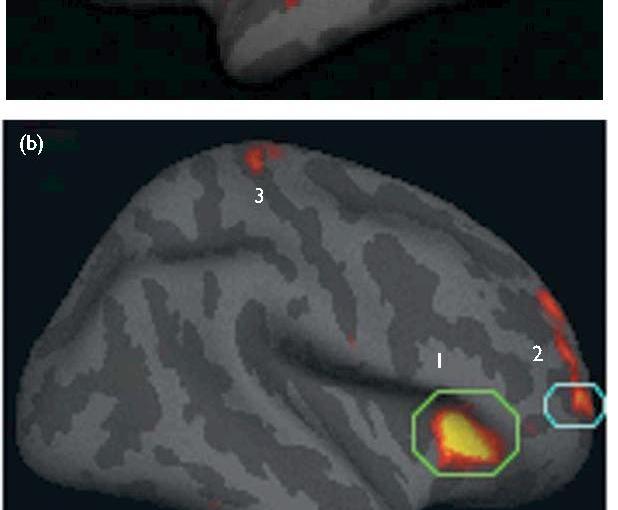
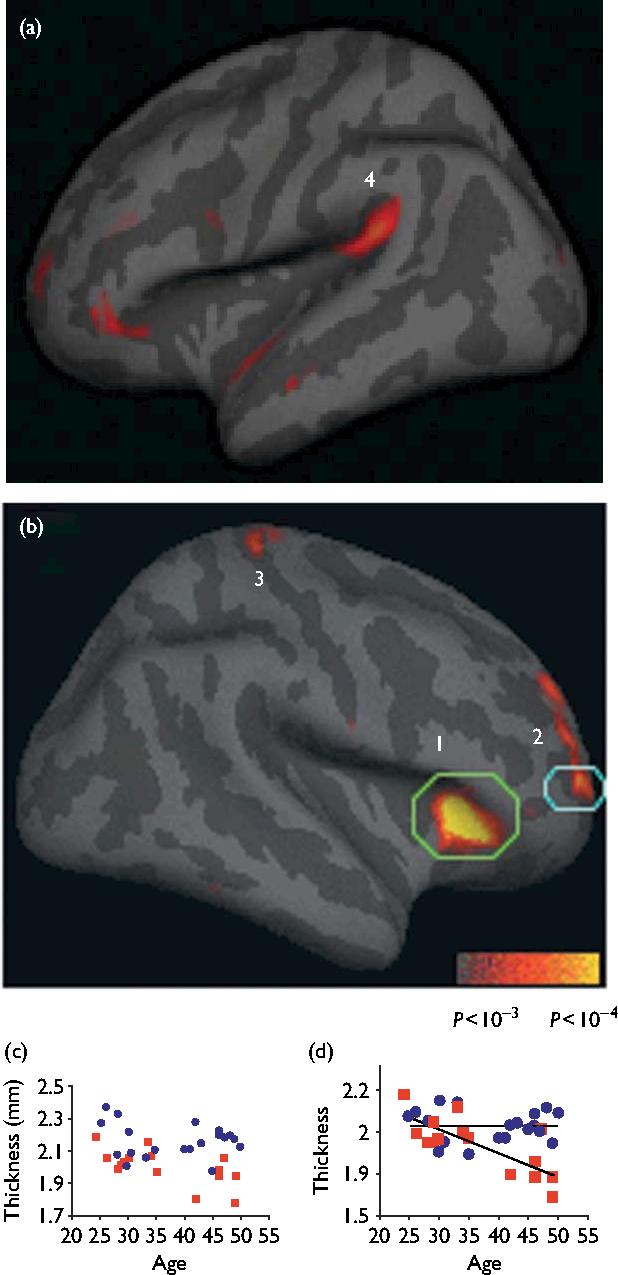
Interestingly, those who practice mindfulness have greater cortical thickness in the anterior regions of the brain: the medial prefrontal cortex, superior frontal cortex, temporal pole and the middle and interior temporal cortices. On the flipside, there was reduced cortical thickness in the posterior regions of the brain including the postcentral cortex, inferior parietal cortex, middle occipital cortex and posterior cingulate cortex. These and other findings indicate that those that take part in meditation over long periods have structurally different brains in terms of both gray and white matter. You can read more here: Lazar et alTang et al, Holzel et al, Luders et al,  Kang et al.

how mindfulness changes the structure of your brain

Image from Meditation experience is associated with increased cortical thickness showing the cortical regions that are thicker in meditators. Numbered regions: (1) insula, (2) Brodmann area (BA) 9/10, (3) somatosensory cortex, (4) auditory cortex.

Loving-kindness meditation has been linked to increased gray matter volume in the right angular and posterior parahippocampal gyri. The right angular gyrus has been linked to empathy, anxiety and mood.

Even if fMRI is just a mirage, DW-MRI seems to back up the findings of changing structure. It is fascinating to think that we can actively structurally change our brains.

Besides the different types of MRI, changes have been shown on EEG (it’s like an ECG/EKG for the brain).  More importantly, those who do mindfulness tend to behave differently – as shown by their differing test scores in various tasks – I shall describe this another time.