What you label as evil essentially depends on which side of you are on.
Being directional, having a goal, being in pursuit involves labelling things and people as allies or obstacles. In pursuit of our goals, we do many things which we may think are perfectly okay, but somebody else will thinks are evil. I am typing this on a MacBook Air. If I were a Chinese person, I would probably have good reason to consider Apple evil. As I am on the consumer side here, I feel somewhat overcharged and not having a lot of options beside MacBook, nonetheless meaning that they are my ally. Good and evil, all at once.
My actions inadvertently lead to the death of the cutest and friendliest cat you can ever hope to meet. This made me see myself as someone who can do evil, even though it was never my intention to do evil. Whenever someone else did evil previously, I felt they were, well, evil. Bad. Shouldn’t exist. This experience has taught me to see things differently.
Another throwback to my 1990s Russian childhood: there were some Roma people around. They have vanished since; I’ve no idea where they’re gone. I guess that’s just part of the lifestyle of those people I witnessed. The unfortunate prejudice was that you need to hold on to your wallet when one is in sight. Indeed, on occasion, I would witness some cursing shopkeeper shouting as a Roma woman was running away. As a child, I recall wondering what stimulates these particular women to live this life. It is really quite clear and much more relatable when you are an adult.
Indeed, a lot of the the men and women whom we may regard as criminals are in pursuit of their goals: they have babies to feed, bills to pay, whatever. We may feel that it is unfair for them to rob what we’ve earned with our hard labour (as if robbing isn’t labour). They may feel it is unfair that we sit in a comfy office pushing paper (as if pushing paper is that easy). Our motivations are actually quite similar.
I really don’t like that variety of philosophy that ends up telling you that white is black and black is white. So I am not doing that. All I am saying is that good and evil are subjective and transient.
Grim but beautiful. Wicklow mountains
A Darwinian life
Any kind of goal-directed behaviour is likely to result in someone else’s suffering. Maybe, in fact, it isn’t even the goal-directedness of our behaviour, but the fact that nature makes us compete. Are win-win situations really that great when you consider the wider context? Tesco (a kind of British Walmart) not only allows residents of small towns to purchase goods cheaper, but it also creates jobs in the small town: someone has to pack the shelves, look after the purchasing decisions, etc. It is also well known that whenever the likes of Tesco move into a small town, for every job they create, they kill two jobs (who wants to buy from the butcher now that you can get the “same” stuff cheaper). Whether it is good or bad on balance, it is Darwinian and it causes suffering for the butcher.
Or consider my poor moths. I lived in a carpeted apartment for a while. Mid-plank I noticed that some bits of the carpet were bare and then found that there were moths living under it. I had to commit absolute genocide against them. Three rounds of poisonous chemicals. They must have “thought” I was evil. But did I really have a choice? Again, a Darwinian reality of them versus me.
In an insect’s mind, the most important life on this planet is an insect’s life. It’s all the insect has – nAot unlike us, though some of us think of life in a more abstract manner.
In a Darwinian world, is it possible to never do evil? How about a better question: is it that clear what good and evil is? Doesn’t it all depend of perspective?
You can have perspective even when its cloudy. Kerry mountains.
Happiness and accomplishment
This is why being terribly obsessed with goals and accomplishment is so disturbing: it relies on a concrete framework of wanted and unwanted events. For those who are especially interested, the 1996 Mount Everest disaster is a great example of how being goal-directed can cloud one’s perception of good vs bad.
A lot of readers indicated that they wish to hear more on the subject of happiness. Read the fable “Blessings in disguise” in this context. Events that we see as undesirable could well be good. I sometimes look back at my failures. In what now seems like a former life, I was interviewed with McKinsey. After what seemed like 17 000 rounds of interviews, I received a phone call from the partner. As he greeted me, I assumed I had it in the bag. Why else would he call me? No, it was a kick in the stomach. I went digging and found out that some slightly younger guy with a reasonably unremarkable CV got it instead of me. I couldn’t figure out the conundrum for ages (I naively believed I could). I now feel that it was a lucky escape.
I even look back at some of the events I then labelled as successes and think: I wonder where I would be now if I hadn’t gone down that rabbit hole.
I want to simply highlight that some of our judgements about good and evil are completely off the wall.
I recall one scientist tell me that he won’t consider his career successful until he gets a paper published in Nature as a first author. Even if we ignore the needy narcissism, what a miserly contract to make with yourself! This is what I call off the wall.
Furthermore, everything is a chain of events.
If my aunt hadn’t suffered a medical negligence case, I wouldn’t have had the chance to go in on a rescue mission and reconnect with her, something that was way overdue. At the time of course, it all seemed like a bad dream.
“I came to you because I feel so pathetic and worthless that I do not even want to be alive. Everyone around me is saying that I’m a loser, a useless idiot. I need your help, Teacher.”
The Teacher, glancing at the young man, hurriedly responded:
“I’m sorry, but I’m very busy right now, so I can not help you. I need to urgently settle a very important matter.” He added: “But if you agree to help me in my quest, then I will gladly help you in yours.”
“With … with pleasure, Teacher,” he muttered, noting with bitterness that he was once again being treated as less important.
“Very well,” said the Teacher. He removed from his left little finger a small ring with a beautiful stone.
“Take the horse and ride down to the market square! I need to urgently sell this ring to pay a debt. Try to get as high a price as you can get and do not agree to the price lower than a gold coin under any circumstances! Head down and return as soon as possible!”
The young man took the ring and rode away. Arriving at the market square, he began to offer the ring to the merchants. At first, they looked upon the ring with interest.
However, when they heard about the gold coin, they immediately lost all interest in the ring. Some openly laughed in his face, others simply turned away, and only one elderly merchant kindly explained to him that a gold coin is too high a price for such a ring and that only a copper coin, or at the very most a silver one, can be gotten for it.
Hearing the old man’s words, the young man was very upset because he remembered the Teacher’s order was not to lower the price below a gold coin. The young man tried again. He went around the whole market offering the ring to a good hundred people. Defeated, the young man once again saddled his horse and returned. Feeling like a failure, he approached the Teacher.
“Teacher, I was not able to complete your assignment,” he said sadly. “At best, I could have gotten a pair of silver coins for the ring, but you ordered not to settle for less than gold! I don’t know whether this ring is worth a gold coin.”
“You just said very important words, son!” replied the Teacher. “Before trying to sell the ring, it would be nice to establish its true value! Well, who could do that better than a jeweller? Ride down to the jeweller and ask him how much he will offer us for the ring. Only, whatever he tells you, do not sell the ring. Come back to me.” The young man again jumped on his horse and went to the jeweller.
The jeweller took his time examining the ring through a magnifying glass. He then weighed it on small scales and, finally, turned to the young man:
“Tell the Teacher that I can not give him more than fifty-eight gold coins at this time.” But, if he gives me two days, I’ll buy the ring for seventy, given the urgency of the matter.
“Seventy coins?” the young man laughed happily. He thanked the jeweller and rushed back in full gallop.
“Sit down here,” said the Teacher, listening to the young man’s animated story. “And know, son, that you are this very ring. Precious and irreplaceable! Only a true expert can appreciate you. So why are you walking around the bazaar, expecting the first person to do this?”
~
The fable doesn’t address the existence of incompetent or fraudulent jewellers, but you get the point. It is to find the right assessor, a jeweller. I like the fable, but I don’t really use this view of self-esteem. It is always a recipe for unhappiness to rely on someone else to tell you your worth, whoever the proverbial jeweller may be: a loved one, a boss, a child, whoever.
For me personally, self-esteem is something that comes free with being alive. I take a Nietzsche-like view on it: to be alive in an of itself is valuable, here and now. No need to wait for a heaven or an enlightenment, no need for approval from other entities. You are responsible for your actions and adaptations, but that’s all you can do. Something somewhere conspired to create the reader and me despite the seemingly omnipresent entropy of the world. Isn’t that enough proof for the fact that we’re worth a lot?
This logic breaks down if you look around and see other people as being worthless. Thing is, I don’t. That’s not to say that I’ve never met anyone I don’t like, but I genuinely see every living creature as worthy (though for some of them, I prefer that they exercise their worthiness somewhere away from me, for example, the family of carpet moths that infested my living room a few years ago. I wish I could let them live, but alas, it was them or me.)
So my answer is that we have to be our own jewellers. Moreover, we should spend most of our time purifying the metal and finding the clearest and most precious stones for what we bring to the world rather than worrying whether we can sell for one, 58 or 70 coins.
When I was a child, I loved Asian fables. They are so neat. Here is an example of an old one, 塞翁失马, or “Blessing in disguise”:
A farmer had only one horse. One day, his horse ran away.
His neighbours said, “I’m so sorry. This is such bad news. You must be so upset.”
The man just said, “We’ll see.”
A few days later, his horse came back with twenty wild horses following. The man and his son corralled all 21 horses.
His neighbours said, “Congratulations! This is such good news. You must be so happy!”
The man just said, “We’ll see.”
One of the wild horses kicked the man’s only son, breaking both his legs.
His neighbours said, “I’m so sorry. This is such bad news. You must be so upset.”
The man just said, “We’ll see.”
The country went to war, and every able-bodied young man was drafted to fight. The war was terrible and killed every young man, but the farmer’s son was spared, since his broken legs prevented him from being drafted.
His neighbours said, “Congratulations! This is such good news. You must be so happy!”
The man just said, “We’ll see.”
~
A modern take on the price of dreams
I found a modern fable written in Russian. While “Blessings in disguise” addresses judgement, this addresses dreams. It’s a nice deviation away from goal-setting, positive thinking and all that other motivational stuff, so here is my (slightly embellished) translation:
On the outskirts of the universe, there was a small shop. It bore no sign: it was blown away by some long-gone hurricane, and the owner was assured that all the residents knew where to find him anyway. The shop traded in desires.
The little shop offered a surprisingly vast array of choices. It was possible to buy almost everything here: huge yachts, apartments, marriage, vice-presidency of a multinational corporation, money, children, a dream job, a beautiful body, being top of the class, power, success and much more. The shop didn’t trade in life and death as that was the jurisdiction of the head office located in the neighbouring Galaxy.
There were those who wanted to go to the store, but never did: they stayed at home and wanted. For those who did visit, the first thing they enquired about was the price of their desire.
The prices ranged. For example, a dream job attracted the price of was abandoning stability and predictability, willingness to independently plan and structure your life, self-confidence and courage to work where you like, not where you “should”.
Power cost a little more: the purchaser had to give up some of their beliefs, be able to find rational explanations, be able to say no, know their own worth (and it should be high enough), allow themselves to be assertive regardless of the approval of others.
Some prices seemed strange: marriage, for example, could be received almost for free. However, a happy life was expensive: personal responsibility for one’s own happiness, the ability to enjoy life, knowledge of one’s desires, refusal to compare oneself to others, the ability to appreciate what is, awareness of one’s own worth and significance, giving up the “victim complex” and the risk of losing some friends and acquaintances.
Not everyone who came to the store was ready to immediately buy their wish. Some, seeing the price, immediately turned around and left. Others stood there in thought, counting their cash and wondering where to get more money. Some complained about exorbitant prices, asked for a discount or were interested seasonal sales.
Though, there were some who left the shop with their cherished desire wrapped in beautiful rustling paper. These lucky few were enviously looked at by other potential buyers. Under their breath, they muttered something about the owner of the shop being the successful purchaser’s distant cousin or acquaintance and the overall unfairness of how effortlessly their desire just fell into their lap.
Business consultants often emailed the owner outlining how he could increase profits by attracting more customers through reduced prices. He always refused, explaining that the the quality of desires would suffer should he lower the prices.
When the owner was asked if he ever feared for his business, he shook his head. He said that there will always be brave men and women willing to risk and undergo change to find the funds for their purchase. They would abandon the habitual and predictable life, become capable of believing in themselves and develop the strength and the means to pay for the fulfilment of their desires.
Reminiscent of a credit notice we see in small shops, the walls of this shop bore a small tattered notice: “If your desire is not fulfilled, it has not been paid for yet.”
~
What do we think of the modern fable? It has a controversial premise: that we all pay the same price for things. I wonder, do we?
Consider a Syrian orphan* vs Baron Trump**. Let’s say, in a few years Baron Trump will walk into some real estate conglomerate and go straight to the top. Unfair? I guess. Will he get to boss around lots of people? For sure, but only so long as it doesn’t really matter. He’s not really the vice president. He only has a fraction of the power of a normal VP. If he had been made into a real vice-president and then made a mistake, that would seriously sabotage daddy’s reputation and power in the said conglomerate. So daddy won’t let that happen: Baron would have to prove to daddy that he can really hold the fort. Baron’s big desire may be to not have to do as daddy says. That’s probably at least as difficult as it would be for the Syrian orphan to become vice president of that conglomerate.
In other words, attaining genuine autonomy and power is equally difficult for both the Syrian orphan and Baron Trump. What do you think of this logic? Even if our Syrian friend makes it to the top, Baron will probably get many more “get out of jail free” cards due to his connections. However, he will also have a lot of enemies he never made himself trying to put him in that proverbial jail. Does it all add up the same way in the end, or am I applying laws of thermodynamics to matters they simply don’t affect?
* My grandfather was a WWII orphan. He still made it to the top and wasn’t that unique in this regard.
** I’ve nothing against the child, but I know he’s the most appropriate figure in the public eye for my theoretical argument
I recall a certain Prof. T., a psychiatrist I worked with and whom I regard highly, recount how he very nearly left psychiatry soon after joining when the writers of the ye old DSM considered including happiness as a psychiatric condition, being the opposite of depression. How very understandable. Happiness is often touted as the purpose of life and the most important thing, the most important condition to fill: “Sure, so long as you’re happy“, as they say in Ireland. I am tempted to go on a rant how the goal-directed pursuit of happiness has made us unhappy, but I think everyone knows that anyway. My discussion with Terraustralis* revealed an interesting attitude:
Happiness isn’t necessarily the point, but it sure is a good survival strategy. It is easier to get through life when you can see the bright side.
It always seems like a barrier to entry and an annoying obfuscation when a person responds to a question by needing to define the terms of the question. However, as I get older, I find myself joining this school of question-dissection.
What is happiness and why do we need it?
I don’t plan to get too metaphysical here. All I want to say is that there are two things commonly discussed using this term:
The concrete sensation of being happy, such as when
a loved one gets you exactly the present you wanted for Christmas, or
you get an acceptance letter from a purchaser, an employer, a journal, etc, or
you notice the colourful sunset and feel at peace, or
you notice that your coffee is particularly nice
or indeed, you think of examples of when you were happy and your brain isn’t that sure what is real and what is a memory.
2. The abstract greater, non-provoked satisfaction, fulfilment or harmony that represents the bottom line of your emotional climate.
I will discuss happiness (1), of the concrete variety – because I feel that the abstract happiness (2) is a product of concrete happiness (1). If concrete happiness (1) is the weather, abstract happiness (2) is the climate. Abstract happiness is probably more often a subject of rationalisation and by its nature, it is more difficult to get a grip on, so we’ll start small(er).
Happiness is a chemical reaction.
Then again, so is everything else.
However, happiness is very directly a chemical reaction, unlike let’s say someone’s well-considered political views. They too are a series of reactions, perhaps even facilitated by the dopamines and serotonins of this world, but they lack the binary nature of the sensation of happiness.
Sorry for dropping the tone, but is happiness that different from an orgasm? Most of us know not to expect that to last forever.
A full moon over Dublin Bay as seen from Dun Laoghaire East Pier. It reminds me of the time I spent abroad, where it was sunny and warm. Should that make me sad? Not at all: I am all the happier to be here.
Reason 1: Happiness only exists in response to a change
There is no happiness when there is no change, real or perceived. Lack of volatility takes away the opportunities to feel happy.
As Sigmud Freud put it: “What we call happiness in the strictest sense comes from the (preferably sudden) satisfaction of needs which have been dammed up to a high degree.”
This is why learning makes us happy: we see progress (or change). Furthermore, we get to control the change to a large degree. This enhances the happiness. This is also why ambitious people tend to be happier (my observation, do you agree/disagree?) It is like they have the activation energy to take the first step to learn something, to start on something. It is the mildly philosophical who are depressed, but they haven’t thought of the South East Indian history. Or how to start a petrol station. Expanding one’s horizons always leads to happiness (it may not be pure, but it is net positive). Some may call it distraction – and that would explain why we love clicking on stupid links shared on social media**. On the bright side, however, it is a form of learning, seeing new opportunities and changing one’s understanding of the world. Happiness comes free with that.
Daniel Kahneman’s book “Thinking, Fast and Slow” has influenced me greatly. His economically-related theories, the ones that got him the Nobel prize, are of little interest to me. I am much more concerned of his background work on general psychology that led him to the conclusions he reached regarding our buying/selling decisions. His discussion of happiness is particularly interesting.
You know the old song by Wham! called “Everything She Wants” where George Michael sings with much anguish: “Why do I do the things I do? I’d tell you if I knew”? Daniel Kahneman knows. Imagine if Machiavelli spoke like Pavlov, they guy with the dogs? This is it.
“For an example, take the following scenarios:
Today Jack and Jill each have a wealth of 5 million.
Yesterday, Jack had 1 million and Jill had 9 million.
Are they equally happy?
… Jack is elated and Jill despondent. Indeed, we know that Jack would be a great deal happier than Jill even if he had only 2 million today while she has 5… The happiness that Jack and Jill experience is determined by the recent change in their wealth, relative to the different states of wealth that define their reference points (1 million for Jack, 9 million for Jill). This reference dependence is ubiquitous in sensation and perception. The same sound will be experienced as very loud or quite faint, depending on whether it was preceded by a whisper or by a roar.”
According to Kahneman, there isn’t just one happiness because there isn’t just one self (the one that resides in our talkative default mode network). There is the experiencing self, a kind of present moment aware self, and the remembering self, including the ruminating sort we so dislike.
The remembering self will focus on the peak and the end of an experience, where the experiencing self, will be, well, experiencing every moment of it. Here is an example:
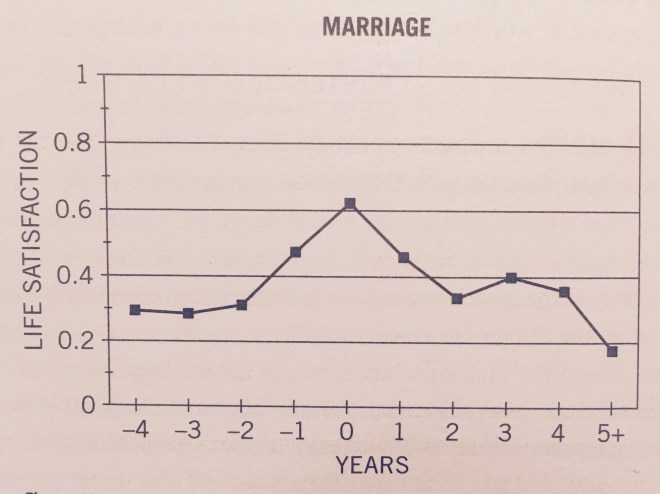
“People who recently married, or are expecting to marry in the near future, are likely to retrieve that fact when asked a general question about their life. Because marriage is almost always voluntary in the United States, almost everyone who is reminded of his or her recent or forthcoming marriage will be happy with the idea. Attention is the key to the puzzle.
People’s level of life satisfaction as a function of time surrounding their wedding. Source: “Thinking, Fast and Slow” by Daniel Kahneman, page 398
The figure shows an unusually high level of life satisfaction that lasts two or three years around the event of marriage. However, if this apparent surge reflects the time course of a heuristic for answering the question, there is little we can learn from it about either happiness or about the process of adaptation to marriage. We cannot infer from it that a tide of raised happiness lasts for several years and gradually recedes. Even people who are happy to be reminded of their marriage when asked a question about their life are not necessarily happier the rest of the time. Unless they think happy thoughts about their marriage during much of their day, it will not directly influence their happiness. Even newlyweds who are lucky enough to enjoy a state of happy preoccupation with their love will eventually return to earth, and their experienced well-being will again depend, as it does for the rest of us, on the environment and activities of the present moment.”
An nice and heavy anchor is Dun Laoghaire harbour, Dublin
Reason 2: Happiness is tied to an anchor bias
What is anchor bias?
Anchoring is a cognitive bias that describes the common human tendency to rely too heavily on the first piece of information offered (the “anchor”) when making decisions.
For example:
“If you are asked whether Gandhi was more than 114 years old when he died you will end up with a much higher estimate of his age at death than you would if the anchoring question referred to death at 35.”
My own tale is that the first “anchor” I’ve thrown was in 1990s Moscow.
I still pause nervously at the thought of the things I avoided. I was very shielded, yet the echo of the various brands of social unrest that surrounded me reached me enough to know I have to watch out. You know how your mother probably taught you to not speak to strangers and not get into a lift (elevator) with people you don’t know? Most of us use discretion with these rules and only put our guard up when something is tangibly “up”. I am used to using these rules verbatim. I still don’t speak to strangers unless I am in a crowded and well-lit place. I still move whenever someone sitting beside me is coughing a lot: you never know, it could be TB. Whenever I am in Moscow, to this day, I always have my guard up. It sounds sinister, but it’s not actually.
It is as if I am constantly anticipating that someone will try to swindle me in some minor way. In a queue, you well get skipped unless you’re paying attention. The florist will inevitably “accidentally” charge for a higher priced bouquet and reissue the invoice once questioned. The radiographer will forget to take the standing X-ray having taken the lying one unless you double check. It’s a mix of carelessness and minor fraud that arises from low wages in a cynically unequal society. This happens everywhere of course, but it is quite consistent in Moscow, or at least is was, in the very turbulent 1990s. You have to be very aware, prepared to stand up for yourself and presume the worst of people. I don’t enjoy being like that. Just to be clear, I don’t hate where I come from or have some sort of overly dramatic story. These are just observations.
Having this 1990s Moscow “anchor”, most places I go to remind me of the pages of a fairy tale book. I may be exaggerating a little, but that’s the crux of the emotion I feel every day. Every day someone is polite to me, I remember that it wouldn’t have been like that back in the proverbial old country.
Whenever things happen without me having to double check that everyone has done their job, I automatically get this wave of bliss, gratitude and a sense of that concrete happiness. It’s like drinking water after a 10 K run. It’s like escaping capture by an enemy.
Why? Because I am anchored to believe that things going smoothly isn’t the norm. Elaborating on Ray Dalio’s formula,
Happiness = reality – expectation (regarding a given event or change in circumstances).
The specific anchor I have is quite low down in the expectation ocean, so happiness is often a positive value. Does it mean I actually have low expectations and take sh*t from people? Somehow it doesn’t. It just makes it easier to be happy. The fact that this isn’t just some idea, but an actual anchor I have been fortunate enough to form makes me see everything though that filter. Biases aren’t always bad.
If I had been reading, not writing this, I would probably think: here goes, be grateful, bla bla, game your mind until you feel happy even though you shouldn’t really. It doesn’t feel like I am forcing this at all. It’s a lucky idiosyncrasy. Can it be extrapolated to other things? So that we can feel happy more effortlessly? Very soon an overzealous extrapolation approach turns into “there are children starving in <remote location>, so you have to value what you have”, which inevitably causes resentment and a feeling of pointless self-fraud over time.
The point is that looking back at our own anchors and expectations (not those of deprived children in a less-developed country) can help to explain how happy or unhappy we feel.
Understanding that happiness is only achieved through change, it helps to think of our lives as a continuum of present moments rather than an efficient emotionless journey from A to B, where B is full of yummy dopamine***. It is just another way to understand the context, gain perspective or whatever other fancy term you may want to use for all those things hidden in plain sight.
In short, happiness is fundamentally decided by:
presence of change (real or perceived)
expectations
It’s also affected by temperament (e.g. the weight one attaches to negative events) and genetics – and I will talk about this another day.
* A gentleman who comments in English, but blogs in Polish here.
** Procrastination is an avoidance behaviour, but it does make us happy in a short term concrete way. I believe it makes us happy using the same mechanism as learning, though on balance, of course, it is a saboteur.
*** Actually, it is the anticipation of B that releases the dopamine.
Goddessism is big among our millennial ladies. This article isn’t about the fact that social media and real life are different. It is about the cheapening of real philosophy that happens on social media and goes unnoticed by too many people.
As you will know, I am not big into positive thinking, at least the inspirational Insta-motivation variety. I have yet another issue with Instagram. It is the one social network that makes me feel kind of icky, and for ages I couldn’t understand why. We all know that social media is a highlight reel, a filtered version of another’s life, etc – but Instagram accentuates this empty feeling. I think it’s because it lacks the option of having any depth.
You can link to a thoughtful article on most networks, but you deliberately need to judge everything by its cover on Instagram.
One could argue it is some kind of inferiority that I am feeling. And it is. It’s a fear that I could never be as perfect as the people in the pictures. Indeed, I couldn’t be. They couldn’t be either. In fact, the subspecies I will discuss below follows a very clear prescribed regimen specifying their clothes, food, wisdom, aspirations, art, fitness, other half and much more. But the point is the horrible fake “spirituality” of these accounts.
Are the comments written by real people or bots? Fakeness traded between fakeness merchants
Instagram is so full of beautiful, minimalist, natural, spiritual, compassionate, eco-friendly yoga-practicing perfect people, women, to be specific.
They look out over the ocean and look so dreamy with the sunset backdrop. The pictures are full with gentle sunlight, smiles and smoothies made of the most righteous greens and the caption inevitably features love of the world, the followers or something trendy. Obviously, these “tropical feels” exist on other media, but Instagram seems to have thousands of accounts with virtually the same vibe. The content clearly has a lot of work dedicated to it, but I struggle to see why people enjoy it. Perhaps, some find that it is genuine?
Whenever I encountered these insta-perfect people in real life, they tend to be highly cynical and critical of others, curse like sailors, yell at their children in a way that makes me worry about the integrity of the windows, drink (not just the smoothies), are insecure about their appearance and just generally be far removed from the fairy tale vibe of their Instagram account.
Many of them go from one beautiful location to another; the further removed from the West, the better – or at least create the impression that they do. More often than not, the photos are made over a few weeks (of what I assume is pretty hard work of shooting) and then released over the following months.
Wisdom meets commerce
Their work is always something special, magical and sacred. There is much about happiness, love of simple things, spirituality, being natural, a wanderer, a wild child, a vagabond, giving hugs and so on.
By playing bingo with the above you can create a nice tagline for the top of the page: “Don’t let your dreams just be dreams” obtained Lisa Smith of @lisadanielle_ It seems that the expertise behind these statements is rather limited and largely repeated by/from other Instagram users in a nice Pacific ocean echo chamber. I doubt that the subscribers care very much. They look for pictures of a life
…from another place, tropical and blue,
We have never been to.
This is from Sylvia Plath’s “Finisterre”. I love the emotion behind these words: they got etched into my mind straight after the first reading. I doubt she would have liked Instagram very much.
Why wouldn’t you be wild and free?
These women tend to paint, create jewellery, produce their own make up lines or run seminars. The more competent ones paint and the really great ones photograph: weddings, editorials and so on. I shudder at their daily routine of waking up and knowing that they need to go out of their way to take shots of things that will appear good to thousands of people. Perhaps, they shudder at the thought of writing an essay, especially one that is clear to the point which can only be obtained by being honest. Not honest like an eco-friendly coffee brand is honest; honest like a best friend is honest. The high quality pictures make it into the Instagram feed; the less artsy are only dignified with a place in the Stories.
“Be yourself, you’re beautiful”, but make sure you are young, actually beautiful and totally carefree
Their appearance is uniformly the sort that can only be obtained by strenuous HIIT and no carbs. Don’t forget the tan.
The goal is to look like the perfectly accepted idea of female beauty, but with a spiritual twist.
A half-naked woman in her late twenties with a body fat of about 18% with a dreamy smile will caption her photo with something like “Remember, everyone is beautiful. Accept your self fully. Love is everything.”
Soulful gratitude, it’s not for show
The more thorough Instagramers will have a story of how they used to hate their body/themselves/their failures, but came to be in a healthy relationship with themselves and now it is their life’s mission to bring this harmony into the world.
They frequently have a soul mate whom they tag in their Instagram and express their gratitude at least twice a week. Don’t be alarmed if some of these bits of wisdom have a tag like for some minimalist watch maker or a boho clothes vendor, usually with an eco-twist:
Lost fishing nets with a purpose
The perpetual summer bodies don’t come easy, I am sure, but the Insta goddesses never bother to make a big deal out of it. However, a nice yoga pose with a “thoughtful” quote is a must. Mindfulness goes without saying. Are there still people who don’t practice mindfulness? Myself, I doubt that between reaching out to bikini manufacturers and running contests for a handmade fairtrade eco-friendly blanket and shooting non-contrived photos of their rigorous relaxation routines they have much “time” for real mindfulness.
Clothes-wise, less is more – because why should we hide? That’s just wouldn’t be that spiritual or close to nature. The boho-twise requires the addition of a hat and numerous bracelets to the bikini bottoms. The top is covered by the long beach-wave hair.
What do goddesses eat? It’s all vegan, raw, super-foody and green. Banish gluten, lactose and all other negativity. The tone of their remarks is so matter of fact, like they’ve never seen a BLT in their lives.
Apparently this is a smoothie. You learn something new everyday.
So for example, a goddess could start every morning with 20 sun salutations and a green smoothie. They charge her up with the sort of energy the no coffee could ever do (throw back to her life before she entered the true world of Bali). It is usually followed by the description of the unfolding life force of nature filling her within and she literally can’t imagine having it any other way.
Give and you shall receive
I have no reason to stick it to Lauren Bullen of @gypsea_lust in particular. They are legion. They come from all countries and write in all languages (though they all spend time in Bali). You know a few people like this. So alike, that you weren’t sure I wasn’t writing about them until you checked the username. They run Instagram-supported businesses, that’s fine, but it is the fact that they are selling something that isn’t real that bothers me.
It seems obvious that people would be able to tell that this is an account made for marketing. But because of this spiritual vibe, insidiously, this affects the moral compass for many otherwise bright people I know.
My millennial peers are often unable to see the difference between shallow marketing and deeper philosophy. Has it always been this way I wonder?
This kind of stuff makes me want to clear my head. So if, like me, you come across this phenomenon, don’t be down. Breath.
P.S. Sorry for the radio silence. I’m moving. It’s a journey. Many journeys back and forth between two houses, in fact. Lots of challenges of all sorts and remembering to breath has been my number one rule. I will write about the whole experience once the dust resettles on my suitcases.
Do you ever just wish you could get someone who knows virtually everything that’s known about the brain and quiz them about mindfulness? Well, I do – a lot – and I just got my wish!
It is my pleasure to present this interview with John McBurney MD. A practicing physician with of over 35 years’ experience, he is board certified in Neurology, Clinical Neurophysiology and Sleep Medicine. He holds an Integrative Medicine Fellowship… The list of his professional accomplishments is obscenely impressive, so I will jump to the bit we all really want to know about: Dr. McBurney maintains a daily mindfulness meditation practice as well as home yoga practice, hence the downward facing bit. Needless to say, I was beyond curious to find out his understanding of how mindfulness affects the brain.
For those of us who are put off by the mystical connotations that surround mindfulness, could you take us back to a schematic, reflex-arc type view of the process and describe the neurological response to mindfulness practice?
I think that the issue of mindfulness intersect with the leading-edge of neuroscience. It is supported by extraordinarily robust data. This area of study has been termed contemplative neuroscience. The Mind and Life Institute which is an outgrowth of the dialogues between the neuroscience community and the Dalai Llamais an important sponsor of research and education on contemplative neuroscience. It ultimately comes down to the concept of neuroplasticity.
Donald O. Hebb coined the doctrine: “neurons that fire together, wire together”. It was an extension of the work done by an American philosopher and psychologist William James in the early XX century. You can practice “bad” things or “good” things – and neuronal ensembles form accordingly. In mindfulness, we are essentially practicing good things.
There is a resting ensemble of neural networks called the default mode network that was discovered using fMRI studies where individuals were asked to lay in the scanner and think of nothing in particular. This kind of mindless mental activity is accompanied by a lot ofself-referential ruminative recursive thoughts that are subserved by brain regions that lie along the midline, especially the prominent in medial parietal lobe. Those types of internal mental states that are remarkably robust and persist under deep general anaesthesia and even in a coma and are probably the neural basis for the self.
The more outward facing parts of the brain – like the dorsolateral prefrontal cortex – are more responsible for an outward orientation to the world have top down executive influence on the activation of those networks.
In mindfulness, in cultivating awareness of the breath and voluntary moment by moment awareness of the brain, we are training the brain – just like when you are learning to play the violin or any other complex skill – we are training to break out of those self-referential ruminative recursive mental states and to achieve an orientation toward the outer world and in the present moment rather than anticipating the future or reliving the past.
There is evidence that mindfulness leads to weaker connections in default mode network. Could we be losing something by focusing more on the external realities rather than the self?
Not everyone has a well formed default mode network. People who have been subjected to severe developmental trauma, neglect and lack secure attachment do not have robust default mode networks. Mindfulness can lower defence mechanisms that are there with good reason. However, most people with a well formed default mode network and secure attachment. We are “taming an elephant”: there is very little chance that we will significantly weaken the elephant.
Occasionally, we do hear of adverse experiences arising from mindfulness. With any robust intervention there are always potential risks.
How long does it take for mindfulness to have a manifest effect?
The results can happen almost immediately, however, they are also cumulative. We are still figuring out what the minimum effective dose it. This reminds me of the discussion of the minimum effective dose of aspirin in stroke and heart attack prevention. When I was a resident, we were advising patients to take two 325 mg tablets twice a day. Over time this dropped to 81 mg of aspirin a day. There is speculation that the required dose may even be lower.
There is a study that defines a new marker. The original fMRI/EEG studies were done by Richard Davidson in Tibetan Buddhist meditators with over 10,000 hours of meditation. This number is somewhat arbitrary and refers to this idea that is the number of hours to become an expert at anything. However, the question arises: what is the relevance of the changes in functional connectivity in the brain in someone who has devoted such a monumental amount of time to meditation to the likes of you and me?
A very neat study was published by David Cresswell in Biological Psychiatry in 2016. They invited individuals with high level of stress, unemployed adults, to a weekend retreat experience. They were randomised to in 2 groups:
a 3 day mindfulness retreat (the treatment group) and
a 3 day relaxation retreat where they read stories, told jokes and had a good time (the control group).
The study was conducted in one centre over one weekend, so it is well controlled. Initially, both groups rated the interventions as being equally helpful to them, subjectively.
The researchers looked at the functional connectivity between the dorsolateral prefrontal cortex and the cingulate gyrus. They also looked at Interleukin-6, a known marker of inflammation, that has been previously shown to be elevated in stressed out unemployed people.
Even with this brief weekend mindfulness intervention, the treatment group developed increased connectivity between the dorsolateral prefrontal cortex and the cyngulate gyrus. There was a neuroplastic response even after a 3 day mindfulness retreat. This was also associated with a decrease in the marker IL-6. Even after 4 months, IL-6 was decreased in the treatment group, but in the control group, IL-6 levels continued to rise, independent of whether they managed to get a job or not.
This is also relevant to doctors, who are at high risk for burnout. Because of their work commitments, the mindfulness retreat for doctors was condensed from the standard 8 week model developed by John Kabat-Zinn to a weekend intervention. The question was: does the weekend model work? The research at the University of Wisconsin where this was developed was reassuring: the residents are less stressed out, more effective and have a greater level of satisfaction.
We still don’t know the absolute minimum dose, but it seems that a weekend of mindfulness can be life-changing for the brain.
Another paper published in PLOS ONE from the Benson-Henry Institute for Mind Body Medicine in Harvard looked at the practices such as meditation, prayer, mindful yoga, Tai-Chi, Qi Gong, etc, i.e. ones that elicit a relaxation response (as opposed the stress response).
This study showed that in both novice and experienced practitioners of relaxation response modalities, there were changes in the epigenetic transcription of the genome. There was upregulation of pathways associated with mitochondrial integrity, downregulation of inflammatory pathways, improved insulin-related metabolism and improved nitric oxide signalling.
Long term potentiation, the standard mechanism for memory formation, strengthens existing neural connections. This happens immediately, as you read this. Over time, long term potentiation leads to formation of new connections,through synaptogenesis, dendritic arborisation and neurogenesis i.e. brain structure changes. In turn, this affects the most neuroplastic neurons located in the hippocampus.
In reference to this fascinating recent study of the fight or flight response, it seems plausible that breathing regulates our stress levels much more than conscious thought. Could you explain the significance of this in terms of mindfulness?
The ancients believed that emotions reside in the body. This comes up a lot in serious yoga classes.
This highly innovative study shows that the control of the adrenal medulla – the main effector of the stress response – is not from the conscious ruminating thinking centres, but by the motor and sensory cortex.
This explains why breathing, as well as yoga and Tai-Chi, are an important part of meditative practice. In my experience, these kind of interventions do affect the stress response in a beneficial way.
Mindful exercise exists in many form. For example, weightlifters need to be very mindful to maintain perfect form. Cycling is another example: it is vital to concentrate on every pedal stroke and maintain an even cadence. Once you start to day dream, you notice straight away that your output is way worse. This overlaps with the concept of flow. It is about getting in the zone. There is a very inspiring TED talk by Judson Brewer MD, Ph.D. that explains the physiology behind flow and how it is augmented by mindfulness. Mindfulness is work, and it does require discipline. There is a paradox here of non-striving and non-doing while also being disciplined.
You are a sleep medicine expert. Could you comment on the relationship between mindfulness and sleep?
Insomnia is a complex problem with many causes. However, for most people with idiopathic insomnia, the cause it these self-referential recursive ruminations. They aren’t able to “turn their brain off”. Through mindfulness practice, they are generally able to tame the default mode network that’s responsible for ruminating and daydreaming. A simple strategy would be to lie in bed and concentrate on the breath. This would ease the transition between wakefulness and sleep.
Mindfulness is a mainstay treatment for many mental health disorders. What about use of mindfulness in the treatment for organic pathology of the brain usually treated by neurologists?
There is some preliminary data that mindfulness training has a beneficial effect of seizure frequency in patients with epilepsy. It is a medical condition associated with tremendous anxiety and stress, so mindfulness could have a significant benefit in more than one way. It may even have a benefit it terms of remembering to take medication on time, etc.
Some robust studies show that the frequency of relapse in multiple sclerosis decreases with mindfulness intervention. The effect from mindfulness is similar in magnitude to the effect from beta-interferon. There is also some research showing that the frequency of inflamed Gadolinuim-enhancing lesions decreases with mindfulness.
John Kabat-Zinn used to take the patients who suffered from chronic pain or had diseases for which we had no answer, and those patients got better. Even beyond neurology, there is some evidence that mindfulness can have benefits in psoriasis. We are probably only at the bottom of this mountain.
Dr McBurney is a board member of Mindful Medicine. It is a non-profit organisation that focuses on teaching mindfulness to health professionals using retreats. He is founder of McBurney Integrative Neurology and is a clinical assistant professor at the University of New Mexico School of Medicine. Dr. McBurney is a native of Alabama and a graduate of Auburn University and the Emory University School of Medicine. He completed his neurology residency and EEG/Epilepsy fellowship at Walter Reed Army Medical Center.In 2014 he completed the Integrative Medicine Fellowship at the University of Arizona Center for Integrative Medicine.
Dr McBurney has given me so much to think about. I will follow up with part 2 of our discussion that focuses more on the philosophical and life experience aspects of mindfulness once I wrap my head around it.
I have to be honest: my interest in mindfulness started off, and still is, almost completely secular. I do not aspire to awakening and all those other big things that spiritual teachers preach (market). For me, it is more about resting the brain so as to allow it to function at its peak. This may sound cold and clinical, but all it is really is that I don’t have massive expectations.
All the same, I figured that if I am to get good at mindfulness, I need to explore it properly. The language used to explain mindfulness: non-attachment, non-judgement, acceptance – seemed very confusing to me. Confusing to the point of seeming to defy basic human nature.
The best way I can phrase it now is that the practice of mindfulness requires us to treat thoughts and emotions as if we are just watching them.
But it did beg the question: how do you make sense of acceptance and non-judgement? How does that gel with constant resistance and overpowering ourselves that we are all so familiar with? How, and why, do we set and strive for goals if we are meant to be just accepting? I did wonder if there is a certain nihilism to the teachings behind mindfulness.
So who better to ask than Professor Nietzsche, nihilism-connoisseur in chief?
Nguyên Giác and I like to explore the thinking behind Buddhism, so in this latest piece I discuss Nietzsche’s understanding, rejection and emulation of Buddhism in his philosophy and explain the logic behind his claim that it is a nihilistic religion.
If you want the quick version, here it is:
Nietzsche misunderstood the concepts of Buddhism by mistaking interdependence for emptiness, probably due to lack of context and good translations
He defined Buddhism as a “true-world theory”, meaning that Buddhism claims there is another, superior form of existence (Buddho, Nirvana, etc) and that inherently defies the value of our common, normal, unawakened life, hence it is nihilistic
Despite Nietzsche’s rejection of Buddhism, his own philosophy is, in places, remarkably similar to it.
Nihilism? Decadence? Will to power? Superman? True World? Eternal Recurrence? Nietzsche was a complex guy. Read this to learn more about how his ideas stood in comparison to those commonly put forward by Buddhist traditions.
We’re taking a darker shade today to paint this fellow. Try to guess who said all this, you’ve definitely heard of him.
He is probably an INTJ. There is no consensus on his personality, but INTJ makes sense to me – clever, daring and ruthless! Put your guess in the comments and then Google any quote to get the actual answer. He said:
One must renounce the bad taste of wishing to agree with many people.
Morality is the herd instinct in the individual.
The visionary denies the truth to himself, the liar only to others.
One chooses logical argument only when one has no other means.
Convictions are more dangerous foes of truth than lies.
Without the errors which lie in the assumption of morality, man would have remained an animal.
All truly great thoughts are conceived by walking.
All credibility, all good conscience, all evidence of truth come only from the senses.
Thoughts are the shadows of our feelings – always darker, emptier and simpler.
The surest way to corrupt a youth is to instruct him to hold in higher esteem those who think alike than those who think differently.
In everything one thing is impossible: rationality.
The recent “Sapiens – A Brief History of Humankind” by Yuval Noah Harari attempts to be the meta-history book of our time. I heard that the book was excellent from a few friends who think that everything popular is excellent.
This passage on Buddhism and happiness confirmed my view that the book is politicised snake oil. I am very open to being convinced otherwise.
Harari: “For 2,500 years, Buddhists have systematically studied the essence and causes of happiness, which is why there is a growing interest among the scientific community both in their philosophy and their meditation practices.”
“Buddhism shares the basic insight of the biological approach to happiness, namely that happiness results from processes occurring within one’s body, and not from events in the outside world. However, starting from the same insight, Buddhism reaches very different conclusions.”
Me: So far so good. Happiness = reality – expectations, meaning that it isn’t only a product of the events of the outside world. The bit about the body is also pretty solid: serotonin, etc.
Harari: “According to Buddhism, most people identify happiness with pleasant feelings, while identifying suffering with unpleasant feelings. People consequently ascribe immense importance to what they feel, craving to experience more and more pleasures, while avoiding pain. Whatever we do throughout our lives, whether scratching our leg, fidgeting slightly in the chair, or fighting world wars, we are just trying to get pleasant feelings.”
Me: Thus spoke Sigmund Freud. We are all about seeking pleasure and even more so avoiding pain.
Harari: “The problem, according to Buddhism, is that our feelings are no more than fleeting vibrations, changing every moment, like the ocean waves. If five minutes ago I felt joyful and purposeful, now these feelings are gone, and I might well feel sad and dejected. So if I want to experience pleasant feelings, I have to constantly chase them, while driving away all the unpleasant feelings. Even if I succeed, I immediately have to start all over again, without ever getting any lasting reward for my troubles.”
Harari: “What is so important about obtaining such ephemeral prizes? Why struggle so hard to achieve something that disappears almost as soon as it arises? According to Buddhism, the root of suffering is neither the feeling of pain nor of sadness nor even of meaninglessness. Rather, the real root of suffering is this never-ending and pointless pursuit of ephemeral feelings, which causes us to be in a constant state of tension, restlessness and dissatisfaction. Due to this pursuit, the mind is never satisfied. Even when experiencing pleasure, it is not content, because it fears this feeling might soon disappear, and craves that this feeling should stay and intensify.”
Me: This is probably true about Buddhism (so not Harari’s problem), though it does strike me as being rather nihilistic. Feelings are biology’s way to tell us how we’re doing, so saying they are inconsequential, ephemeral and aren’t worth pursuing seems defiant of our very nature.
Harari:”People are liberated from suffering not when they experience this or that fleeting pleasure, but rather when they understand the impermanent nature of all their feelings, and stop craving them.This is the aim of Buddhist meditation practices.”
Me: Well, that’s not going to happen so long as we have an intact limbic system.
Harari: “In meditation, you are supposed to closely observe your mind and body, witness the ceaseless arising and passing of all your feelings, and realise how pointless it is to pursue them. When the pursuit stops, the mind becomes very relaxed, clear and satisfied. All kinds of feelings go on arising and passing – joy, anger, boredom, lust – but once you stop craving particular feelings, you can just accept them for what they are. You live in the present moment instead of fantasising about what might have been.”
Me: Things are about to get a little meta. What if you feel like pursuing your feelings? That’s a thought. Why reject it? Why disallow yourself from craving something? Isn’t that a “wrong” thing to do when you’re meditating? Harari is leading us down the road of blissful oversimplification. Unfortunately, it’s not that simple. Furthermore, our limbic systems will always crave certain feelings. That’s hard wired, and no amount of cognitive machinations or meditation is going to change that. So maybe these “accepting” people sitting in a lotus position on a green moral highground somewhere should accept their own biology instead?
Harari: “The resulting serenity is so profound that those who spend their lives in the frenzied pursuit of pleasant feelings can hardly imagine it. It is like a man standing for decades on the seashore, embracing certain ‘good’ waves and trying to prevent them from disintegrating, while simultaneously pushing back ‘bad’ waves to prevent them from getting near him. Day in, day out, the man stands on the beach, driving himself crazy with this fruitless exercise. Eventually, he sits down on the sand and just allows the waves to come and go as they please. How peaceful!”
Me: Miracle pill talk.
Harari: “This idea is so alien to modern liberal culture that when Western New Age movements encountered Buddhist insights, they translated them into liberal terms, thereby turning them on their head. New age cults frequently argue: ‘Happiness does not depend on external conditions. It depends only on what we feel inside. People should stop pursuing external achievements such as wealth and status, and connect instead with their inner feelings.’Or more succinctly, ‘Happiness begins within.’ This is exactly what biologists argue, but more or less the opposite of what Buddha said.”
Me: Nice summary, to be fair. However, he is calling people out on something he is also culpable of.
Harari: “Buddha agreed with modern biology and New Age movements that happiness is independent of external conditions. Yet his more important and far more profound insight was that true happiness is also independent of our inner feelings. Indeed, the more significance we give our feelings, the more we crave them, and the more we suffer. Buddha’s recommendation was to stop not only the pursuit of external achievements, but also the pursuit of inner feelings.”
Me: I am sorry, what? “True happiness is also independent of our inner feelings”? What is truehappiness? Why is that not an inner feeling? How do you define true happiness as distinct from just, you know, normal happiness? I surmise that normal happiness is a fleeting ephemeral emotion that he denigrated earlier, but I am really confused, what is true happiness?! Is this just an epithet designed to make me feel like a mere mortal not worthy of understanding Harari’s grand opus?
Harari: In Buddhism, the key to happiness is to know the truth about yourself – to understand who, or what, you really are. Most people wrongly identify themselves with their feelings, thoughts, likes and dislikes. When they feel anger, they think, ‘I am angry. This is my anger.’ They consequently spend their life avoiding some kinds of feelings and pursuing others. They never realise that they are not their feelings, and that the relentless pursuit of particular feelings just traps them in misery.
Me: What are we then? What’s real? We’re in the Matrix, aren’t we?…































 A millennial's musings