How to stop worrying about things that may never happen?

After blogging for less than a week, I am getting contacted by the audience – this makes me so happy! J. wrote:

I’ve recently started meditating and practicing mindfulness. I downloaded a couple of apps to help make it apart of my daily routine, but still have fears if I’m “doing it properly.” I guess this is a normal fear for most people starting out but I tend to overthink things that are seemingly out of my control. I’ve had this problem for as long as I can remember, dating back to my adolescence. I suppose my question to you is, how do we stop worrying about things and situations that are probably never going to happen?

The first thing that comes to mind is one of my favourite quotations from Mark Twain: “I am an old man and have known a great many troubles, but most of them never happened.”

Even the way J. phrased the question is so interesting: how do we stop worrying about things and situations that are probably never going to happen? Clearly J. cognitively understands  that his fears are unfounded: the things he fears are probably never going to happen. However, intellectually understanding something doesn’t always help us feel it. Depending on your personality, it may of may not be possible to outthink a feeling. As an ENTP, I only require a conscious realisation to change the way I feel. The answer is always within us.

What does worrying do for us? Why are we so addicted to it? How do we manage to continue to worry even though it hurts so much? The answer is that on some level we believe that worrying is better than not worrying. How can worrying be better? It is better because it keeps us safe. In a sense, it makes us feel like we are in control. If we are always looking out for what can go wrong – bad things are less likely to happen. This is a likely core belief for someone who worries a lot. Our brains are evolved for fear: fear is the software that keeps us safe. As a species who is only 200,000 years old and whose conditions have changed so starkly in the last few hundred years (food is more available and sabre-toothed tigers aren’t that common), we haven’t managed to change this core software of fear. Fear is our friend. It has kept us alive as a species. There comes a point where it just isn’t feasible to keep budgeting for the downside. Once you are prepared, once you have addressed everything that is in your control, that’s it. Fear is no longer useful (we’re not taking about survival situations).

how to stop worrying about things that may never happen

Seneca’s letters are incredibly helpful when it comes to dealing with anxiety in my experience. The thought of reading or listening to an Ancient Roman philosopher is daunting, but it is surprisingly approachable. Seneca wrote a bunch of letters to Lucilius – and these letters are often regarded as a key text in stoic philosophy. They read like a reddit post though! Letter XVIII. On Festivals and Fasting talks about putting yourself in controlled situations that you fear. It’s not about leaving your comfort zone or skydiving if you are afraid of heights. It is considering: what is the worst case scenario. The outcome is that you become less afraid.

It is easier to believe something when you see it. Everyone has friends who are chill no matter what happens – they are the people you want to spend more time with. Maybe that’s not possible, but you have the internet – lot of bloggers, youtubers etc, who laugh in the face of fear – people who do extreme sports, etc. Seeing that another point of view exists is always helpful in getting out of a rut.

You can also play word associations with yourself. No thinking allowed. Just blurt out the very first thing that comes to mind. Say fear – what would you say next?  I was very surprised when I did this exercise. The first thing that came to me was abandonment. Fear of abandonment is a very real thing. Cognitively, I thought that I would be afraid of not achieving certain goals. What bubbled up in this interesting exercise was that I was afraid for my relationships. It didn’t make cognitive sense before it happened, but when it did – it gave me a huge insight into a whole part of my life I was hiding from.

How does mindfulness make this better? It allows these fears to crystallise – when fears are less vague, they are easier to handle. It allows things that we are hiding from to bubble up and be dealt with. And of course worrying is a habit. It requires certain pathways to strengthen. By directing what your mind is doing, it is easier to replace the worrying habit with something much more productive. Scientific evidence that I will go through another time supports the idea that mindfulness helps with anxiety.

Some philosophers and psychiatrists believe that we only have two fundamental emotions: fear and love. It doesn’t make much sense at the start, but on reflection: what is anger? It is fear that someone is crossing your boundaries. What is regret? It is fear that you missed out. What is sadness? It is fear that life will never be this good again. The ultimate fear is that we aren’t deserving of other people’s love, that we’re not good enough.

In that vein, the only way to deal with fear is to focus away from it – onto something else. Instead of asking what can go wrong, ask how can I make it better? Instead of asking how do I avoid peril, ask how can I get what I really want? Instead of asking how do I stop worrying, ask how do I help my friend stop worrying? Our brains will probably default to looking for sabre toothed-tigers, unless we ask the right questions.


Mindfulness: must I practice acceptance?

The concept of acceptance has been a tough one for me to grasp when it comes to mindfulness – for a long time. The term acceptance is hugely common in guided mediations and among yoga practitioners. Accept reality, accept how you feel, accept how others treat you, etc.

Maybe I am a finished type A, but I am not about raw acceptance, I said. I want things to be better, I said. There’s more to life than just accepting what’s there in front of me. To me human nature is all about agency, about having a direction and doing things that I feel will be good for those around me. Acceptance and growth seemed at odds. It’s some kind of nihilistic concept that Nietzsche’s last man would appreciate. I am much more about Nietzsche’s will to power. Will to power is another misnomer. It sounds like something a megalomaniac would be after. In actual fact, it is the will to overpower yourself and your circumstances in order to do something meaningful. I think we will all agree that’s a pretty important force. In a sense though, we are resisting reality rather than accepting it when we are moving in a chosen direction.

mindfulness meditation acceptance meaning

I think I am not the only one misunderstanding the term acceptance. In fact, it nearly put me off the whole mindfulness thing. I don’t want to wallow in the sometimes pathetic present with no prospect of things being better. I had this anxiety that if I accept things, I will lose my drive to grow. From what I gather, that’s a very common thing among people who are driven to achieve. Then I figured it out.

It’s an order problem. You need to accept things before you can figure out what you want to do about it. Frankly, I think acknowledge is a better term. You need to acknowledge reality before you can change it. Mindfulness is all about being closer to reality. It’s about breaking down assumptions and models and coming back to the hard data of what’s around us.

Our desire for things to be a certain way may cloud our perception of how things actually are. The point isn’t tolerating bad things and hoping that the universe will put things right. The point is being fearless to examine reality and not run away from it. To see the wood and the trees. To not take it personally when you realise that things aren’t perfect.

I am not sure that’s how Buddhists approach acceptance. However, it doesn’t really matter. I am not here to practice a religion or do things as instructed by some high priest – no matter how en vogue they may be. I am much more interested in figuring it out for myself – and for the rest of us who are trying to make a change for the better.

Mindfulness: am I doing it right?

Being a beginner in mindfulness is hard – because you’ve no idea what to aim for. It is a personal journey and it is hard to imitate someone, which is how we normally learn.

Many take up mindfulness to relax, to not judge one self as harshly or to get rid of some anxiety. It can be a double edged sword: if you are used to judging and getting anxious we will do so indiscriminately, even in relation to mindfulness. “It’s not working for me”, “Why can’t I do this right”, “I am never going to feel better”… This can be very upsetting. Here you are trying this wishy washy new age thing, feeling like a fool – and it’s making things worse.

mindfulness am i doing it right

In reality, it is about managing your expectations. It’s like doing a burpee, or learning to drive – entirely counterintuitive at the start, but also entirely achievable and useful. The first rule is to just show up. Don’t set a crazy standard like: I will get up earlier and meditate for 20 minutes every morning and 20 minutes right before bed. Start with 5 minutes a session. It’s much more achievable. Developing new habits is all about the small wins that allow you to build momentum.

The goal isn’t to sit there for 5 minutes with absolutely no thoughts. The goal is to bounce back from any thoughts as soon as they show up. Yes, that sounds strange, but it really is the truth. Your experience can be serene and enjoyable or it can be like a game of whack-a-mole. Both are entirely legitimate and valuable. Why? Because you are training that same pathway of staying centred on one thing.

It’s like going to the gym. Some days you feel like you have killed it, you’ve done your new personal record in 2 different things, you feel unstoppable. Other days, for no apparent reason at all, it feels like you’re hungover and your whole body seems to be resisting the gym session. While the first one feels like winning, it is probably facilitated by the second. The good days are made possible by the struggle of the tough days. And how do you feel at the end of a tough session on a tough day: kind of not great, but also kind of proud for showing up. That’s exactly how you should approach the whack-a-mole days in mindfulness practice.

So what does it actually feel like to do mindfulness? There’s nothing esoteric: you can hear the noises around you, smell the smells. You don’t levitate or enter parallel universes.

It is something like this:

  • make a conscious effort to take a deep breath and feel it
  • focus on feeling it wherever you feel it most: maybe in your chest or in your nostrils
  • now the game of whack-a-mole begins: you hear some harmless noise – a car door closing in the distance
  • you consciously acknowledge that this is a noise and rather than going down the rabbit hole of wondering who it is that’s getting into the car, where they are going and where you should be going  – and God know what else – you say to yourself: back to the breath
  • phew, breathing again and focusing on it
  • now a memory comes in
  • you consciously acknowledge the memory. You try really hard to not concentrate on it, but it just seems to unfold and carry you with it. You feel tempted to relive the memory. You even feel like it could be a better use of time to think about that memory. However, you remind yourself that you made a commitment to focus on your breath for 5 minutes. After all, you can always come back to that memory after the 5 minutes are done. You direct everything you’ve got to the breath and the memory fades
  • again, you’re breathing and focusing on the sensation in your nostrils. All is going well
  • until you suddenly find yourself amid your to-do list. You didn’t even notice how it snuck up on you and now you are figuring out whether it is best to collect the kids first and then go to pick up the new photographs, or do it in reverse. You may feel kind of disappointed that you’ve been duped by your own mind – here you are trying to do mindfulness and drawing a to-do list instead without knowing it. You may be even judging yourself for not being strong enough to sustain the focus. Still, you find the perseverance to go back to the breath
  • and just as you are calmly resting in a state of awareness, your chime goes off – it’s been 5 minutes already

mindfulness meditation am i doing it right

There are plenty of reasons to give out to yourself for not being perfect. The point is though that mindfulness is like an audit: it shows you how well you are able to focus. I guess it’s better than an audit because it teaches you to focus better. But the point remains. Even if you become frustrated with mindfulness and just go on about your daily life without practicing mindfulness, all of these processes that you were able to observe insightfully will continue. Mindfulness is our chance to get insight and make change. To diagnose and treat. To strengthen to the good habits and weaken the bad ones. It gets better over time, or rather – you get better over time with practice. The trick is to acknowledge reality before judging. There is this expression in psychology: the tyranny of the shoulds. It really is a tyranny. It doesn’t mean that you can’t set goals and aspire to be better. It means that you need to take stock of what’s going on before you decide what you should do. Observe what happens while you are practicing mindfulness, acknowledge it – and work to change it if that’s what you want. Judging as a first step only clouds our ability to think clearly. In order to change something, to learn something or to get better, we need to first acknowledge our realities.

What having no idea about psychiatry is like

In all my time in medicine, psychiatry was certainly the steepest and most unexpected learning curve.

The truth is that I started off as a pro nerd who wanted to be a surgeon. When they said medicine is an art and a science, I was just waiting for them to stop. In medical practice, choosing an antihypertensive drug is not an art. Perhaps, looking for new mechanisms of action is more creative, but not the practice of prescribing. There are scientifically rigid algorithms on how it should be done as of today, and the rest is harmful heresy – not art.

a medical student's journey through psychiatry

When I was in first, second and third year of medicine, I was convinced I wanted to do general surgery. Possibly paediatric. I took serious steps to that effect. I found a family friend who was a surgeon, and aged 19, I was spending my summers doing 36 hour shifts of shadowing surgeons. Scrubbing in on critical abdominal aortic aneurism ruptures, appendectomies, cholecystectomies, you name it. I learnt much faster in those 3 months of summer than surgical trainees in their cursus honorum residency.

At that time, I was shaping up to become a pragmatic and practical surgeon. We all know the kind of culture that is prevalent among surgeons – especially 10 years ago. Needless to say, it rubbed off on me too and I was expecting psychiatry to be a wishy washy waste of time. There was no stigma, no prejudice, no resistance – just an expectation of something I will have no interest in.

Then my college experience of psych began. I recall being late to the first lecture and sitting down at the back with one purpose only: make sure I am signed it. I wasn’t expecting to learn anything other than a bunch of genetics concerning schizophrenia and Alzheimers and be lectured on good communication skills.

I was so wrong.

My attention was instantly captivated by the lecture. It had nothing to do with the lecturer: he was ok, but it’s not like he was ultra captivating, charismatic or whatever. It was the substance of what he was saying. The lecture was on something called phenomenology (the study of subjective experiences). So for example, I learnt what the difference is between an illusion and a hallucination. What knight’s move is. Perseveration. Running commentary.

It was fascinating. It was like a parallel universe just opened up to me. I was entirely unfamiliar with all of these things. No portrayal of these phenomena in films comes close to actually considering what it is like, never mind meeting a person who suffers from such a thing. Maybe A Beautiful Mind is a place to start. But still, it barely, I mean barely, scratches the surface. I was in the industry, I was top of my class and yet until I went and properly exposed myself to it – I was so so ignorant. It is important to realise that the general population, no matter how educated, has absolutely no idea what a person with a severe and enduring mental health problem goes through. Zero.

psychiatry as an art

As a fervent advocate of the scientific method, I would like to point out the role of art in this. It’s not art in some kind of mystical, deeper meaning sense. It is art in the sense that it is creative. Surgery is creative – but in a practical sense. It’s just a more conservative field.

Psychiatry is cognitively creative. It’s not algorithmic like most of medicine. Much of it has never been done before. The DSM differs so much edition on edition, that it is clear that we haven’t even come close to understanding what’s really going on. Paradoxically, the actual practice of psychiatry is quite intuitive 90% of the time.

Ten percent of the time, though, psychiatry requires a doctor to think outside the box in another dimension. Because you cannot MRI someone’s brain and say – this is mercury poisoning, not dementia. This isn’t depression, this is catatonic schizophrenia. You really need to not just think, but rely on something less tangible – does it feel like this person is depressed or does it feel like it’s EUPD? Freud tried putting all kind of names on these intangible feelings. It’s just a first attempt. Is it possible that both of these diagnoses are missing the point of what’s really going on beneath the surface and in another 20 years the DSM will have neither of those in it? If House solves puzzles, this is solving puzzles when you have no idea what the resulting picture is going to be.

Mindfulness and fear of failure

What is dealing with losing like for people? I am not talking about dealing with rejection. When other people are involved – that’s different. Losing, failure. This kind of thing.

I think the practice of mindfulness has taught me something really valuable on this front: we shouldn’t be quick to judge. In reality, calling something a success or a failure is quite closed-minded. It was easy back in school and college: if you get an A you’ve won, anything else – you’ve lost. If you score a goal, you’ve won – and so on. It’s not that clear cut in academics and sport in the medium term, and it certainly isn’t clear cut in life – because its a long game. I won’t really know what was a success and what was a failure until I am on my deathbed.

fear of failure mindfulness

Looking back, things that seemed like overwhelming successes in the past lead me down pathways I soon abandoned. Being the best at something, winning competitions – the conventional definition of success – often leads to a tree of really tough choices and pressure of other people’s expectations. Success brings it’s own set of challenges, hence it is difficult to sustain it.

On the other hand, what seemed like giving into my weaknesses turned out to be huge wins. Giving up on relationships – huge relationships that really mattered in my life – at the time it seemed like shameful quitting, like a black mark that I could never wash away – yet I am liberated by my choices everyday. Getting invested into other relationships without knowing where it is going, uncovering my vulnerabilities – that felt like it could only end it tears, but in reality it turned out to be the biggest gift. Career pivots felt like controlled failure. Nasty people judge you, and nice people pity you. Of course, knowing what you want makes it all irrelevant, but nobody likes to feel that lonely.

The other things that matters when thinking about fear of failure is what do we actually fear? Who is the toughest judge? The career pivots were experiences in my life when other people felt I was failing whereas I knew I wasn’t. That taught me something: I fear not trying more than I fear letting irrelevant people down. I think a lot of people worry about letting people they care about down: their family and significant others. We make this erroneous assumption that we can make other people happy without doing what’s right for ourselves in the long run. 

Martyrdom is a hiding place. Hiding from judgement; hiding from the accountability that going after our dreams brings. It’s a way to blame others for not doing what’s really hard. The most ironic thing is that it will probably come as no surprise to the people we are trying to please that we’re not happy, but they will never even suspect the weight and severity that we assigned to their opinion. There’s nothing malicious in this. In fact, the harm is done by ourselves: assuming that the people who are meant to care about us simply won’t understand. There’s a way to present our troubles in a way that is open and vulnerable rather than an acid test. Chances are that the people who care will come around to see our reasons.

Mindfulness is the best way to uncover our assumptions, that’s why I love it so much. No amount of reading or soul-searching will help to understand what’s going on inside unless we practice. Reflection to mindfulness is like stretching is to exercise. They go incredibly well together, but let’s not skimp on our practice either.

Technology and human interaction

Some worry, even fear, that technology may surpass human interaction. This is exactly what I would call a Promethean fear: the fear that a new technology will somehow lead to our demise or change human nature. Human nature seems robust. Things like running water, central heating – even money and fame – only expose and amplify what was there to begin with. There’s no significant change in human nature during any person’s lifetime. We live like the royalty of a thousand years ago, but still believe that we don’t have enough. We still crave the same things: love, meaning, safety, exploration and growth. When I see a guy sitting across from a girl in Starbucks looking at his phone – that’s boredom that has become socially acceptable whereas it wasn’t quite as “normal” before. It is the fundamentals of their relationship exposed – and it is obvious that something isn’t right. In days gone by it would have been a yawn – or simply staring into space. Now this is emptiness filled up with the instant gratification of likes and shares on social media and the lovely cats on YouTube. The ancient Egyptians would be proud.

It’s not that things don’t change. They change gradually. Human nature appears to remain fairly constant. What if technology gets a sprinkle of human nature when it comes to artificial intelligence. When machines can properly learn and execute without our approval – that can get scary. We may fall in love with AI – the way that was shown in the film Her. Something interesting happened today when I went running. Naturally enough, I procrastinated right up to the point of when it became dark as I was finishing my run. I went to turn on the flashlight on my iPhone only to realise that the latest update has changed the layout of the place that the flashlight button is normally in. It took some fiddling, but I found it. For about three minutes I was let down and disappointed by Apple – stranded in the dark. I was afraid that I’d step on something. In a way, that’s kind of the fear of AI: they will sabotage us by taking control. It’s happening already, in 2016. I never asked for my phone to move the flashlight button. Have my interactions changed? I don’t think so. In the 1990s, parents were terrified of adding phone lines into their kids rooms – because that would finish them. Video games. TV. Radio – before that. Nothing has really changed the fundamental needs we have. Do people actually spend less time in the pub? I think they do. However, they are spending more time at festivals – taking snaps of their tents and dirty boots – and surely to God, they are interacting with other people.

What did people do before the radio? Before this so called technology? After all, we are still using electromagnetic waves to communicate, so the radio is a closer relative of modern technology than it might initially appear. They read books and newspapers. Is it really that different that reading something online? For sure, there’s no instant feedback, but you are still finding out what people did miles and years away from where you are. I think that reading a book by Seneca or Tolstoy is a human interaction. It is deep, meaningful – it is life changing. Sometimes it is like getting advice from a grandfather you never had. To further emphasise that point, I remember having a brief imaginary love affair with Prince Andrei from War and Peace. Am I that different from the poor chap in Her? I have a bit more insight, that’s all. Human nature will drive us to find answers in whatever place is available – nature, books or social media. We seek and find human interaction no more and no less than we did before.

I honestly can’t be sure what the world was like before the printing press. I guess people were just bored more. I guess they craved each other’s company more. I am not sure that they had that luxury as going back even 200 years ago putting food on the table was a real struggle. Is it possible that people interacted more in the past? Possibly. However, if that is the case – that ship has sailed a long time ago.

If anything I would argue that my mother in her 50s has the opportunity to be connected to her classmates that she hadn’t seen in 30 years – an option she would never have had had she been born 30 years earlier. Technology gives us opportunities to be social or to hide from human interaction. The choice is down to human nature – the nature of any given human. It is tempting to blame technology. We all know that it’s not the development of advanced weapons that leads nations to be more aggressive. It’s not the development of social networks that causes people to give terrible anonymous comments. It’s the other way around. The problem is that blaming technology is just another way to hide from our own choices.

technology and human interaction

How mindfulness changes the structure of your brain

What does mindfulness actually do to your brain? I decided to start off with the most concrete examples. Literally, those who meditate and those who don’t have different looking (and measurably functioning) brains, a bit like the people who go to the gym tend to look different to who don’t.

It’s understood at this point that it leads to structural change. In short, it changes the connections between different neurons (brain cells). It strengthens the pathways that are helpful to mindfulness and weakens ones that interfere with it. This is also known as neuroplasticity: the changing of neurons, to put it literally. This is a bit too high level for some people so I wanted to delve a little deeper.

Functional magnetic resonance imaging, fMRI, studies are of questionable significance, but then again, everything is. Many scientists hypothesised whether there is a change in the connectivity between default mode network (DMN) regions.

A DMN is basically a collection of parts of the brain that like to be in sync with each other when we are at rest. These parts are especially active when we’re not involved in a goal-directed task, e.g. when we are day dreaming. Sometimes the DMN gets shut off when we are actually doing something goal-directed. It can be hard to imagine what a brain network is without naming a specific part of the brain. The difficulty with naming it… Is evident when you try. But we shall try. What has been conventionally included in the DMN is as follows: posterior cingulate cortex, precuneus, medial prefrontal cortex, angular gyrus, dorsomedial prefrontal cortex… The list goes on. It is mostly a variety of cortical regions. Interestingly, it overlaps with parts of the limbic system at the hippocampus.

So what fMRI studies found was that those who practice meditation had weaker functional connections between certain DMN regions – especially those associated with emotional judgement. On the flipside, meditators had stronger links in other regions (specifically the dorsomedial prefrontal cortex and right inferior parietal lobule). It is difficult to articulate what exactly this means in practical terms, but it’s real – whatever it is. You can read more about these studies here and here.

Mindfulness is associated with greater attention related activity in the anterior dysgranular insula regions. This suggests that mindfulness is linked to being able to find better context for internal sensations given one’s the surroundings. In other words, it helps to answer the question – why do I feel a this way in these circumstances? (See study)  On a related note, another study suggested that this ellusive non-reactivity that we are all after is inversely related with insula activation. Mindfulness could reduce vulnerability to depression by reducing automatic emotional responding via the insula.

A different type of MRI, so called diffusion tensor imaging, or DW-MRI, has also been used to study those who practice meditation.

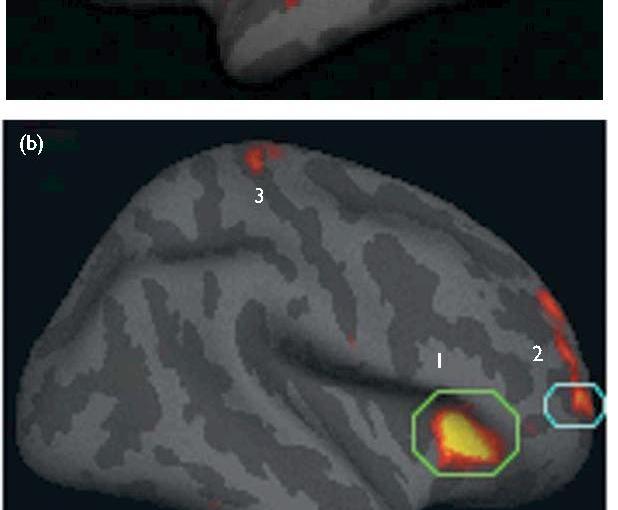
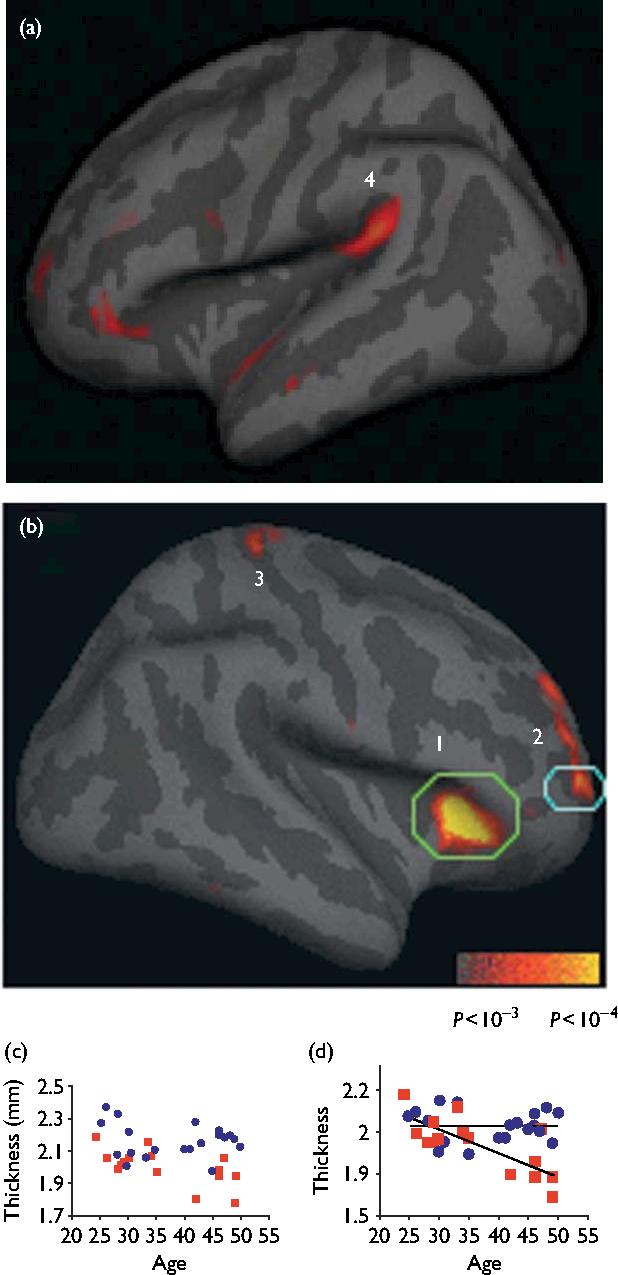
Interestingly, those who practice mindfulness have greater cortical thickness in the anterior regions of the brain: the medial prefrontal cortex, superior frontal cortex, temporal pole and the middle and interior temporal cortices. On the flipside, there was reduced cortical thickness in the posterior regions of the brain including the postcentral cortex, inferior parietal cortex, middle occipital cortex and posterior cingulate cortex. These and other findings indicate that those that take part in meditation over long periods have structurally different brains in terms of both gray and white matter. You can read more here: Lazar et alTang et al, Holzel et al, Luders et al,  Kang et al.

how mindfulness changes the structure of your brain

Image from Meditation experience is associated with increased cortical thickness showing the cortical regions that are thicker in meditators. Numbered regions: (1) insula, (2) Brodmann area (BA) 9/10, (3) somatosensory cortex, (4) auditory cortex.

Loving-kindness meditation has been linked to increased gray matter volume in the right angular and posterior parahippocampal gyri. The right angular gyrus has been linked to empathy, anxiety and mood.

Even if fMRI is just a mirage, DW-MRI seems to back up the findings of changing structure. It is fascinating to think that we can actively structurally change our brains.

Besides the different types of MRI, changes have been shown on EEG (it’s like an ECG/EKG for the brain).  More importantly, those who do mindfulness tend to behave differently – as shown by their differing test scores in various tasks – I shall describe this another time.

The value of work

As someone who really gave it everything when it came to studying or working and not necessarily seeing it as having given me what I wanted, I ran the risk of learning helplessness. Somewhere within me there is a belief that work is a double edged sword. Work is only useful when the direction is right (no physics puns intended). In all honesty though, it really is a vector. I have seen so many people expending so much energy getting nowhere fast. Ray Dalio says that you should only work on the things you really want.

mindfulness-belief-modification

As a true millennial, I didn’t know what I wanted for a long time. Something is telling me that in another 5 years, looking back on this note, I will think: Ha, I though I knew, but I didn’t really. In any case, I have a better idea now than I did five years ago. I recognise what my priorities are. It’s family first and everything else after that.

The learnt helplessness comes in where you finally get the freedom to start again and work on what you really want, but you wonder – is there any point? What if I am wrong again? There’s also a feeling of being spent – having worked so hard in the past, you’re not sure you’ve got the energy anymore. Of course, these beliefs aren’t helpful and luckily they are entirely changeable. I guess I wouldn’t have even ever come close to being aware of them had it not been for mindfulness. The truth is that work is useful when it is in the right direction. Time is going to go by so I may as well put in the work and make a bet on what I believe in. There’s no certainty and no promises, but it is better to always have a direction and therefore a chance at a legacy. The spent thing is nonsense too – you only get stronger from exercising mental muscles through study and work. Past experiences can equally serve as references for one’s ability to succeed regardless of the complexity of the task. After all, there’s always a choice.

What mindfulness teaches you

I had a really hard time trying to do mindfulness last night. It took me a good 30 minutes to even get into my first proper breath that I could focus on. This is unusual for me. At this point I’ve been a pretty decent meditator for about 1.5 years.

What was it? Procrastination. Why? Falling asleep and meditating is effort. It takes effort to not go down 10 million rabbit holes. Saying no is more difficult than it may initially seem. However, it is completely necessary. Focus is the mother of execution. The only way to execute is by focusing on one thing at a time. It’s unitasking. Even if it seems like you are multitasking: you are only ever doing one thing at any given time – just switching more often than you think. Multitasking is a form of hiding: if you fail, you had “so much going on.” Whereas if you are working on just one thing – you can’t really run and hide from it, it is staring you in the face.

The other thing that mindfulness teaches you is that it’s not how many times you fail, it’s all about getting back up on your feet. It doesn’t matter how many times your mind wanders. Every single time you bring it back – you got back up on your feet. The neural pathway that is responsible for bringing you back has just gotten that little bit stronger. It’s like a biceps curl for your focusing muscles.

Does it only do focus? No. It also gives breadth somehow. There’s a technique called noting. So when a memory comes in: you say memory. A plan, an idea, a fantasy, an itch, a dart of pain, a noise and so on. Identifying things helps to deal with them.

Once I was able to get past the initial wall of procrastination and actually went and did it, straight away – I got an amazing reward. I saw the sky as cloudy and then my mind just shifted to the other side of the clouds – where is was sunny and still. Maybe this was just a really small hypnagogic hallucination, but it gave me an insight. Cognitively, it is such an obvious thing: we all know that things have different meanings depending on what side you look at them. To really feel it, to really internalise the meaning of this is something much deeper.

The overflowing cup

I heard this Asian parable today. A student wanted to learn from a master. He already considered himself a good student and quite intelligent. The master sat him down for tea. The master started pouring him tea. He filled the cup, but did not stop. The tea was spilling and running down the students legs. Eventually, baffled, the students exclaimed – what are you doing?! The master explained: you cannot fill a cup if it already full.

mindfulness-reassessing-beliefs

Asian culture is so interesting. Modern day Asia and the US value achievement. Modern day Europe and history book Asia value savouring and contemplation. The culture of letting go that is so central to the teachings of Asian religions and meditative practices seems counter-intuitive at first. Will you learn if you let go? Are you giving up? What is the difference between letting go and giving up?

It’s not like we are as finite as a cup. However, the most accessed memories are references are probably quite a small portion of everything we know. I think that above all it is letting go of stuff that’s not relevant any more. There’s learning and then there’s going around in filtered – not tinted – filtered glasses. Past experiences create distorting filters that add meanings to things that aren’t necessarily there. Staying in touch with reality is our biggest job. It is the one thing that allows people to figure out how to make their dreams come true: you need to always be aware of the ever-changing direction of the wind so that you can adjust the sails in order to get to where you need to be. You also need have a map, however. You need to learn to predict the weather – as much as it is possible.

The trick is to constantly reassess what should be in your cup. Beliefs shouldn’t just be formed by your own experiences, but constantly change with incoming information. An awareness of outside data is important, but an awareness of your own internal software is equally as important – that’s what mindfulness is for. It’s not just garbage in – garbage out. It is good data in – garbage out if the software is garbage. Every day is an iteration in testing both perception and our inner workings.