Between reality and metaphysics

The term “meta” is en vogue now. Meta means beyond. Metaphysics means philosophy today, but at the time it was just a term to describe what Aristotle did beyond physics. We now use it for anything self-referential: a met-analysis is an study of studies and a meta sandwich would be a sandwich made of sandwiches. Maybe I should change the name of this blog to Metathinking.

Metaphysics is really the science of that which isn’t immediately tangible. It isn’t knowable. David Hume destroyed it. He basically said that if it cannot be experienced, it doesn’t exist. For example, causality cannot be experienced – or verified. Hence, philosophy is largely left with nothing to say as it is not empirical. Arthur Schopenhauer believed metaphysics was there, but said it wasn’t knowable. Immanuel Kant restored it. Kant analysed epistemology. He argued that it is impossible to know, or experience, anything without certain made up a priori concepts – that he called synthetic (as distinct from analytical concepts, but just like empirical). These synthetic concepts are more abstract and general rather than purely random and logical like empiric observations. For example, he argued that time and space aren’t part of our experience, but a condition that makes our experience possible. Concepts like quality and quantity are in this same category. However, this still mean that metaphysics couldn’t hold – as it is entirely outside of experience. As such, his problem with concepts like god was that they are full of non-falsifiable statements. If it cannot be verified, it doesn’t make sense.

Kant came up with his own metaphysics. To him, the mental apparatus required to experience things were metaphysical: time, space, necessity and being vs not being. So he came up with something else instead – that which wasn’t metaphysical, which isn’t empirical, but necessarily precedes the empirical. His categorical imperative was that one has to act in a way that one would wish the rest of the world acted. This is how he said it:

“Act only according to that maxim whereby you can, at the same time, will that it should become a universal law”.

Sounds a lot like,

“Do unto others as you would have them do unto you”

However, unlike Jesus (and others to whom this was attributed in different religious texts), Kant didn’t tell people what to do, he just opened that up for discussion. There isn’t a moral charge in this. Another interesting thing is that Kant’s imperative inherently presumes that we should assume that others are motivated by the exact same things we are motivated by, being rational beings. Big assumption.

Kant’s philosophy is attractive because it provides a context for real events rather than going off into the ridiculously theoretical. At the same time, because it lies in that grey are between the empirical and the theoretical, to me it still feels like metaphysics.

what-is-metaphysics

Philosophers: practicing what you preach

Children are a spectacular audience in that they have a great BS filter. It is quite common in paediatrics for kids to be very skeptical of advice. I recall an overweight doctor working in paediatric endocrinology giving dietary advice to a diabetic child. Let’s just say, the poor doctor was informed of the value of giving advice that they themselves don’t follow.

Through the years, I’ve met many smoking surgeons, neurotic psychiatrists and overweight dieticians (but never a less than glowing dermatologist). It’s not necessary to practice what you preach to give good advice. However, going directly against what you preach, what you are meant to be good at – does raise authenticity and competence concerns, not always fairly, but we would be worse off without this filter.

Whatever about overworked doctors, my real question is about philosophers. Schopenhauer is widely regarded as having been an intolerable hedonistic psychopath and a chauvinist. It is well known that he nearly pushed a woman down the stairs – for being annoying. He bailed on a woman who was pregnant with his child. Hegel did something not entirely dissimilar. Nietzsche didn’t have much of a social life, except for in brothels (not unlike Schopenhauer, actually). Kant didn’t have one at all. Gazillionaire Seneca denounced worldly possessions. He was clearly preoccupied with a fear of poverty. At times, in his letters to Lucillius, he sounds like he’s trying to calm himself down more than anything else. I strongly believe he has what modern day psychiatrists would call a passive death wish. Marcus Aurelius was born into being arguably the most powerful man in the world – and so his advice sounds good, but it’s not clear of how much use it was to him. Seneca’s and Marcus Aurelius’ explanations often reference two separate entities: luck an the gods, without really examining the nature of these. Machiavelli, regarded by many as the ultimate weasel and plamaser, didn’t exactly fare so well at court. Freud came up with a theory that is to philosophy as Newtonian physics is to physics. Nonetheless, there is some outrageous stuff in there too. And if you say enough – some of it is going to be right, a bit like a broken clock is right twice a day.

Two quotes come to mind. Both from Seneca. The first I will use as a disclaimer:

“I shall never be ashamed of citing a bad author if the line is good”.

The second, the one I am actually interested in is:

“Religion is regarded by the common people as true, by the wise as false, and by the rulers as useful.”

What if replace the word religion with the word philosophy? Let’s be honest, philosophy is nearly more powerful than religion – because it spreads more insidiously. There’s no discrete baptism, no conversion, no point of no return – just silent incremental exposure. And so, I wonder, we treat philosophy with such reverence, but should we?

philosophy practice what you preach

A religion for people who, in troubled times, don’t want any trouble

Breakfast of Champions was completely different to my first encounter with Vonnegut – Slaughterhouse-five. Breakfast is vehemently anti-American – in a way that is could be anti-any nation and is disturbingly relevant today. Vonnegut has a way of stripping away the sugar coating. He speaks of the slave-trade as buying and selling agricultural machines. This comparison is brought back every time he mentions the social problems of those whose ancestors were slaves: he compares them to actual metal machines and explains that the latter are cheaper leaving the former jobless. Plain, cynical and sobering.

The book is largely centred around the concept of free will. As a medic, I recall learning about free will in physiology. Back in the 1980s, Libet et al did a clever experiment showing that the brain initiates a movement before we are aware of wanting to carry out the movement. Subjects were asked to sit in front of a clock. They were told to move at will – and note the time when they decided they were going to move . An EEG was recorded. Essentially, the EEG showed that the impulse to move occurred around a second before subjects became aware that we’re going to move. Libet and colleagues said:

“cerebral initiation of a spontaneous, freely voluntary act can begin unconsciously, that is, before there is any (at least recallable) subjective awareness that a ‘decision’ to act has already been initiated cerebrally.”

This is a good review of the subject free will in physiology. In short, awareness of volition occurs in parallel to actual agency. Whether volition is causal to movement – nobody knows. Our story-telling machine brains do like to think that it is causal of course.

As a person fascinated by mindfulness, I was curious about Vonnegut’s reference to transcendental meditation. Bunny, one of the characters, used TM. Vonnegut described the procedure in Breakfast. Vonnegut doesn’t hide his scepticism.

I appreciate that absolutely everything that involves a financial transaction can be called a scam. Some people think it is insane that the seemingly skill-less abstract art is sold for millions. Some people trust in banks, corporations, governments – and others are swayed by the evidence that these institutions cannot be trusted. Appreciating this subjectivity, my impression of transcendental meditation is that there is a big scam element to it. There are also some elements of religion in it. While I am interested in learning about the ancient tradition of this particular kind of meditation, the TM organisation and its specific take on the technique smacks of danger to me. I would certainly stay well away.

kurt vonnegut free will transcendental meditation breakfast of champions

Kurt Vonnegut’s wife and daughter were practitioners of TM. He said: “Nothing pisses them off anymore. They glow like bass drums with lights inside.” So far, so good. He later said about TM:

“a very good religion for people who, in troubled times, don’t want any trouble.”

This really resonates with me.

Much like positive thinking, transcendental meditation promises the world via some very simple thing that you have to do compulsively – and preferably attend expensive seminars. It’s very important to never doubt the high priests of these respective philosophies – otherwise, it won’t work. I mean, come on.

It also makes sense that TM and positive thinking has worked for some trustworthy high-profile people. It’s because what they call TM and what they call positive thinking is different to what the seminar-selling folk mean. They take a common sense approach – not a “I will take everything literally and follow all instructions” approach that the gullible people these things attract take.

Escaping the cr*p never really works. Transcending into an imaginary ocean of perpetual calm is a form of cheap escapism that only works for seconds. On that note, I recall having a really bad stomach pain. Without any set purpose, my mind wandered and I imagined getting a shot of morphine. I immediately felt much better. However, I still had to go to hospital to make sure it was nothing serious. One simply has to acknowledge their pain and deal with it. Thinking magically won’t resolve it.

The proper, non-commercial, non-popularised practice of TM is a form of mindfulness -and I have every faith that it works well. It’s not my weapon of choice, but I recommend that people try it. Om is a always a good mantra to start with. I don’t see the value in getting mystical with “personalised” mantras. The point remains: if it walks and talks like a scam, it probably is. The other point is that Breakfast of Champions is another worthwhile book.

transcendental meditation scam kurt vonnegut breakfast of champions

Here we are, trapped in the amber of this moment

“And I asked myself about the present: how wide it was, how deep it was, how much was mine to keep.”

Kurt Vonnegut is a genius – and it turns out he is a real connoisseur of the present moment – but he never stood a chance. I heard phenomenal quotes by him: ”We are what we pretend to be”, and rave reviews from a lot of well-read people. Reddit told me that Slaughterhouse-Five was a good place to start – and so I did. His examination of Christianity is excellent. The aspect of his book that left me feeling let down is the whole antiwar piece. He preemptively defends his attempt to write an antiwar book in Chapter 1 by acknowledging that its most likely a pointless affair – but still, his antiwar manifesto seems to lack depth.

“How nice – to feel nothing, and still get full credit for being alive.”

Vonnegut’s reflections on religion are certainly striking. He seems to strip down all the bells-and-whistles. He makes this interesting point: Jesus was a man like the rest of us. The fact that he is glorified makes it OK for us to not strive to be like him – because we couldn’t possibly. However, an appreciation of Jesus as a nobody would allow people to take responsibility for their actions much more. It strangely reminds me of the G.O.P. philosophy and what a well-off Republican might say about the poor in the context of the American dream – just swap the concepts of morality and money around.

Kurt Vonnegut Slaughterhouse 5 meaning
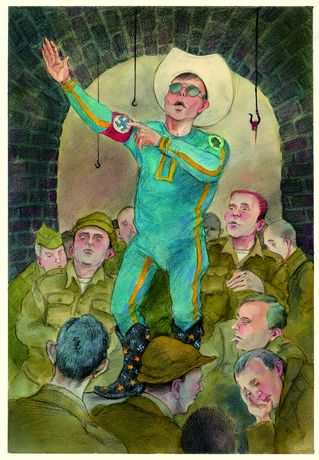
This is what an American Nazi looks like – illustrated by John Holder

“All moments, past, present and future, always have existed, always will exist.”

Vonnegut’s descriptions of women are hilarious. He’s a Dostoevsky-level psychologist. The emotion Vonnegut creates most masterfully is that he-gets-it feeling most of us yearn for. You’d definitely go for a pint with Kurt. For me, when he said that Lot’s wife looking back “was so human” elevated Vonnegut into the “can-do-no-wrong” status. Reading about her in this context tempts me to identify her as the first ever case of PTSD – before it had a name.

“People aren’t supposed to look back. I’m certainly not going to do it anymore.”

His uncomplicated sentences and the absence of excess linguistic ornaments really add to Vonnegut’s main point – war is war. While it is tempting – and indeed seduces most, there’s no use in getting caught up in the ideology or the methodology of war at the expense of understanding the plain reality of it.

“I think you guys are going to have to come up with a lot of wonderful new lies, or people just aren’t going to want to go on living.”

At the start, the frequent remark “So it goes” is gratifying. It occurs anytime somebody or something dies. It has an interesting effect – for me it breaks the forth wall and lets me, as the reader, know that the author and I are on the same page. However, as the book progresses, it becomes compulsive, matter-of-factly and annoying. His use of symbolism is a little too overbearing in general. His overly physiological remarks and “toilet humour” took away from the work for me.

Kurt Vonnegut Slaughterhouse 5 essay
Absurd and relatable. Illustration by John Holder.

“If I am going to spend eternity visiting this moment and that, I’m grateful that so many of those moments are nice.”

The non-linear nature of the narrative emphasises the senselessness of war – but again, towards the end of the book it just seems to be happening for its own sake. There are lots of non-linear compositions that benefit from this structure. My favourite examples are the films Once Upon A Time In America and Pulp Fiction. I think Vonnegut overdid it.

“Why you? Why us for that matter? Why anything? Because this moment simply is.”

The fatalist aspect of the Tralfamadorian philosophy and the recurring quote about having the wisdom to know if you can change something, the courage to change it – and all that – seem to conflict. In a sense, Christianity is fatalist. The “So it goes” reprise has a memento mori quality to it.

“No art is possible without a dance with death, he wrote.”

Vonnegut doesn’t have a very clear philosophical message, but he seems to be convinced there is very little free will if any. The irony of the main character surviving the war despite having absolutely no survival instinct adds to this. Billy seems to have little insight into his own suffering. He escapes reality by travelling in time. Vonnegut doesn’t really offer us an opinion on whether that’s a form of madness – or real life. My impression is that Vonnegut’s outlook is that life in general appears pretty random and not worth sweating over.

“Well, here we are, Mr. Pilgrim, trapped in the amber of this moment. There is no why.”

There is a lot of criticism in the above review, but actually I loved the book. My next stop is Breakfast of Champions.

Schopenhauer’s genius and mindful boredom

Arthur Schopenhauer said something very interesting:

“Genius is the power of leaving one’s own interests, wishes, and aims entirely out of sight… so as to remain pure knowing subject, clear vision of the world.”

He argued that talent allows people to get to where other’s cannot get, while genius allows to solve problems that other’s don’t see. By that logic, Uber and Facebook are examples of genius – with a hefty dose of being in the right place at the right time.

What strikes me about this quote by Schopenhauer is how Eastern it is. I have been thinking about the subject of dreaming of a better future vs fully engaging with reality. It seems like there is no way to set goals without trading in some of the appreciation of what’s currently going on. By setting goals, we almost certainly forego the opportunity to experience what Schopenhauer called genius.

Being grounded in reality is possibly the thing we run from the most. We call it boredom. How many apps do you open on your phone just to not be alone with yourself and your surroundings when you’re on your own? I, for one, open too many. And before there were apps, books and music – there were daydreams. Boredom is a form of pain – according to Schopenhauer. He said it was an issue of affluence: if one moves on from satisfying the most basic needs, boredom becomes the source of discomfort to deal with next.

Boredom seems to upset children too. They are generally excellent at finding solutions to it: in fact, I’ve always been encouraged “to do x, y and z – because it’s better than being bored”. This is also why children hate school: there’s no escape from boredom. Boredom is vilified from the get-go.

Maybe it’s time to be bored – and not to plug every free minute by consuming something in a directed manner. Having too much direction – too many goals – leaves us with a kind of schizophrenia-by-choice – as it is splitting us away from what’s actually going on. It’s not a comfortable thought for me. All along, I’ve been sailing towards certain coasts, catching up with milestones and deadlines – while becoming progressively wrapped up in my own bubble. At the same time, I am terrified of not sailing in a direction: the thought of waking up one day when I am x age and realising I’ve nothing to show for the last y years is scary. However, it is clearly also silly. By being more mindful of what’s going on – rather than constantly having my eyes on the prize, I will surely be mindful of what way my own life is unfolding.

A focus on the present moment doesn’t mean becoming reactive and directionless. It’s not about passively accepting everything that happens and losing all sense of agency. It’s about acknowledging what’s going on and what one can do about it – while letting go of illusions. I am talking about – most of all – the illusions propagated by modern-day influencers that we can create the future. In a sense, we can, but not through brute determination and risk taking – rather through relentless examination of what’s around us – and that means embracing boredom.

On a personal note, I have a very long night connection flight coming up soon – and I realised that I was dreading it. Why? Because I feared the impending boredom. For some reason, I can’t fully relax into a book or film while I am travelling. Then I remembered something I’d noticed year ago. Some of my most significant realisations tend to happen when I am travelling. Long connecting flights are better than any meditation retreat. One has to be alert enough to be on time, watch out for gate changes and not lose one’s boarding pass – and kind of kill time too. This state allows me to be ok with the fact that I will be bored. I am inevitably grateful with what bubbles up to the surface through this boredom.

mindfulness boredom schoppenhauer genius appreciation of reality

Time, Socrates and Taleb

N.N. Taleb has to be one of my favourite thinkers of our time. He has taken uncertainty – the root of all evil to so many people – and mathematically explained why it’s not such a bad things at all. In fact, in certain circumstances, we can benefit from uncertainty by being what he calls antifragile. WordPress just underlined this word in red, which is disappointing. It’s a concept that should spread widely.

He sometimes posts one liners on Facebook that then generate a lot of discussion. His most recent:

“The tragedy of our time is the monoculture of ideas: all ‘thinkers’ are forced to believe the same bullshit.”

Not that I am trying to meta-prove him wrong, but I disagree. It’s not the tragedy of our time. It has almost certainly always been that way. Ever since I first heard Socrates talking about youth, I’ve been highly sceptical of any remarks that proclaim that our time is somehow unique. Arguably one of the most powerful minds of all times said:

“The children now love luxury. They have bad manners, contempt for authority; they show disrespect for elders and love chatter in place of exercise.”

It’s quite fascinating really. You’d swear he was talking about the kids now – with their latest iPads. However, he said this sometime during 5th century BC.

It would be too sweeping a statement to say that nothing ever changes, but it’s fair to say that human nature remains fairly constant – which is what Taleb’s comment is addressing. I don’t think that that’s a pedantic reason to disagree with him. I think we’re so prone to see ourselves as unique and special that we forget to learn from history.

UPDATE: So I left a brief comment to this effect on Taleb’s post; my first time to do so. And then – he replied! He replied to only 2 comments of over a hundred (the other one exposed him as a Russian spy), so I feel a bit like the sensei at the top of the mountain talked back. His comment was: Globalisation. That’s an interesting take on it. On top of globalisation, there is also the internet – so the monoculture gets even stronger. I guess there is an interesting point arising out of this discussion: our propensity for herd mentality is made even worse by the internet. 

It’s difficult to meaningfully stand out when the way to get heard is through the network effect.

human nature doesn't change

When mindfulness seems impossible

Western culture is all about results. This mentality is evident virtually everywhere. We all prefer tasks that yield immediate tangible results. The prototypical somewhat narcissistic CEOs tend to be focused on results. We haven’t really moved since the time Ford made lapel pins with the number of the financial result they wanted to achieve – for everyone in the company. We’ve replaced them with motivational posters. During our formative years – in school, we are conditioned to look for results: high grades, won matches and debating trophies. The recent fitness cult is also driven by results. It is fascinating what people will do to get a six pack. While there was always the phenomenon of recounting your experience as a result, social media enhanced this conversion of experiences into results: taking a picture in a scenic place is different to just being there.

why-is-mindfulness-so-hard

Mindfulness goes against this obsession with results. It’s tempting to compare a tough mindfulness session with a tough day at the gym, but the analogy doesn’t really hold. There is no metric, no result, nothing tangible, strive towards or nothing to brag about in mindfulness. If you go running and it’s really tough, at the end you can say: I ran a 5K today. What if you just turned up and ran for 30 minutes? That a bit closer to mindfulness, but the fitness world wouldn’t approve. After all, you could have been slacking off for the 30 minutes. Why weren’t you tracking your speed? Why didn’t you measure the distance? Did you at least weigh yourself or measure your waist the next day? What gets measured gets managed, they say – and it’s true. Fascinatingly, there is no goal and no metric in mindfulness other than to actually turn up and do it. It’s binary.

So if the whole thing is making you feel like it’s impossible, just remember that it’s a yes or a no. Any kind of yes, even the most distracted meditation that feels like a Herculean effort, is a yes.

Some worry that if your practice feels really distracted, it doesn’t count. It does. However, there are ways to make it better. There are countless techniques, but this is the one I found works best: counting.

Counting involves focusing on a very transient moment in time: the moment when the in-breath becomes the out-breath and then the slightly longer moment: when the out-breath stops.

So it goes:

  • breath in
  • when your in-breath stops, count 1. You may not even have time to say 1. You can just see the number in your head.
  • breath out
  • when you breath out stops, count 2. There will probably be more time here

It may be tempting to pause after the in-breath. Some people do. For me, it seems that mindfulness is more natural when you are just observing your breath rather than changing it.

It’s not always true, but in case of meditation the maxim done is better than perfect certainly applies.

tips to make mindfulness easier

Why forcing positive thinking doesn’t work

The positive thinking crowd – who have flooded every corner of the internet, most of all social media, would have us believe that our minds instinctively drive us towards that which we focus on. Hence, it makes sense to focus on the good, according to them.

As a naturally skeptical-yet-optimistic person, I find myself repelled by the cult of positivity. Below, I explain the theory behind positive thinking and the reasons why it ultimately doesn’t work.

does positive thinking work

There is logic behind positivity. For example, attentional bias and its many cousins are our way of noticing the things we prefer to notice even more.

So if we try to notice good things, we are likely to notice a disproportionate amount of good things. It is assumed that by being surrounded by positivity, we will feed off this virtuous cycle and gather the strength to produce other good things. Another argument in defence of positive thinking is that our brains tend to follow certain patterns, habits of sorts. Feeling good more often leads to more feeling good. Another virtuous cycle.

Positive thinkers encourage setting and identifying with ambitious goals as a necessary part of all achievement in life. There are endless quotes from celebrity icons to support this. Many of those who have succeeded would say – I had a vision of x, y, z – and here I am now, I’ve achieved it.

We don’t hear the, undoubtedly, innumerable stories of those who go through the same “law of attraction” process – without ever arriving at their destination.

In addition, we’re quick to assume a causal relationship between the idiosyncrasies of the successful and their success. These are just two of many biases that are inherent in the positive thinking logic. So of what value is this obsession with studying the habits of the ultra-successful? As role models – fair enough. However,

the studies that support positive thinking are more often than not obviously in violation of basic parts of the scientific method.

But hey, it takes a while to prove anything, so we will bear with them for now.

By that same positive thinking logic, thinking about negative things will somehow lead to these bad things. Good point (we will agree with their assumptions for now). There is one problem with it though. Let me explain.

Forcing ourselves to focus on the good things creates a kind of dissonance. One part of our brains is saying: we should feel positive in all circumstances. Another part of our brain is pointing out all the things that we are used to feeling bad about.

Now, it is possible that the way we are interpreting the world is unhelpful, but this requires a lot of work to unmask and change. Therefore, until the hard work of rethinking our beliefs, for example, through the (much more) scientifically backed talk therapy is at least attempted, it is impossible to cure the feeling that something is off kilter in our heads as a consequence of positive thinking. It feels fraudulent and may even make the subject feel worse. Furthermore – and this is the interesting part – this sensation of something not being right will draw more attention to these negative thoughts we were told to run from.

The swollen positivity of Instagram’s motivational gurus doesn’t just urge us to be positive – it tells us that being negative is wrong.

“Rid your life of negative people”. “Purge negative words from your vocabulary”. “Avoid negative thoughts”. Forcing positivity accentuates negativity: whenever we feel down we will flag it as red, pumped by inspirational quotes. So positive thinking urges us to focus on the negative. Isn’t this negative focus going to lead to negative events – by their own logic? In addition,

the red-flagging of negative thoughts often results in further guilt and helplessness to go with our already negative feelings.

There is another problem with telling people not to think stuff. It was voiced by Fedor Dostoyevsky, a hero of mine since back in school when I managed to write an exam essay outlining the importance of the religion in Crime and Punishment that was corrected by a 70 year old Soviet-through-and-through teacher of literature – resulting in a stellar grade. Fedor gets the credit here. Anyway! He said that the things that we try to not think about are the very things we end up thinking about.

Could you do me a favour and not think of a blue scarf please?

Yeah, I know.

Furthermore, telling someone how they should feel is fertile ground for tyrannies of the shoulds – feeling low as a consequence of now complying with some preconceived rule, or should. More unintended negativity.

This emphasis on avoiding negativity draws us no less to negative events than the focus on positivity draws us to positive events

…I hypothesise. In addition, the dissonance and a new rule to follow about something only partially under our control in and of themselves feels rotten, i.e. more negative feelings.

does the law of attraction work

I think positive thinking is flawed: not because it has no basis, but because its basis has counterweights that accentuate the negative thoughts just as much – made worse by the uncomfortable dissonance it creates. It just makes us judge our thoughts more.

Don’t get me wrong, I don’t think that allowing ourselves to ruminate on sad things we cannot change, having no faith in ourselves or any other unhelpful behaviour should be encouraged to spite the positive thinkers of the self-help industry. I just don’t believe positive thinking is going to solve the underlying conflicts. It is a good idea to see the best in people and things etc. It is a good idea to let our positivity strengthen. It just can’t be compulsive – or the positive effect is ruined as described above.

There’s no need to dwell on the negative beyond what is reasonable either. For example, raising awareness about suicide sometimes results in a higher incidence of it. Not dwelling on something can be achieved without running from it, however.

There is a nice point on the emotional “graph” – and I think we could reach it by being a bit more open-minded about the negative.

It makes sense to reflect on this through the most extreme negative thought – of death. Being comfortable with the thought of death seems preposterous to most people – unless they are a doctor or something like that. Even then – it’s not their own death they are thinking about. When I first heard of the annual Mexican festival in celebration of death, it seemed insane – blasphemous in a kind of secular way. My own mother, who unlike me did not grow up with Halloween, still feels there’s something not quite right about it. People in our culture seem to avoid thinking about death as if somehow thinking about it will bring it closer.

Where do positive thinkers stand on death? Is thinking of death banned as well? It would seem obvious that death is regarded as one of the worst possible outcomes in our culture. Well, ok, but it’s going to happen anyway. The theory underlying positive thinking would lead us to believe that thinking of death will somehow bring it closer. The thought of our own mortality cannot be easily tolerated. It has to go right now. We may touch wood or bless ourselves to undo the damage it already caused. Obviously, there are other explanations for this besides what we usually call positive thinking, but the mechanism is the same. We just don’t want to bring it upon ourselves.

So is it ok to talk about death yet? The Mexicans are a pretty happy people, or so they say in those country-by-country happiness studies. Death was a beloved subject of the medieval tradition – with their skulls on their tables in countless paintings to remind themselves of death.

There are many lessons to be derived from thinking of death.

The Stoics loved thinking of death – it’s their way to remind themselves that nothing is worse than death – and death isn’t that bad. It’s our beliefs about it that make it bad. Hence, there is no need to fear death. Since we don’t have to fear death – the worst outcome of all, surely, we don’t have to fear anything else. Buddhists would regard death as just another experience – neither good nor bad.

Maybe that’s it: it’s all about trying to avoid uncertainty “the thought of undiscovered country from whose bourne/ No traveller returns, puzzles the will”. Positive thinking seems to heal the pain of uncertainty.

It positively confuses our brains – that aren’t very good at distinguishing between fantasies and reality to begin with. One of the proposed benefits of positive thinking is that it gives us a sense of certainty. It is argued then that once we believe that something is indeed possible, we will find it easier to achieve it. That’s why it’s so popular: it eases the fear of uncertainty.

does positive thinking really work

Besides being told to think positively, could there be other reasons why we dislike thinking about death so much then – given that is, well, as good as certain? The facts may be the facts, but way we think about death is full of uncertainty. In the extreme, there is a part of each of us that isn’t quite certain that we will die: it will be an older me, a more prepared me, not me me. Maybe; but seeing as how at 27 I don’t feel radically different to how I felt when I was half that age, I imagine it will be me me. However, just like the minus infinity to 1989, the infinity that I will miss out on after I am gone is just a part of what we got into when we were born. We also have no idea what will happen when we die – if anything, adding to the dreaded uncertainty. As evidenced by the scanty insights brought up here though: there is much to learn by thinking of the seemingly negative.

It would be mean to get to this point and not offer some kind of alternative to the wretched positive thinking. My answer, as much as it is possible to answer, is giving up on the hatred of uncertainty. There will always be uncertainty. No amount of meaningful relationships or possessions will ever shield us from uncertainty. We probably should set goals, but not cling to them unaware of the changing world around us. We can try and tame uncertainty by working around it, by forming beliefs that aren’t sabotaged by uncertainty – but not by resisting it through compulsive meaningless positive thinking.


Do you have to learn about Buddhism to fully understand mindfulness?

The extent to which mindfulness and meditation are intertwined with Buddhism is disturbing for me. It’s not that already committed to another religion and feel defensive. I don’t hate or judge religion, or Buddhism especially, but I would rather not go there. When mindfulness teachers go on about Buddhism, how it is more of a philosophy, how it’s important in understanding mindfulness – I feel like a car salesman is selling me on a bunch off car accessories I determinedly do not need. Can I just get the car? Here, I just want the mindfulness, not the philosophical paraphernalia. Is it possible?

Yes. I went and studied what these people have to say. First of all, there are other religions that involve meditation, even Christian ones. The philosophies are completely different. This means that the philosophy is optional. Second, the ideas of Buddhism that are supposed to help you to understand mindfulness are echoed elsewhere, for example, in the writings of Stoic philosophers or more recently in the writings of Viktor Frankl. This means that the philosophy isn’t exclusive to Buddhism.

do-you-have-to-learn-about-buddhism-to-fully-understand-mindfulness

I have stripped down the relevant beliefs here:

  • There’s nothing certain in life. Certainty is an illusion. We will never achieve certainty. The reason why most people want to be wealthy is because they feel they won’t have to worry about x, y, z. In truth, wealthy people indeed do not have to worry about x, y and z – they now worry about a, b and c. Furthermore, things are always changing.
  • Thoughts and emotions happen to us the same way as the weather. Thoughts and emotions are like noises, smells and sensations. The mind is, among other things, a sensory organ. It perceives thoughts and emotions – we don’t have control over them, but we can control what we do about them. We control the beliefs that we have – for sure. This will have an impact on thoughts and emotions, but indirectly and over time. You teach yourself not to cringe at the smell of vomit, and you can teach yourself not to cry at the end of a sad film. However, the thoughts and emotions still come in from the outside in. Any kind of thinking is thinking.
  • Feeling happy all the time isn’t the goal. You should just observe how you feel without judging it. It doesn’t mean you can’t act on what you’ve observed, but you certainly shouldn’t act before you’ve acknowledged everything that’s going on. Assuming that you can – and should – always feel happy causes a lot of the pain we feel.
  • Escaping how you are feeling is pointless. It will just take longer to get past the challenges associated with how you are feeling. This is where the way they deal with resistance comes in. You can act to change your reality – they don’t call that resistance. However, not understanding reality is resistance. Most violence and bad things come from this resistance.
  • Mindfulness isn’t there to make you a better person or make you happy. It’s just a way to understand what’s going on.
  • You don’t have to feel a certain way to act a certain way. Since thoughts and emotions aren’t always in your control, it doesn’t make sense to wait for your feelings to be right to act. For example, you can go to work without being motivated.

do-you-have-to-be-a-buddhist-to-understand-mindfulness

Knowing what to want

It’s always been difficult for me to choose what it was I wanted to “do with my life”. The main reason for this is that conventional low-risk options promoted to school students are all meh. It is hard to choose between broccoli and cabbage when you’re really after ice cream.

What is it to want something? In the XXI century pop culture sense, it is to be excited about something. Stoics talked a lot about wanting – as one of the most important things. They didn’t give much direction as to how to choose what you want. However, having a direction is life is key according to them. Buddhism seems to focus on the present and away for the need for certainty that is a prerequisite for goals.

It seems that the most successful people choose one thing that they won’t give up. Some call it passion, but it’s not really possible to actually be consistently passionate about something. For most people, it is a way of feeling special and having a sense of belonging – I am a painter. Rather than being something to work at, now it is a romanticised notion. Furthermore, a lot of people live in limbo of not having found their passion yet. This presupposes that it has been decided for you. Not feeling in control or having responsibility for your so called passion is a sure way to fail. Lastly, it’s a great excuse to never starting to do anything. If you commit to something, you can fail – people would rather not try and avoid the possibility of failure. What drives people to keep going is why they’re doing it. However, it’s not enough.

We want to do things we are good at. Small wins and a sensation of progress is what keeps us going. Hence, it makes sense to do things that we are good at. Of course, the more you do something, the better you get at it – but it always makes sense to play to your strengths.

Even if you are fantastic at something, however, it makes sense to make life easier for yourself by making yourself different. Getting to be the best in the world at one particular skill is awfully hard. The chances of success are very small. However, you can be in the top 1% in the world by working hard at it. Is this enough? It is – when you combine it with something else. It is much easier to be the best in the world in something super niche. You may not be the best physicist or the best economist, but you may be the best at applying the computational methods used in physics to economics models.

You may also like:

Millennial ENTP struggles

knowing-what-your-life-is-about