Side effects of meditation: be warned!

In the professional medical world, Medscape is probably the most trusted up to date online resource. I am delighted to see that yesterday they published an article that highlights some of the more challenging and distressing aspects of meditation based on a recent scientific paper in PLOS One.

The reason I am so glad is that it means we’re moving to a different approach to meditation, one with more well-warranted rigour in how people talk about this intervention and away from the perception that this is something without side-effects.

Crux of the study:

  • the challenging aspects of Buddhist-derived meditation practices are well described in Buddhist tradition but are less so in Western scientific literature
  • the researchers interviewed nearly 100 meditators and meditation teachers from each of three main traditions: Theravāda, Zen, and Tibetan.dangers of meditation, side effects of mindfulness
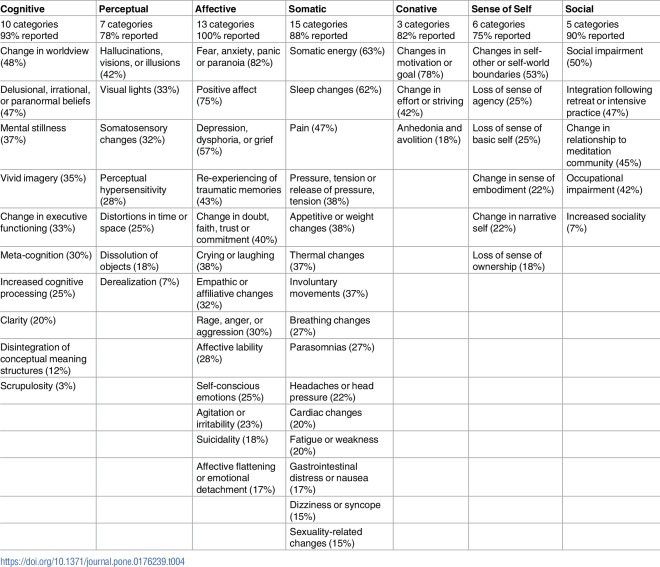
  • the researchers developed a taxonomy of 59 experiences organised into seven domains: cognitive, perceptual, affective (emotions and moods), somatic (relating to the body), conative (motivation or will), sense of self, and social.
  • all meditators reported multiple unexpected experiences across the seven domains of experience. 
  • the duration of the effects people described in their interviews varied widely, ranging from a few days to months to more than a decade, the investigators report.
  • some meditators reported their feelings, even the desirable ones, went too far or lasted too long, or they felt violated, exposed, or disoriented. 
  • meditation experiences that felt positive during retreats sometimes persisted and interfered with their ability to function or work when they left the retreat and returned to normal life.
  • the meditator’s practice intensity, psychiatric history, trauma history and the quality of supervision are important factors that influence the meditators experience, but not for everyone.factors that influence quality of meditation
  • the study highlights that the one size fits all approach isn’t ideal: “The good news is that there are many different programs out there and different practices available, and with a little bit of homework and informed shopping, someone could find a really good match for what they are after,” she said. “But I think often people just sign up for whatever is the most convenient or the best marketed, and it’s not always a good match for their constitution or their goals.”

Dissecting the side effects 

Here are the reported side effects with the percentage of people who reported them in brackets:
side effects of meditation cognitive, perceptual, affective, somatic, sense of self, social

It’s fascinating to note that nearly 50% noted a change in worldview. Open mind, new philosophy – fair enough. I would be on the fence about saying that I have a different world view because of meditation. It’s clearer, it’s calmer, it’s more adaptable, but it’s not really changed. Thus, it is possible that people who try to meditate are often looking for a new worldview or are quite suggestible.

Nearly the same number of people reported delusional, irrational and paranormal beliefs! I guess this is all based on Buddhism and there is a strong religious element to it. However, people were clearly made uncomfortable by it. I certainly experienced this: this is why I tread carefully when I go exploring meditation resources. A huge number of them are zealous, either for reasons of unquestioning devotion, or commercial ones. Snake oil requires faith.

Again, over 40% reported hallucinations. Just as a reminder – delusions and hallucinations are the key ingredients of psychosis and good reason to admit someone to a psychiatric ward. Obviously, these must not be quite as persistent as those associated with psychiatric disease, but if I had seen this table before starting mindfulness, I would have thought much more carefully. In this sample, 32% of people had a prior psychiatric history. This doesn’t explain how common all these DSM-sounding symptoms are among them.

Fear, anxiety, panic or paranoia came up for over 80% of people. I think is more a reflection on the sample than on meditation. Why to people meditate? Often they come upon it as a cure for anxiety. Indeed, in my experience, besides actually getting rid of the anxiogenic stimulus, meditation is a great method to deal with it. Depression was very common too at over 50%. Anhedonia and avolition – being unable to experience pleasure and not having any desire to do anything – are hallmarks of depression and were experienced by 18%. Personally, anxiety has always accompanied meditation in some way or another, but not in a bad way. It’s a little bit like saying that exercise cause shortness of breath. However, panic and paranoia are step to far.

Where there are mood changes, there are autonomic function changes and indeed they seem to have been affected too: level of energy, quality of sleep, appetite, etc. It’s unfortunate to note that many of those changes were negative with common reports of fatigue and pain.

As expected, 75% of meditators had their mind bent by Buddhist approaches to the self. We also know from MRI studies, that the anatomical self, seated in default mode network is modified by meditation, so this is expected.

Clarity, meta-cognition and increased cognitive processing – that’s our thinking clearly box ticked.

What does all of this mean?

To meditate or not? Meditate, but proceed with caution, a healthy balance of open-mindedness and scepticism – and preferably with supervision. In the words of Dr Walsh, it’s important to be challenged, but not overwhelmed.

As for me, I often take breaks from meditation. If it’s not happening, I don’t force myself too much. Thirty seconds of mindfulness is better than ten minutes of desperate striving effort and then feeling exposed, lonely and inadequate. To give it a Buddhist twist, we can think of the experience as if it is the weather. You may have decided that you are jogging today, but if it is stormy outside, it’s better to be a bit more adaptable, stay at home and practice your planks. Same here.

Reference:

Lindahl JR, Fisher NE, Cooper DJ, Rosen RK, Britton WB (2017) The varieties of contemplative experience: A mixed-methods study of meditation-related challenges in Western Buddhists. PLoS ONE 12(5): e0176239. https://doi.org/10.1371/journal.pone.0176239

P.S. Have a look at this Christian blogger explaining the emotional conflict she experienced when exploring yoga. It’s not important to be religious to understand that imposing one system of beliefs over another, whatever it may be, can be highly distressing.

negative effects of meditation
Just a picture of Dublin in the sun


The successniks of Silicon Valley learn philosophy, but search for the secret sauce continues

‘Men work together,’ I told him from the heart,
‘Whether they work together or apart.’
– Robert Frost

“Practical philosopher” Andrew Taggard disabuses founders, executives, and others in Silicon Valley of the notion that life is a problem to be solved, and happiness awaits those who do it:

“Philosophers arrive on the scene at the moment when bullshit can no longer be tolerated,” says Taggart. “We articulate that bullshit and stop it from happening. And there’s just a whole lot of bullshit in business today.”

Taggart seems to preform a sort of CBT on CEOs. This article also features the term successnik when talking about the Silicon Valley execs. What a gem.

But wait, maybe we have the secret sauce after all?

Harvard/MassGen “psychiatrist, psychoanalyst and Zen priest” Robert Waldinger draws an interesting conclusion to one of the longest studies on happiness, carried out at Harvard…

Now, before we get all excited, it is an observational study of a small-ish bunch of Boston men, so go easy on the extrapolation. But here is the said sauce:

“So what have we learned? What are the lessons that come from the tens of thousands of pages of information that we’ve generated on these lives? Well, the lessons aren’t about wealth or fame or working harder and harder. The clearest message that we get from this 75-year study is this: Good relationships keep us happier and healthier. Period.”

I asked a similar question of Dr John McBurney – and his answer was community as well. Other research points out that when it comes to relationships, the absence of the negative is far more important than any grand gestures or unbelievable highs in determining whether these relationships will last.

successniks of silicon valley learn philosophy

Given that for millions of years our very survival has been predicated on our tribe much more so than on our personal achievements, it makes sense that we weight it so highly. Evolution carved us out for survival and not for happiness.

So perhaps, somewhere between the first and second step of the Maslow pyramid (that is physiological needs and safety), we’ve been missing community. In today’s society we can pay for the fulfilment of both of those – and that’s where most people are stuck.

Why do people want to be successful? Because it solidly ticks off the bottom two steps of the pyramid. If you are more cynical, let me phrase it this way: hedonism is step one, narcissism is step two.

Maybe the hack is in the fact that having a community provides both physiological and safety cover. Furthermore, unlike money in an of itself, it also let’s us into the higher up steps of the pyramid. I am calling it a “hack” because few people consciously feel community is that important.

Why don’t more people invest into community?

1. “I want to be special”

Blending in with a community is no fun. If you didn’t figure it out on your own, is it worth the same to you? All the cool guys seem to have done it one their own. We know that’s not true, of course.

However, it is hard to have a lot of impact if all you ever do is comply with the unspoken traditions of your community. So in a sense, it does prevent personal accomplishment. It’s important to clarify that you can’t make do with any sort of community: it has to be supportive. A conflicted community (or family) is probably more harmful than being alone based on what Dr Waldinger discussed.

2. “You can’t trust no one”

Indeed, communities do have a way of ostracising people – and generally being poisonous when things aren’t going well. All of a sudden your neighbour of yesterday is making a business out of your misery. We have all heard the stories from wars and famines that illustrate people’s disregard for the life of another in extreme circumstances.

This fact doesn’t stand alone of course. We’ve also all heard stories of altruistic sacrifices around those same wars and famines. And – what if you had been working in an individualistic rather than a community-centred manner: this isn’t a guarantee either because you’ve invested into things that may not have any value in extreme circumstances.

In the extreme, banks collapse, property gets nationalised, political regimes choose new heroes and scape goats… Less extremely, industries rise and fall, changing laws and regulations present new challenges.

If you want to be pragmatic about it, think of community as a diversification strategy. It seems that trusting your own accomplishments over trusting the community is a false path to success – whatever for you feel you need it.

harvard happiness stud role of community

The spiritual aspects of mindfulness through an evidence-based lens

I’ve spoken about mindfulness to numerous psychiatrists, those that I’ve worked with and experts from various out-postings of the Western world. Completely unprompted, they all converge on one point:

We should pay more attention to what the Eastern philosophy already knows about the body and mind.

As Western doctors, we are trained in the evidence-based tradition. We hate nonsense treatments that are painfully common. Glucosamine. Cough remedies. None of them are better than placebo.

Then there is a rake of stuff that isn’t useless per se, but useless because it is irrelevant:”X reduces the risk of Y 10 times”… but they never tell you that it reduces risk from 0.001% to 0.01%. I call all of this snake oil, and I am passionate about doing what I can to protect the audience.

I am conflicted however: it seems that it’s impossible to address certain issues using an evidence-based approach. There is simply no way to do a randomised-controlled trial on certain things.

Whenever some esoteric group get something right, I tell myself that even a broken clock is right twice a day and if predictions are general enough, they cannot be proven wrong, a bit like a horoscope.

However, all of these renowned people trained in the evidence-based tradition are saying that much of these robust observational findings by Buddhists tend to get confirmed by our methods, such as fMRI, now, hundreds of years later. What a seductive proposition!

john mcburney neurologist mindfulness

Dr John McBurney spoke to me about this in detail:

“I recently attended the International Symposium of Contemplative Studies ran in conjunction with the Society for Neuroscience annual meeting. This is an outgrowth of the dialogues between the Dalai Lama and the neuroscience community that began in 1987 and resulted in a satellite meeting at the annual Society of Neuroscience meeting in 2005 entitled “The Science and Clinical Applications of Meditation”. Out of these interactions an entire field of neuroscience has emerged: contemplative neuroscience.

What bothers me the most about the popularisation of mindfulness is that it is seen as an end instead of a means. This has the potential to deepen our self-absorption and even to become an exercise in narcissism.

Mindfulness is both fully embodied and relational. In other words mindfulness is a  fundamental practice for getting in touch with our true selves. That true self or true nature is fully embodied.

In other words, it doesn’t just exist in our conscious thinking minds; it encompasses our full being including our somatic awareness, gut, heart and breath. But this must also extend beyond our bodies to others to achieve its full significance. In this way what arises out of mindfulness is what matters the most. This is the relational part. So mindfulness fully realised is not just within us, but also between us.

The Dalai Lama says that if everyone in the world meditated, there would be no more war. The reason for that is the fundamental goodness of human nature. Human infants are born genuinely helpless. Most people have a fundamentally positive attachment experience – or they don’t survive.

This is reminiscent of Harlow’s experiments in which baby monkeys were deprived of maternal interaction and were either developmentally devastated or died. So without the interaction with the mother the baby is like the seed that does not  germinate..

So when we “get out of our own way” as Judson Brewer talks about in his TED talk, what emerges is our nature that is inherently good and compassionate, seeking to address suffering in ourselves and other people.

To my mind, mindfulness is the first step in realising that nature. It is a necessary, but non-sufficient condition. Mindfulness is a start, but ultimately it comes down to what we do with it. Some people have severe, traumatic attachment experiences, in some ways like Harlow’s monkeys.

This results in severe disruption in personality development. They may have borderline features and don’t have a strong sense of self or feeling of right or wrong, but for most of us this thankfully doesn’t apply. For most of us, all we need to do is to get out of our own way to realise the beauty of our own nature.

Into the Magic Shop: A Neurosurgeon's Quest to Discover the Mysteries of the Brain and the Secrets of the Heart

There is a lot of discussion about the popularisation of mindfulness and the misdirection that the general public is getting. It is possible for it to become too simplified, so that it becomes harmful. For example, Shinto Buddhism was misused in Imperial Japan and atrocities were committed because of that or in our times lets look at the ethical dilemma posed by the mindful sniper. It’s not just practice that makes perfect.

It is perfect practice makes perfect. It is really a value judgment that comes out of mindfulness. Which is reflected in our relationship with others and the world.  It this way mindfulness becomes mindfulness in the service of others through compassion which in a way is a superpower. Just look at this article from CNN posted a few days ago.

One of the people I’ve crossed paths with is James Doty. Now, he is a professor of neurosurgery in Stanford. He is an amazing human being. He and I were residents together and became good friends. He went on to accomplish great things.

He says that he was misapplying the mindfulness skills that he was taught as a child. He learnt to concentrate in a very profound way. Back when we were residents  he struck me as an uncompromisingly focused person, at times arrogant, and always hilarious. But as he now admits he hadn’t had his bowl filled with compassion.

Into the Magic Shop James Doty review

He was very mindful and amazingly effective. Since then he has gone on to do truly amazing things that were directly born out of his becoming mindfully compassionate. He has done philanthropic work on the back of CyberKnife success. He founded a journal club at Stanford where they would read the latest studies in contemplative neuroscience and wondered if the Dalai Lama would find this interesting.

He was able to network through to Thupten Jinpa, Dalai Lampa’s English translator, and as he describes in his bestseller (Into the Magic Shop) soon found himself meeting with the Dalai Lama! Out if this The Center for Compassion And Altruism Research And Education (CCARE) was started at Stanford University. His memoir, Into the Magic Shop: A Neurosurgeon’s Quest to Discover the Mysteries of the Brain and the Secrets of the Heart, is a tremendous resource in that it is both a first person account and sort of a manual on how to develop mindfulness and compassion.

Mindfulness is but the vessel in which the full contents of our consciousness is held.”

You may also like my recent interview with Dr McBurney: A downward facing doc explains the brain wiring behind mindfulness

The darker side of mindfulness: being overwhelmed, side effects and the difficulty of finding a good teacher

It was my pleasure to speak to Dr Chris Walsh, an Australian mindfulness pioneer since the 1980’s and a respected psychiatrist. Dr Walsh has trained with leading Western mindfulness figures such as Jon Kabatt Zinn, Mark Williams, Kristin Neff and Daniel Siegal. Dr Walsh and I spoke about the darker side of mindfulness.

As with any area experiencing such strong growth, mindfulness is surrounded by myths and misconceptions. What is one that you feel particularly strongly about?

It’s used by business to make people work harder. It’s not so much a myth, it’s just the way it is being used.

People think it’s a relaxation technique. This is tricky to address. Mindfulness does help people to relax, but that’s not the main game. It’s about training your awareness.

You cannot count on mindfulness to make you relax.

If occasionally mindfulness doesn’t help you relax, you will feel that it’s not working and are missing out on an opportunity to learn to hold an unpleasant feeling. This can be destructive.

Chris Walsh mindfulness expert tips

Mindfulness can bring out negative emotions, especially during the initial stages. How would you recommend that a person deals with that?

The first thing is to have a good teacher. It’s a delicate balance and it can be hard to know when to lean into the negative emotion and when to stand back from it.

The basic principle is that it is ok to feel challenged, but it’s not okay to feel overwhelmed.

With any kind of learning, including learning to be mindful, it is normal to oscillate between feeling comfortable and feeling challenged. If you’re never challenged, especially with something experiential like mindfulness or a sport, the learning isn’t in its optimal state. Getting overwhelmed in mindfulness is the equivalent of getting injured when training, and this sets back the progress.

I have a few tricks on how to deal with being overwhelmed during mindfulness.

  • The feeling of being overwhelmed is most likely to occur when doing a body scan, especially when focusing on the chest and abdomen as this is where we tend to feel anxiety. I encourage people to find “safe places” where they are less likely to feel this anxiety: such as the resting one’s attention on the sensation of breath in their nose. Even this can be too much for some people.
  • Awareness of sounds can also help, as the attention is then focused on something outside the body.
  • Allowing oneself to move can also help to deal with the sense of being overwhelmed. In the Tibetan mindfulness tradition you can move; in the Zen tradition you are meant to be still no matter how much one’s knees hurt. This stillness doesn’t work for people with a lot of agitation. Doing walking mindfulness or exercising before doing mindfulness can help greatly. Some people think that this is an avoidance behaviour. I believe, it is taking a distance, while still still remaining present to the difficult experience.
  • Sometimes it is okay to let one’s mind wander off. When I run classes with inpatients, I tell them that it’s okay to daydream if it gets too much. The important thing is: come back because this way you can learn what has changed. This is very empowering: we don’t always have to do something to change things. They change by themselves.

These tips work for patients with mental health issues, e.g. PTSD, as well as people with no mental health issues.

the darker side of mindfulness chris walsh

Have you ever had any experiences when mindfulness had side effects? The “decentering” in mindfulness may impact an individual’s concept of the “self”. There are anecdotal reports of some vulnerable individuals developing dissociation and psychosis after reading self-help books or attending seminars – and more recently after practicing mindfulness. Do you see any risks in “trying it at home” when it comes to mindfulness?

It is damaging when people use mindfulness to dissociate or disconnect in some way. Two patients I encountered were attached to ecstatic states.

The first was a man with a background of heroin and alcohol addiction. He was able to stay away from drugs and alcohol for 10 years and then relapsed – which is when he came to me. He told me he was using mindfulness to stay away from his addictions and meditated for 8 hours a day! Just before the relapse he got a job: this stopped him from meditating for 8 hours a day, and so he relapsed.

When I questioned him about his mindfulness practice, he told me that he would just got into a blissful state for 8 hours, never experiencing any negative emotions.

I asked him to deliberately call to mind some unpleasant experiences while practicing mindfulness and pay attention to how it felt in his body rather than holding on to these blissful states. The lesson here is to get comfortable with feeling uncomfortable. In Tibetan Buddhism, they talk about samadhi. It is a blissful state – and sometimes people get addicted to this state. Some people this is enlightenment, but the Buddhist teachers say that that’s a delusion, an unhealthy attachement to something.

The second case that comes to mind was of a man with schizophrenia. Many of my patients with schizophrenia derived a great benefit from mindfulness. This man was having a Kundalini experience, where energy was going up and down his spine. They talk about it in the Hindu tradition. He would go through this experience for many hours a day and it made him more delusional and psychotic. It was very hard to persuade him to do less meditation!

I wouldn’t’ call either of these experiences mindfulness, as they weren’t this open, non-judgemental states. This is why having a teacher is important: so that you can reflect on your experience and receive some guidance.

how to choose mindfulness teacher

How should one go about choosing their mindfulness teacher?

There are no absolute guarantees. I am aware of some highly trained psychiatrists who teach mindfulness, but don’t practice it. They say they do, but by talking to them, you quickly realise they don’t: they have a kind of striving attitude.

For people with psychiatric conditions, it is better to have someone who understands both the Western and the Eastern traditions. If you have a teacher, a psychologist or psychiatrist, who comes from the Western tradition only, it is important that they practice mindfulness themselves. It’s important for a teacher to be able to tune into the problems that arise for people as they go through their mindfulness journey rather than sticking to a rigid program.

does mindfulness have side effects

There is a one size fits all approach to mindfulness among the public at the moment. Do you feel that that it’s appropriate for someone to use an app or should they find a teacher?

In my classes, I have a handout that reviews the apps and advises my patients to beware of any apps that tell them what to feel or that they should relax. People can play with apps – it gives them experiential information that allows them to commit to go to a class. Some people learn a lot from the apps. I haven’t seen the good apps causing any harm. Headspace is quite good. Buddhify is great for getting past the idea that mindfulness only happens on a cushion and has lots of shorter meditations that people like. Insight timer has nice mindfulness bells and nice soundtracks. Some are a bit New Age-y, so people need guidance in choosing the right ones. iTunes U UCLA meditations are quite good too. I send people to my website as I have some soundtracks there.

how to deal with feeling overwhelmed during mindfulness

What are your thoughts on transcendental meditation? It became commercialised quite quickly once it reached the West. Do you worry that mindfulness is headed in that same direction?

I did TM for a few years and found it helpful. I studied Buddhist meditation before that and it gave me the impression that the mind has to be completely quiet – which caused a lot of agitation. TM helped me to get past that as it involved returning to the mantra without trying to eliminate thoughts. TM also taught me about preliminary practices such as exercise.

In the East, mindfulness is used to investigate the mind as well as everything else. A lot of the insights of Buddhist psychology are now being confirmed using Western methods, such as fMRI. I believe this aspect of the Eastern tradition doesn’t get enough attention. However, we need to separate the psychology, philosophy and the religion. Those who say that Buddhism isn’t a religion are lying: it is a religion, but as well as that there are psychological and a philosophical components. These can be separated out, just like has happened in the West.

The tradition in the East is 2,500 years old, so we run into a lot of interpretation and translation problems. The Eastern languages have changed in meaning and nuance in that time just as much as Western languages have. Jus think how much trouble we have interpreting Shakespeare and his writing was only 500 years ago. Furthermore, Buddhist psychology is based on  human investigation that has evolved over time, so it’s not like the Bible that has been “handed down” and and passed on as some kind of unchanging truth. The Eastern mindfulness tradition, in fact, has a lot in common with the Western scientific tradition. This tradition has evolved from the Socratic tradition which is based on debate and questioning. rather than prescriptive rote learning. I believe that if we start paying more attention to what is already known in the East our progress in understanding the mind will be accelerated and our meditation practices will become even more effective.

Dr Walsh’s own website contains a lot of case studies and blog articles on mindfulness that I would highly recommend: mindfulness.org.au

Two obscure but important reasons why it so hard to feel happy

I recall a certain Prof. T., a psychiatrist I worked with and whom I regard highly, recount how he very nearly left psychiatry soon after joining when the writers of the ye old DSM considered including happiness as a psychiatric condition, being the opposite of depression. How very understandable. Happiness is often touted as the purpose of life and the most important thing, the most important condition to fill: “Sure, so long as you’re happy“, as they say in Ireland. I am tempted to go on a rant how the goal-directed pursuit of happiness has made us unhappy, but I think everyone knows that anyway. My discussion with Terraustralis* revealed an interesting attitude:

Happiness isn’t necessarily the point, but it sure is a good survival strategy. It is easier to get through life when you can see the bright side.

It always seems like a barrier to entry and an annoying obfuscation when a person responds to a question by needing to define the terms of the question. However, as I get older, I find myself joining this school of question-dissection.

What is happiness and why do we need it?

I don’t plan to get too metaphysical here. All I want to say is that there are two things commonly discussed using this term:

  1. The concrete sensation of being happy, such as when

a loved one gets you exactly the present you wanted for Christmas, or

you get an acceptance letter from a purchaser, an employer, a journal, etc, or

you notice the colourful sunset and feel at peace, or

you notice that your coffee is particularly nice

or indeed, you think of examples of when you were happy and your brain isn’t that sure what is real and what is a memory.

2. The abstract greater, non-provoked satisfaction, fulfilment or harmony that represents the bottom line of your emotional climate.

I will discuss happiness (1), of the concrete variety – because I feel that the abstract happiness (2) is a product of concrete happiness (1). If concrete happiness (1) is the weather, abstract happiness (2) is the climate. Abstract happiness is probably more often a subject of rationalisation and by its nature, it is more difficult to get a grip on, so we’ll start small(er).

Happiness is a chemical reaction.

Then again, so is everything else.

However, happiness is very directly a chemical reaction, unlike let’s say someone’s well-considered political views. They too are a series of reactions, perhaps even facilitated by the dopamines and serotonins of this world, but they lack the binary nature of the sensation of happiness.

Sorry for dropping the tone, but is happiness that different from an orgasm? Most of us know not to expect that to last forever.


happiness depends on expectations biases and change
A full moon over Dublin Bay as seen from Dun Laoghaire East Pier. It reminds me of the time I spent abroad, where it was sunny and warm. Should that make me sad? Not at all: I am all the happier to be here.

Reason 1: Happiness only exists in response to a change

There is no happiness when there is no change, real or perceived. Lack of volatility takes away the opportunities to feel happy.

As Sigmud Freud put it:  “What we call happiness in the strictest sense comes from the (preferably sudden) satisfaction of needs which have been dammed up to a high degree.”

This is why learning makes us happy: we see progress (or change). Furthermore, we get to control the change to a large degree. This enhances the happiness. This is also why ambitious people tend to be happier (my observation, do you agree/disagree?) It is like they have the activation energy to take the first step to learn something, to start on something. It is the mildly philosophical who are depressed, but they haven’t thought of the South East Indian history. Or how to start a petrol station. Expanding one’s horizons always leads to happiness (it may not be pure, but it is net positive). Some may call it distraction – and that would explain why we love clicking on stupid links shared on social media**. On the bright side, however, it is a form of learning, seeing new opportunities and changing one’s understanding of the world. Happiness comes free with that.

Daniel Kahneman’s book “Thinking, Fast and Slow” has influenced me greatly. His economically-related theories, the ones that got him the Nobel prize, are of little interest to me. I am much more concerned of his background work on general psychology that led him to the conclusions he reached regarding our buying/selling decisions. His discussion of happiness is particularly interesting.

how anchoring bias affects happiness
You know the old song by Wham! called “Everything She Wants” where George Michael sings with much anguish: “Why do I do the things I do? I’d tell you if I knew”? Daniel Kahneman knows. Imagine if Machiavelli spoke like Pavlov, they guy with the dogs? This is it.

“For an example, take the following scenarios:

Today Jack and Jill each have a wealth of 5 million.

Yesterday, Jack had 1 million and Jill had 9 million.

Are they equally happy?

… Jack is elated and Jill despondent. Indeed, we know that Jack would be a great deal happier than Jill even if he had only 2 million today while she has 5… The happiness that Jack and Jill experience is determined by the recent change in their wealth, relative to the different states of wealth that define their reference points (1 million for Jack, 9 million for Jill). This reference dependence is ubiquitous in sensation and perception. The same sound will be experienced as very loud or quite faint, depending on whether it was preceded by a whisper or by a roar.”

According to Kahneman, there isn’t just one happiness because there isn’t just one self (the one that resides in our talkative default mode network). There is the experiencing self, a kind of present moment aware self, and the remembering self, including the ruminating sort we so dislike.

The remembering self will focus on the peak and the end of an experience, where the experiencing self, will be, well, experiencing every moment of it. Here is an example:

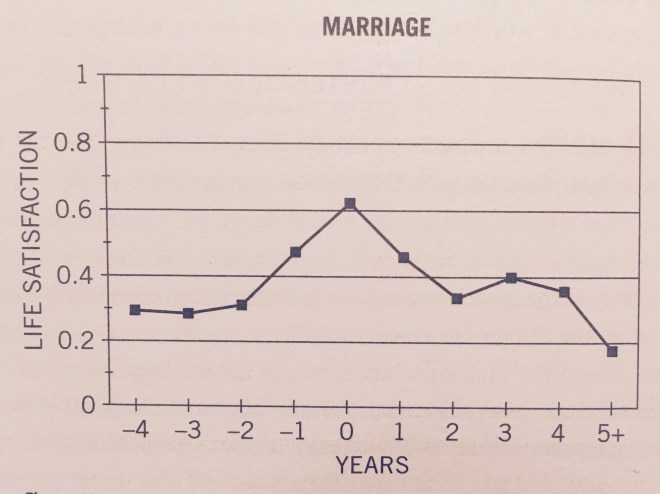
“People who recently married, or are expecting to marry in the near future, are likely to retrieve that fact when asked a general question about their life. Because marriage is almost always voluntary in the United States, almost everyone who is reminded of his or her recent or forthcoming marriage will be happy with the idea. Attention is the key to the puzzle.

what determines how happy you feel
People’s level of life satisfaction as a function of time surrounding their wedding. Source: “Thinking, Fast and Slow” by Daniel Kahneman, page 398

The figure shows an unusually high level of life satisfaction that lasts two or three years around the event of marriage. However, if this apparent surge reflects the time course of a heuristic for answering the question, there is little we can learn from it about either happiness or about the process of adaptation to marriage. We cannot infer from it that a tide of raised happiness lasts for several years and gradually recedes. Even people who are happy to be reminded of their marriage when asked a question about their life are not necessarily happier the rest of the time. Unless they think happy thoughts about their marriage during much of their day, it will not directly influence their happiness. Even newlyweds who are lucky enough to enjoy a state of happy preoccupation with their love will eventually return to earth, and their experienced well-being will again depend, as it does for the rest of us, on the environment and activities of the present moment.”

how to feel happy all the time anchoring bias
An nice and heavy anchor is Dun Laoghaire harbour, Dublin


Reason 2: Happiness is tied to an anchor bias

What is anchor bias?

Anchoring is a cognitive bias that describes the common human tendency to rely too heavily on the first piece of information offered (the “anchor”) when making decisions.

For example:

“If you are asked whether Gandhi was more than 114 years old when he died you will end up with a much higher estimate of his age at death than you would if the anchoring question referred to death at 35.”

My own tale is that the first “anchor” I’ve thrown was in 1990s Moscow.

I still pause nervously at the thought of the things I avoided. I was very shielded, yet the echo of the various brands of social unrest that surrounded me reached me enough to know I have to watch out. You know how your mother probably taught you to not speak to strangers and not get into a lift (elevator) with people you don’t know? Most of us use discretion with these rules and only put our guard up when something is tangibly “up”. I am used to using these rules verbatim. I still don’t speak to strangers unless I am in a crowded and well-lit place. I still move whenever someone sitting beside me is coughing a lot: you never know, it could be TB. Whenever I am in Moscow, to this day, I always have my guard up. It sounds sinister, but it’s not actually.

It is as if I am constantly anticipating that someone will try to swindle me in some minor way. In a queue, you well get skipped unless you’re paying attention. The florist will inevitably “accidentally” charge for a higher priced bouquet and reissue the invoice once questioned. The radiographer will forget to take the standing X-ray having taken the lying one unless you double check. It’s a mix of carelessness and minor fraud that arises from low wages in a cynically unequal society. This happens everywhere of course, but it is quite consistent in Moscow, or at least is was, in the very turbulent 1990s. You have to be very aware, prepared to stand up for yourself and presume the worst of people. I don’t enjoy being like that. Just to be clear, I don’t hate where I come from or have some sort of overly dramatic story. These are just observations.

Having this 1990s Moscow “anchor”, most places I go to remind me of the pages of a fairy tale book. I may be exaggerating a little, but that’s the crux of the emotion I feel every day. Every day someone is polite to me, I remember that it wouldn’t have been like that back in the proverbial old country.

Whenever things happen without me having to double check that everyone has done their job, I automatically get this wave of bliss, gratitude and a sense of that concrete happiness. It’s like drinking water after a 10 K run. It’s like escaping capture by an enemy.

Why? Because I am anchored to believe that things going smoothly isn’t the norm. Elaborating on Ray Dalio’s formula,

Happiness = reality – expectation (regarding a given event or change in circumstances).

The specific anchor I have is quite low down in the expectation ocean, so happiness is often a positive value. Does it mean I actually have low expectations and take sh*t from people? Somehow it doesn’t. It just makes it easier to be happy. The fact that this isn’t just some idea, but an actual anchor I have been fortunate enough to form makes me see everything though that filter. Biases aren’t always bad.

If I had been reading, not writing this, I would probably think: here goes, be grateful, bla bla, game your mind until you feel happy even though you shouldn’t really. It doesn’t feel like I am forcing this at all. It’s a lucky idiosyncrasy. Can it be extrapolated to other things? So that we can feel happy more effortlessly? Very soon an overzealous extrapolation approach turns into “there are children starving in <remote location>, so you have to value what you have”, which inevitably causes resentment and a feeling of pointless self-fraud over time.

The point is that looking back at our own anchors  and expectations (not those of deprived children in a less-developed country) can help to explain how happy or unhappy we feel.

Understanding that happiness is only achieved through change, it helps to think of our lives as a continuum of present moments rather than an efficient emotionless journey from A to B, where B is full of yummy dopamine***.  It is just another way to understand the context, gain perspective or whatever other fancy term you may want to use for all those things hidden in plain sight.

In short, happiness is fundamentally decided by:

  • presence of change (real or perceived)
  • expectations

It’s also affected by temperament (e.g. the weight one attaches to negative events) and genetics – and I will talk about this another day.

 * A gentleman who comments in English, but blogs in Polish here.

** Procrastination is an avoidance behaviour, but it does make us happy in a short term concrete way. I believe it makes us happy using the same mechanism as learning, though on balance, of course, it is a saboteur.

*** Actually, it is the anticipation of B that releases the dopamine.

A downward facing doc explains the brain wiring behind mindfulness

Do you ever just wish you could get someone who knows virtually everything that’s known about the brain and quiz them about mindfulness? Well, I do – a lot – and I just got my wish!

It is my pleasure to present this interview with John McBurney MD. A practicing physician with of over 35 years’ experience, he is board certified in Neurology, Clinical Neurophysiology and Sleep Medicine. He holds an Integrative Medicine Fellowship… The list of his professional accomplishments is obscenely impressive, so I will jump to the bit we all really want to know about: Dr. McBurney maintains a daily mindfulness meditation practice as well as home yoga practice, hence the downward facing bit. Needless to say, I was beyond curious to find out his understanding of how mindfulness affects the brain.

For those of us who are put off by the mystical connotations that surround mindfulness, could you take us back to a schematic, reflex-arc type view of the process and describe the neurological response to mindfulness practice?

I think that the issue of mindfulness intersect with the leading-edge of neuroscience. It is supported by extraordinarily robust data. This area of study has been termed contemplative neuroscience. The Mind and Life Institute which is an outgrowth of the dialogues between the neuroscience community and the Dalai Llama  is an important sponsor of research and education on contemplative neuroscience. It ultimately comes down to the concept of neuroplasticity.

Donald O. Hebb coined the doctrine: “neurons that fire together, wire together”. It was an extension of the work done by an American philosopher and psychologist William James in the early XX century. You can practice “bad” things or “good” things – and neuronal ensembles form accordingly. In mindfulness, we are essentially practicing good things.

There is a resting ensemble of neural networks called the default mode network that was discovered using fMRI studies where individuals were asked to lay in the scanner and think of nothing in particular. This kind of mindless mental activity is accompanied by a lot of  self-referential ruminative recursive thoughts that are subserved by brain regions that lie along the midline, especially the prominent in medial parietal lobe. Those types of internal mental states that are remarkably robust and persist under deep general anaesthesia and even in a coma and are probably the neural basis for the self.

The more outward facing parts of the brain – like the dorsolateral prefrontal cortex – are more responsible for an outward orientation to the world have top down executive influence on the activation of those networks.

In mindfulness, in cultivating awareness of the breath and voluntary moment by moment awareness of the brain, we are training the brain – just like when you are learning to play the violin or any other complex skill – we are training to break out of those self-referential ruminative recursive mental states and to achieve an orientation toward the outer world and in the present moment rather than anticipating the future or reliving the past.

contemplative neuroscience mechanisms behind mindfulness

There is evidence that mindfulness leads to weaker connections in default mode network. Could we be losing something by focusing more on the external realities rather than the self?

Not everyone has a well formed default mode network. People who have been subjected to severe developmental trauma, neglect and lack secure attachment do not have robust default mode networks. Mindfulness can lower defence mechanisms that are there with good reason. However, most people with a well formed default mode network and secure attachment. We are “taming an elephant”: there is very little chance that we will significantly weaken the elephant.

Occasionally, we do hear of adverse experiences arising from mindfulness. With any robust intervention there are always potential risks.

How long does it take for mindfulness to have a manifest effect?

The results can happen almost immediately, however, they are also cumulative. We are still figuring out what the minimum effective dose it. This reminds me of the discussion of the minimum effective dose of aspirin in stroke and heart attack prevention. When I was a resident, we were advising patients to take two 325 mg tablets twice a day. Over time this dropped to 81 mg of aspirin a day. There is speculation that the required dose may even be lower.

There is a study that defines a new marker. The original fMRI/EEG studies were done by Richard Davidson in Tibetan Buddhist meditators with over 10,000 hours of meditation. This number is somewhat arbitrary and refers to this idea that is the number of hours to become an expert at anything. However, the question arises: what is the relevance of the changes in functional connectivity in the brain in someone who has devoted such a monumental amount of time to meditation to the likes of you and me?

A very neat study was published by David Cresswell in Biological Psychiatry in 2016. They invited individuals with high level of stress, unemployed adults, to a weekend retreat experience. They were randomised to in 2 groups:

  • a 3 day mindfulness retreat (the treatment group) and
  • a 3 day relaxation retreat where they read stories, told jokes and had a good time (the control group).

The study was conducted in one centre over one weekend, so it is well controlled. Initially, both groups rated the interventions as being equally helpful to them, subjectively.

The researchers looked at the functional connectivity between the dorsolateral prefrontal cortex and the cingulate gyrus. They also looked at Interleukin-6, a known marker of inflammation, that has been previously shown to be elevated in stressed out unemployed people.

Even with this brief weekend mindfulness intervention, the treatment group developed increased connectivity between the dorsolateral prefrontal cortex and the cyngulate gyrus. There was a neuroplastic response even after a 3 day mindfulness retreat. This was also associated with a decrease in the marker IL-6. Even after 4 months, IL-6 was decreased in the treatment group, but in the control group, IL-6 levels continued to rise, independent of whether they managed to get a job or not.

This is also relevant to doctors, who are at high risk for burnout. Because of their work commitments, the mindfulness retreat for doctors was condensed from the standard 8 week model developed by John Kabat-Zinn to a weekend intervention. The question was: does the weekend model work? The research at the University of Wisconsin where this was developed was reassuring: the residents are less stressed out, more effective and have a greater level of satisfaction.

We still don’t know the absolute minimum dose, but it seems that a weekend of mindfulness can be life-changing for the brain.

Another paper published in PLOS ONE from the Benson-Henry Institute for Mind Body Medicine in Harvard looked at the practices such as meditation, prayer, mindful yoga, Tai-Chi, Qi Gong, etc, i.e. ones that elicit a relaxation response (as opposed the stress response).

This study showed that in both novice and experienced practitioners of relaxation response modalities, there were changes in the epigenetic transcription of the genome. There was upregulation of pathways associated with mitochondrial integrity, downregulation of inflammatory pathways, improved insulin-related metabolism and improved nitric oxide signalling.

Long term potentiation, the standard mechanism for memory formation, strengthens existing neural connections. This happens immediately, as you read this. Over time, long term potentiation leads to formation of new connections,through synaptogenesis, dendritic arborisation and neurogenesis i.e. brain structure changes. In turn, this affects the most neuroplastic neurons located in the hippocampus.

mindfulness minimum effective dose response neurology

In reference to this fascinating recent study of the fight or flight response, it seems plausible that breathing regulates our stress levels much more than conscious thought. Could you explain the significance of this in terms of mindfulness?

The ancients believed that emotions reside in the body. This comes up a lot in serious yoga classes.

This highly innovative study shows that the control of the adrenal medulla – the main effector of the stress response – is not from the conscious ruminating thinking centres, but by the motor and sensory cortex.

This explains why breathing, as well as yoga and Tai-Chi, are an important part of meditative practice. In my experience, these kind of interventions do affect the stress response in a beneficial way.

Mindful exercise exists in many form. For example, weightlifters need to be very mindful to maintain perfect form. Cycling is another example: it is vital to concentrate on every pedal stroke and maintain an even cadence. Once you start to day dream, you notice straight away that your output is way worse. This overlaps with the concept of flow. It is about getting in the zone. There is a very inspiring TED talk by Judson Brewer MD, Ph.D. that explains the physiology behind flow and how it is augmented by mindfulness. Mindfulness is work, and it does require discipline. There is a paradox here of non-striving and non-doing while also being disciplined.

You are a sleep medicine expert. Could you comment on the relationship between mindfulness and sleep?

Insomnia is a complex problem with many causes. However, for most people with idiopathic insomnia, the cause it these self-referential recursive ruminations. They aren’t able to “turn their brain off”. Through mindfulness practice, they are generally able to tame the default mode network that’s responsible for ruminating and daydreaming. A simple strategy would be to lie in bed and concentrate on the breath. This would ease the transition between wakefulness and sleep.

mindfulness default mode network neurological basis for the self

Mindfulness is a mainstay treatment for many mental health disorders. What about use of mindfulness in the treatment for organic pathology of the brain usually treated by neurologists?

There is some preliminary data that mindfulness training has a beneficial effect of seizure frequency in patients with epilepsy. It is a medical condition associated with tremendous anxiety and stress, so mindfulness could have a significant benefit in more than one way. It may even have a benefit it terms of remembering to take medication on time, etc.

Some robust studies show that the frequency of relapse in multiple sclerosis decreases with mindfulness intervention. The effect from mindfulness is similar in magnitude to the effect from beta-interferon. There is also some research showing that the frequency of inflamed Gadolinuim-enhancing lesions decreases with mindfulness.

John Kabat-Zinn used to take the patients who suffered from chronic pain or had diseases for which we had no answer, and those patients got better. Even beyond neurology, there is some evidence that mindfulness can have benefits in psoriasis. We are probably only at the bottom of this mountain.

Dr McBurney is a board member of Mindful Medicine. It is a non-profit organisation that focuses on teaching mindfulness to health professionals using retreats. He is founder of McBurney Integrative Neurology and is a clinical assistant professor at the University of New Mexico School of Medicine. Dr. McBurney is a native of Alabama and a graduate of Auburn University and the Emory University School of Medicine. He completed his neurology residency and EEG/Epilepsy fellowship at Walter Reed Army Medical Center.  In 2014 he completed the Integrative Medicine Fellowship at the University of Arizona Center for Integrative Medicine.

Dr McBurney has given me so much to think about. I will follow up with part 2 of our discussion that focuses more on the philosophical and life experience aspects of mindfulness once I wrap my head around it.

neurological path mindfulness default mode network adrenal medulla

What psychiatrists think of Donald Trump

It is considered unethical and unprofessional for psychiatrists to hand out opinions about public personalities from afar. This rule was broken recently, with regards to, of course, Donald Trump.

Letter to the editor

A letter to the editor in The New York times, signed by Lance Dodes, an addiction psychiatrist, former Harvard assistant professor (and 34 other professionals) on the 13th Feb 2017 stated:

“Silence from the country’s mental health organizations has been due to a self-imposed dictum about evaluating public figures (the American Psychiatric Association’s 1973 Goldwater Rule). But this silence has resulted in a failure to lend our expertise to worried journalists and members of Congress at this critical time. We fear that too much is at stake to be silent any longer.”

“Mr. Trump’s speech and actions demonstrate an inability to tolerate views different from his own, leading to rage reactions. His words and behavior suggest a profound inability to empathize. Individuals with these traits distort reality to suit their psychological state, attacking facts and those who convey them (journalists, scientists).”

“In a powerful leader, these attacks are likely to increase, as his personal myth of greatness appears to be confirmed. We believe that the grave emotional instability indicated by Mr. Trump’s speech and actions makes him incapable of serving safely as president.”

A strongly-worded response to the letter

A pretty badass response came in the next day, 14th Feb 2017: a follow-up letter to the editor from Allen Francis, who wrote much of the DSM IV, including the diagnostic criteria for Narcissistic Personality Disorder. Much as the DSM IV has its flaws, this guy is really on point, in my more than humble opinion:

Most amateur diagnosticians have mislabeled President Trump with the diagnosis of narcissistic personality disorder. I wrote the criteria that define this disorder, and Mr. Trump doesn’t meet them. He may be a world-class narcissist, but this doesn’t make him mentally ill, because he does not suffer from the distress and impairment required to diagnose mental disorder.”

“It is a stigmatizing insult to the mentally ill (who are mostly well behaved and well meaning) to be lumped with Mr. Trump (who is neither).”

“Bad behavior is rarely a sign of mental illness, and the mentally ill behave badly only rarely. Psychiatric name-calling is a misguided way of countering Mr. Trump’s attack on democracy. He can, and should, be appropriately denounced for his ignorance, incompetence, impulsivity and pursuit of dictatorial powers.”

His psychological motivations are too obvious to be interesting, and analyzing them will not halt his headlong power grab. The antidote to a dystopic Trumpean dark age is political, not psychological.”

Should psychiatrists stay silent?

Looking down from her moral high ground on the 2 lads in a newspaper fight is the president of the American Psychiatric Association, Maria A Oquendo, who pointed out that while she could understand the desire to “get inside the mind” of a presidential candidate, having psychiatrists comment publicly about people they have not examined threatens to erode the public’s confidence in the profession.

“Simply put, breaking the Goldwater rule is irresponsible, potentially stigmatizing, and definitely unethical,” she wrote.

As for me, I believe that, psychiatrists shouldn’t be analysing living political figures – as psychiatrists. As people with opinions, however, I feel they should be heard – just like anyone else. They also happen to be very good at analysing people’s behaviour. It is up to the reader to understand that this is not an excerpt from Trump’s personal medical files, instead it is just another opinion made legitimate by our commitment to free speech.

What is this psychiatric condition they are debating about?

Narcissistic personality disorder is a mental disorder in which people have an inflated sense of their own importance, a deep need for admiration and a lack of empathy for others. But behind this mask of ultraconfidence lies a fragile self-esteem that’s vulnerable to the slightest criticism. For those of you not familiar with the DSM, it is a (the?) diagnostic guide for psychiatrists. We are currently of the 5th edition. Here are the criteria for NPD:

The essential features of a personality disorder are impairments in personality (self and interpersonal) functioning and the presence of pathological personality traits. To diagnose narcissistic personality disorder, the following criteria must be met:

A. Significant impairments in personality functioning manifest by:

1. Impairments in self functioning (a or b):

a. Identity: Excessive reference to others for self-definition and self-esteem regulation; exaggerated self-appraisal may be inflated or deflated, or vacillate between extremes; emotional regulation mirrors fluctuations in self-esteem.

b. Self-direction: Goal-setting is based on gaining approval from others; personal standards are unreasonably high in order to see oneself as exceptional, or too low based on a sense of entitlement; often unaware of own motivations.

AND

2. Impairments in interpersonal functioning (a or b):

a. Empathy: Impaired ability to recognize or identify with the feelings and needs of others; excessively attuned to reactions of others, but only if perceived as relevant to self; over- or underestimate of own effect on others.

b. Intimacy: Relationships largely superficial and exist to serve self-esteem regulation; mutuality constrained by little genuine interest in others‟ experiences and predominance of a need for personal gain

B. Pathological personality traits in the following domain:

1. Antagonism, characterized by:

a. Grandiosity: Feelings of entitlement, either overt or covert; self-centeredness; firmly holding to the belief that one is better than others; condescending toward others.

b. Attention seeking: Excessive attempts to attract and be the focus of the attention of others; admiration seeking.

C. The impairments in personality functioning and the individual‟s personality trait expression are relatively stable across time and consistent across situations.

D. The impairments in personality functioning and the individual‟s personality trait expression are not better understood as normative for the individual‟s developmental stage or socio-cultural environment.

E. The impairments in personality functioning and the individual‟s personality trait expression are not solely due to the direct physiological effects of a substance (e.g., a drug of abuse, medication) or a general medical condition (e.g., severe head trauma).

Friday’s 5 cognitive curiosities journal club

A weekly trail mix of thought-provoking essays and research.

1. I Asked a Psychopath How to Stop Caring About Rejection

From Vice

This brilliant article summarises the feelings of a psychopath with insight. I think is a valuable approach as instead of demonising people with psychopathy, it is better to understand:

  • With rejection, I always ask myself “why did this happen?” I never ask “why am I not worthy?” When I get rejected I feel bad for like negative-two seconds. It’s just, oh how do I fix it?
  • Everything for me is a percentage. For example if I think something’s against me at about 20:1, I’ll put in 20 different proposals or versions to make sure I get what I want. Doing that trains your expectations too. If your chances are 20:1 and you only put in one attempt, then you can’t get upset if it doesn’t work.

2. New research finds that dopamine is involved in human bonding

From Proceedings of the National Academy of Sciences

“We found that social affiliation is a potent stimulator of dopamine,” says Barrett. “This link implies that strong social relationships have the potential to improve your outcome if you have a disease, such as depression, where dopamine is compromised. We already know that people deal with illness better when they have a strong social network. What our study suggests is that caring for others, not just receiving caring, may have the ability to increase your dopamine levels.”

3. The reasons behind right- and left-handedness revealed

From eLife

Epigenetic factors appear to be at the root of it, reflecting environmental influences. Those influences might, for example, lead to enzymes bonding methyl groups to the DNA, which in turn would affect and minimise the reading of genes. As this occurs to a different extent in the left and the right spinal cord, there is a difference to the activity of genes on both sides.

Unlike other forms of caregiving, the act of mothers singing to infants is a universal behaviour that seemingly withstands the test of time.

4. Infant brains engage through song

From University of Miami

“High cognitive scores during infant-directed singing suggested that engagement through song is just as effective as book reading or toy play in maintaining infant attention, and far more effective than listening to recorded music.”

“Mothers around the world sing to their infants in remarkably similar ways, and infants prefer these specialised songs. The tempo and key certainly don’t need to be perfect or professional for mothers and infants to interact through song. In fact, infants may be drawn to the personalised tempo and pitch of their mother, which encourage them to direct their gaze toward and ultimately communicate through this gaze.”

5. Use it or lose it: how the brain chooses what memories to store

From eLife

“This goes some way to answering the long-standing question of whether the formation of generalised memory is simply a result of the brain’s network ‘forgetting’ incidental features,” Morrissey explains. “On the contrary, we show that groups of neurons develop coding to store shared information from different experiences while, seemingly independently, losing selectivity for irrelevant details.”

Have a lovely weekend everyone!


Five philosophical myths about mindfulness that are sabotaging your practice

From a useful superstition with medical benefits to a deeply spiritual practice, mindfulness has seen a variety of labels. Together with Nguyên Giác, we put together a list of common misplaced attitudes towards mindfulness, so that you don’t sabotage your practice. [Watch video instead]

Mindfulness has become quite popular and seems to be gaining further momentum. It is set to soon be mainstream.

As is often the case with explosive popularity, there are some misconception and misinterpretations about mindfulness making the rounds among bloggers and on social media. 

1. Mindfulness is a Buddhist concept

It’s not uniquely Buddhist. Mindfulness has roots going back to Christianity. More that that: wherever humans have existed, they have discovered mindfulness. Many traditions poke around the mindfulness bush, some more directly than others. Why? Because mindfulness is healthy. It makes sense, evolutionarily. A mindful population will thrive. A population lacking mindfulness will have a hard time propagating the memes (Richard Dawkin’s meme, not the funny picture, meme.. although they are related) and genes that define its character.

Christianity has elements of mindfulness practice present in ritual and scriptural form (both within and outside of the canon).

There are a number of passages that obviously point to the practice of mindfulness, and there are many others that, when understood in context, point to mindfulness practice.

Whenever you have people that are practicing awareness of what they are doing in that moment, you have mindful people. When people know they are washing dishes, they are mindful dishwashers. Christians who are mindfully carrying candles, passing out bread and wine, and consciously delighting in each other’s company are Buddhist Christians – they are increasing awakeness in the world.

As Thich Nhat Hanh says,

“‘Buddhism is a practice. Like Yoga’. It is not a ‘religion’ in the way that Christianity is a religion. There are no gods. No required beliefs.. Nothing to take ‘on faith’.”

It is an open-handed teaching, hiding nothing, encouraging actual practice, letting you realise things without forcing it. The labels of “Buddhist” and “Christian” can be hindrances. It is nice to respect our spiritual ancestors, but it is foolish to isolate ourselves within the confines of some set of teachings. Old “maps” may not accurately represent the present territory.

Some people make the claim that there is an actual historical link between Jesus and Buddha. Indeed, there were Mahayana Monks in Egypt during Jesus’ lifetime. But, with or without the causal connection, Buddha/Gnosis is one – the message is the same. People can happen across the same spiritual truths in totally separate cultural contexts. The historical connection would be interesting and exciting, but it is not necessary.

So, in conclusion, there are some big chasms to cross as one journeys between world views, but if we look within we will find one human experience– we are unique, but we share common ground. It is beautiful. If we can learn to gently share our ideas with respect and give credit where credit is due, this era of history can be an amazing one.

Naturally, mindfulness occurs in religions other than Christianity and Buddhism, we shall try to address that another time.

myths and misconceptions about mindfulness
Sure, who wants an article on mindfulness without a picture of a woman meditating?

2. Mindfulness is about detachment and emptiness

Buddhist terminology also presents some problems for the Western Mind.

The translators of yore did not have the proper conceptual tools to work with the subtle ideas generated by Buddhist genius. And, still, people are hung up on ideas of “nonself”, “emptiness”, “detachment”, etc.

The Christian West has to do some serious psychic judo to make sense of these things without experiencing intense fear and trembling.

There are many potential points of conflict, but, let’s focus on non-self. Anatman. Anatta. No atman. This seems to have been one of the Buddha’s big ideas. There is no independently existing ego, or self-sustaining identity, anywhere in existence. All is dependent on all. Every square inch, square centimetre, every atom is as significant as the largest star. Look at “Indra’s Net”. It’s a nice way to visualise emptiness, or non-self: emptiness and non-self are the same idea. Interdependence is a better word. So when you read, “non-self”, “emptiness”, “voidness”, etc… just remember interdependence.

In the West, largely populated with traditional Christians, many have trouble with all this. There is this idea of “something out of nothing” that the Christian must accept in order to fall in line with dogma. It is totally illogical. Therefore, the Christian declares that faith is necessary. The question, “what was before the beginning?” will never be answered. Those who try to convince you that they have answered that question are liars or fools. Asserting that “God did it” is dangerous, the priests who make such assertions are “like dogs in the cattle manger, they can’t eat and they won’t let the cattle eat”. And, this is what Jesus is implying in the Gospel of Thomas when he encourages us to ignore those who claim to know “the way to heaven”.

On a more comforting note, the Jesus of the Gospel of Thomas also recognises this truth of non-self, which is very closely related to the truth of impermanence, another central Buddhist idea.

He also declares that all things that come together will fall apart. Everything will change.

Gospel of Thomas, 11:

Yeshua said / This heaven will pass away / and the one above it will pass away. / The dead are not alive / and the living will not die. / During the days when you ate what is dead / you made it alive. / When you are in the light, what will you do? / On the day when you were one / you became two. / But when you become two, what will you do?

Some people want to hide in their meditation halls, with their tibetan loving-kindness mantras – that’s fine… However, the Bodhisattva (the being tending toward awakening) engages the world and meets people where they are at. By helping others in real life, the Bodhisattva also develops her own Buddha Nature.

what we get wrong about mindfulness meditation

3. Mindfulness is part of the positive thinking / law of attraction world view

Many have come to view mindfulness as a close cousin of positive thinking. This is a misconception.

Mindfulness cultivates non-judgement – which the exact polar opposite of insisting on only ever dignifying positive thoughts with our attention.

A concept seemingly resonant with positive thinking/ law of attraction appears in the Dhammapada, one of the primary collections of teachings attributed to Siddhartha Gautama:

Mind precedes all mental states. Mind is their chief; they are all mind-wrought. If with an impure mind a person speaks or acts suffering follows him like the wheel that follows the foot of the ox.”

However, mindfulness emphasises the value of accepting things as they come.

Yes, we “create our own reality”, but we certainly don’t do it alone.

Reality is seen from a fundamentally different viewpoint in the philosophy underpinning mindfulness. The Bodhisattva does not proclaim that things are either positive, negative or neutral– Buddha abides “beyond good an evil” – beyond positive and negative and neutral.

In many Buddhist schools, there is this idea of the Five Skandhas. The Five Heaps. The Five Collections or Aggregates. Instead of a self-sustaining ego, Buddha spoke of these components – the Five Skandhas – that make up a personality.

The sensory experience, contact with sense objects through one of the sense doors (light / eye, sound / ear, chemical / taste and smell, pressure and heat / touch, thought / mind), is either positive, negative or neutral.

There is an event, and there is a knee-jerk reaction to it that is either good, bad, or not good or bad.

The Five Skandhas are empty”. They are interdependent. Sensation is just one of these heaps. Sensation depends on form, perception, mental formations, and consciousness. And – positive, negative and neutral are also empty!

There is no positive without negative or neutral, and the same is true for negative and neutral.

Our strength is not found in forcing reality to remain “positive”. We are considered accomplished because of the strength we have to endure the snaky shifting of Samsara. We endure the ups and downs, we remain in this mind system with these sentient beings, unperturbed by the positives and negatives and neutrals. We are beacons of peace and stability in this chaotic ocean.

4. Mindfulness is a natural remedy for anxiety

People want to talk about mindfulness like it’s some miracle pill. Despite what we so often hear, this practice of mindfulness is not always roses and cotton-candy. The practice of mindfulness may reveal things one has been been avoiding. This can be painful. This is the real work though! Learning to see clearly requires deep compassion for oneself and for all sentient beings. Gentleness can smooth over those scratchy rough spots.

Mindfulness meditation is work, but it is healthy, soothing work.

New things will be noticed. New things can cause fear. If new things aren’t being noticed, if fear isn’t arising, it is probably a good idea to refocus the practice. But how?

The goal is not to be rid of negative emotions.

Mindfulness meditation teaches us to put harsh feelings into context and not become totally overwhelmed by their presence. The goal is not to become a tranquil yuppy – it is to become present, aware and in touch with actual bold faced reality.

Yes, there are benefits. Mental and physical health benefits.

Breathing meditation can bring calm. “Negative” feelings can also arise – they are as real as “positive” feelings.

During practice, all of these arising positive and negative thoughts are gently touched – and like the fragile bubbles they are, they pop. It is not difficult. There is no strain. However, it is work. Perfectly paradoxical.

You may also like: Mindfulness is pointless – and that’s the point

what we misunderstand about mindfulness

5. Mindfulness is a medical treatment

Here in the West, the main drive for the explosion of mindfulness practice seems to be coming from the medical community. This is awesome. As always, medicalising normal processes is dangerous. It is especially common these days when people look to science for answers – rather than to religion. However, difficulty arises when science, which is much more about questions than it is about answers, becomes scientism, or high priests with Ph.D.’s handing out evidence-based dogma.

There is a lot of cultural appropriation going on around here. Doctors are not far off taking credit for practices that have already been employed for thousands of years. On the surface, this is all fine and dandy, but looking deeper we can see that it’s part of a larger pattern. We Westerners have not been so kind to our friends around the world. We take and take and take. The practice of mindfulness cannot be “owned”, but it seems to me that we should be giving more credit to it’s Eastern roots. Indeed, those roots extend beyond the Buddhist tradition. There are things to be learned from the cultures that have grown up with these practices.

Instead, it looks to me like as Westerners, we are trying to distill the “useful” practices from what we consider to be “superstition”.

Our sciences are constantly revealing a stranger and stranger reality. We would do well to hold our verdicts on what is and is not superstition.

philosophical misconceptions about meditation mindfulness

Four reasons why daydreams scare off mindfulness

Complex problems have simple easy to understand wrong answers.

Henry Louis Mencken

I have recently been very interested in what it is that makes mindfulness feel quite difficult at times.

Up to 96% of adults daydream every day.

I am using the term daydreaming in the broadest possible way. There are ways in which it is positive (visualisation, rehearsal, creativity), but we all know that it can get out of hand very easily.  These so called self-generated thoughts (SGTs) interfere with external task performance and can signal unhappiness and even mental health issues. They also occupy our thoughts for upwards of half of the time. In appropriate contexts, SGTs

  • allow us to connect our past and future selves together,
  • help us make successful long-term plans and
  • can provide a source of creative inspiration.

Given the time dedicated to the task, it seems natural to suggest that there must be an evolutionary advantage to being preoccupied with a daydream.

Contrary to the mindfulness rhetoric, daydreams can be seen as a mechanism for the consciousness gain freedom from the here and now – reflecting a key evolutionary adaptation for the mind.

There is evidence that  SGTs are normal and may even be beneficial, so our natural inclination  to dismiss mind-wandering – and recent odes to the benefits mindfulness – are perhaps oversimplifying the problem.

mindfulness slipping into daydream

For the moment, however, I will focus on the negative aspects of daydreaming.  In 2016, the Journal of Conscious Cognition did a study on self-identified “maladaptive daydreamers”. These guys had more daydreams that involved fictional characters and elaborate plots and spent 56% of their waking hours fantasising.

Maladaptive daydreaming caused significant distress to the affected and was associated with higher rates of ADHD and OCD.

Another study echoed the findings and showed that the daydreams were typified by complex fantasised mental scenarios that were often laced with emotionally compensatory themes involving competency, social recognition, and support.

Of note, solitude is required for elaborate daydreams – worsening any existing social dysfunction.

Mind-wandering is situations when attention is required is obviously negative: it can signify performance disruptions, cognitive problems, risk taking or low motivation to perform a task. At the same time, the question arises: how do we define a situation that requires attention?  The resolution here is obvious. The capacity to regulate the occurrence of SGTs so as to reduce the risk of derailing on-going task performance is a marker of properly functioning, well-adjusted cognition. It is context-dependent – and requires self-awareness. Indeed, a brain trained with the practice of mindfulness would seem better equipped to recognise appropriate situations and adapt more quickly.

On a more philosophical note, however, what’s to say one isn’t missing out on some important unknown unknown in an apparent “safe-to-daydream zone”?

Based on some research and a preliminary Twitter poll, I have come up with 4 main feelings that trigger daydreams.  If none of the four describe what it is like for you, please do comment, I am very keen to find out!

maladaptiveday dreaming mindfulness