Why Christ was a carpenter

The wonderful Pink Agendist recently introduced Jordan Peterson by quoting this:

“Haven’t heard of Jordan Peterson?

Take one part Carl Jung, one part Solzhenitsyn, one part Kermit the Frog, and one part St. Augustine. Put all this in a conceptual blender”.

While I don’t particularly like any of those ingredients, just like a Negroni, Peterson turned out to be more than the sum of his parts and just fabulous in small quantities.

He is quite right-wing compared to what I am used to. He explains the plight of young women and why they don’t “move up the corporate ladder” extremely well here. He made an interesting point: that status is more important for men compared to women because it’s the main criterion on which women judge men. This almost certainly applies in many animal societies where the winner takes all, but I am not so sure it applies with us. I think that when it comes to forming serious relationships, men require a woman to have a CV comparable to theirs, a family background comparable to theirs, etc. A man’s infatuation is unlikely to override these more prosaic factors. Herein probably also lies the real answer to “why he lost interest”: his interest was in a woman’s superficial qualities and burnt out pretty quickly as it should, while her underlying “status” wasn’t attractive enough to sustain more long-term interest. It’s less psychopathic than it sounds as it is simply based on common interests.

His advice for hyper-intellectual people is refreshing. He explains how you can be utterly unwise and even useless with an IQ of 160. It’s good for the ubereducated millenial to listen to this in a world where intelligence is pretty glorified. Peterson’s ideas are very reminiscent of Taleb’s “intellectual yet idiot”, “skin in the game” stuff.

Peterson takes a literary critic type approach to the Bible. He says that Jesus Christ was a carpenter because there is a certain honesty in a carpenter’s work: it falls down if it isn’t made well, so there is less BS-vending and more doing. Furthermore, Jesus has moral superiority without having a Ph.D. and a New York Times best-seller, so the lesson is that you don’t have to be “intelligent” to be effective.

His book, Maps of Meaning, seems to be of interest. Here is the PDF available free via his website (nice touch). Any reviews? To me, he sounds like a dilettante, albeit with a professor title. I suppose if you are popularising stuff, it’s hard to sound any different.

Some of Peterson’s videos though reek of the usual quasi-scientific verging on self-helpy aspects of psychology (one of his books is called 12 Rules for Life. Hmm.) Some of his political views seems to be sensationalist. He’s even been featured on Oprah, but still, interesting presence.

I found his list of recommended books pretty good though:

1. Brave New World – Aldous Huxley

2. 1984 – George Orwell

3. Road To Wigan Pier – George Orwell

4. Crime And Punishment – Fyodor Dostoevsky

5. Demons – Fyodor Dostoevsky

6. Beyond Good And Evil – Friedrich Nietzsche

7. Ordinary Men – Christopher Browning

8. The Painted Bird – Jerzy Kosinski

9. The Rape of Nanking – Iris Chang

10. Gulag Archipelago (Vol. 1Vol. 2, & Vol. 3) – Aleksandr Solzhenitsyn

11. Man’s Search for Meaning – Viktor Frankl

12. Modern Man in Search of A Soul – Carl Jung

13. Maps Of Meaning: The Architecture of Belief – Jordan B. Peterson

14. A History of Religious Ideas (Vol. 1Vol. 2Vol. 3) – Mircea Eliade

15. Affective Neuroscience – Jaak Panksepp

Hear vs listen

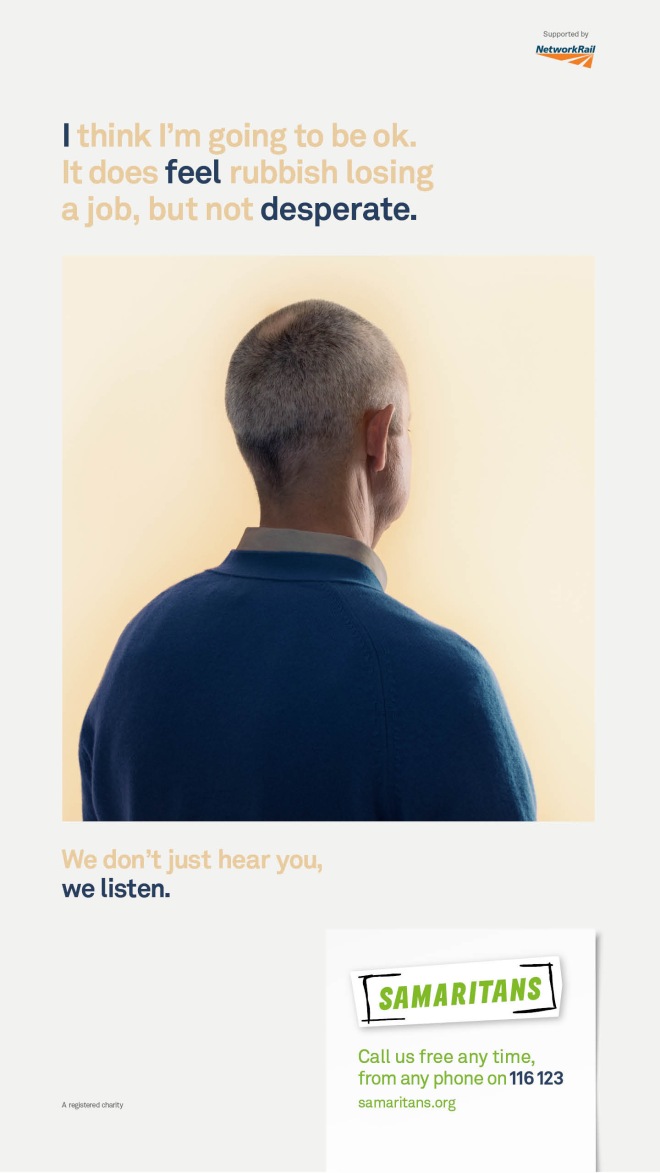
I noticed new Samaritans posters today at a train station:
hear vs listen samaritans campaign
samaritans campaign hear vs listen

A general stickler and former editor, I immediately caught on to the peculiar language.

To me, listening just means perceiving sound, albeit attentively. Hearing means taking it in. And, hearing = listening + understanding.

I don’t think the dictionaries (Oxford) agree with me:

hear

hɪə/
verb
perceive with the ear the sound made by (someone or something)


listen

ˈlɪs(ə)n/
verb

give one’s attention to a sound

My one argument is that the verb listen can be used in the continuous, whereas hear is more perfect:

“I hear you”

means I understand the emotion you are trying to convey – in millennial English.


“I am listening to you”

means I will take in all these sounds you make, but there is no guarantee it will make sense to me.

Thoughts?
You may listen to Linkin Park, but then you hear the news…
I guess the reason it registered on my radar was the poor Chester Bennington. Another high profile suicide, another wave of suicides that will follow. Take care of yourself.

Emotions as the meaning of life

And so we continue our search for the meaning of life. Robert Solomon’s The Passions offered an interesting take on this question. He proposed the idea that emotions are the meaning of life: as in they add the meaning in a life; emotions add meaning to our experience the world.

When I first came across this idea, I thought it was strange, but really it does make sense. Emotions have a strong effect of perception. Perception heavily influences our understanding of reality and thus has an impact on the meaning we attribute to things, life itself being one of those things.

Emotions are probably the strongest mental phenomena, built of thoughts and feelings – and very importantly, ultimately resulting in action, as the name suggests. Emotions are the driver of behaviour. My entrepreneurial soul was quite impressed when I heard that every sale is a promise of a future state. Emotions rule us, so we may try to be a little bit more aware – and perhaps less disrespectful to them.

Solomon argues that emotions are judgements rather than plain feelings arising from bodily reactions. Emotions tells us whether something matters – or is meaningful. Solomon also argues that emotions are in a sense chosen, sort of along the lines of stoic philosophy. As with beliefs, emotional judgements are often unintentional and unconscious, but we are still responsible for evaluating and changing them if that’s warranted.


According to Matthew Ratcliffe, Solomon sees emotions as the ‘meaning of life’, in the sense that they are a precondition for the intelligibility of all our goal-directed activities. If no actual or possible states of affairs were ever judged by us to be preferable to any other, we would have no grounds for action. Without emotions, we could have no projects, nothing to strive for, no sense of anything as worth doing:

“I suggest that emotions are the meaning of life. It is because we are moved, because we feel, that life has a meaning. The passionate life, not the dispassionate life of pure reason, is the meaningful life.”

emotions are the meaning of life robert solomon
Everything looks better in the sun

As someone who has spent some time studying emotions, I occasionally hold out hope that one day science succeeds in transcending the prism of bias and emotion and we are able to see the world without the emotional projections. Being that little bit pragmatic though – and seeing people like N. Taleb do it, I realise that we have to give up on overintellectualising and accept our limitations – or rather break up with our illusion that we are so above our lowly emotions.

The interesting thing about Solomon’s writing is that he emphasises the existential aspect of emotions: this our experience of being present.

The other interesting aspect is how neuroplasticity affects our perception: any time we experience an emotion a certain pathway gets potentiated and the next time we perceive similar inputs, the fact that we experienced an emotion relating to it previously will have changed the way we see the world. There is positive feedback here.

Neuroplasticity affects everything, but a lot of it is mediated through emotion. My personal working theory is that the meaning of life is the impact that you have (appreciating that that’s very vague, but the point here is that it’s different to the en vogue “the meaning of life is happiness”). But how do I decide what is full of impact? I need to feel that it has meaning. The exact values I consider to be full of impact may in theory be independent of emotion, but in reality they are completely affected by emotion. That warm feeling of satisfaction and accomplishment has to flow through me to know that what I am doing is meaningful. I usually only arrive there through what would look to an outside person as a silent CBT session with myself, so it isn’t entirely detached from intellectualising, but it has to feel right in order for me to know that it is right.

What if I do find something meaningful? It is going to invoke strong emotions. The common denominator of meaning does seem to be emotion.

Solomon drew a lot of Martin Heidegger’s concepts of mood. Mood is probably a more more precise word for what Solomon was talking about. The weather (emotion) matters less than the climate (mood) when we decide on the meaning of things around us. Our moods probably invoke the exact brands of biases and focuses of those biases that will allow us then to form our ideas on the meaning of what we see. Heidegger has an interesting definition for mood: it is a background sense of belonging to a meaningful world. That’s kind of like saying that I, as an object, have a relationship with all these other objects and I am trying to evaluate the condition of that relationship. “Sun’s out, so everything is good” or “Nobody is replying to my emails, so I feel like sh*t”. This certainly describes my mood a lot of the time, but then I slap myself and go back to a more Stoic/Nietzschean attitude to evaluating my own actions rather than the world’s response to me.

Reality is real no matter how we perceive it, but meaning is pretty personal.

P. S. I wrote a Haiku while sitting on a beach in Dublin:

An old dog,
once black, now wiser,
at sunset.

Here is the culprit:

robert solomon the passions emotions as meaning of life

P. P. S. I also drew something mighty odd. Feel free to indulge in the madness mindfulness and colour it in.

mindfulness-colouring-for-adults-psychedelic-seagull-snail-hand-drawn

Download PDF: psychedelic seagull with snail beak

Ok, very last thing. If you liked this, you may also like Footnotes to Plato, specifically a post on the why one would develop a philosophy in life.

Happiness research: everything useful we’ve managed to gather so far

“Those who live under the self-imposed pressure to be optimal in their enjoyment of things suffer a measure of distress” – Nassim Nicholas Taleb

Is that because those who put try to optimise for happiness are miserable to begin with – or because optimising is a curse?

Happiness seems to be on everyone’s mind.

Yes, we’re on a quest to be happier and we’re trying to game the system.

No, it may not actually be helpful to overall happiness, who knows.

I decided that I will start this post as my one stop shop for all the quality neuroscience on happiness. I am sure it will be elaborated on, but so far, here is what we all have to know.

Lottery winners aren’t happier right now

Back in 1978, Philip Brickman published a study that has since been replicated many times. Its finding are so significant that if I had my way, it would be on the school curriculum. It’s a deeply unsettling study on many levels, yet it is so fundamental for anyone who has an interest in understand how human beings function.

They had three types of people:

  • those who recently won a lottery
  • those who recently lost the ability to move their legs
  • those who haven’t had any major life events recently

The researchers gathered the happiness ratings for the above groups. The main lesson is that there was no statistically significant difference between the the lottery winners and the control groups in terms of their present happiness.

The accident victims were less presently happy than the controls, but their ideas of their future happiness weren’t significantly different.

Daniel Kahneman described further insights into “What proportion of the day do paraplegics spend in a bad mood?” His answer appears to be that over time, people’s attention is drawn away from the negative change. Exceptions include exposure to loud noise, pain and severe depression.

It seems that the strongest emotions of the winners were also quite short-lived:

“Both contrast and habituation will operate to prevent the winning of a fortune from elevating happiness as much as might be expected. Contrast with the peak experience of winning should lessen the impact of ordinary pleasures, while habituation should eventually reduce the value of new pleasures made possible by winning.”

We spoke about happiness being affected by expectations as well as reality. This research shows that the brain is quite adaptable in terms of expectations.

The scary thing about this research is that it attacks the fundamentals of our culture. When the prince rescues us from the tower or the princess breaks the curse by kissing us (underline as required), after a while, we won’t feel much different than we did before. In general, things may be different, but they probably won’t feel different unless you actively pay attention.

So what’s the point of chasing after achievements if they won’t make you happy? Well, I wouldn’t put it quite like that. They will make you happy every time you think of them: which for most of us isn’t that often. They are meaningful (well, I assume they are meaningful) regardless of how much dopamine they fill you with. So don’t give up just yet.

This brings me to my next point, that happiness is less dependent on reality than it is on constant, internal factors.

Long-term happiness is on a thermostat

There is beautiful symmetry in the brain as it relates to happiness – or at least I ill simplify things to look this way for our purposes today.

The right prefrontal cortex is associated with anxiety, anger and unhappiness.

The left prefrontal cortex, it seems, is active among people who report high levels of happiness.

Measuring the ratio of right to left prefrontal cortex activity is predictive of a person’s happiness level. That’t it. That’s your level of happiness.

So are we doomed? Is this it? Our happiness level is set and that’s it? Thankfully, no. The most effective answer is… drumroll… mindfulness training.

Daniel Goleman has written about Richard Davidson’s research for The New York Times if you want more detail.

how-do-i-feel-happier-in-life

Money is somewhat related to happiness still

So does this mean money has no bearing on happiness? Not quite. There was a clear positive relation between income and happiness. Importantly, it is subject to diminishing returns – and earlier than you might think.

According to our good friend Daniel Kahneman, by the time you get up to an annual household income of around $50K, the increases become very small. At $81K, the scores peak (2016 USD). By the way, happiness is cheaper in Alabama and more expensive in New York – just like the cost of living.

Think about – and value – time

There is something relieving about Stoic philosophy. Just like Christianity, it was popular among all social classes. Seneca basically sees death as a relief.

I always thought valuing death is nihilistic, but sometimes I just can’t quite resist the pleasure of acknowledging that death is part of life. Perhaps my happiness doesn’t stem from some strangely happy passive death wish. It seems that focusing on time makes people happier. Here is a HBR interview with the researcher.

Experience nature

Going outside, leaving the urban landscape and spending time in a natural environment makes people happy. Peter Aspinall spent time evading urban Scots here. A more comprehensive meta-analysis of these studies suggests there are strong links between nature and happiness.

I am always so happy when there is research to prove the obvious.

Also, hospital patients who get to look out the window do better.

Apparently, if you can’t escape the urban jungle, viewing natural settings can still help. Nat Geo Wild, here I come.

what-affects-how-happy-you-feel
My personal research shows that ice-cream causes happiness, even if you’re just after spending 40 minutes running in the rain

Body language

Body language signals things to the brain, it’s not just the brain signalling things to the body. One of the slickest experiments was designed in way that the subjects didn’t know they were being investigated to assess happiness.

In 1988, Fritz Strack found that people who held a pen between their teeth, which induces a smile, rated cartoons as funnier than did those who held a pen between their lips, which induced a pout, or frown.

It seems, however, that there were questions raised when someone tried to replicate it recently.

Good relationships

Harvard/MassGen psychiatristRobert Waldinger draws an interesting conclusion to one of the longest studies on happiness, carried out at Harvard: “Good relationships keep us happier and healthier. Period.”

Under this heading, I will very briefly go over the highlights of the neuroscience of good relationships: avoiding negative things is more important than having overwhelmingly positive experiences, no dismissive behaviours and seeking new experiences together.

Gratitude

You’ve heard all about this before.

Exercise

I won’t bore you.

Oxytocin

Imagining being happy

I guess we become what we pretend to be. Nakia Gordon studied what happens to participants who pretend to laugh or pretend to cry.

The results were predictable: thinking about laughing made people happy and thinking about crying made people sad.

Happiness begets happiness

Happy people are more productive, have better memories and better immune function.

The selfish catharsis of criticising others

“Rare are helpful speakers, rarer still are good listeners, but rarest of all are words that though unpleasant are helpful.”

– Nàgarjuna

The concept that we criticise others for what we dislike about ourselves is met in Buddhist writings and is popular amount (pop) psychology publications. I was wondering if there is any basis to it.

The inspiration comes from criticism I kept receiving from my grandmother. It always came down to competence with her: I was criticised for being incompetent in its various incarnations. Over little things. Leaving the light on in the corridor. Not leaving the light on in the corridor when guests are over. Forgetting to buy something in the shop.

Then there were big things. Any time I defended myself against her criticism over big things, it inevitably transpired that her accusations were based on erroneous assumptions. She didn’t realise how hard I was working or what I was trying to do. Mostly though, it was over small things, especially for not complying with her idiosyncratic world view.

She wasn’t even that tyrannical: she would say to me that I am my own person and I make my own decisions. According to her, what I heard from her wasn’t oppressive and unsupportive, no, it was just her opinion – and she is entitled to one, right?

Naturally, her approach showed a lack of understanding of human emotion, relationships, empathy…

Furthermore, looking back on her life, it’s easy to see why she might see herself as the very thing she is accusing me of, of cautioning me against seeing as how she doesn’t actually mean harm: “incompetent”. Her life was so full of endless challenges: stagnation and lack of opportunity under Brezhnev, hopeful but troubled times under Gorbachev, then turbulent and Darwinian fighting to get by under Yeltsin.

All of the above have left her with no real tradable skills, just the knowledge of how to adapt while not getting accused of something she didn’t do, swindled or killed. By today’s definition of success she’s not all that “competent”.

So was she just trying to counsel me so that I avoid her fate? That may be what she told herself, but I believe the real motivation isn’t quite as selfless. In fact, it’s quite the opposite.

Knowing that she isn’t the picture of competence and success as it is understood in today’s culture, she pokes holes in the competence and success those around her so as to not feel quite so inadequate. In other words, if those around her aren’t better than her – at least in some ways, then she’s not so bad either. It was done to maintain self-respect.

Any time I would ask her if she has her phone before leaving, she would snap at me: “Stop asking me such nonsense!” It’s not that I felt that she wasn’t independent or indeed was trying to be in some way offensive. However that obviously hit right where it hurt the most: competence and independence.

Obviously, this extends beyond issues like competence and independence. It can be anything at all.

Interpersonal criticism and rejection always come down to the same main point: it’s far less about the person being criticised or rejected, it’s about the needs of the person doing the criticising and the rejecting.

I am not writing this to simply hate on the critics and tell them to get out of here “with their negativity”. The really interesting part is the following. Next time when you feel like criticising someone, ask yourself: is there something about me that makes me criticise this person? It can be fascinating what you find out 😉

Is there any mysticism to this? I don’t think so at all, even though these kind of theories often arise from the more spiritually inclined. I believe this phenomenon arises from recency/attention bias. If something is on one’s mind, e.g. competence, one is more likely to find issues with it in others.

If we were to try and be scientific about it, I would design an experiment like this: interview a person about things that bother them the most about themselves, then interview those closest to them in a random population, without directly letting them know the hypothesis. 

I think an intervention-based trial would be less than ethical, but that could be tried too! For example, criticise person A about trait X and then ask them to find faults in people in a prerecorded video. Thoughts? 

“If we had no faults, we should not take so much pleasure in noting those of others.”

-François de La Rochefoucauld

Lessons from the May challenge: all about anxiety

How did the 16 days in May challenge go? Not to the discouragement of my readers, I admit defeat.

16 day mindfulness challenge

This really was a challenge, and I am not that happy with how it went. Why? Life got in the way. I was under a lot of pressure to get a project done with lots of codependencies and lots hinging on it. During the early days of the challenge, I received fairly disconcerting feedback, so everything else went on hold. Anxiety took over.

A lot of people suffer with anxiety. Many refer to a small study that was done among the elderly and asked them what their biggest regret in life was. Many said that they worried too much. Well, of course! With the benefit of hindsight, that’s easy to declare.

A lot of people also say that anxiety isn’t going to help the outcome. Of course it will, otherwise we wouldn’t have evolved it. Naturally, there is pathological anxiety – and I am not talking about that, but in these days of overmedicalising feelings strong anxiety is seen as needing to be gotten rid of.

Maybe the problem isn’t the anxiety? Maybe the problem is the thing that’s causing anxiety? Genius thought, I know. But it seems to be denied any viability in our society. [Then they ask how did we all turn out to be special snowflakes. Hmm.]

Well, I didn’t get rid of my anxiety or try to suppress it. Once I just admitted to myself that I was anxious, a weight came off my shoulders. This is that classic acceptance thing they talk about in mindfulness. Anxious. So what? It’s not a crime. It’s not a defect. It’s just my experience and right now, in this moment, it’s not actually that bad at all. Acceptance of reality gave me the opportunity to work on the underlying cause of the anxiety.

Right, closer to the point:

1. A day without assumptions

OMG. How do you live without assumptions? Occam’s Razor: the simplest answer is usually correct. When I got my worrying feedback, I immediately started mind-reading, mitigating the worst case scenario, assigning probabilities to possible outcomes and acting. Acting is such a drug against anxiety. The problem is of course that directionless hustle isn’t necessarily better than inaction. It’s exhausting and it is possible to do damage like a bull in a china shop.

2. A walking meditation

Definitely a win. Interestingly, it was my olfaction that work up by doing this. I spent most of my life living in a city and that’s not the sort of place where you want to expose yourself to smells. Also, a walking meditation is kind of more lighthearted than the more perfectionist sitting meditation.

3. Get one thing that you have been putting off done

I’ve emailed a bunch of people about a project we all committed too, but all left it to stagnate. Two of the three recipients were very helpful in moving it forward and now, somehow, we have a fourth, who just contacted me out of the blue. Coincidence? Providence?

4. Make a list of your habits

I was too nervous to do that with all my stress. What if I exposed something so disappointing or annoying that I would be too upset? I simply didn’t have the reserve to do it at this time. I will add it to my list (guess that’s a habit…)

lessons learnt from mindfulness

5. Ask: Why am I doing this?

W was easy. I know what I consider meaningful. I also know that this changes. I know why I am doing what I am doing though sometimes I wish the routes were straight lines. Ultimately, we have to adapt to our environment and respect the peninsulas of circumstance that we navigate around.

6. Wear the worst clothes you own

Haha, well that led to a clearout! (Anyone of eBay?) It wasn’t so bad at all. Where I live, in Dublin, clothes aren’t as much of a status symbol as they are in some places – like Russia, or I imagine China, or even the UK. I am very grateful for that.

7. Spend the day on your own, no social media

Fail. I can spend the day on my own, but social media – that’s tough. I have this sensation that I am about to get some kind of interesting news via social media. All it is in reality is a trained dopamine-mediated habit. I need to get out of it. It’s not that hard, but once again, it may expose things. For example, it can expose just how lonely I feel sometimes. And then, if I commit to not having social media, at least on certain days, then I am leaving myself to confront the loneliness. As a teenager, I used to travel a lot – and it would always be a connection flight. Sometimes, the connection would be 4 or 5 hours. This was before the kind of engaging social media we have now and certainly before widespread free wifi. I just remember that horrible mix of boredom and loneliness and I don’t ever want to feel it again. Having said that, I always say I come up with some of my best realisations in transit. Maybe then, I should just take the bandage of and be alone with myself, whatever may bubble up.

8. Write down the things that annoyed you

Fail once again. I was worried that it would put me in a foul mood. That’s quite presumptuous and possible wrong. It remains on the to-do list.

9. Go through the notification settings on your phone

Done. Much less distraction now. Best decision ever.

10. Try some mindful cooking

I couldn’t really do that. I was worried that I don’t have the time with my project. It also felt a bit wrong to be messing around with new recipes when things are shaky. Once again, pretty presumptuous, but hey, all I can do is all I can do.

11. Note how much of the stuff you do isn’t for you

This turned out to be a surprise. Even from a Machiavellian points of view, I can easily argue that everything I do for others is done as an investment into a relationship.

12. Look back at where you came from and see where you are now

What a magical thing to do. I thought of my parents, of where I was born, of where I started, of the role I had to play in where I am here today. I think so many of us get upset as we feel that life happens to us and that we don’t have any real control. To any human being, it is very upsetting to not be in control. But is it true? On the one hand, in the grand scheme of things we are small and insignificant. But in the context of our own lives, we are a big deal. Just like the Stoics would argue it’s important to focus on what you do or think as a person. Circumstances aren’t always a form of feedback about how well or poorly we are doing. Looking back at how we navigated our circumstances, even back when we were younger and much more naive, is bound to generate some feelings of pride and invigorate the perception of who we are people.

13. Pay attention to the people in the shop queue

Well, let’s just say I was dragged shopping in IKEA during this time. There was a lady in front of us in the queue who changed her mind on what she was going to buy and was hiding the goods she was going to just dump at the cashier under a pile of bags. Before sneaking the stuff away, she looked over at us a bit like a poorly trained dog looks at people passing by when it’s eating. But I really couldn’t be bothered judging. Maybe she has too much sense to just buy 3 French presses (that don’t filter anything by the way)?

14. Check email only twice a day

Fail. What if something super important happens and I don’t even know?! I need to work on this.

15. Look back at the last 5 purchases you made and whether you needed them

They were all quite optional. I’ve learnt the lesson of not having useless clutter a long time ago (moving dorm rooms every year in college will teach that fairly quickly). However, I was quite surprised at how I could have gotten away without having a lot of these things.

16. Thank yourself for trying so hard

This is a lot like looking back at where you came started. Yes, sometimes the seas part, the light shines, the lucky break happens and we should be endlessly grateful for these blessings. However, we should thank ourselves for working so hard and having faith even when things don’t look good.

lessons learnt from mindfulness challenge

The wheat from the chaff: philosophy vs self-help

There is something cringy about the notion of self-help. Yet blogging in the philosophical rambling genre invariably has a whiff of it. Even more generally, be it the Bible, Seneca, Leo Tolstoy, Viktor Frankl, Daniel Kahneman or Oprah, or in fact, any autobiography, aren’t they all essentially trying to answer the same question, namely how to make the most of our time here?

what is the difference between philosophy and self-help

Where do we draw the line?

Some writers, psychologists and philosophers have been using a quagmire of specialist terminology to warden off any suspicion of belonging to the self-help family. Religion is many things to many people, but it definitely ticks all the self-help boxes. What about picking up a new hobby? Is that a self-help action? What about ringing up a friend? What about going to the gym to get some endorphins? While we usually draw the line at solitary activities, preferably done alone, by overweight single middle-aged single women called Bridget in the company of Ben and Jerry… But being serious, it isn’t clear how to actually draw the line between legitimately working on oneself and being the gullible victim of charlatans.

Following a discussion on a wonderful Facebook group, Scott Brizel suggested an interesting approach: the problem is solved by noting the distinction between philosophy and ‘wisdom traditions’, even though wisdom traditions are (possibly wrongly) often called philosophies. Wisdom traditions propose strategies for living well, while philosophy is a method of inquiry into the meaning of ideas. Despite the loose use of ‘philosophy’ with respect toward it, Buddhism, for example, is a wisdom tradition, not ‘philosophy’ nor even ‘religion’. Religions tell creation stories, yet they may attempt to add value by establishing an associated wisdom tradition. The three ideas are often conflated, with some systems being both religions and wisdom traditions, but if you note the distinctions I draw, it will be easy to distinguish them.

Why people buy self-help books

The biggest predictor of whether a person will buy a self-help book is whether they have bought one before.

It is possible that the soothing feeling people get from buying and/or reading literature in the self-help genre is simply the reassurance that there is a solution to the problem.

As human beings, we have a profound desire to affect the world around us. This even applies to very young children, who can be taught to pedal a bike. While they don’t understand the significance of pedalling, the fact that the wheels are turning seems to motivate them to do more of it. Seeing tangible results of our actions gives us the feeling of control.

The feeling of control, the belief that our actions will deliver an impact, is probably our number one motivator. So no wonder people buy these books: by buying a book, they are buying equity in the belief that they can change themselves or even the world around them.

why people buy self-help books

Anyone who questions the ability of self-help methods to genuinely address the problem they aim to address seems like a party pooper who is stealing our dream of control. Indeed, Maslow’s hierarchy of needs, safety and security, in this case it is the belief that there is an answer and a role model to guide hold our hand, is more important than the need for self-actualisation.

Self-help books give a sense of safety and certainty. Placebo and religious texts have this in common too.

The authors inevitably portray themselves as a role model for whom these rituals have worked. Indeed, studies done on laboratory animals in helpless positions try to do things that are somehow associated with a reward or schedule. It’s an anxiety-defying ritual, not a solution to the problem per se.

As a child I spent a lot of time in Russia where books were very cheap and ubiquitous – and in the pre-internet era, well, they were the internet. Fiction never really did it for me, unless it was detective stories, and they, as we know, tend to be less than well written for the most part. Encyclopaedias were a bit hit with me, but also books on psychology.

As Western culture came flooding in, so did Dale Carnegie, Tony Robbins and their friends becoming an instant hit with a society turned upside down. My peers and I read some of these books, and they’ve left a negative impression congruent with the aftertaste of much of the rest of Western culture with its endless brands: the obvious repackaged and presented as a revolutionary discovery.

By the time The Secret came around, I was starting college. It wouldn’t occur to me to read that. I got a summer job in a book shop (the shopkeeper suggested I take the academic section, hmm, wonder why). The manager, when he wasn’t schooling me for being late, was perplexed at the proverbial middle-aged women who buy The Secret merchandise: he wasn’t sure how an adult could be convinced that by writing their wishes in a notebook that says The Secret on it (€7.99) as opposed as normal writing pad (€1.99) is better. I guess he just didn’t get why people buy things.

Years later I saw the film Little Miss Sunshine that I would highly recommend to anyone who wants to forget that they’ve held a self-help book in their hands.

why self-help doesn't work

What does the self-help obsession tell us about the society we live in?

Based on my reading of Durant’s The Lessons of History, the rise of the self-help genre is nothing unusual: whenever the role of religion diminishes in society, we flee to other sources of wisdom, or surrogate wisdom as the case may be.

For most millennials I see around me, our moral word seems to be a quilt of Christianity, Western liberalism with a touch of yoga-driven mysticism. I often think that it’s better to be confused and forced into questioning values than to unconditionally accept a bunch of dogma.The wishful thinking of self-help puzzled me for a long time. Is it really that different to a prayer? As a professor of psychology Rami Gabriel puts it:

Popular psychology comes with a message about the possibility of surmounting obstacles through the free will of the almighty self, as well as continual exhortations to practise hopeful optimism and disable despair and hopelessness: in all, a reflection of an individualistic, even narcissistic, culture in the contemporary US.

I would change US to the West. The cultural shifts in the US may be modulated as the cross the Atlantic, but Europe feels the reverberations of these developments for decades. I strongly agree with the narcissistic piece: all of this literature proclaims that you can change the world by changing yourself. While it may seem humble at first, it is actually enragingly self-centred. Of course, the purpose isn’t to be self-centred. It is to keep building the sense of control that would (in theory) allow one to rise above whatever circumstances that are holding them back.

So what is the difference between philosophy and self-help?

Self-help is hedonistic: do this and life will get better. Philosophy doesn’t aim to change one’s life, only to understand it.

Philosophy doesn’t provide any real recommendations. Self-help is bursting with answers: it is prescriptive. I guess the reason I am even asking this question is because if I hear someone say “don’t think about the negative”, I am keen to think of what the reasons and implications are, in other words, I think of the philosophy of the recommendation. To me, self-help is a truncated philosophy, though it doesn’t try to be.

Philosophers don’t tend to solve problems, they tend to ask and sometimes try to answer questions. Self-helpers have all the solutions. In fact, they tend to only have one solution, for all ills.


Want to be great at something? You simply need to like it

A lot of the literature in psychology, especially the type read by people not trying to get a Ph.D., is focused on success. How to be successful. What do successful people do. You know. It gets quite tiring after a while, especially because for the most part it is a thinly veiled sales pitch or click bait.

Inspiration or perspiration?

I’ve gone through the non-click bait writing/research on the matter and noticed some interesting patterns.

First, I will define success as being in the top 1% of something: swimming, earning money, cutting out adenoids… whatever floats your boat.

It appears that in the majority of cases, someone’s success in a particular field is mostly related to experience and practice, not to innate ability.

I’ve been very fortunate to have gone to school with some incredibly talented people. As we were growing up, I watched their motivations change: some people would get by on raw talent, after all school was never designed to be difficult, while some, who were mediocre to start, became unbeatable.

This observation of mine is echoed in the literature. Even if one’s first attempts at something are poor, it is bears no relationship to the overall outcome. Obviously, there are some factors at play, but they tend to be obvious: like, to be a jockey or a ballerina you simply have to be light.

However, when the mission is a little more intangible, such as becoming a good writer or being good at maths, the impact of practice greatly outweighs that of talent. This dynamic is also congruent with the idea that a mindset of believing in one’s improvement is fundamental to motivation (as distinct from the belief that one’s ability is fixed which ultimately leads to learned helplessness).

how to get good at anything

Aptitude tests show aptitude, not outcomes

Consider aptitude tests. I would argue that they need to be scrapped as they predict nothing at all. Research doesn’t support the assertion behind aptitude tests, namely that the X-factor is present in a person before they put in the work required in a particular field. I also want to prevent anyone from conflating the ideas of practice outweighing talent vs nurture being more important than nature, but I will come to that later.

I like to observe people. I especially keep a mental chart for anyone who I flag as having a high IQ or a high EQ. All of these people consistently make bad decisions in their respective fields of prowess when they aren’t paying enough attention. My musings are once again congruent with available data: SAT scores explain 9% of the variance in first year college grades.

Interest is far more important than aptitude.

Even if you have the aptitude, you still need to focus on what it is exactly you are doing to actually perform well. For example, I did well in my (what you would call equivalent to) SAT’s and in first year of college. But not in fourth year: I was only around 75% centile. Why? I lost interest, didn’t like it, stopped paying as much attention and didn’t put in as much time into the specific subject.

do aptitude tests matter when choosing career

What is the relationship between accomplishment and practice?

Can you max out your practice? Sort of: you can reach 100% in a test, but in reality practice always leads to improvement. There is of course, such a thing as inappropriate practice: overtraining, staying up at night to study instead of sleeping, but you get the point.

Anders Ericsson did some great research in this area. He confirmed a few interesting things:

  • Improvement is subject to diminishing returns. In other words, one makes more progress in the first 1,000 hours practicing something than they do in their most recent 1,000 hours.
  • Interestingly, he found that these diminishing returns often create the illusion of a plateau, however, progress continues as evidenced by a ton of studies.

is it important to like your career

What is deliberate practice?

Ericsson uses the term deliberate practice to differentiate junk hours from practice that will actually make a difference in one’s level of achievement, and this is how he defines it:

1. Focus your attention on the work with the intention to improve.

2. Your practice should be targeted to your current level of skill. 

3. After you attempt something, you should get to immediate, informative feedback until you have complete clarity in relation to what you did right and what you did wrong.

If practice is all I need, how do I motivate myself to practice?

All of this sounds very laborious: having to chip away at something, constantly look for feedback and address endless mistakes. There is only one way to avoid this hell: to like what you are doing. They say that if you pick a job you like doing, you won’t have worked a day in your life. It is sort of true.

My parents’ generation nearly all switched jobs. My parents, being Russian, were in their 30s when the USSR collapsed and so were forced to find a new way to make it. My generation is also constantly changing jobs. I know so many young doctors, nurses, solicitors, accountants who end up changing their field of work: however, they aren’t forced by harsh economic perturbations. They are forced by the discrepancy between what they were taught would be good for them as a career versus what is it actually like.

Aptitude tests and risk-averse parents had aspiring accountants believe they will be good at their job. They are good at it, but they soon realise they are ambivalent about it.

And it is hard to get up early in the morning 5 days a week when you are ambivalent. This is the reason so many people who were so “promising” end up having lacklustre careers: if you don’t like doing what you’re doing, you’re not going to find it easy to practice and if you don’t find it easy to practice, the competition will quickly leave you behind.

I recall taking a deep breath in and out to simply refocus as I was writing a note in a patient’s chart towards the end of a 14 hour shift in the emergency department, the last 9 of those without any breaks. The nurse sitting beside me took this to be a sigh of desperation and said: “It’s just another half hour until you’re finished.” Clearly, this nurse has been in a place where she was literally counting the minutes until she can go home. She was being supportive and relating to an experience she thought I was having. I was just tired. The way she said it was: “I know how much you don’t want to be here; I feel the same”. I bet there was a time when she was really excited about her work. She is good at her job. But she will never get better. And because lack of progress causes tremendous unhappiness in and of itself, she is likely to leave that job.

practice beats talent

What if I like something that I can’t turn into a career?

I think that that’s just a story we tell ourselves. Wearing a suit and going to work 5 days a week isn’t a career. Or maybe it is, but in that case we don’t all need a career. It’s hard for me to guess what people need, but I hypothesise that people need meaningful impact. And in this case, it is possible to make an impact doing virtually anything. Is it possible to make a living out of it? I would argue that it is. It requires some creativity, but with the internet people have been able to find their tribe much more easily. By listening to the audience, it will soon become obvious how to make what you are good at extremely useful to people – and monetise it. You don’t have to be an entrepreneur, you can be a freelancer, or even an employee. As for security, I also believe that that’s more of a story. Corporations collapse, technology makes professions irrelevant, cheaper labour elsewhere leads to job losses… Employment is far riskier that it is made out. 

The point is that it is being good that sells.

If you manage to get amazing at something odd (break-dancing, why not), you are at least as likely to sell it as if you’re mediocre at something for which there is a lot of demand (accounting). I will let you judge the level of happiness attained through these two routes for yourself.

It’s not all that simple of course. If you’re relying on being the best at something, you need to constantly put in the practice or create systems around you that will allow you t grow, e.g. creating things that last like organisations and leveraging other people. If you are relying on being mediocre where there is high demand, you will probably get away with it for the rest of your less-than-happy life.

What if I don’t know what I like?

You do, but it’s hard to be honest with yourself because it may lead to a lot of uncomfortable conclusions.

I’ve always liked writing, but I was always told it is a road to nowhere. Of what use is writing? When you’re 17, you listen to adults and trust them. Having said this, I liked science just as much. However, my interest in science was encouraged, but my interest in writing wasn’t.

It can also feel like it’s a very individualistic thing to say: “I like X”, X being piano, fashion, philosophy, whatever. We’re taught that it’s not about liking things, it’s about finding a good solid field where you can be successful. Whatever that means. So saying “I like X” is immediately contrary. There is an implicit “it doesn’t matter what you like, the choice you make it about your future! This isn’t a game!”

This kind of attitude plants a lot of doubt of course: what if X is just an infatuation? What if in 3 years’ time I am sick of painting and all I want is to start a family which is far easier to do if I become an accountant? It’s a risk, I guess, but I’ve never met anyone who really liked something and actually got sick of it. They may have been repeatedly rejected, something bad may have happened that became associated with X – but I’ve never met anyone who just lost their passion from first principles.

It can even cause guilt: doing something that you like feels like it isn’t work and is therefore not valuable. The insight here is that it feels like work to most people. 

It’s also important to remember that we like things we are good at. It’s therefore good to at least try and differentiate between positive feedback and genuine interest.

should-i-do-what-i-like-or-what-makes-money

How are accomplished people’s brains different?

Isabelle Gauthier and Michael Tarr created a new field of study: Greebles. These are a family of 3-D structures, they are made up, none of the participants of their studies knew anything about them and had to learn from scratch.

As the participants practiced identifying and classifying these ridiculous Greebles, Gauthier and Tarr observed the developments in their brains using fMRI. When participants were first learning about Greebles, a huge portion of their brains was active. As they practiced more and more, fewer regions showed activity, but they ones that remained active became more active. Greebles are a nice example, but there are a number of studies like this that all point that brain activation gets more precise and efficient.

The meaning of meaningful glances

I also like to observe experienced doctors. Every morning, a senior physician would do a round and be presented with the case details of the patients who were admitted through the emergency department overnight. A lot of these presentations are really vague, that’s just the nature of the activity. The experienced senior physicians have a way of narrowing it down effortlessly: and most of the time they are correct. There is one minor detail that I noticed: they tend to fixate on something for a few seconds before they pronounce their verdict on the working diagnosis. It’s like they aren’t really here. The transient but significant fixation is especially juxtaposed with the hustle and bustle of the emergency department.

It turns out that that’s a thing that experts do. Studies of eye-tracking movements of by Joan Vickers call it the quiet eye.‹ Ordinarily, our eyes jump from one object to another, about 3 times per second. The movements are controlled without our conscious involvement. As we focus on a task, these movements become more deliberate. Especially accomplished people tend to stop their eye movements for as much as a whole second as they are about to act (or make a decision). Once again, we are looking at precision and efficiency: limiting the information input to be able to focus on what is relevant. This seems to be the real skill behind being accomplished at something (incidentally, it is also the skill that is directly trained though mindfulness meditation). 

Having reviewed the mechanics of being good at something, it is obvious that it comes at an obvious cost. By going in for the kill each time, the accomplished performer is likely to miss something in plain sight simply because their optimised equation didn’t factor it in. There is valuable flexibility in being a novice.

You may also like:

Paul Graham: What Doesn’t Seem Like Work?

FT: How a ‘no-plan’ plan launched a career at Facebook

The darker side of mindfulness: being overwhelmed, side effects and the difficulty of finding a good teacher

It was my pleasure to speak to Dr Chris Walsh, an Australian mindfulness pioneer since the 1980’s and a respected psychiatrist. Dr Walsh has trained with leading Western mindfulness figures such as Jon Kabatt Zinn, Mark Williams, Kristin Neff and Daniel Siegal. Dr Walsh and I spoke about the darker side of mindfulness.

As with any area experiencing such strong growth, mindfulness is surrounded by myths and misconceptions. What is one that you feel particularly strongly about?

It’s used by business to make people work harder. It’s not so much a myth, it’s just the way it is being used.

People think it’s a relaxation technique. This is tricky to address. Mindfulness does help people to relax, but that’s not the main game. It’s about training your awareness.

You cannot count on mindfulness to make you relax.

If occasionally mindfulness doesn’t help you relax, you will feel that it’s not working and are missing out on an opportunity to learn to hold an unpleasant feeling. This can be destructive.

Chris Walsh mindfulness expert tips

Mindfulness can bring out negative emotions, especially during the initial stages. How would you recommend that a person deals with that?

The first thing is to have a good teacher. It’s a delicate balance and it can be hard to know when to lean into the negative emotion and when to stand back from it.

The basic principle is that it is ok to feel challenged, but it’s not okay to feel overwhelmed.

With any kind of learning, including learning to be mindful, it is normal to oscillate between feeling comfortable and feeling challenged. If you’re never challenged, especially with something experiential like mindfulness or a sport, the learning isn’t in its optimal state. Getting overwhelmed in mindfulness is the equivalent of getting injured when training, and this sets back the progress.

I have a few tricks on how to deal with being overwhelmed during mindfulness.

  • The feeling of being overwhelmed is most likely to occur when doing a body scan, especially when focusing on the chest and abdomen as this is where we tend to feel anxiety. I encourage people to find “safe places” where they are less likely to feel this anxiety: such as the resting one’s attention on the sensation of breath in their nose. Even this can be too much for some people.
  • Awareness of sounds can also help, as the attention is then focused on something outside the body.
  • Allowing oneself to move can also help to deal with the sense of being overwhelmed. In the Tibetan mindfulness tradition you can move; in the Zen tradition you are meant to be still no matter how much one’s knees hurt. This stillness doesn’t work for people with a lot of agitation. Doing walking mindfulness or exercising before doing mindfulness can help greatly. Some people think that this is an avoidance behaviour. I believe, it is taking a distance, while still still remaining present to the difficult experience.
  • Sometimes it is okay to let one’s mind wander off. When I run classes with inpatients, I tell them that it’s okay to daydream if it gets too much. The important thing is: come back because this way you can learn what has changed. This is very empowering: we don’t always have to do something to change things. They change by themselves.

These tips work for patients with mental health issues, e.g. PTSD, as well as people with no mental health issues.

the darker side of mindfulness chris walsh

Have you ever had any experiences when mindfulness had side effects? The “decentering” in mindfulness may impact an individual’s concept of the “self”. There are anecdotal reports of some vulnerable individuals developing dissociation and psychosis after reading self-help books or attending seminars – and more recently after practicing mindfulness. Do you see any risks in “trying it at home” when it comes to mindfulness?

It is damaging when people use mindfulness to dissociate or disconnect in some way. Two patients I encountered were attached to ecstatic states.

The first was a man with a background of heroin and alcohol addiction. He was able to stay away from drugs and alcohol for 10 years and then relapsed – which is when he came to me. He told me he was using mindfulness to stay away from his addictions and meditated for 8 hours a day! Just before the relapse he got a job: this stopped him from meditating for 8 hours a day, and so he relapsed.

When I questioned him about his mindfulness practice, he told me that he would just got into a blissful state for 8 hours, never experiencing any negative emotions.

I asked him to deliberately call to mind some unpleasant experiences while practicing mindfulness and pay attention to how it felt in his body rather than holding on to these blissful states. The lesson here is to get comfortable with feeling uncomfortable. In Tibetan Buddhism, they talk about samadhi. It is a blissful state – and sometimes people get addicted to this state. Some people this is enlightenment, but the Buddhist teachers say that that’s a delusion, an unhealthy attachement to something.

The second case that comes to mind was of a man with schizophrenia. Many of my patients with schizophrenia derived a great benefit from mindfulness. This man was having a Kundalini experience, where energy was going up and down his spine. They talk about it in the Hindu tradition. He would go through this experience for many hours a day and it made him more delusional and psychotic. It was very hard to persuade him to do less meditation!

I wouldn’t’ call either of these experiences mindfulness, as they weren’t this open, non-judgemental states. This is why having a teacher is important: so that you can reflect on your experience and receive some guidance.

how to choose mindfulness teacher

How should one go about choosing their mindfulness teacher?

There are no absolute guarantees. I am aware of some highly trained psychiatrists who teach mindfulness, but don’t practice it. They say they do, but by talking to them, you quickly realise they don’t: they have a kind of striving attitude.

For people with psychiatric conditions, it is better to have someone who understands both the Western and the Eastern traditions. If you have a teacher, a psychologist or psychiatrist, who comes from the Western tradition only, it is important that they practice mindfulness themselves. It’s important for a teacher to be able to tune into the problems that arise for people as they go through their mindfulness journey rather than sticking to a rigid program.

does mindfulness have side effects

There is a one size fits all approach to mindfulness among the public at the moment. Do you feel that that it’s appropriate for someone to use an app or should they find a teacher?

In my classes, I have a handout that reviews the apps and advises my patients to beware of any apps that tell them what to feel or that they should relax. People can play with apps – it gives them experiential information that allows them to commit to go to a class. Some people learn a lot from the apps. I haven’t seen the good apps causing any harm. Headspace is quite good. Buddhify is great for getting past the idea that mindfulness only happens on a cushion and has lots of shorter meditations that people like. Insight timer has nice mindfulness bells and nice soundtracks. Some are a bit New Age-y, so people need guidance in choosing the right ones. iTunes U UCLA meditations are quite good too. I send people to my website as I have some soundtracks there.

how to deal with feeling overwhelmed during mindfulness

What are your thoughts on transcendental meditation? It became commercialised quite quickly once it reached the West. Do you worry that mindfulness is headed in that same direction?

I did TM for a few years and found it helpful. I studied Buddhist meditation before that and it gave me the impression that the mind has to be completely quiet – which caused a lot of agitation. TM helped me to get past that as it involved returning to the mantra without trying to eliminate thoughts. TM also taught me about preliminary practices such as exercise.

In the East, mindfulness is used to investigate the mind as well as everything else. A lot of the insights of Buddhist psychology are now being confirmed using Western methods, such as fMRI. I believe this aspect of the Eastern tradition doesn’t get enough attention. However, we need to separate the psychology, philosophy and the religion. Those who say that Buddhism isn’t a religion are lying: it is a religion, but as well as that there are psychological and a philosophical components. These can be separated out, just like has happened in the West.

The tradition in the East is 2,500 years old, so we run into a lot of interpretation and translation problems. The Eastern languages have changed in meaning and nuance in that time just as much as Western languages have. Jus think how much trouble we have interpreting Shakespeare and his writing was only 500 years ago. Furthermore, Buddhist psychology is based on  human investigation that has evolved over time, so it’s not like the Bible that has been “handed down” and and passed on as some kind of unchanging truth. The Eastern mindfulness tradition, in fact, has a lot in common with the Western scientific tradition. This tradition has evolved from the Socratic tradition which is based on debate and questioning. rather than prescriptive rote learning. I believe that if we start paying more attention to what is already known in the East our progress in understanding the mind will be accelerated and our meditation practices will become even more effective.

Dr Walsh’s own website contains a lot of case studies and blog articles on mindfulness that I would highly recommend: mindfulness.org.au

Friday’s cognitive curiosities: a trip to the book shop in the age of unenlightenment

My first curiosity is an essay from the Financial Times. I have mixed feelings about the FT. It’s pretty impossible for a paper like that to be neutral, but the FT doesn’t even try. I am constantly disappointed with its sneaky political undercurrent. At the same time, I cannot find a news outlet that would be as well presented and lack the dogma. Anyway, the essay is titled The age of unenlightenment, written by Robert Armstrong.

The author is thinking of why it seems that we are getting dumber.

the age of unenlightment robert armstrong
Spring is in the air, finally. West Pier, Dún Laoghaire Harbour

I used to think that older generations always denounce younger ones because it is a kind of tradition. However, given that the human brain is indeed getting smaller (and chances are we aren’t getting smarter), maybe there is some merit to their nagging?

A book by Sloman and Fernbach entitled The Knowledge Illusion: Why We Never Think Alone offers clever demonstrations of how much we take for granted, and how little we actually understand. An example: try drawing a picture of a bicycle, with the chain, all the bits of the frame, and the pedals all in the correct place. It is not so easy. In an experimental setting, half of people set this task fail it. If that’s too basic, explain how a flush toilet works. Easy? Well, unless you described how a trapway creates a siphoning effect, you got it wrong.

Granted, I am trained as a doctor, however I knew 80% of the basics about how the body functions before I went in to college. It never fails to impress me that most people haven’t a clue about how their body works, but they really think they do. Women endlessly discuss what’s good for their skin, but seem to miss the crucial detail that virtually non of the miracle co-enzymes and ultra-proteins in their creams get absorbed past the epithelium. Guys in the gym would authoritatively discuss the benefits of “fast carbs” immediately after a gym session and how to prevent “knots” forming in muscle tissue, but ask them about insulin or myosin – and they haven’t a clue. And I don’t mean they don’t know the terms, but they just don’t understand the basics. A much more florid and familiar example is of people who love talking about geopolitics. They rarely know where the “enemy” actually is on the map.

Robert Armstrong continues:
Technology has encouraged us to confuse access to information with knowledge. Education treats teachers as customer-service professionals rather than people who know things that students don’t, and offers students inflated grades, meaningless credentials and a false sense of their own wisdom. Journalists are encouraged to give their audiences what they want, rather than telling them what they need to know.

I agree with all of the above. There is a sense in the above lines that it was different in another time. I sincerely doubt that it was. However, I do feel that the rate at which raw information is becoming available is rising. Still, as few people know what to do with it as back in the proverbial day. It seems Mr Armstong’s conclusion is that the books he has read on the matter (listed below) focus more on the problem than on proposing solutions. Frankly, I’ve never read a book that was any good that proposed solutions. Observing what’s going on in plain sight and asking the right questions is usually more than enough. Here are the books:

  • The Knowledge Illusion: Why We Never Think Alone, by Steven Sloman and Philip Fernbach, Macmillan
  • The Death of Expertise: The Campaign Against Established Knowledge and Why it Matters, by Tom Nichols, Oxford University Press
  • #republic: Divided Democracy in the Age of Social Media, by Cass Sunstein, Princeton University Press
The Art of Thinking Clearly by Rolf Dobelli review
A fine Friday afternoon in Dublin

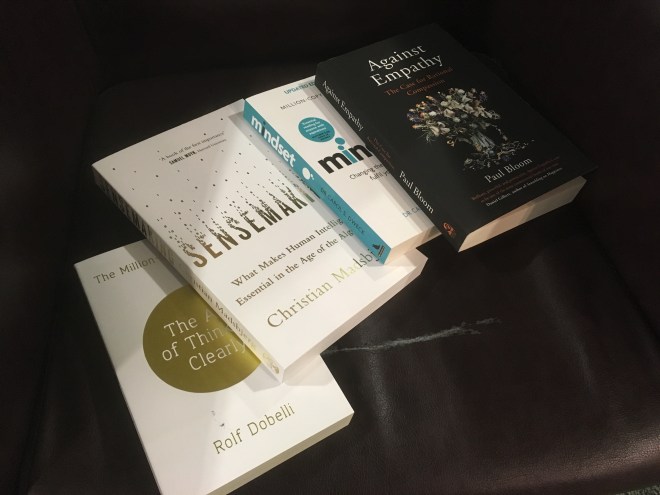
While we are speaking about books, I’ve been into the book shop and looked over the newest books in the psychology section. I sat in Hodges and Figgis’ leather chair and flicked through a few books. I always do that before I decide to read a book: I’ve bought too many “recommended” books that turned out to be either poor quality (as in, I couldn’t even finish them) or insidiously venomous making me wish I hadn’t come across them at all. In any case, I tend to really engage with the books I read, so there is a courtship ritual before I commit to reading the entire work. It went like this:

  • The Art of Thinking Clearly by Rolf Dobelli

“The Art of Thinking Clearly by world-class thinker and entrepreneur Rolf Dobelli is an eye-opening look at human psychology and reasoning — essential reading for anyone who wants to avoid “cognitive errors” and make better choices in all aspects of their lives.”

Mmm, it’s a very practical rewrite of Daniel Kahneman’s and Nassim Taleb’s thoughts. I would have thought that the former were practical enough. The back of the book featured praise by Sam Harris. I found Harris interesting initially but soon was uncannily repelled from his lopsided philosophy. I would be more careful in my choice of allies than Mr Dobelli. Could be a light read for someone unfamiliar with cognitive biases, but if you have any respect for your little grey cells, go straight to Kahneman. My (binary) rating for this book is: Nay.

Mindset : Changing the Way You Think to Fulfil Your Potential by Carol Dweck review
The sun setting over Howth
  • Mindset : Changing the Way You Think to Fulfil Your Potential by Carol Dweck

“After decades of research, world-renowned Stanford University psychologist Carol S. Dweck, Ph.D., discovered a simple but groundbreaking idea: the power of mindset. In this brilliant book, she shows how success in school, work, sports, the arts, and almost every area of human endeavor can be dramatically influenced by how we think about our talents and abilities. People with a fixed mindset—those who believe that abilities are fixed—are less likely to flourish than those with agrowth mindset—those who believe that abilities can be developed”

Psychology classics retold – and not in a very compelling way. Nay.

  • Against Empathy: The Case for Rational Compassion by Paul Bloom

“We often think of our capacity to experience the suffering of others as the ultimate source of goodness. Many of our wisest policy-makers, activists, scientists, and philosophers agree that the only problem with empathy is that we don’t have enough of it.

Nothing could be farther from the truth, argues Yale researcher Paul Bloom. In Against Empathy, Bloom reveals empathy to be one of the leading motivators of inequality and immorality in society. Far from helping us to improve the lives of others, empathy is a capricious and irrational emotion that appeals to our narrow prejudices. It muddles our judgment and, ironically, often leads to cruelty. We are at our best when we are smart enough not to rely on it, but to draw instead upon a more distanced compassion.”

I thought there was some merit in this book, but Daniel Goleman said a lot of the same stuff better. It may seem that he proposes the opposite to what this book is about, but that’s only an illusion. Perhaps, given the denigration of the intellectual and analytical approaches in the media, this books attempts to restore the balance and say that a quest for empathy isn’t going to solve our problems? It’s a nay from me, though the tone of the book is pleasantly contrarian.

Against Empathy: The Case for Rational Compassion by Paul Bloom review
Hopefully, I will find a yay in my next book shop trip

P.S. If you want to see some beautiful nature photos and are interested in travel, my friend Charis blogs about the island I was recently on – Cyprus. I was there with her for some of the trips she describes. I will write more about my escapade to the Eastern Mediterranean at some stage.