Words or empathy?

Words. Words can change how we feel in an instant, they can prime us to act in a certain way without us knowing – but they also can completely misfire.

It seems very obvious now, but it took me ages to figure this out: people don’t always mean what they say.It’s not necessarily because they are lying, but a lot of the time it is because they lack insight and communication skills.

What really hammered it home to me was when a consultant psychiatrist was explaining to me how to handle the “admit-me-or-I-will-kill-myself” kind of presentation. He asked me a very simple question: “If you wanted to kill yourself, would you go to a hospital to inform the doctor?” I’ve no intention of trying to simplify the complex issue of suicide, but there is certainly a type of patient who honestly believes they want to kill themselves and come to hospital, still. Why??? Because the words are misfiring. The words they are saying are: “I want to kill myself”. What (some of them) mean is that they are in so much emotional pain that they have no idea how to get out of it, but they would really like help. It can be, strangely, easier to identify the desire for suicide as the problem because it is a bit more external – at least compared to one’s coping skills.

The moral of the story was: people don’t always mean what they say – and they may not even know it.

This disconnect between words and insight is well known among international relations officials. Here what is said is just as important as what it is left unsaid. The people who answer questions at conferences (e.g. press conferences at the White House) aren’t the officials and military generals actually who know the most. The spokespeople are briefed in a very specific way and believe the things they say. It is too difficult to have insight into how you will be understood, so they get people who specifically understand the exact right stuff.

The significance of precise language is well known in Hollywood.

The production team of Gone with the Wind fought long and hard just to be allowed to have Rhett say “Frankly, my dear, I don’t give a damn.”

Damn was a vulgar word and the censors weren’t happy. However, “I don’t care” just doesn’t provoke the same emotions. Also, it is often said that the word frankly was an unscripted improvisation by Clark Gable – it wasn’t. It’s just different from the book, but that’s how it was in the script.

Nassim Nicholas Taleb said it well here:

when one of these [Salafi] fundamentalists talks to a Christian, he is convinced that the Christian is literal, while the Christian is convinced that the Salafi has the same oft-metaphorical concepts to be taken seriously but not literally –and, often, not very seriously.

empathy and suicide

What got me reminiscing about this was a post by FJ of The Pensives about critical thinking as an antidote to manipulation. FJ identifies reading people (and empathy) as a key part of examining one’s true intentions. FJ’s insight certainly resonates with my own – that there is meaning way beyond words. I think context needs to be examined. Incentives need to be looked at. FJ’s argument is that putting oneself in someone else’s shoes is important. Maybe he is saying the same thing in different words – no pun intended, but there’s also a potential caveat here. It’s best expressed by Nicholas Epley wrote in his fabulous book Mindwise:

Reading body language and trying to take on the other’s perspective doesn’t seem to help to understand the person better. What does help is creating situations where people can openly tell you what they think – and listen carefully.

Obviously, that’s not always possible. However, the point I am trying to make is that while empathy has become an increasingly popular concept, we shouldn’t envisage it as an antidote.

You may also like:

Cognitive curiosities: what our minds do without telling us

Knots

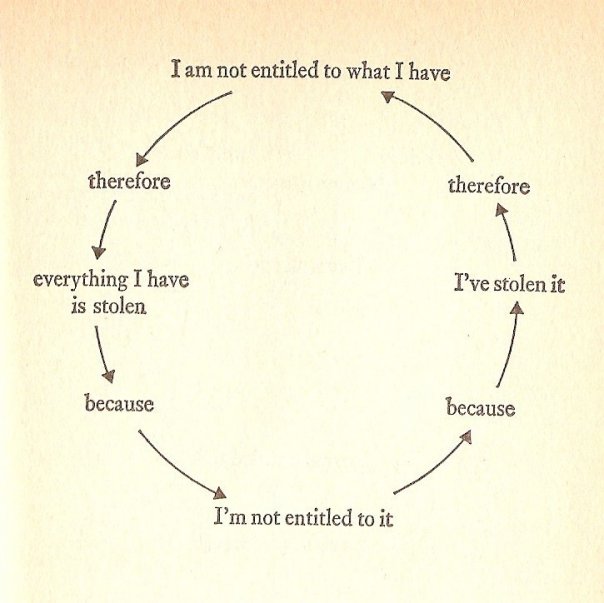
I was reminded of R.D. Laing’s book Knots, which is a gleefully brusque collection of various traps of thinking.

Here are some of my own examples. This one is from my time on the medical wards:

Patient’s family: “We don’t agree with your diagnosis. Do some more tests”Me: “Did you have any specific alternative diagnoses or additional tests in mind?”Patient’s family: “Don’t ask us. You’re the doctor!”

Source: Knots – an absolute gem of a blog on psychiatry

Inside a bilingual mind

My mother is in the throes of learning a foreign language – and I am doing my best to help. I am bilingual in English and Russian. There are definitely lots of people more talented at languages than I, but I am always surprised at how exceedingly rare people with near-perfect grammar and pronunciation in two languages actually are. Indeed, it is one of the things that stops me from wanting to learn another language – knowing how hard it is to get to proficiency.

In my attempt to help out with my mam’s progress, I found a lecture from this polyglot on the psychology of learning a language. He made a very interesting point:

in order to speak a different language you need to mentally switch wavelength and adopt a new persona. He argues that a language has a certain emotional state associated with it.

I don’t think it’s as literal as “happy vs sad”, but it’s more like a feeling you get when you speak a language. To be blunt about it, I imagine if I tried to speak Italian I would be more laid back and extroverted than if I tried to speak German. Indeed,

a few of my close friends remark that my mannerisms, tone and timbre all change when I switch between my two native languages. I had zero insight into this until I was told about it.

On reflection, I realised that a friend of mine who is fluent in German and English does something similar. He kind of seems to look at his shoes more when he speaks German – and seems generally less approachable.

what it's like to be bilingual

I also feel quite different when I am speaking English vs Russian. This is going to sound like I’ve lost the plot, but I can think of no better way to describe it.

In English, things are slick – like an iPhone. In Russian, things are deep and meaningful – like Dostoevsky.

I like to listen to podcasts. I realised that listening to a good podcast in Russian made me see the speaker as being intelligent, whereas a good podcast in English made me feel that the speaker is competent. The difference is subtle and so cliché! It gets worse. The Russian speaker always seems a little too direct – though not aggressive – and the English speaker seems a little sales-pitchy. I mean that’s just caricature-worthy  – but also true.

It looks like I am susceptible to the “national stereotype” biases even though I am well able to play for both sides and understand that these are just biases.

Much as I hate to admit it, I think I am also more polite when I speak English – and probably more tolerant. At the same time, I would also tend to oversimplify things more when speaking English.Perhaps having to speak English as a lingua franca has changed the world. The Financial Times has an interesting published an article portraying the ultimate beneficiaries of this arrangement as its victims here, arguing that China and Russia understand the USA and UK much better than they understand the rest of the world.

English is a language that doesn’t really allow for long sentences because there aren’t sufficiently complex noun and adjective endings, verb conjugations, etc to show what belongs where in a long sentence. For example, a typical German sentence is longer – because they do have the necessary grammatical framework.

In order to make sense in English, sentences have to be short and declarative – and by proxy, so do one’s thoughts.

All in all, there is definitely a persona-migration that happens in my head when I switch languages.

But that, as usual, got me thinking.

Adopting a persona to do any task at all is a thing. It’s not limited to languages. It’s a bit like having an implicit role model. It’s a dangerous game to play though.

On the one hand, it seems to make things easier. If one imagines themselves as a competent surgical trainee from Gray’s Anatomy, studying for medical finals get that little bit easier. However, isn’t this a departure from reality? I really like the point brought up in Steven Pressfield’s War of Artimagining yourself as a poet/artist/programmer/whatever – is only a vanity project. The point isn’t to define oneself as a poet/artist/programmer/whatever, the point is to make poems/art/code/whatever. Acting in a role, faking it until you make it is well and good, but travelling too far out into the world of alter-egos, be they Italian or surgical, should be done with a lot of insight.

Good advice vs bad advice

“I hesitate to give advice because every major single piece of advice I was given turned out to be wrong and I am glad I didn’t follow them.”

– Nassim Nicholas Taleb

Taking advice from anyone, be it Seneca, an aunt or an admired mentor  is risky business. Almost everybody who gives advice means well – even those who make money by doing it. However, it is very easy to overgeneralise with advice. It’s also tempting to shift part of the responsibility for results onto the advice giver – without meaning to do so – just one reason we are drawn to good advice, hacks, secrets, tricks and shortcuts. It’s also not uncommon to receive conflicting advice from seemingly reputable sources. What to do then? Here are four questions to ask before deciding to take on advice.

Is it advice or is a fact?

Exercise is good for you is a fact; it’s not advice. It applies to everyone from recent ICU patients to pregnant women to the elderly to – basically everyone. Obviously, the application of this fact is different for all these people, but it is all based off the same fundamental principle. High-intensity interval training and a ketogentic diet would be good for you is advice. It doesn’t apply to everyone. People who say it assume that everyone is just like them, so it will work for everyone (or for a critical mass that makes the rest irrelevant). It won’t work for everyone – simply because the assumptions don’t hold for everyone. It’s not 100% clear what those assumptions are, perhaps it is genetics, microflora, etc, but it’s not a fact and as advice it needs to be refined, i.e. made contextual – I will explain further on.

How does one distinguish between facts and advice? It’s probably an intuitive judgement that relies on the universality of a statement. If it is a fact, great; a new gem for our wisdom collection. If it is advice, we shall continue to investigate.

Is it a sales pitch?

Watch an interview with Richard Branson. He always says it is very important to let go, not hold a grudge and other such merry stuff. He also always brings up this example: when he started his airline, British Airways tried to sabotage it through a series of illegal tricks like calling Virgin passengers, telling them their flight is cancelled and rebooking them with BA. Being the sound lad that he is, he made up with the management of BA after the dust settled on their conflict. Great story. There’s just one problem. If Mr Branson really took his advice seriously – he wouldn’t have gone around 20 and 30 years later dragging British Airways through the dirt. Yes, they arguably deserve it, but it certainly isn’t an example of letting go and being sound. What it is, is a sales pitch for people who lack insight. Branson is basically talking up the brand that centres so significantly around his persona. If he is sound, surely you will want to buy from him and his c. 400 companies.

There are, of course, less subtle examples of this. Is there a conflict of interest? The most obvious example comes from the glut of people online who sell X teaching others how to sell X. For example, people who sell courses on how to sell courses. Professional advice givers that aren’t really professional – the many life coaches out there – are in that same category. To be fair, even doctors and lawyers could be accused of this. The difference is that there is a greater degree of responsibility that the provider assumes for their client. So the difference isn’t qualitative, it is quantitative.

Taking advice from mentors is ridden with problems too. They have an ego and a reputation to defend. Before I went into medicine, Every. Single. Doctor. I met told me not to do it. They told me I would regret it. Once I was in it, it was a different game. They couldn’t talk to me earnestly like before because they had standards and facades to uphold – a vision to sell. Any complaint regarding the issues in medicine goes down like we’re in the Stanford prison experiment. Ok, it’s not a sales pitch, but it’s a perversely related beast based on a conflict of interest.

The reason advising in various shapes and forms is a whole industry, is that it sells. It sells just like Coke. Advice is a product, it’s the intangible magic pill – one that makes us feel good too.

how to get good advice

Is this advice contextual?

Advice without context is meaningless. That part of the advice industry that is tailored is useful. So for example, a one-on-one consultation with a doctor or lawyer, an engagement with a management consultant would be contextual. They ask questions, in other words, they find out the context. All advice should really always carry the same disclaimers as medical advice. For example, Marcus Aurelius’ advice to live every day like it’s our last isn’t right for everyone. Similarly, just because Jimmy does better on the purple inhaler doesn’t mean that Bobby will too. It wouldn’t be right for Jimmy to tell Bobby to throw out his brown inhaler and buy a purple one. This logic should be applied to all advice.

This is one of the reasons why “secrets” often traded by people who did well in something are of limited value. They lack context. Furthermore, this is made worse by a certain cognitive bias: once one learns something, it is virtually impossible to imagine not knowing about it.

Daniel Kahneman, in his wonderful Thinking Fast and Slow, showed that we have 2 systems: one intuitive, stereotype-driven fast system, and the other logical slow system. The trick here is that everyone’s fast system is slightly different. The point of giving advice is to elicit an idiosyncrasy about this particular person’s fast system that is so far from reality that it is hurting them.

Do I want to swap places with this person?

It’s only a crude proxy, it doesn’t always apply, but generally, unless a person is living your dream at least in that aspect of their life on which they are advising – it’s probably not worth taking their advice. It still a valuable data point, but not good advice. This is why it is hard to take advice from overweight doctors and why reading the biographies of philosophers has me feeling shocked with their trail of pregnant land ladies and other hypocrisies. It is also the reason why role models are usually more beneficial than advice givers.

how to get good advice

And yes, I know that someone out there will call this advice – or even meta-advice! However, I don’t think it is possible to give advice by asking questions. Questions direct people to narrower answers, but I do believe that this set of filters will lead to more thoughtful and relevant decisions.

A religion for people who, in troubled times, don’t want any trouble

Breakfast of Champions was completely different to my first encounter with Vonnegut – Slaughterhouse-five. Breakfast is vehemently anti-American – in a way that is could be anti-any nation and is disturbingly relevant today. Vonnegut has a way of stripping away the sugar coating. He speaks of the slave-trade as buying and selling agricultural machines. This comparison is brought back every time he mentions the social problems of those whose ancestors were slaves: he compares them to actual metal machines and explains that the latter are cheaper leaving the former jobless. Plain, cynical and sobering.

The book is largely centred around the concept of free will. As a medic, I recall learning about free will in physiology. Back in the 1980s, Libet et al did a clever experiment showing that the brain initiates a movement before we are aware of wanting to carry out the movement. Subjects were asked to sit in front of a clock. They were told to move at will – and note the time when they decided they were going to move . An EEG was recorded. Essentially, the EEG showed that the impulse to move occurred around a second before subjects became aware that we’re going to move. Libet and colleagues said:

“cerebral initiation of a spontaneous, freely voluntary act can begin unconsciously, that is, before there is any (at least recallable) subjective awareness that a ‘decision’ to act has already been initiated cerebrally.”

This is a good review of the subject free will in physiology. In short, awareness of volition occurs in parallel to actual agency. Whether volition is causal to movement – nobody knows. Our story-telling machine brains do like to think that it is causal of course.

As a person fascinated by mindfulness, I was curious about Vonnegut’s reference to transcendental meditation. Bunny, one of the characters, used TM. Vonnegut described the procedure in Breakfast. Vonnegut doesn’t hide his scepticism.

I appreciate that absolutely everything that involves a financial transaction can be called a scam. Some people think it is insane that the seemingly skill-less abstract art is sold for millions. Some people trust in banks, corporations, governments – and others are swayed by the evidence that these institutions cannot be trusted. Appreciating this subjectivity, my impression of transcendental meditation is that there is a big scam element to it. There are also some elements of religion in it. While I am interested in learning about the ancient tradition of this particular kind of meditation, the TM organisation and its specific take on the technique smacks of danger to me. I would certainly stay well away.

kurt vonnegut free will transcendental meditation breakfast of champions

Kurt Vonnegut’s wife and daughter were practitioners of TM. He said: “Nothing pisses them off anymore. They glow like bass drums with lights inside.” So far, so good. He later said about TM:

“a very good religion for people who, in troubled times, don’t want any trouble.”

This really resonates with me.

Much like positive thinking, transcendental meditation promises the world via some very simple thing that you have to do compulsively – and preferably attend expensive seminars. It’s very important to never doubt the high priests of these respective philosophies – otherwise, it won’t work. I mean, come on.

It also makes sense that TM and positive thinking has worked for some trustworthy high-profile people. It’s because what they call TM and what they call positive thinking is different to what the seminar-selling folk mean. They take a common sense approach – not a “I will take everything literally and follow all instructions” approach that the gullible people these things attract take.

Escaping the cr*p never really works. Transcending into an imaginary ocean of perpetual calm is a form of cheap escapism that only works for seconds. On that note, I recall having a really bad stomach pain. Without any set purpose, my mind wandered and I imagined getting a shot of morphine. I immediately felt much better. However, I still had to go to hospital to make sure it was nothing serious. One simply has to acknowledge their pain and deal with it. Thinking magically won’t resolve it.

The proper, non-commercial, non-popularised practice of TM is a form of mindfulness -and I have every faith that it works well. It’s not my weapon of choice, but I recommend that people try it. Om is a always a good mantra to start with. I don’t see the value in getting mystical with “personalised” mantras. The point remains: if it walks and talks like a scam, it probably is. The other point is that Breakfast of Champions is another worthwhile book.

transcendental meditation scam kurt vonnegut breakfast of champions

Stoics on anxiety

Seneca repeats some form of this thought throughout his letter: it is the most ridiculous thing to be defeated by the fear of defeat.

Why, indeed, is it necessary to summon trouble, – which must be endured soon enough when it has once arrived, or to anticipate trouble and ruin the present through fear of the future? It is indeed foolish to be unhappy now because you may be unhappy at some future time.

Men are so thoughtless, nay, so mad, that some, through fear of death, force themselves to die.

Seneca claims that there are two options. Whatever you fear will either be insignificant – and you will make it through, or it will be short lived – because you don’t survive it.

You will thus understand that what you fear is either insignificant or short-lived

Stoics reflect on death a lot. Death is the ultimate worst case scenario – and it’s not that bad, according to Seneca:

Death is so little to be feared that through its good offices nothing is to be feared.

Seneca advocates that we take unmask what we are actually fearing. I believe this is his was to say: what is the worst that can happen?

Remember, however, before all else, to strip things of all that disturbs and confuses, and to see what each is at bottom; you will then comprehend that they contain nothing fearful except the actual fear. That you see happening to boys happens also to ourselves, who are only slightly bigger boys: when those whom they love, with whom they daily associate, with whom they play, appear with masks on, the boys are frightened out of their wits. We should strip the mask, not only from men, but from things, and restore to each object its own aspect.

Stoics on wanting

Your greatest difficulty is with yourself; for you are your own stumbling-block. You do not know what you want. 

Deciding what one wants is an incredibly important – according to all philosophers. The word goals has come into our lingo in a new way in the last 10 years.

Seneca remarks on the importance of deciding on one thing rather than wavering. At the same time he acknowledges that to demand absolute consistency would be an unreachably perfect standard to set:

Men do not know what they wish, except at the actual moment of wishing; no man ever decided once and for all to desire or to refuse. Judgment varies from day to day, and changes to the opposite, making many a man pass his life in a kind of game. Press on, therefore, as you have begun; perhaps you will be led to perfection

For men who leap from one purpose to another, or do not even leap but are carried over by a sort of hazard, – how can such wavering and unstable persons possess any good that is fixed and lasting?

I do not say that the philosopher can always keep the same pace. But he can always travel the same path.

Do you ask me what this real good is, and whence it derives? I will tell you: it comes from a good conscience, from honourable purposes, from right actions, from contempt of the gifts of chance, from an even and calm way of living which treads but one path.

“It is bothersome always to be beginning life.” Or another, which will perhaps express the meaning better: “They live ill who are always beginning to live.” It is because the life of such persons is always incomplete.

Not knowing what one wants is incredibly damaging according to Seneca. It leads to a reactionary life.

There are only a few who control themselves and their affairs by a guiding purpose; the rest do not proceed; they are merely swept along, like objects afloat in a river. And of these objects, some are held back by sluggish waters and are transported gently; others are torn along by a more violent current; some, which are nearest the bank, are left there as the current slackens; and others are carried out to sea by the onrush of the stream. Therefore, we should decide what we wish, and abide by the decision.

Seneca spoke about the value of expectations and desires. This is a really tough one. On the one hand, life becomes easier when you drop your expectations, which is what the following quote is about. However, does this mean dropping your standards? I think a better interpretation would be losing a sense of entitlement that luck and external circumstances owe you anything. I think Seneca means that rather than finding satisfaction in attaining external goals, happiness should come from within. In other words, the goals you set shouldn’t relate to things like living in a house of x sq. footage and having y dollars in the bank, but rather becoming a certain kind of person.

“If you wish,” said he, “to make Pythocles rich, do not add to his store of money, but subtract from his desires.” This idea is too clear to need explanation, and too clever to need reinforcement. There is, however, one point on which I would warn you, – not to consider that this statement applies only to riches; its value will be the same, no matter how you apply it. “If you wish to make Pythocles honourable, do not add to his honours, but subtract from his desires”; “if you wish Pythocles to have pleasure for ever, do not add to his pleasures, but subtract from his desires”; “if you wish to make Pythocles an old man, filling his life to the full, do not add to his years, but subtract from his desires.”

Stoics on happiness

Seneca felt that happiness comes from within. It is impossible to be happy while relying on luck and external circumstances. In other words, happiness shouldn’t be conditional on anything outside of your control.

Do you ask what is the foundation of a sound mind? It is, not to find joy in useless things. I said that it was the foundation; it is really the pinnacle.

We have reached the heights if we know what it is that we find joy in and if we have not placed our happiness in the control of external circumstances.

Seneca acknowledges that feeling joy that doesn’t come from external circumstances may not come naturally:

Above all, make this your business: learn how to feel joy.

I do not wish you ever to be deprived of gladness. I would have it born in your house; and it is born there, if only it be inside of you. I mean from your very self, that which is the best part of you.

Furthermore, the kind of joy that arises from outside tends to lead to sorrow:

Pleasure, unless it has been kept within bounds, tends to rush headlong into the abyss of sorrow.

The importance of self-awareness

I often think of The Great Gatsby. While everything in it has been said before, it seems like a particularly easy-to-understand piece on human nature – not least because it seems to be reflective of what our society looks like almost 100 years on. Gatsby was great because he was motivated by love and incredibly focused and resourceful in his quest. There were also many reasons why he wasn’t great: he lied about his origin, he lied about his name, he was a criminal, he had no problem seducing a married woman with a child… Most of all he got carried away from reality. He didn’t see Daisy for who she really was even though it should have been obvious. He suffered from infatuation, limerence and obsession.

why self awareness is important

There’s an interesting dichotomy that arises from obsession. On the one hand, it is a way to get motivated like nothing else. I was recently listening to an interview with Travis Kalanick, the CEO and co-founder of Uber, who talked about how he chose his idea. He said he was in love with the idea of Uber. He also said that after you fall in love with your idea the hard part is to adjust it to the world so that it is exactly the best it can be. It seemed that all great entrepreneurs develop their businesses for some kind of personal reason. Mark Zuckerberg said that Facebook was something he would have wanted to use for himself. He seems fascinated with how people have huge areas of the cortex dedicated to deciphering the meaning of facial expressions, seemingly minor detail. The kind of motivation that’s required to spend every waking hour you’re not doing coursework in one of the top universities working on social websites means intense interest. Whether it is obsession or not, it’s close to it. Our culture seems to value obsession. In fact, the word has connotations of real dedication and martyrdom. There are gyms called Crossfit Obsession. A “normal” person couldn’t have the level of dedication that these entrepreneurs have, or a particular variety within the men and women of Crossfit – we’ve all met them. A healthcare professional would surely class them as having traits of OCPD, or find a way in which their activity is a form of escapism.

However, all great entrepreneurs are sufficiently in touch with reality so as to know how to adapt. This brings me to the second part – obsession needs to be balanced with reality. For anyone who knows the feeling, they know that this is much easier said than done. When one tries to reflect on reality, it is easy to slip into denial. Alternatively, it can be easy to see the flaws, decide that you obsession is silly and give up on it. It is much harder to see the flaws and incorporate this information meaningfully into your quest.

This idea of either idealising or damning your quest first came to me when I was dealing with patients who had emotionally unstable personality disorder as a doctor. People with EUPD tend to undergo something called splitting: something/someone is either perfect, or they aren’t worth thinking about at all. In fact, this is characteristic of many personality disorders. For example, people with narcissistic traits are very quick to decide that someone’s opinion is worthless if they don’t like something about this person.

self-awareness-is-the-key-to-success

How is it that some people are able to benefit from the momentum of obsession, but not dragged down by the unhelpful ignoring or reality or give up on their idea at the first sign of imperfection?

Are these great entrepreneurs necessarily all free from toxic personality traits? Not at all. It must be possible, however, to be sufficiently self-aware so as to let those parts of your personality that you need the most at a given moment to fully express themselves. After all, all these personality traits that we regard as vulnerable – and put them down as traits of personality disorders – evolved for a reason. They made sense in a context. They are only called abnormal because they stopped being adaptive when the environment changed, but the person who developed them lacks the self-awareness required to acknowledge that they are using legacy software – never mind adjust again. So it’s not like there’s just one personality type, not one strategy that will carry you through, but like Darwin said – it is the most adaptable that makes it through. Adaptability is completely a function of self-awareness.

So, how could we hook up with some of that self-awareness? My hypothesis is, as always, by paying attention to it. It is surprising how commonly people are unable to describe how they feel. How do you feel right now? Is it easy for you to answer? In normal life – and in psychiatry – I’ve met pretty high functioning people who are unable to answer that question. Really and truly, they look at you like you are an alien, look away and after about 10 seconds they say, I don’t really know. It’s obviously a spectrum and it’s not uncommon. Some of these people will try and assess how they should feel, making cognitive judgements about their circumstances. It’s called alexithymia. I think this is the first step. Ask the question – how does it feel? Putting words on it is a good place to start. Tackling physical sensations first could be an even better idea. When you notice that you are hungry – how does it feel? Is there a pain in your abdomen? Where? What kind of pain? Is it a cramp or a dull ache? Is there some nausea that comes with it? Does your abdomen feel warm or cold? Essentially, it is a form of mindfulness. With some practice it will be easier to put words on your feelings, or your inner state. It’s not a case of needing to soul-search. It’s not cognitive, it’s all about feelings. Whether we like it or not, emotions play a decisive role in our behaviour – they give rise to our behaviour, that’s what the word means. I think that mindfulness has the potential to increase self-awareness like no other instrument at our disposal. Mindfulness is known to increase empathy. Self-awareness is no less important. People who lack empathy are probably lacking insight into their own feelings to begin with. It may even make sense to think of self-awareness as a form of inner empathy.

If there was one thing that I think would advance someone’s personal development by leaps and bounds – it would be self-awareness. It doesn’t matter that you aren’t the strongest, the tallest, the smartest – or whatever, but if you able to be sufficiently self-aware so as to surround yourself with the right people – you can compensate for those weaknesses – and focus on your strengths.

Addicted to headphones

As soothers are to toddlers, headphones are to anyone who has given up their soother. As someone who’s trying to incorporate as much mindfulness as possible into my life, I was wondering why listening to music is so addictive. Anytime I leave the house I get a little rush – mmm, headphone time! The gym is great for listening to music too. Weights seem lighter and the treadmill moves in slow motion to David Guetta.

addicted-to-headphones

Having learnt about the rush on dopamine that’s associated with anticipation and how it makes our daydreams addictive, I’ve become intrigues as to what behaviours of mine are affected by this. I think my craving for the bass to drop is the same.

It all began when I started exercising. As well as being phenomenally good for me, it has turned into an exercise in escapism. When I hear my favourite tracks, my mind always wonders to the good times I had with my friends and all those associated daydreams. Essentially, listening to music has become an augmented day dream for me.

It seemed near impossible to leave my phone behind as I went for my evening walk. It genuinely felt like saying goodbye at the airport as your best friend is leaving for Australia (that would be a remote location relative to me!) I did. And it was a very nice walk. I noticed the shops that I passed by, I noticed some cool constellation – still no idea what it is – and I even helped someone with directions. Most of all, however, I was able to think more clearly. 

My yearning for the headphones is a case of classical conditioning. Once the music is on, my thoughts are off to a nice place – away from here. They go in a circle and never reach anything. This time – walking without headphones was different – I was more aware of what was around me – and in my own head. I came home and wrote some interesting notes down about a question that had been bothering me before hand. All of these occurred while I was walking – in relative silence.

I would argue that it is good to give up the headphones once in a while. Maybe even most of the time. Listening to music is different for different people, but for me it is a way to run away from my current state into a safe place. It’s necessary sometimes, but most of us probably overdo it.