Fear: a millennial perspective

Man cannot endure his own littleness unless he can translate it into meaningfulness on the largest possible level

Ernest Becker

Fear of the passage of time

I recently came across the term chronophobia in the context of people doing exams: knowing that exam day is ever closer makes people anxious. Chronophobia was defined as an experience of unease and anxiety about time, a feeling that events are moving too fast and are thus hard to make sense of, in “Chronophobia: On Time in the Art of the 1960s” by Pamela Lee.

Chronophobia isn’t a formal diagnosis, neither does it feature in scientific literature. In other words, it’s not really a phobia. It is more of an unpleasant feeling – one that is often expressed in art.

It is common in prison inmates, students in long academic programs and the elderly. When one is anxious, it is not only possible to be anxious about the event, but also its inescapable approach. Chronophobia is less about the doom and more about it being impending.

chronophobia anxiety about passage of time
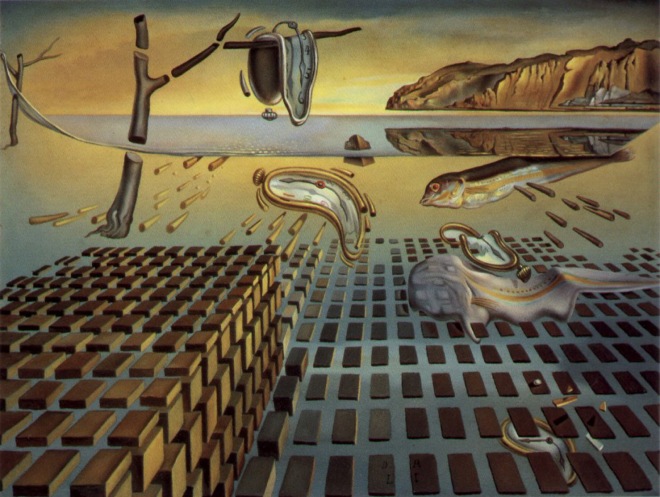
Salvador Dali: The Persistence of Memory, 1931. The melting clock describes the feeling of chronophobia rather well

Chronophobia appears to be connected with heightened awareness of the passage of time that is inherent in distant deadlines for significant events.

This morning during my 10 minutes of mindfulness, something interesting bubbled up. I randomly remembered myself on an airplane travelling back to Moscow to visit family about 2 years ago. I felt a strong urge to be that person again, a bit like when I’m on vacation and towards the end, with a sigh, I think back to how liberating the first day off felt. Or when I reach the last bite of some dopamine-explosive dessert, I think back to how happy I felt when it was just put in front of me. We all love vacation and desert. However, my wish to be 2 years younger makes little sense. I was in the throes of a challenging 70-80 hours per week medical rota. It took much ingenuity to carve out enough time to travel. Is it regret? It wouldn’t be fair to say that the last 2 years were somehow a waste of time in any regard. Why do I feel so drawn to the thought of going back in time?
fear of the passage of time chronophobia
Salvador Dali: The Disintegration of the Persistence of Memory, 1954. Dali saw the fish as a symbol of life

Fear of opportunity cost

Aged 27, I frequently contemplate what it would go back to a previous point in time. I think it’s the understanding of the limited nature of time. I also worry about opportunity cost. In economics, there is the term opportunity (alternative) cost is the value of the option that we don’t choose when making a decision. [If I have 1 euro and buy a 1 euro can of Coke, I would have to forego the 1 euro Mars bar in order to have it. I would thus potentially worry about what it would have been like if they got a Mars bar instead.] The feeling is different to decision-anxiety. It’s not even about second guessing one’s choice, but more about imagining alternative paths.

The word decision literally means the cutting off – of other options. Thinking of the alternatives always reminds us of the unyielding nature of choice and how we really can’t literally “have it all”.

Robert Frost’s famous (infamous?) “The Road Not Taken” is a brilliant and often misinterpreted examination of the nature of choice. It is important to recognise the speaker’s deliberation: he says the roads are much the same: “just as fair”, “really about the same”, “equally lay”.

“The Road Not Taken”, a frequent feature of post-card philosophy, is often oversimplified to say that the speaker chose the less travelled road – and, woohoo, that’s amazing. It’s more complex than that.

The speaker admits that he left the first road “for another day”. While he knew he would never go back, the torment of admitting the final nature of choice is just too much. 

One can get very detailed when describing their particular fear. I certainly don’t support the idea of including “fear of opportunity cost”, “fear of the passage of time” or even “fear of choice” as phobias into the DSM. Indeed, this is perfect ground for thinking by induction. Is there a common thread here?

fear of death emotional coping mechanisms
Hans Holbein the Younger: The Ambassadors, 1533. Note the anamorphic skull in the foreground. It surely is a reminder of death

Boiling down fears to a common denominator: could it be death?

Why does chronophobia affect students? Time forces them to deal with events that will affect serious aspects of their lives such as their future careers – and thus even more permanent things like social class, the kind of people they will be likely to marry and so on. Exam results’ effects are by no means definitive, but probabilistically they are significant.

It has become popular to say that there are only 2 human emotions: fear and love.

Everything negative is a form of fear. It kind of makes sense: anger is a way of defending one’s point of view, property or whatever other boundary. Being sad is a fear that one will never be as happy as they were before as a result of an event (not talking about depression here). Disgust is a fear that something will negatively impact one’s existence. You get the gist.

The other popular thought is that all fear is a form of the ultimate fear – of death.

Going back to chronophobia again, why does it affect the elderly? Time threatens the existence of the elderly. It threatens all of our’s existence, but the elderly are more aware of it – mostly for social and cultural reasons. Now, none of us are deluded enough to actually think we’re not going to die. However, as Ernest Becker points out:

we have 2 ideas of the self: the physical and the symbolic.

In my opinion, our rationality only extends as far as the physical self. We are preoccupied with ways to immortalise our symbolic self. As per the “Mahabharata”:

“The most wondrous thing in the world is that although every day innumerable creatures go to the abode of death, still man thinks that he is immortal”.
fear of being insignificant
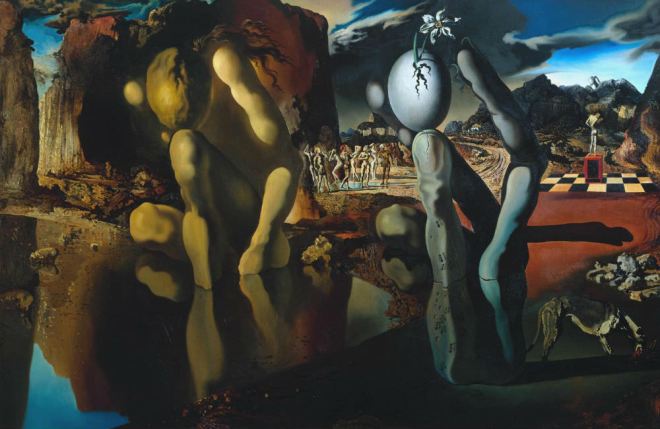
Salvador Dali: Metamorphosis of Narcissus, 1937. Dali had an interest in psychiatry

The recent debate that followed my discussion of the role of validation in our self-esteem sparked some follow on thoughts. In short, it showed that people with narcissistic tendencies experience much emptiness or even self-hatred – and validation is used to take the edge off. However, as all creatures who make choices, people with narcissistic tendencies are subject to avoiding pain and seeking pleasure (thank you, Dr. Freud). Clearly, they find narcissism more tolerable that the alternative. How could this be?

What if those who crave validation to feel good about themselves chose to be this way because the alternative – knowing that one is inherently valuable, without any validation – makes the thought of inevitable death absolutely intolerable? If one feels that they’re not that valuable, dying isn’t quite as scary or tragic.

Realising that a person is valuable, getting attached and then letting go is much harder than never getting attached – in this case to your self, as is the case with death. This devaluation allows people to cope with the fear of death. At the same time, the person with narcissistic tendencies maintains the upside of being able to work on “their immortality projects”, like winning medals and getting promotions. This is just a hypothesis of mine. I understand that I have no idea what Steve Jobs was really like. A lot of people say that he was an obnoxious narcissist. He said this, which happens to be congruent with my hypothesis:

Remembering that you are going to die is the best way I know to avoid the trap of thinking you have something to lose. You are already naked. There is no reason not to follow your heart.

There are other psychologically sneaky ways that we deal with the fear of death that have stood the test of time (well, since 1974 or so when “Denial of Death” was published):

Becker argues that everything we do: writing books, starting businesses, having children are all ways to transcend – and not have to deal with – death.

It makes sense too: the thought that everything one ever does will disappear into oblivion is so hard to accept that in order to keep going we find ways to defy death’s erasure of our existence by leaving a legacy.

fear of being insignificant

One’s own death is hard to imagine. It is as if we believe we will still be alive on some level after we die, but unable to act on our dreams and stuck reminiscing of the time we were alive and lamenting we didn’t do more.

If leaving a legacy isn’t an option, then one can choose to believe in the afterlife to help themselves cope with the concept death.

Paradoxically, dying may be a way to transcend death. Physical death could be a route to symbolic immortality. Just think of war heroes.

While death could explain a lot of our autopilot behaviour, we don’t seem to want to think about it very often. We are told to think positive thoughts instead.

To think, or not to think – about death

all fear is fear of death
...what dreams may come, when we have shuffled off this mortal coil…

Constant reminders of death were common all throughout the last millennium: having a skull on one’s desk was kind of like having sticky notes or an extra mouse. An experiment where people were asked to write about death before they were asked about their country’s war efforts showed that thinking of death made people more enthusiastic about war -as it adds meaning, purpose, a sense of belonging, a feeling of impact…

The Stoics came up with a variety of reasons and hacks to not fear death such as the symmetry argument: fearing death is like fearing the fact that one wasn’t alive before one was born. I won’t go down the rabbit hole of explaining how to fear death less.

The purpose of my reflection isn’t to say we shouldn’t fear death, and it will all be fine. It is more of an inquiry into what behaviours of ours are motivated by the fundamental, underlying fear, which so far appears to be that of death. However,…

It’s not death we fear, it is not having an impact

Is it really death we fear? I think a better way of putting it is that we fear that we’re inconsequential, insignificant, that we made no difference through our existence.

For those who insist that it is a fear of death: it’s that of the symbolic self. For those who insist that our biggest fear is to not be loved: to have someone love one is probably the biggest impact one can have on another human being. Perhaps, it is the ultimate, or the one that really count. I am not sure. However, my point remains: it is about impact.

It could just be a millennial’s take on it. With a lesser role of traditional religion in today’s society, millennials have the unfulfilled need for meaning – and have a habit of finding it in the most peculiar places.

My recent discussion of meaning according to Nietzsche prompted many to comment that the fact that we die and that the universe will ultimately end (something to do with the Sun and physics) implies that there could be no meaning in our lives. I don’t follow this argument. To me, it is like saying there’s no point in eating because you’ll get hungry again. Clearly though,

for a lot of people death is the ultimate enemy in a game rigged against them.

I used the word impact above for a reason. I could have said consequence or meaning, but something stopped me. Both of those words are overused and call to mind all kinds of associations. Furthermore, I thought of animals. They are driven largely by the same evolutionary forces as we are, and I think we overestimate the extent to which animals are different. They may not have insight, but they are a reflection at least of how nature intended things. To illustrate, I will use an example I recall from watching a BBC documentary on giraffes. Two massive male giraffes were fighting for a female. How on earth do giraffes fight, I hear you ask. Well, they violently swing their entire necks to strike. The force of the swing is enough to shatter their skulls. The battle went on to the point of near death… for the sake of a female. The giraffes decided/were driven by nature to go that far just to reproduce – so death is less important than an opportunity to have impact, which, for giraffes I think is reasonable to assume, is to have progeny.

I don’t think that the fear of not having an impact is the same as the fear of failure. One can fail, but still achieve a lot and have an impact. Failure is defined in terms of a percentage of the way to realising a dream. Impact, or lack thereof, is much more real.

I feel that a human being on their death bed is likely to think of what impact they have had, not where they ranked compared to their dream.
fear of not making a difference
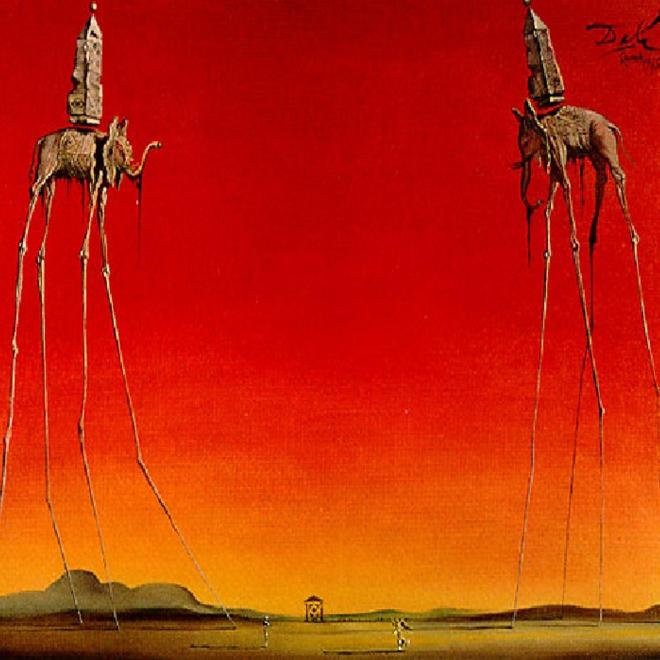
Salvador Dali: The Elephants, 1948. Not quite giraffes, but close enough

On the bright side…

There is a “cure” for fear of choice

Going back to my own ENTP-torment of being more interested in talking about choices rather than actually making them, I am looking for some kind of resolution. N. N. Taleb, a favourite writer of mine, is popularising the concept of optionality. He argues that having options is a great thing:

Optionality is the property of asymmetric upside (preferably unlimited) with correspondingly limited downside (preferably tiny).

It’s not really a way to get out of making choices. Instead, it is a way to do what you were going to do anyway, but leaving cheap enough nets here and there to see if one day something nice washes up in one of them such that covers the cost of having had the nets n times over.

He argues against specialisation (i.e. going down too far in the decision tree of choices or going down to the end of just one branch). We are all familiar with specialisation success stories. The Nobel Prize goes to the person who studied a particular enzyme for 30 years. The startup that solves a specific problem in one particular niche is the one that does well. Kim Kardashian has one thing going for her, and she’s taken over the world…

Taleb reminds us that there are cemeteries of specialised ventures and people. Just because the successes that make into the media are specialised, doesn’t mean all of them are. Specialisation comes from the propensity to make choices. It is not the only way to achieve something. Hence, it is possible that the act of making choices is overvalued.

Richard Branson has over 400 companies. Is it because he is greedy – or perhaps because he understands that specialisation is a dangerous game to play? Venture capitalists and angel investors back things in a non-specialised way. All financial investors do. It may look like it is specialised on the surface, but it really isn’t. Biotech, or robotics, isn’t a specialisation. These are incredibly broad fields. It’s like saying blogging is a specialisation. Investors take directional bets once is a while, i.e. ones that really require a choice, but they do so in a way that for every 1 euro they invest, they stand to gain 10, and only invest a tiny fraction of their euros into these schemes. This is exactly congruent with Taleb’s definition of optionality.

I have fabulously rationalised away the pressure to make choices here. However, the real work is in putting oneself into situations where optionality can be exercised.

The older I get, the more I realise that there’s quite a lot of engineering involved in all of this. It’s not so much about going after specific visions, but creating situations where visions can flourish – and ultimately have an impact.

millennials fear not having an impact
Maybe, the millennial/Gen Y variety of man (and woman) are a bit different…

You may also like:

Millennial corporate office workers and their transgender bathrooms

Millennial ENTP struggles

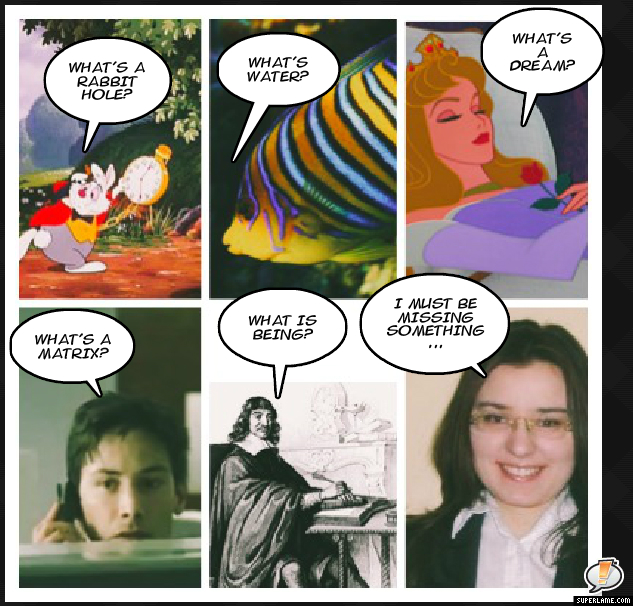
“What… is water?” asks the fish

A huge percentage of the stuff that I tend to be automatically certain of is, it turns out, totally wrong and deluded.

David Foster Wallace

I got into a merry debate with the lovely Pink Agendist about choosing day-dreaming versus being in the moment that ultimately elicited that we broadly agree: reality is a hugely interesting topic. In his touching speech, David Foster Wallace says :

The alternative is unconsciousness, the default setting, the “rat race” – the constant gnawing sense of having had and lost some infinite thing.

In a disarming manner, he admits that he isn’t saying anything ground-breaking. His point, however, is that it is so hard to keep the important thoughts in front of us that they are worth repeating. It seems that from Buddhists to Seneca to Darwin, the main philosophical thought that resonates with me is: be aware and adapt. Even in his seemingly grim Letter 61, Seneca says:

Let us set our minds in order that we may desire whatever is demanded of us by circumstances, and above all that we may reflect upon our end without sadness.

Few concepts send my mind into a spin like this. Part of me resists: humans accomplished what they’ve accomplished by defying their odds, not by accepting what is demanded of them. Siberia demands that you freeze to death or leave, for example. However, I think it is a misinterpretation on my part. Seneca is instead saying: find a way to use this situation. What is demanded is that one figures out how to chop wood and sustain a fire, so one has to manage themselves in such a way that they could do this eagerly and well. This one sentence explains the nature of cognitive behavioural therapy used today: changing one’s mind will change one’s emotions – and how one behaves. The point isn’t to idolise Seneca. I am sure that many generations of John the Caveman said it before him. The point is that the concept is as relevant today as it ever was.

Another part of me says: what are the circumstances – and what do they demand? I made a little graphic to show the nature of my confusion. Understanding the circumstances may require the sort of insight that I am not even aware exists.

developing self awareness though mindfulness

I haven’t figured out another way to get closer to understanding any of the above other than through mindfulness and reading the works of philosophers that stood the test of time. Even then, reading a philosopher’s thoughts is secretly wishing that someone else has it all figured out. This is another brilliant point that David Foster Wallace brings up: even if one doesn’t think that they have a religion, they still worship something – and have some kind of default setting:

In the day-to-day trenches of adult life, there is no such thing as atheism. There is no such thing as not worshipping. Everybody worships. The only choice we get is what to worship… The insidious thing about these forms of worship is not that they’re evil or sinful; it is that they are unconscious. They are default settings.

Just like Pema Chodron explains, it is part of human nature to assume that someone else has the answer. After all, that is what we are conditioned to believe as children through the behaviour of adults – they always know best. When we ourselves become adults, that void is then filled with some kind of worship. The only way to snap out and have the ability to choose again, even for a moment, seems to be by being in the moment.

I am tangentially involved in game development and recently came across a game called The Stanley ParableIt involves a corporate employee and his choices. The game is incredibly philosophical, touching on the concept of choice and free will – and I couldn’t do it justice here. However, if you have nothing to do on a dark January night, it will rock your world.

Have a mindful weekend, everyone.

Don’t change the channel

Mindfulness is effective in treating many mental health problems and psychiatric conditions. For those who don’t suffer from the above, it seems to still be beneficial in terms of focus, mood, relationships and results – based on many people’s personal experiences. Why then, is it so difficult at times? It is difficult for the same reason than escapism is easy. I am not Bill Murray’s biggest follower, but in one interview he said:

I would like to be more consistently here… I would like to see what I could get done if I didn’t cloud myself with automatic [thoughts]… If I were able to not change channels in my mind and body.

everyday mindfulness not day dreaming

He didn’t say anything ground-breaking, but his channels analogy really struck home with me. Having listened to this interview in the morning, I was on an uncomfortable journey between two cities today. To the right of me was a morbidly obese gentleman who sprawled himself across about three seats in an unorthodox position rarely seen in public. To the left – a lady who evidently led a lifestyle that didn’t involve too much personal hygiene. Having sneakily moved to another seat, I was putting my headphones in, prepared to sail away into a safe and pleasant day-dream. However, in my mind, I could hear the echo of the interview: don’t change the channel. Some voice of cognition questioned what I could possibly gain by being present when the present is like this? I wasn’t sure. What did I have to gain by being in a day-dream? A mindfulness devotee would surely say: nothing. Well, if people never day-dreamed, we would still live in caves. If we didn’t rehearse situations, ruminate, “mind-read” and obsess, the world would be different. I guess some may even argue it would be better. I am not sure.

I wish it was clear cut. I wish this story had an elegant twist where being present resulted in some kind of miraculous revelation. Instead it made me more aware that it is as easy to slip into the mindfulness cult as it is into a day-dream.

Ironically, Spotify shuffled to a nice house remix of R. Kelly’s Bump and Grind. As my mind was indeed very distinctly telling me “No“,  I took my headphones out. I could feel so much resistance. It angered me and made me sad that instead of floating off into a day-dream, I righteously deemed it necessary to stay in the present moment. I felt a bit like a Brave New World character without her soma. It felt necessary to stay present though. I ended up just being aware – of a storm inside.

Now, at the end of this mindful day, I can’t proudly declare that I feel at peace. There was no external conflict whatsoever, but I feel like I’d been in a blazing row for hours. With it though, there’s a certain exhausted clarity, like everything has been unreservedly said and it is all out in the open.

Faced with a choice like this again, I will probably choose mindfulness over the day-dream – again. I will stick with this channel called Reality, as we know it, rather than If I were with my friends or some other blissful escape route to rainbows and unicorns. Being honest, in part it is because I “read it in a book” and the high priests say it’s good for me. However, in part it is because I appreciate just how rarely I am even present enough to make this choice.

The day-dreams will happen regardless, the awareness won’t.

how to stop daydreaming

The many ways the tail wags the dog

I first tried to read Robert Cialdini’s Influence: The Psychology of Persuasion a few years back. While the introduction is full of interesting facts, it is clearly a book written for a wide audience and has a slightly off-putting uniquely-American selling pitch quality despite being about how to not be sold to. I revisited it this Christmas, and I am very happy I did. My initial approach to it was as a book on marketing. I doubt I am the only one – learning to be good at marketing makes me feel a bit… fraudulent. Reframing it as learning about human behaviour – makes all the difference. It’s especially ironic as the book would explain why that is. In essence, it is a more dated (1984), less academic, but none the less brilliant rendition on the same issues as Daniel Kahneman’s Thinking Fast and Slow. The academic tone is probably my favourite, but it did, nevertheless, take me a particularly long time to read Thinking…, so if it seems too tedious – Influence is the perfect alternative. [Having said that, it is of a lower academic standard. For example, Cialdini’s description of S. Milgram’s famous experiment is inaccurate and his interpretation – sensationalist, but it’s still an interesting point of view that could be true.]

robert cialdini influence review

There are 6 rules of influence, Cialdini posits: Reciprocity, Social Proof, Consistency, Liking, Authority and Scarcity. The gist of it is summarised here.

Essentially, the entire book is about expectations – and how they reign over us.

I am tempted to go into a mindfulness/stoicism spiel here, but I’ll save that for later. I imagine reading this somewhat dated but still fundamentally brilliant book before the advent of social media would have been one of the best education investments one could make. Now, we are much more familiar with social proof, authority, etc as we see it every day. We probably have much sharper BS detectors for these particular marketing tricks than people did when this book was written in the 1980s. However,

this book explains the fundamentals incredibly well – and while we learnt a bit on how to not be BS’d when buying, most of us are clueless about these influence modalities in their applications outside of mechanical buying and selling .

Essentially, all of these 6 things set expectations: one feels obliged to reciprocate, one feels reassured by social proof, one trusts authority even more than one could ever imagine, etc.

Cialdini’s examples come from all areas of life.

Be it buying petrol, ordering desert, changing the behaviour of prisoners of war or navigating a romantic issue – Cialdini shows how expectations – rather than reality – determine our behaviour.

He moves from his selling pitchy voice to a much more ethically-charged discussion on how people deal with authority later in the book. He has incredible insight. He even discusses free will very briefly. It seems as though he would have liked to write a much more academically themed book, but felt he wouldn’t reach as wide an audience.

cialdini influence kahneman thinking fast and slow review

Here are some of my favourite chunks:

Consistency

This stretch below will make it easier to let go of your failed romances:

Take the bettors in the racetrack experiment. Thirty seconds before putting down their money, they had been tentative and uncertain; thirty seconds after the deed, they were significantly more optimistic and self-assured. The act of making a final decision—in this case, of buying a ticket—had been the critical factor. Once a stand had been taken, the need for consistency pressured these people to bring what they felt and believed into line with what they had already done. They simply convinced themselves that they had made the right choice and, no doubt, felt better about it all.

Before we see such self-delusion as unique to racetrack habitués, we should examine the story of my neighbor Sara and her live-in boyfriend, Tim. They met at a hospital where he worked as an X-ray technician and she as a nutritionist. They dated for a while, even after Tim lost his job, and eventually they moved in together. Things were never perfect for Sara: She wanted Tim to marry her and to stop his heavy drinking; Tim resisted both ideas. After an especially difficult period of conflict, Sara broke off the relationship, and Tim moved out. At the same time, an old boyfriend of Sara’s returned to town after years away and called her. They started seeing each other socially and quickly became serious enough to plan a wedding. They had gone so far as to set a date and issue invitations when Tim called. He had repented and wanted to move back in. When Sara told him her marriage plans, he begged her to change her mind; he wanted to be together with her as before. But Sara refused, saying she didn’t want to live like that again. Tim even offered to marry her, but she still said she preferred the other boyfriend. Finally, Tim volunteered to quit drinking if she would only relent. Feeling that under those conditions Tim had the edge, Sara decided to break her engagement, cancel the wedding, retract the invitations, and let Tim move back in with her.

Within a month, Tim informed Sara that he didn’t think he needed to stop his drinking after all; a month later, he had decided that they should “wait and see” before getting married. Two years have since passed; Tim and Sara continue to live together exactly as before. He still drinks, there are still no marriage plans, yet Sara is more devoted to Tim than she ever was. She says that being forced to choose taught her that Tim really is number one in her heart. So, after choosing Tim over her other boyfriend, Sara became happier with him, even though the conditions under which she had made her choice have never been fulfilled. Obviously, horse-race bettors are not alone in their willingness to believe in the correctness of a difficult choice, once made. Indeed, we all fool ourselves from time to time in order to keep our thoughts and beliefs consistent with what we have already done or decided.

Robert Cialdini's Influence: The Psychology of Persuasion review

Social Proof

It works even when it’s phony:

I don’t know anyone who likes canned laughter. […] The people I questioned hated canned laughter. They called it stupid, phony, and obvious. Although my sample was small, I would bet that it closely reflects the negative feelings of most of the American public toward laugh tracks.

Why, then, is canned laughter so popular with television executives? They have won their exalted positions and splendid salaries by knowing how to give the public what it wants. Yet they religiously employ the laugh tracks that their audiences find distasteful. And they do so over the objections of many of their most talented artists. It is not uncommon for acclaimed directors, writers, or actors to demand the elimination of canned responses from the television projects they undertake. These demands are only sometimes successful, and when they are, it is not without a battle.

What could it be about canned laughter that is so attractive to television executives? Why would these shrewd and tested businessmen champion a practice that their potential watchers find disagreeable and their most creative talents find personally insulting? The answer is at once simple and intriguing: They know what the research says. Experiments have found that the use of canned merriment causes an audience to laugh longer and more often when humorous material is presented and to rate the material as funnier. 

Together with Daniel Kaheman’s Thinking Fast and Slow, Daniel Goleman’s Emotional Intelligence and, to a somewhat lesser extent, Mark McCormack’s What They Don’t Teach You at Harvard Business School, this book is essential reading in understanding human behaviour.

Here is the full book though I imagine this breaches copyright

Get these blog posts via Facebook!

Best guided meditations for beginners

I don’t really use guided meditations anymore. They get  little “interrupty” after a while. I am at that point now that in any troubling situation, my mind goes straight to mindfulness. Tired? Mindfulness. Don’t know what to do next? Mindfulness. Want to check email for the 25th time today? Mindfulness. I don’t mean a full on session with all the (unnecessary) bells and whistles – I mean taking a few minutes to ground myself in the situation through conventional mindfulness techniques – breathing is a good one for me. I’m not giving up this habit any time soon.

best app for mindfulness review

Having said all this, I would consider guided meditations the best starting point to get into mindfulness. Most of these are free or have a free trial. Here are some recommendations:

1. Relaxing visualisation

This relaxing visualisation to bring stress levels down is narrated by a very talented practicing clinical psychologist from Trinity College Dublin Angie McLoughlin. It’s free and a good place to start. It get you to visualise a place you like. Angie speaks in a, I don’t know, Scottish or maybe Northern Irish accent? Showing my ignorance here. She trained in San Francisco, and so

I am primed to always think of the San Fran Pacific coast and sitting under a pine tree in Presidio when I listed to it.

This grounding exercise for anxiety is also narrated by Angie. More suitable for acute stress.

2. Headspace

Headspace: there’s a free trial that then leads into a subscription at about 70 euro per year. This app sends push notifications to practice for 10 minutes a day. It has some animations. The meditations are a little bit too preachy for my liking: it is almost like the narrator is trying to sell the concept. “You will feel the benefit of x, y, z…”

I found the animation about taming one’s mind like a horse by tying it to a stake using a long rope and shortening the rope every day disturbing.

I think their analogies are a little too crude, but to be fair they probably have been able to reach more people that way. It’s narrated by a man in a British accent.

3. Calm

Calm. Calm and Headspace are direct competitors. Calm is marginally cheaper. The difference is that Calm has no animations and is more psychology-driven. For example,

the narrator would deconstruct the beliefs that often underlie stress and anxiety – or goes through the cognitive processes behind judgement and self-esteem.

It’s more intelligent and less preachy than Headspace. It’s narrated by a woman in an American accent. The exact intonations are a little bit overemphatic at times – but that’s probably just an American thing. There are also a ton of “soothing ocean sound” type settings that can be nice on occasion as a kind of white noise that somehow automatically leads to more present moment awareness. I found it easier to stick with Calm than Headspace because it goes into the reasons behind feelings, allowing for relevant questions and insights.

4. Tara Brach

Tara Brach is a bit of a meditation-guru. She brings the whole Buddhist vibe in – if you’re into that. I once heard her story – it is very interesting. A few dodgy things happened to her at the hands of yogis, but she didn’t run away.  For me, Buddhism is endlessly interesting but not something I want to commit to. If you are different, Tara will be great for you.

She has a very gentle manner and doesn’t take herself very seriously, which is so endearing.

I’ve never met her, but I imagine that if I did, it would completely change how I felt for the day. She kind of radiates this feminine loving-kindness-acceptance vibe. She speaks in a very non-grating American accent.

5. UCLA

UCLA Mindful Awareness Research Center meditations are free and complete.

UCLA probably cover the lion’s share of what Calm and Headspace cover – but they are less personable.

They are more clinical, kind of like the safety instruction on a plane. They are narrated by a woman in an American accent. They are also available in Spanish.

There a lot of meditations on YouTube. I’ve bumped into a few too many dodgy ones, so I would recommend sticking with the tried and tested above.

6. Simple Habit

Simple Habit is much like Calm. However, it is 5 minutes every time. There are a variety of speakers and styles, so it’s a great starting point.

For the sake of balance, I include this FT article that reflects the limitations of mindfulness apps. Apps and internet resources are a great starting point. However, really, it’s not just a ritual. It’s about being in the moment in our daily lives.

You may also like:

Beginner mistakes in mindfulness and how to avoid them

Mindfulness changes brain structure

Mindfulness colouring sheets

calm-review-headspace-review-mindfulness-exercises.jpg

A religion for people who, in troubled times, don’t want any trouble

Breakfast of Champions was completely different to my first encounter with Vonnegut – Slaughterhouse-five. Breakfast is vehemently anti-American – in a way that is could be anti-any nation and is disturbingly relevant today. Vonnegut has a way of stripping away the sugar coating. He speaks of the slave-trade as buying and selling agricultural machines. This comparison is brought back every time he mentions the social problems of those whose ancestors were slaves: he compares them to actual metal machines and explains that the latter are cheaper leaving the former jobless. Plain, cynical and sobering.

The book is largely centred around the concept of free will. As a medic, I recall learning about free will in physiology. Back in the 1980s, Libet et al did a clever experiment showing that the brain initiates a movement before we are aware of wanting to carry out the movement. Subjects were asked to sit in front of a clock. They were told to move at will – and note the time when they decided they were going to move . An EEG was recorded. Essentially, the EEG showed that the impulse to move occurred around a second before subjects became aware that we’re going to move. Libet and colleagues said:

“cerebral initiation of a spontaneous, freely voluntary act can begin unconsciously, that is, before there is any (at least recallable) subjective awareness that a ‘decision’ to act has already been initiated cerebrally.”

This is a good review of the subject free will in physiology. In short, awareness of volition occurs in parallel to actual agency. Whether volition is causal to movement – nobody knows. Our story-telling machine brains do like to think that it is causal of course.

As a person fascinated by mindfulness, I was curious about Vonnegut’s reference to transcendental meditation. Bunny, one of the characters, used TM. Vonnegut described the procedure in Breakfast. Vonnegut doesn’t hide his scepticism.

I appreciate that absolutely everything that involves a financial transaction can be called a scam. Some people think it is insane that the seemingly skill-less abstract art is sold for millions. Some people trust in banks, corporations, governments – and others are swayed by the evidence that these institutions cannot be trusted. Appreciating this subjectivity, my impression of transcendental meditation is that there is a big scam element to it. There are also some elements of religion in it. While I am interested in learning about the ancient tradition of this particular kind of meditation, the TM organisation and its specific take on the technique smacks of danger to me. I would certainly stay well away.

kurt vonnegut free will transcendental meditation breakfast of champions

Kurt Vonnegut’s wife and daughter were practitioners of TM. He said: “Nothing pisses them off anymore. They glow like bass drums with lights inside.” So far, so good. He later said about TM:

“a very good religion for people who, in troubled times, don’t want any trouble.”

This really resonates with me.

Much like positive thinking, transcendental meditation promises the world via some very simple thing that you have to do compulsively – and preferably attend expensive seminars. It’s very important to never doubt the high priests of these respective philosophies – otherwise, it won’t work. I mean, come on.

It also makes sense that TM and positive thinking has worked for some trustworthy high-profile people. It’s because what they call TM and what they call positive thinking is different to what the seminar-selling folk mean. They take a common sense approach – not a “I will take everything literally and follow all instructions” approach that the gullible people these things attract take.

Escaping the cr*p never really works. Transcending into an imaginary ocean of perpetual calm is a form of cheap escapism that only works for seconds. On that note, I recall having a really bad stomach pain. Without any set purpose, my mind wandered and I imagined getting a shot of morphine. I immediately felt much better. However, I still had to go to hospital to make sure it was nothing serious. One simply has to acknowledge their pain and deal with it. Thinking magically won’t resolve it.

The proper, non-commercial, non-popularised practice of TM is a form of mindfulness -and I have every faith that it works well. It’s not my weapon of choice, but I recommend that people try it. Om is a always a good mantra to start with. I don’t see the value in getting mystical with “personalised” mantras. The point remains: if it walks and talks like a scam, it probably is. The other point is that Breakfast of Champions is another worthwhile book.

transcendental meditation scam kurt vonnegut breakfast of champions

Here we are, trapped in the amber of this moment

“And I asked myself about the present: how wide it was, how deep it was, how much was mine to keep.”

Kurt Vonnegut is a genius – and it turns out he is a real connoisseur of the present moment – but he never stood a chance. I heard phenomenal quotes by him: ”We are what we pretend to be”, and rave reviews from a lot of well-read people. Reddit told me that Slaughterhouse-Five was a good place to start – and so I did. His examination of Christianity is excellent. The aspect of his book that left me feeling let down is the whole antiwar piece. He preemptively defends his attempt to write an antiwar book in Chapter 1 by acknowledging that its most likely a pointless affair – but still, his antiwar manifesto seems to lack depth.

“How nice – to feel nothing, and still get full credit for being alive.”

Vonnegut’s reflections on religion are certainly striking. He seems to strip down all the bells-and-whistles. He makes this interesting point: Jesus was a man like the rest of us. The fact that he is glorified makes it OK for us to not strive to be like him – because we couldn’t possibly. However, an appreciation of Jesus as a nobody would allow people to take responsibility for their actions much more. It strangely reminds me of the G.O.P. philosophy and what a well-off Republican might say about the poor in the context of the American dream – just swap the concepts of morality and money around.

Kurt Vonnegut Slaughterhouse 5 meaning
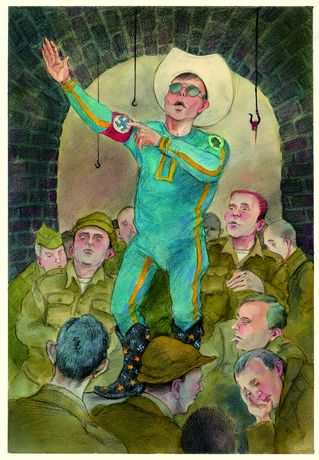
This is what an American Nazi looks like – illustrated by John Holder

“All moments, past, present and future, always have existed, always will exist.”

Vonnegut’s descriptions of women are hilarious. He’s a Dostoevsky-level psychologist. The emotion Vonnegut creates most masterfully is that he-gets-it feeling most of us yearn for. You’d definitely go for a pint with Kurt. For me, when he said that Lot’s wife looking back “was so human” elevated Vonnegut into the “can-do-no-wrong” status. Reading about her in this context tempts me to identify her as the first ever case of PTSD – before it had a name.

“People aren’t supposed to look back. I’m certainly not going to do it anymore.”

His uncomplicated sentences and the absence of excess linguistic ornaments really add to Vonnegut’s main point – war is war. While it is tempting – and indeed seduces most, there’s no use in getting caught up in the ideology or the methodology of war at the expense of understanding the plain reality of it.

“I think you guys are going to have to come up with a lot of wonderful new lies, or people just aren’t going to want to go on living.”

At the start, the frequent remark “So it goes” is gratifying. It occurs anytime somebody or something dies. It has an interesting effect – for me it breaks the forth wall and lets me, as the reader, know that the author and I are on the same page. However, as the book progresses, it becomes compulsive, matter-of-factly and annoying. His use of symbolism is a little too overbearing in general. His overly physiological remarks and “toilet humour” took away from the work for me.

Kurt Vonnegut Slaughterhouse 5 essay
Absurd and relatable. Illustration by John Holder.

“If I am going to spend eternity visiting this moment and that, I’m grateful that so many of those moments are nice.”

The non-linear nature of the narrative emphasises the senselessness of war – but again, towards the end of the book it just seems to be happening for its own sake. There are lots of non-linear compositions that benefit from this structure. My favourite examples are the films Once Upon A Time In America and Pulp Fiction. I think Vonnegut overdid it.

“Why you? Why us for that matter? Why anything? Because this moment simply is.”

The fatalist aspect of the Tralfamadorian philosophy and the recurring quote about having the wisdom to know if you can change something, the courage to change it – and all that – seem to conflict. In a sense, Christianity is fatalist. The “So it goes” reprise has a memento mori quality to it.

“No art is possible without a dance with death, he wrote.”

Vonnegut doesn’t have a very clear philosophical message, but he seems to be convinced there is very little free will if any. The irony of the main character surviving the war despite having absolutely no survival instinct adds to this. Billy seems to have little insight into his own suffering. He escapes reality by travelling in time. Vonnegut doesn’t really offer us an opinion on whether that’s a form of madness – or real life. My impression is that Vonnegut’s outlook is that life in general appears pretty random and not worth sweating over.

“Well, here we are, Mr. Pilgrim, trapped in the amber of this moment. There is no why.”

There is a lot of criticism in the above review, but actually I loved the book. My next stop is Breakfast of Champions.

Schopenhauer’s genius and mindful boredom

Arthur Schopenhauer said something very interesting:

“Genius is the power of leaving one’s own interests, wishes, and aims entirely out of sight… so as to remain pure knowing subject, clear vision of the world.”

He argued that talent allows people to get to where other’s cannot get, while genius allows to solve problems that other’s don’t see. By that logic, Uber and Facebook are examples of genius – with a hefty dose of being in the right place at the right time.

What strikes me about this quote by Schopenhauer is how Eastern it is. I have been thinking about the subject of dreaming of a better future vs fully engaging with reality. It seems like there is no way to set goals without trading in some of the appreciation of what’s currently going on. By setting goals, we almost certainly forego the opportunity to experience what Schopenhauer called genius.

Being grounded in reality is possibly the thing we run from the most. We call it boredom. How many apps do you open on your phone just to not be alone with yourself and your surroundings when you’re on your own? I, for one, open too many. And before there were apps, books and music – there were daydreams. Boredom is a form of pain – according to Schopenhauer. He said it was an issue of affluence: if one moves on from satisfying the most basic needs, boredom becomes the source of discomfort to deal with next.

Boredom seems to upset children too. They are generally excellent at finding solutions to it: in fact, I’ve always been encouraged “to do x, y and z – because it’s better than being bored”. This is also why children hate school: there’s no escape from boredom. Boredom is vilified from the get-go.

Maybe it’s time to be bored – and not to plug every free minute by consuming something in a directed manner. Having too much direction – too many goals – leaves us with a kind of schizophrenia-by-choice – as it is splitting us away from what’s actually going on. It’s not a comfortable thought for me. All along, I’ve been sailing towards certain coasts, catching up with milestones and deadlines – while becoming progressively wrapped up in my own bubble. At the same time, I am terrified of not sailing in a direction: the thought of waking up one day when I am x age and realising I’ve nothing to show for the last y years is scary. However, it is clearly also silly. By being more mindful of what’s going on – rather than constantly having my eyes on the prize, I will surely be mindful of what way my own life is unfolding.

A focus on the present moment doesn’t mean becoming reactive and directionless. It’s not about passively accepting everything that happens and losing all sense of agency. It’s about acknowledging what’s going on and what one can do about it – while letting go of illusions. I am talking about – most of all – the illusions propagated by modern-day influencers that we can create the future. In a sense, we can, but not through brute determination and risk taking – rather through relentless examination of what’s around us – and that means embracing boredom.

On a personal note, I have a very long night connection flight coming up soon – and I realised that I was dreading it. Why? Because I feared the impending boredom. For some reason, I can’t fully relax into a book or film while I am travelling. Then I remembered something I’d noticed year ago. Some of my most significant realisations tend to happen when I am travelling. Long connecting flights are better than any meditation retreat. One has to be alert enough to be on time, watch out for gate changes and not lose one’s boarding pass – and kind of kill time too. This state allows me to be ok with the fact that I will be bored. I am inevitably grateful with what bubbles up to the surface through this boredom.

mindfulness boredom schoppenhauer genius appreciation of reality

The dangers of laser-like focus

Passion and focus are spoken about all the time. “You have to be passionate about what you’re doing, or it’s not right for you.” All the heroes of our time – mostly in tech – are known for their relentless focus on their passion. It probably culminates in the now near-mythological figure that is Steve Jobs.

the dangers of focus

I am highly distractible, but when it came to something I consider important – I’ve always been the kind of person who locks on – and that’s it. A certain degree of fanaticism was involved in many of the projects I pursued. When I was a medical student, the rest of the world didn’t exist outside of medicine. When I did HIIT, I really did it – stars in my eyes and all. Even this – I said I would blog every day.

In my experience, it’s a double edged sword. Focus is always avoiding the completeness of the present moment. We trade awareness for a hope of a better future. It’s still puzzling to me how one can be purely mindful and make plans, but our culture certainly tells us to make lots of them – and don’t forget the assorted to-do lists to go with it.

Even forgetting about mindfulness, focus is dangerous: focus on the wrong thing – and it’s a real problem. I’ve obsessed about the things that most girls obsess about: boys, weight, nice things. I am in my 20s, so it’s quite forgivable. Still, having the kind of personality that locks onto things, it’s tough to get out of a focus-rut once you are in it. It’s not OCD, but the word tormenting seems appropriate. My only medicine for this has been mindfulness – or a rude awakening from the real world. I much prefer the former.

For those of us who are super-focused, or those reading all of this advice to be laser-focused and wishing that they could be like that, remember that it comes at a price.

being really focused

When mindfulness seems impossible

Western culture is all about results. This mentality is evident virtually everywhere. We all prefer tasks that yield immediate tangible results. The prototypical somewhat narcissistic CEOs tend to be focused on results. We haven’t really moved since the time Ford made lapel pins with the number of the financial result they wanted to achieve – for everyone in the company. We’ve replaced them with motivational posters. During our formative years – in school, we are conditioned to look for results: high grades, won matches and debating trophies. The recent fitness cult is also driven by results. It is fascinating what people will do to get a six pack. While there was always the phenomenon of recounting your experience as a result, social media enhanced this conversion of experiences into results: taking a picture in a scenic place is different to just being there.

why-is-mindfulness-so-hard

Mindfulness goes against this obsession with results. It’s tempting to compare a tough mindfulness session with a tough day at the gym, but the analogy doesn’t really hold. There is no metric, no result, nothing tangible, strive towards or nothing to brag about in mindfulness. If you go running and it’s really tough, at the end you can say: I ran a 5K today. What if you just turned up and ran for 30 minutes? That a bit closer to mindfulness, but the fitness world wouldn’t approve. After all, you could have been slacking off for the 30 minutes. Why weren’t you tracking your speed? Why didn’t you measure the distance? Did you at least weigh yourself or measure your waist the next day? What gets measured gets managed, they say – and it’s true. Fascinatingly, there is no goal and no metric in mindfulness other than to actually turn up and do it. It’s binary.

So if the whole thing is making you feel like it’s impossible, just remember that it’s a yes or a no. Any kind of yes, even the most distracted meditation that feels like a Herculean effort, is a yes.

Some worry that if your practice feels really distracted, it doesn’t count. It does. However, there are ways to make it better. There are countless techniques, but this is the one I found works best: counting.

Counting involves focusing on a very transient moment in time: the moment when the in-breath becomes the out-breath and then the slightly longer moment: when the out-breath stops.

So it goes:

  • breath in
  • when your in-breath stops, count 1. You may not even have time to say 1. You can just see the number in your head.
  • breath out
  • when you breath out stops, count 2. There will probably be more time here

It may be tempting to pause after the in-breath. Some people do. For me, it seems that mindfulness is more natural when you are just observing your breath rather than changing it.

It’s not always true, but in case of meditation the maxim done is better than perfect certainly applies.

tips to make mindfulness easier