Evolution’s black swans

Nature must want us to be bad at understanding black swans. (I am still, sort of, listening to The Black Swan.)

The guy who discovered that carrots are edible didn’t really think, “Hmm, there is a small chance that this is a strange variety of hemlock and I will die and thus my family will die as I won’t be there to feed them, but the odds are that I will be fine”*. The man who ate the first carrot was playing Russian roulette, like the guy who lived across the way from Nero Tulip.

Evolution is playing her own game and worries more about the species rather than the individual. Hence, it is in her interest to instil into us a blissful ignorance for hidden risks and a strong hope for hidden rewards. She stands to lose, what, just a few individuals? – but to gain a carrot-induced reproductive boost! And of course, our enterprising caveman introduces carrots to the wider populace, takes a nice cut for himself and his genes.

It’s like that old adage they pass around in finance classes: what is the best way to make money in the casino?

Answer: own it.

* It’s quite possible that his other option was certain death by starvation, which legitimises his decision entirely.

** Just something that came out of a reddit debate:

It is more correct to replace the word “species” with “kin group” and my point still stands (and I guess a species is just a large kin group). Any group that produced the risk-taking individual (phenotype) is likely to still have those genes in its gene pool (genotype). Thus, if it benefits the group, they expand in number. If such a group were basal to all modern humans, it would explain why we view risk in a way that the average insurance broker would disagree with. Consider 2 options, A and B, where A has a higher expected value. A would seem to be the right choice, but if B has a huge payoff, then an individual who does the WRONG thing and gets lucky will be selected for and expand his lineage very quickly. Yes it will be disadvantageous in the long run, but i) nobody said humans are built for the long run and ii) if he has extinguished his rivals’ lineage by sheer weight of numbers by the time luck runs out, and then there is a mutant descendant that corrects his “genetic mistake” and becomes risk averse, it doesn’t matter if all the other descendants do badly, he has still propagated his genes into the future in a way he would not have been able to had he evolved to always make the correct decision based on expected value.

If you don’t think that eating carrots is an evolutionary jackpot, think about rice. The man who discovered rice did very well genetically. But how many like him died eating random stuff?

Btw, I am not attributing a metaphysical guiding hand to evolution.

Turning wine into water

I was watching Troy with somebody who happens to know a lot of useless things (his words, not mine). The Trojans and the Greeks were having a feast and he mentioned that they used to dilute their wine.

So we read into it. The natural max alcohol content in wine is 15%. Apparently, the Greeks used to dilute it up to 9:1, as in 9 parts water, 1 part wine!

I decided to try it with a 13% Montepulciano to get that full-bodied Mediterranean taste that opens sweet and ends earthy. We decanted it for an hour.

diluting wine with water
50 ml wine in each, 2:1, 1:1, pure

As a baseline, it was rich, sweet, with an astringent end-note.

At 1:1 (1 part water, 1 part wine), it was very sour with the astringent aftertaste.

At 2:1, it was sour, like pink grapefruit juice, the astringent aftertaste was lighter.

At 4:1, it was like lemon water with a mind astringent end-note. Sort of refreshing.

At 6:1, I couldn’t tell there was alcohol in it.

I don’t think I will be trying it with red again. I think white will come out more with the dilution.


Cool, as of 1528

Sprezzatura [sprettsaˈtuːra] is an Italian word originating from Baldassare Castiglione‘s The Book of the Courtier, where it is defined by the author as “a certain nonchalance, so as to conceal all art and make whatever one does or says appear to be without effort and almost without any thought about it”. It is the ability of the courtier to display “an easy facility in accomplishing difficult actions which hides the conscious effort that went into them”.

Sprezzatura has also been described “as a form of defensive irony: the ability to disguise what one really desires, feels, thinks, and means or intends behind a mask of apparent reticence and nonchalance”. (Wikipedia)

The word has entered the English language; the Oxford English Dictionary defines it as “studied carelessness”.

It would be the Italians who would come up with something like this and it would be in Oxford that they would make it sound so lame… Why couldn’t they just say cool?

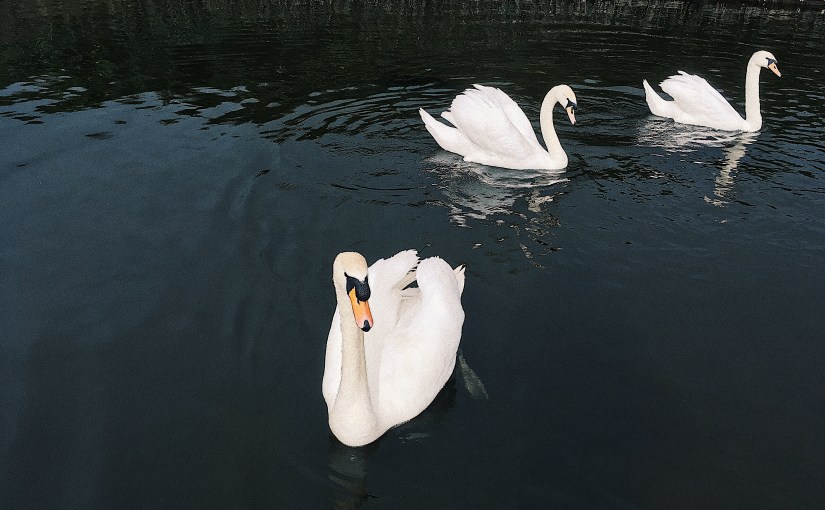
I think swans have a significant amount of sprezzatura.

Sprezzatura is my excuse for not publishing the results of how I got on with the plans I set in September. It is also one of the great things I learnt from Taleb’s The Bed of Procrustes. I recommend it.

P.S. An existential question for WordPress bloggers. Why WordPress and not Instagram or Facebook? Why not Medium?


Is it a man’s world?

Kitchens aren’t designed for men.
The average Irish man is 14 cm taller than the average Irish woman. The sinks are too low for them, the cupboards open straight in their faces – and who can get down low enough to see what is in the freezer compartment…

Clearly, it is men who build kitchens.

In very old buildings, men just built things without a 100 considerations. I would find it difficult to reach things from the top shelf in the GMB, for example. In other words, 100 years ago, kitchens were designed by men, for men. Not on purpose, of course.

Later, women became in charge of their household spending and builders started building for their target audience. He who pays the piper…

A strategic error and failure to consider n-order consequences.

Inbox Clogging Friday

Every store I ever visited sent me an email today. Or so it feels.

I don’t even have to make a list of places I may want to unsubscribe from.

The thing is that the average “European” doesn’t have a bull’s notion about Thanksgiving or Black Friday. If anything, Black Friday sounds akin to Bloody Sunday.

We never had Black Friday in Europe up until about 2 years ago. It’s just marketing and no apologies.

The ROI of beauty

Empirically, the most accomplished, intelligent people I know couldn’t give two fks about beauty standards.

All the same, it is super popular and desired. Being beautiful seems to serve a purpose beyond health and attraction. I am wondering what that is.

I followed Jessi Kneeland a few years ago after seeing a recommendation on Greatist. Obsessed with HIIT, the fitness-junkie in me rejoiced at finding her, fit as a tennis ball.


In the last year, she switched from being a fitness guru to a body image coach:

“Here are some of the boxes which a modern woman must check in order to be hot. (You’ll notice that many of these are actually “achieved” through effort, skill, time, and money, rather than inborn):
➡️A thin/toned hourglass body
➡️Big perky breasts
➡️Long femme smooth hair
➡️Youthful appearance
➡️Big doe eyes
➡️Kardashian level makeup
➡️Smooth and hairless skin
➡️Well-fitted clothing and high heels
➡️A particular way of moving, speaking and posture.” Source

I think this is a really interesting point: hotness is down to the amount of energy you put into it. My personal experience would be congruent with her ideas.

“Women were taught that our purpose in life was to be desirable enough to “snag” a good partner.”

That is certainly the idea being thrown around by “empowering” publications. I think any woman who was told this and bought it already had issues with her self-respect.

I went through a rebellious phase when I was around 12. Sporting short hair with a touch of pink, I was asked to stay behind after class. The teacher didn’t bring up anything academic. She told me that she does not approve of my image and that women ought to have lovely long hair.

I told her that I don’t subscribe to her standards of what women “ought” and could she please refrain from biting into my after school time unless absolutely necessary.

Being a rebellious teenager seems to be like chicken pox. It’s better to get over it when you are a teenager.

I’m not immune from societal expectations. I do admit to feeling a little ill when seeing some of the casual modelling that goes on on Instagram.

But if I were to feel bad when watching the Oscars for not being a movie star or feel bad when going to a gallery for not being an artist, that would be silly.

It’s best not to confuse societal expectations and your own. But this is where it gets interesting:

“Beauty standards got invented to help women be more competitive in the man-snagging market, and the whole thing escalated endlessly until we all have to look like airbrushed celebrities in order to be “good enough”.

Indeed, what is the point of beauty standards if not to attract a partner?

“I wondered if women who aren’t attracted to men might worry less about looking “hot,” since the whole women-as-beautiful-sex-objects thing was made by and for men, right?”

Basically, she asked LGBT women. As an experiment, this didn’t control for the “looking for a partner” aspect, only for “looking for a male partner”.

“The feedback I got proved this shit has nothing to do with men at all: being gay does *not* seem to offer ANY freedom from the pressures of the male gaze, beauty standards, or insecurities…

It’s not for men. So then what are doing this all for?”

What if we tried to control for “looking for a partner”? Ask married people? Well, they still have to “maintain a parter”, so that’s out.

So why do women do it?

A lot of men do the male equivalent, but it seems that that’s not quite as common.

Is it literally being gullible? These standards are floating out there, so we adapt them with the idea that… That what? It will make us better people? Plug holes in our self-esteem?

Or is it literally just down to being a more attractive partner? But that doesn’t add up because (from what I can tell) a lot of men don’t like women who fulfil the “hotness standards” outlined above.

So, either the purpose of looking hot is to find/maintain a partner, only the method is miscalculated, or there is some other reason. Let’s consider proving your worth as a reason.

Traditionally, men had other ways of proving their worth, e.g. their work. That’s increasingly popular with women. In that case, looks should be less important in today’s society than they were 200 years ago. I have no way whatsoever of testing that.

It’s well known that beautiful people are assumed to be more persuasive, trustworthyintelligent and generally better.

The question then arises: is it worth it?… Cause it is hard work – as Jessi has shown us above.

Curious as to what you think!

UPD: This is a really interesting perspective on gender issues.

Trying to be old

I loved how the sun lit up the windows of the ostentatiously classy restaurant come wine bar on St. Andrew’s Street in Dublin called Stanley’s. The bleached turquoise exterior with golden letters spelled understated chic.

A few doors down from the expensive Trocadero, the location seemed perfect for such a place.

It opened about 2 years ago. Today I found that it’s been replaced with a place called Kathmandu, a gerrish, bright orange Nepalese eatery. Full of people. 

Stanley’s was never full of people.

Why? Where did they go wrong? Where didn’t they go right, more like? The broadly positive Irish Times review and then another even more positive one? The perfect location? The classy interior in modern blues and grays? What more could people want?

Or is it maybe that classy is old-fashioned. Maybe these things don’t sell anymore.

I love old books, films, chandeliers, even houses. Often these things sell at a perplexing yet welcome discount.  Has it always been this way – that old things are cheap?

Writing up my list of the Christmas gifts I want to give, I realised that I strongly prefer older things. I think it’s from reading too many XIX century novels…

Which would you rather get for Christmas, a new iPhone or an antique chandelier? 

It turns out that the iPhone is about five times the price. This raises another point: did old things always go at a discount?

And finally, maybe that’s why Stanley’s closed down. Perhaps their bet was on people’s vanity, a desire for a classy place to shorten the protracted winters nights. But it never caught on.

Trying to be old without actually being old may be a hard sell. 

Silver linings

I edit essays almost every day. One sparkled my eyes with its brilliance. Later I realised that the author plagiarised it from John Green’s Looking for Alaska. Oh well.

I guess I can’t be expected to have read every novel ever written. My silver lining lies in the revelation that I’m good at spotting great writing 😉

In my quest to produce notes for Macbeth, I watched Scarface. A favourite of mine. Macbeth and Scarface would make a fabulous comparative study.

This time I noticed how the camera work underlined the message.

When Elvira snorts cocaine, the camera moves back and zooms in at once, mimicking the mind-altering effects of the drug.

When Tony gets killed, the camera moves from his lifeless body to the steely assassin and onto the fountain encircled with the neon sign “the world is yours“. The assassin obviously becomes the new Tony and the world is now his. The camera bows down to the winner by showing him from below, then it slowly follows the assassin as he descends down the stairs and distances to show what’s ahead of him. Endless dead bodies. His path will inevitably bring him to the bottom of the stairs, to the midst of the carnage and the cycle will repeat.

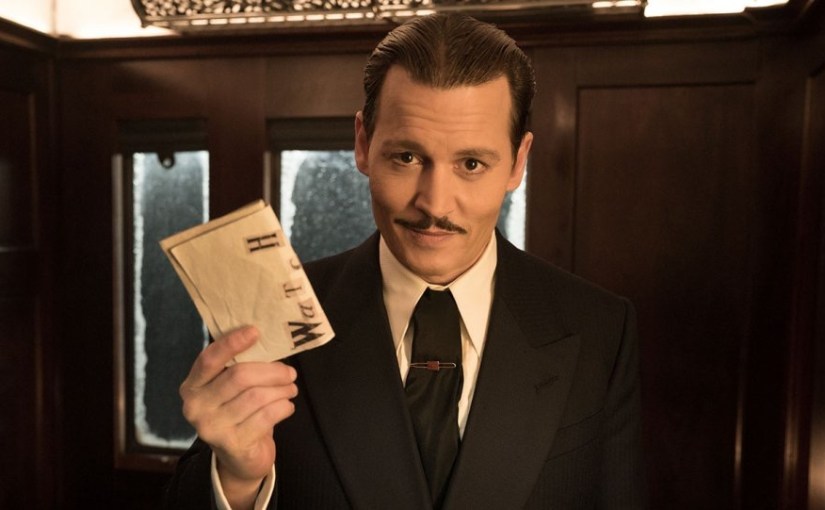
Murder on the Orient Express, 2017

For anyone who has seen the David Suchet version, it’s doomed to disappoint. 

I love Poirot. The ITV rendition with David Suchet is the classiest, coziest drama you will ever see. The only other TV series I enjoyed as much is Blackadder (and the Russian TV show What? Where? When?)

What about this latest film? 

Kenneth Branagh’s Poirot is straight out of Hollywood. He elegantly sabotages the villains with his cane, uses it to tear down locked doors, plays tricks with unloaded guns and insists that everyone straightens their ties all the time. It’s more of an ageing James Bond than Poirot. 

In terms of culture wars, Branagh’s Poirot used a the portrait of a long lost love for his ethical struggles rather than a religious relic. 

Michelle Pfifer as the victim’s grandmother was pretty awesome, to be fair. Just Dench didn’t really add anything, unfortunately.

For anyone who likes David Suchet’s performance, I don’t advise going to this. Not even to stare at Johnny Depp. 

In defence of four letter words

So,  now that D.H. Lawrence is on the Leaving Cert syllabus, to understand the man better, I’ve decided to read his most famous and controversial Lady Chatterly’s Lover.

My first impression was that there must be something really different about those times and now.

I thought: I can honestly say that my millennial brain didn’t detect anything remotely scandalous in it. The publisher was taken to court, you know, under the Obscene Publications Act in the UK… Fair enough, the subject is a little racy, but no racier than, say, Anna Karenina.

Apparently the man who led the prosecution of the trial in 1960 asked if it were the kind of book “you would wish your wife or servants to read”… Hard to believe that that was said not even 60 years ago!

My other impression was that it was bland. What is this book about at all? Why is it famous? Just by virtue of the trial?

Something wasn’t right.

Well… it turns out that I read a censored version without being aware of it.

I’ve looked over the full text now, and I can see how much I missed out on. Whoever insists on publishing abridged and censored versions has no soul.

Up until this point I never believed that swearing adds anything, but this has made me change my mind. And want to swear, too.

Here is the full version if you need it.