“It’s only natural”

This is a work of fiction. Names, characters, businesses, places, events, locales, and incidents are either the products of the author’s imagination or used in a fictitious manner. Any resemblance to actual persons, living or dead, or actual events is purely coincidental. This is not intended as a substitute for the medical advice of physicians. The reader should regularly consult a physician in matters relating to his/her health and particularly with respect to any symptoms that may require diagnosis or medical attention.

A very handsome, fit and well-dressed young man came in to see me about a nagging, chronic gut problem. This is the sort of thing that medicine doesn’t really have an answer for and the referring family doctor knew this as did the said dashing young man. The reason for her referral was that he had had enough.

I took a very long history filled with exacerbations and remissions going back to when he was a teenager, alleviating and aggravating factors that the tormented young man never really managed to leverage.

All the same, he was ahead of the curve in his career. He travelled extensively, ran a half-marathon and even climbed Kilimanjaro.

We were nearly certain that his condition didn’t have an organic cause we could address, but given the one or two potential pointers for such a cause, the duration and extent of his distress, it was decided that the gentleman should have some specialist investigations. As a sort of an advance measure, we gently suggested that in all likelihood, the tests won’t find anything and if so, there won’t be much we could offer him besides a few tweaks of what has helped him in the past. At this point he covered his face with his hand, then made a tight fist whitening his knuckles, plunging visibly into anger and frustration – not so much at us, it seemed, but at the powerlessness of medicine and his ill fate.

There is no denying that this high-flying man suffered greatly with his imperfect bowel. I was left there wondering two things.

This man is so accomplished, able to climb mountains and run marathons, why does he so firmly believe that his condition is “debilitating”? I can only presume that he has a kind of equation in his head where his potential plus his condition equals his reality. I did wonder if his reality could have been far more impressive had it not been for these bouts of gastrointestinal torture. I have the suspicion that the thought occurred to him. Perhaps it occurred to him many times a day.

Furthermore, if he is determined to eradicate this unidentified fiend sabotaging his gut, why didn’t he do more of what worked and avoid the aggravating factors? It would seem a little maladaptive to refuse to negotiate with the affliction. Or did he write down all his shortfalls to the condition, thus allowing him to sustain a vision of unadulterated, perfect potential trapped by the wretched disease?

I then wondered if that is our perfectionist millennial nature that’s always chasing the latest maximising-optimising lifehack or is that the sort of irreducible self-selection that particular kind of young person to hospital regardless of their generation or culture.

The reason I wonder this is that only last week I was trying to convince a much older man to consider treatment for his chronic pain, but he insisted, “it’s only natural”. Then again, I don’t think it would ever occur to him to climb Kilimanjaro.

Gisgo

Prior to the Battle of Cannae, a Carthaginian officer named Gisgo commented on how much larger the Roman army was. Hannibal replied, “Another thing that has escaped your notice, Gisgo, is even more amazing—that although there are so many of them, there is not one among them called Gisgo”. Source

I misread it at first and thought – Glisgo, what a fabulous name for a cat.

It’s that simple

A 60 year old woman told me today that she lost 10 kg (22 pounds) in the space of one month, without starving herself, etc. Her bloods even look better. Of course, she has a lot to lose (say 30-40 kg), but I just think it’s so amazing when people do actually do it.

I asked her what was the main cause she could identify – giving her a few a few options, such as changing what she eats, exercise, a life event?

And she said, “not overeating”.

And simple truth miscalled simplicity, indeed.

Decisions

Whenever I struggle to make a decision, I think of Seneca’s letters. In short, the message is, if you had a very short time to live, what would you do?

I have recently discovered another method.

Imagine you are an 85 year old you giving yourself advice. What would your 85 year old self tell your present self?

Written under the influence of geriatrics and Saint-Emilion.

A little bit of Irish politics

What is the purpose of having four political parties if for the last couple of constitutional referendums they all virtually agreed with each other on how people should vote?

I don’t necessarily disagree with them, but there seems to be a resounding group-thinking lack of pluralism.

P.S. Are you painting yourself green for Paddy’s Day?

If Symptoms Persist by Theodore Dalrymple: my highlights

A retired psychiatrist tells all. Warning: Controversy and cynicism ahead.

“I find my own cynicism witty and sophisticated; but in others I find it callous and brutal.”

[About health promotion]: I am so heartily sick of the tepid existence which we doctors are now peddling as the elixir of life that when one of my patients refuses to take my good advice, I want to jump up on my table and give three cheers.

I know there are medical fascists around –a former President of the Royal College of Physicians is one –who would make such patients pay for the treatment of their ‘self-induced’ diseases, but this seems to me to come perilously close to the Erewhonian nightmare, in which youths who bash old ladies over the head will receive treatment but people with heart attacks will be punished.

It is a well-known fact that one of the best preservatives against ill health is self-employment. The self-employed cannot afford to be ill, while those in the employ of others cannot afford (it often seems) to be entirely well.

I should have bought something for my ward with the £ 5, of course, but the devil entered me and I decided to go through the proper channels. [What follows is his recount of how he spent multiples of the “thank you” from a patient on the bureaucracy of “proper channels”].

‘I’ve realised, doctor,’ she said, ‘that life’s not worth killing yourself for.’

The symptoms of her illness were vague but debilitating: she could no longer summon up the energy to do the thing she did not wish to do, such as vacuum-cleaning and ironing.

[About a patient who didn’t notice at all that she was being seen by a doctor who was standing in for her regular doctor, Dr S, who is a very warm-hearted individual]: I feel rather sad on Dr S-’ s behalf. He thinks his patients value his efforts, but in fact he is valued only for his function, as a vacuum cleaner or washing machine is valued.

[About a woman who immigrated to the UK and successfully built a life there, only to find her one of her sons deliberately unemployed and one in jail]: How has her dream of thirty years ago been turned into this nightmare? I do not have the whole explanation, but I suspect that those who teach that employment is exploitation, that law is injustice, and that racial prejudice is so ubiquitous and all-pervading as to render personal effort superfluous, have much to answer for.

No matter how deluded and paranoid people are, they are usually able to refrain from attacking several policemen, each of whom is over six feet tall.

Since activity is as good as action, the first thing to do is to form a committee… The purpose of this committee is to assure the Health Authority that it can assure the Ministry that it can assure the Minister that he can assure the Government that it can assure the Opposition that something is indeed being done.

As everyone is aware, alcohol is responsible for accidents, murder, suicide, cirrhosis, cancer, heart disease, stroke, divorce, crime and ruination, as well as 95 per cent of the enjoyment at social occasions and a considerable, if lesser, proportion of government revenue.

[On health education]: Their jobs depend upon a permanent effervescence of publicly-funded panic.

Dealing with people makes you appreciate things.

[To a patient]: ‘What you’re really saying to me is this: when you have found the single piece of buried treasure in my psyche that explains my behaviour, I will automatically stop breaking into people’s houses; but if you don’t find out what it is, which is your job as a doctor, then, when I break into people’s houses and steal their videos, it is really your fault and not mine.’

In the eternal struggle between doctor and patient, I told a medical student last week, the patient always has the upper hand. This is because, while the doctor is constrained by a code of behaviour, the patient is not: he can use any means he likes to bring about his desired end… A doctor has to learn to accept blackmail, I said, with a good grace.

Surely, if passive smoking is bad for one, the passive consumption of junk food must be even worse.

The ward smoke alarm went off in the midst of my reflections. I went to see what was happening: the alarm was being tested. It took three men to test it, one up a ladder, one with a clipboard at the base of the ladder, and one –a Fire Prevention Engineer –to oversee operations. And then, suddenly, the whole meaning of life became clear to me: so to arrange things that we survive until tomorrow.

One of the worst things about being a doctor is that you have to pretend that repulsively bad manners are a sign of suffering.

After all, if you don’t do anything, you can’t be accused of inefficiency.

Our Culture, What’s Left of It by Theodore Dalrymple: my highlights

A fascinating book from a retired psychiatrist/prison doctor who has seen the sort of things most of us never encounter. Mostly skeptical and confrontational, occasionally dark and a little prudish – with ephemeral sightings of the most honest optimism. Verbose. I usually despise verbosity, but his is the sort that I like to read out loud.

There is something to be said here about the word ‘depression,’ which has almost entirely eliminated the word and even the concept of unhappiness from modern life. This semantic shift is deeply significant, for it implies that dissatisfaction with life is itself pathological, a medical condition, which it is the responsibility of the doctor to alleviate by medical means. Everyone has a right to health; depression is unhealthy; therefore everyone has a right to be happy (the opposite of being depressed).


When young people want to praise themselves, they describe themselves as ‘nonjudgmental.’ For them, the highest form of morality is amorality. There has been an unholy alliance between those on the Left, who believe that man is endowed with rights but no duties, and libertarians on the Right, who believe that consumer choice is the answer to all social questions, an idea eagerly adopted by the Left in precisely those areas where it does not apply.


It is only the sentimentalist who imagines that the profundity of a person’s response to tragedy is proportional to the length, volume, or shrillness of his lamentation.


Danger simplifies existence and therefore—again when chosen, not imposed—comes as a relief from many anxieties. [About a photographer in Vietnam]: He loved the country, but his commitment to it was only war-deep: if peace, alas, were to break out, he would have to find another conflict to photograph.


Untold numbers of my patients, with every opportunity to lead quiet, useful, and tolerably prosperous lives, choose instead the path of complication and, if not of violence and physical danger exactly, at least of drama and excitement, leading to sleepless nights and financial loss… As many have told me, they prefer disaster to boredom.


…social theorists often suppose that human beings have a clear idea what it is they want from life, and behave moreover as if they were rational calculating machines designed to procure it.


I learned early in my life that, if people are offered the opportunity of tranquillity, they often reject it and choose torment instead.


For a long time I pitied myself: had any child ever been as miserable as I? I felt the deepest, most sincere compassion for myself. Then gradually it began to dawn on me that the education I had received had liberated me from any need or excuse to repeat the sordid triviality of my parents’ personal lives. One’s past is not one’s destiny, and it is self-serving to pretend that it is.


…a rejection of everything associated with one’s childhood is not so much an escape from that childhood as an imprisonment by it.


I had assumed, along with most of my generation unacquainted with real hardship, that a scruffy appearance was a sign of spiritual election, representing a rejection of the superficiality and materialism of bourgeois life.


[About Soviet border officials]: He surmised that these border officials had been deprived of all true discretion and were deeply fearful themselves of the power to which they were subordinate… ‘automata inconvenienced with a soul’:


[About St Petersburg]: The very selection of the terrain—a freezing swamp—for the construction of a city by the fiat of the czar was an expression of contempt for humanity, for in such a place construction necessarily entailed the deaths of hundreds of thousands of men. Only where human labour—and life itself—ostentatiously counted for nothing could such a system of building maintenance have been envisaged, let alone tolerated.


An uncorrupt leviathan state is, in fact, more to be feared than a corrupt one.


The British, by contrast [to the Italians], are still attached to their state as calves to the udder. They have just voted massively for a party and a man who claim to be responsible for everything—whose government has recently issued, for example, an official booklet to every engaged couple outlining the advantages and disadvantages of marriage, as if the population were incapable of thinking for itself even about those things that most intimately concern it (which, under a regime like this, is increasingly the case).


British liberals, who habitually measure their own moral standing and worth by their degree of theoretical hatred for and opposition to whatever exists.


[About Princess Diana]: In an age when strength of character consists of being able to flaunt one’s weaknesses to the prurient gaze of millions of idle onlookers, nothing could establish her bona fides better than her confession that she induced herself to vomit after eating too much: just like a thousand or a million salesclerks anxious about their weight… That her tastes were, despite her privileged upbringing, utterly banal and plebeian appeared very clearly at the funeral, where Elton John sang his bathetic dirge immediately after the prime minister read Saint Paul’s magnificent words in Corinthians.


Those who think that an understanding of the double helix is the same as an understanding of ourselves are not only prey to an illusion but are stunting themselves as human beings, condemning themselves not to an advance in self-understanding but to a positive retrogression.


Many a man is the Macbeth of his own little world, and the measurement of evil is not the same as a body count.


Macbeth is motivated in equal measure by ambition and by the fear of appearing weak and small in the eyes of his wife… Shakespeare gives us to understand that their self-pity—and by extension all self-pity, including our own—is dangerous, permitting evil in the name of restitution… And in showing us that the line is always there, easily and disastrously crossed, Shakespeare destroys the utopian illusion that social arrangements can be made so perfect that men will no longer have to strive to be good. The prevention of evil will always require more than desirable social arrangements: it will forever require personal self-control and the conscious limitation of appetites.


…a Marxist wondering whether or not the historical inevitability of the triumph of the revolution requires his participation… As Russian Marxists needed their Lenin, so Macbeth needs his Lady Macbeth… She humiliates him into doing what he knows to be wrong, just as many of my patients who take heroin started to take it because they were afraid to seem weak in the eyes of their associates… The lesson is that any powerful emotion or desire, however virtuous in many circumstances, can be turned to evil purposes if it escapes ethical control.


Macbeth is aware throughout the play that what he does is morally wrong: he never claims (as do so many modern relativists) that fair is foul and foul is fair. He thus single-handedly refutes the Platonic theory of evil as ignorance of the good. Unlike his wife, he never deceives himself that a little water can clear them of their deeds.


Only if we obey rules—the rules that count—can we be free.


Penguin Books’ proposed publication of Lady Chatterley’s Lover clearly suggests that the company knew the book could not be defended against the charge of obscenity; publication had to wait until Penguin could rely for the book’s defence upon the evidence of ‘expert,’ that is to say elite, opinion.


The idea that social perfection is to be achieved through wonderfully sensual sexual relations between men and women is a fantasy unworthy of prolonged intellectual consideration. To call it adolescent tripe is to be unfair to many intelligent adolescents.


[About Virginia Woolf]: One way to surpass her father and her uncle in achievement was, of course, to disparage and destroy all they had erected.


An incident when I practiced medicine many years later on an island in the Pacific Ocean reinforced this lesson. Next to the small psychiatric hospital, with its yard enclosed by a high wire fence, was the leper colony. Every afternoon, the lepers would gather at the fence to mock the lunatics as they were let out for their exercise, performing their strange dances and shouting at unseen persecutors.


There is a permanent temptation, particularly for intellectuals, to suppose that one’s virtue is proportional to one’s hatred of vice, and that one’s hatred of vice is in turn to be measured by one’s vehemence of denunciation.


‘Artists must continue the conquest of new territory and new taboos,’ Rosenthal continues, in prescriptivist mood. He admits no other purpose of art: to break taboos is thus not a possible function of art but its only function. Small wonder, then, that if all art is the breaking of taboos, all breaking of taboos soon comes to be regarded as art.


That civilised life cannot be lived without taboos—that some of them may indeed be justified, and that therefore taboo is not in itself an evil to be vanquished—is a thought too subtle for the aesthetes of nihilism.


This way of thinking about culture and civilisation—possible only for people who believe that the comforts and benefits they enjoy are immortal and indestructible—has become almost standard among the intelligentsia of Western societies.


At the same time, achievements are taken for granted, as always having been there, as if man’s natural state were knowledge rather than ignorance, wealth rather than poverty, tranquillity rather than anarchy. It follows that nothing is worthy of, or requires, protection and preservation, because all that is good comes about as a free gift of Nature.


[About the freedom to use drugs]: In practice, of course, it is exceedingly difficult to make people take all the consequences of their own actions—as they must, if Mill’s great principle is to serve as a philosophical guide to policy. Addiction to, or regular use of, most currently prohibited drugs cannot affect only the person who takes them—and not his spouse, children, neighbours, or employers.


No one seems to have noticed, however, that a loss of a sense of shame means a loss of privacy; a loss of privacy means a loss of intimacy; and a loss of intimacy means a loss of depth. There is, in fact, no better way to produce shallow and superficial people than to let them live their lives entirely in the open, without concealment of anything.


When sex is deprived of the meaning with which only the social conventions, religious taboos, and personal restraints so despised by sexual revolutionaries such as Ellis and Comfort can infuse it, all that is left is the ceaseless—and ultimately boring and meaningless—search for the transcendent orgasm.


The law of unintended consequences is stronger than the most absolute power.
Besties and other blogging finds

Some bloggers I have enjoyed reading of late if you need recommendations 🙂 I love blogs about real people who share at least some unbridled emotion. Disclaimer: lots I haven’t mentioned…

Brian’s bloga man we affectionately call Pink’s blog, Bela’s blog, Stephen’s blog, Kenzie’s blog, Plectumm’s blog, with special thanks to a particularly tempered interlocutor.

Paul and Akira’s trials and tribulations: I have been reading George F.’s works for some time and lately he has upped the crazy dial resulting in some pretty captivating riffs.

Brand new blog about writing and a long standing oneKelsey’s blog about goals: Kelsey reached out to me about her blog where she explores goal-focused pursuits.

Lots more out there, please comment with your own faves, so that I can follow them.

February results of the Image Experiment

In January, I decided I would do an Image Experiment. I started off with make up, but quickly moved on to other aspects of image.

What I learnt working on my image this February:

  • it’s super hard to meaningfully communicate who you are through what you wear
  • people are friendly to you in proportion to how well you suit their sense of style (a variation of “people like people who are like them”)
  • buying expensive “investment” pieces is overrated
  • taking photographs of your own outfits leaving the house is a really easy way to see how others see you
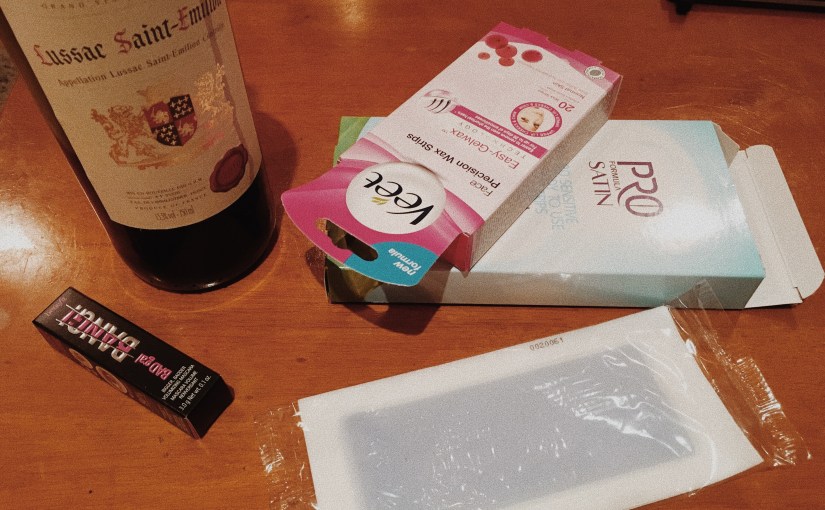
  • on a practical note, having your eyebrows waxed is far less painful than getting them threaded or shaped – and clay masks are it.

Even though Christmas is only a memory at this point, Santi continued to be kind by invoking some awesome sales. I purchased a black faux shearling coat, a pink wearable blanky puffy coat (both in Zara) and dug out a pink garçon cut woolly coat (Betty Barclay), all of which seemed to have garnered me some respect from people my own age (see points one and two above). Cos has also been full of pleasant surprises.

I have found that the expensive investment pieces go out of date, even if they are deemed to by “timeless”.  God is in the detail and having experimented with both “timeless” and “trendy”, I think there is something to be said for the freshness of cutting edge detail. On that note, I bought an Italian leather bag so minimalist it is hard to imagine how it could be any stricter. I felt though that it reflected what I needed and what I wanted to say.

I know that everyone is saying it, but really, less is more when it comes to clothes. In rearranging my wardrobe, I realised that I wear only about 10 things and the rest is 80% deadweight legacy occupying prime real estate in my wardrobe and 20% special occasion wear. Needless to say, I moved all the deadweight stuff out, which eliminated the illusion that there was all this choice and made it easier and more pleasant to decide what to wear.

The theory is that your style is a way to signal your substance. This put me into an absolute brain spasm, for I have no idea how to translate the substance into image. I guess that’s the reason for the experiment.

I have figured it’s important to acknowledge that between my height and that I am always ID’d, I look a little younger than I am. I never felt quite comfortable in a feminine look unless it was either girly or classic, i.e. I can’t handle wilting flower and smouldering temptress . Where I was born, a resting bitch face is simply called a resting face, so on the scale of Sailor Moon to Hermione, I should err on the side of  serious kind of younger, on the stoic end of preppy.

I implemented this when I had the misfortune to break my old glasses, which has never happened to me before. I decided to treat myself to a new set after almost 10 years. I went with a catty tortoiseshell pair and a round rimless pair as I felt they communicated my lack of interest in talking about the weather.

At a little reunion with my friends from a multinational I used to work for and seeing my old classmates, it was remarked that my skin and hair looked very good, which I will put down as confirmation bias evidence that my clay masks are doing something good.

I have also found that people like to talk about something you are wearing and what they choose to talk about is an interesting reflection on the person. How can I say this without sounding very Machiavellian? People seem to like you if they like what you are wearing and they will like it if they feel that that is something they themselves could have worn.

IMG_9278