The film about Churchill

Darkest Hour opened today in Ireland.

Spoiler: the most exciting thing about the film is Gary Oldman’s makeup.

The first half of the film captivates the viewer with the impossible situations Churchill is forced into, the many subplots shaping the final decision and lots of moral ambiguity. Churchill is portrayed as a somewhat flawed but likeable human being.

The second half, however, bores them with cliche rallying for a cause.

Interestingly, the audience was made up of a mix of school kids still in their uniforms and people over fifty. Millennials? Zero interest.

And Nike isn’t perfect

Finally, I mustered the courage to go for a run, the first time after the Christmas-New Year gluttony season. I launched myself off my behind and out the door, only to realise that my runners hurt my feet because they’re weathered and to retreat.

When I was younger, I loved jogging. The trouble is that urban running will turn to dust even the sturdiest knees, so I avoid it (except barefoot on the beach, but you couldn’t do that where I live).

I always worried about biomechanics and can vouch for Brooks Adrenalines, Brooks Ariel and Nike Lunar Glides.

As I only need these for the occasional run, I decided to go with the less extravagant Nike Lunars.

Why am I telling you all this?

Because design. They make it out like it is all so slick and cool (in some ways it is), but to order a pair of Nike shoes I had to:

  • launch a LiveChat from the purchase page as it was giving me gobbledygook error codes
  • the LiveChat person told me that I am on the Irish site, but LiveChat doesn’t service the Irish site, only the UK one, and I have to ring the Irish customer service
  • I rang the Irish customer service only to be told that well, who knows, just clear the cache and try again in an hour
  • the fact that this advice worked only emphasises the randomness of how Nike handle the process

Why was there a link to LiveChat from a page that isn’t services by LiveChat? (the URL contained ie, the Irish country domain)

Why does the UK LiveChat not deal with the Irish site?

Why is there no Irish LiveChat if there is an Irish call centre? (The guy who answered the phone sounded local).

Why does the website spew error codes that are remedied by, basically, giving it a kick?

Nike has such pristine design. Always has. Let’s be honest, I shop in Nike not just for the biomechanics, but for the clean feeling that their design brings. A bit like getting your teeth cleaned.

But this part of the user experience is more like falling into a barrel of tangled wires. I’m not annoyed, just a little disillusioned. Santa isn’t real –  and Nike isn’t perfect. A company that is so driven by image, they really have to get their online act together.

So that I can get that clean feeling again.

The gender pay gap 💩

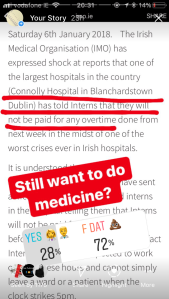
There is a hospital crisis in many places in Europe and it’s quite bad in Ireland. It’s a complicated situation. In the midst of this, one of Dublin’s major hospitals decided they won’t pay interns overtime.

Some background. Interns work anywhere between an average of 45 and 80 hours per week in my experience. I assume the hospital will pay for the on-call time (i.e. scheduled overtime), but not overtime done on regular days.

A lot of people who follow my education platform are interested in medicine. I decided to ask a question:

gender gap medicine ireland

First, it doesn’t help the doctors’ wages that people who want to do medicine are ok with working for free.

More interestingly, I found that there was a big divide between men and women. There is an all out war at the moment on whether this gap is at least in part explained by the choices that women make (e.g. 1 vs 2).

In the sample, there were 241 women and 57 men. The sex of 7 voters was unknown.

Of the men who voted, 82.4% said no. Of the women, 69.7% said no.

Surely this is contributing to the gender pay gap?

Of the yes voters, 12.0% were male. Of the no voters, 21.9% were male.

gender pay gap in irish hospitals
The chi-square statistic is 3.7272. The p-value is .053534. This result is not significant at p < .05.

Why? Some theories. The ones that are highlighted are the ones I feel are more plausible.

  1. Women are more likely to agree to work for free
  2. Women value altruism more than men do (conflicting evidence on this, e.g. 1 vs 2 vs 3)
  3. Women value prestige more than men do (rebuttal: I think men tend to engage in costly signalling more than women)
  4. Women don’t have the foresight to understand what it is like to not get paid for work (rebuttal: I think this is subsumed by reason 6)
  5. Men perceive that they are valued by society based on their ability to earn, not based on their job title (rebuttal: men chase after medals and value the concept of fighting for their country. There is no major monetary reward for that. Similar to number 3)
  6. Women are more optimistic about being able to enact change should they themselves be in an unfavourable situation
  7. Women don’t intend to stay in medicine for the rest of their lives (rebuttal: that’s not impossible, but it doesn’t explain why they would go into at all)
  8. Women don’t see their job as their only income (similar to the above point)

Problems:

  1. Self-selection: people who follow a service that helps to do especially well in school do not necessarily represent the general population
  2. This is a survey, hence the answers are more about one’s projections than actual behaviour
  3. Internalised gender roles: women are supposed to care more about helping others than money, therefore in a survey, they will answer “yes” (this is somewhat subsumed in reason 2)
  4. The sample in mostly women, so men’s answers have less statistical power
  5. The sample is small
  6. The voters lack context
  7. The way I phrased it may have put people off medicine, or indeed made them more righteous in voting yes.


Young Irish women in business, where art thou?

There are few things I love more than blogging, but sometimes I leave the den to socialise…

It would be awesome to go to a place where you could mingle with women in business.

Why women? Places that aren’t woman-only, tend to be >80% men, something I learnt from experience. It’s not always conducive to making good connectons.*

So I went for a google for local female entrepreneurial stuff. It spat out a whole list of places. The websites scream empowerment through networking, in bright pink. One even offered good vibes. In bright pink. A bit like Ann Summers.

I also came to learn that women in business more often than not means C-suite employees of large corporations. Fair enough. Even here, with 1-2 exceptions, it is similar.

What I notice is that the average age is ~40. Also fair enough.

What I had been expecting to find was 30 year old entrepreneurs. I think that’s quite different.

But what does it mean?

That it’s virtually impossible to have built something by 30, in this part of the world?

That virtually no women in their 30s take business seriously?

*because it’s downright odd to come to a group of lads and say hello. They look so excited that it doesn’t feel like they have any interest in talking about anything serious.

P.S. Preachin’

Young Irish Entrepreneur women

My inner bored-Elon-Musk speaks up, writer’s edition

Here is a “bored Elon Musk” type idea. (I get them a lot.)

  1. Authors often struggle to get an audience
  2. People love subscription services
  3. Could you subscribe people to books they’ll like?

Turns out, Kindle beat me to the punch:

“Unlimited Reading. Unlimited Listening. Any Device. Enjoy this book and over 1 million titles, thousands of audiobooks, and recent magazines on any device for just £7.99 a month.”

*It would go something like this:

  1. The author provides the service with a number of 100% discount codes for their eBook.
  2. There is a gentle review process to pick, let’s say, 10 authors each month, in each category.
  3. The consumer gets a set of 10 such codes, for 10 different books, emailed to them every month, and pays a small fee for this subscription
  4. The author gets 1/10 (fee*number of subscribers – small cut for services) for their efforts. Their upside: exposure, reviews, and money – after all, it’s not nice to ask people to work for free.

Could still do it for non-Amazon platforms. Writers, whatcha think?

P.S. Awesome video by Jordan Peterson on existentialism.

Book Review: The Elephant in the Brain

Trying to decide whether I will like this…

This is a very good video by one of the authors.

Update:

  1. The book seems to support the hypothesis that we do things because of the signal it sends to other members of our species about us rather than for the direct, obvious reason. The authors appear rather non-committal about it, at the same time.
  2. I preferred watching a one hour video to reading an Oxford University Press book. Times are changing, indeed! Having said that, my motivation (as far as I can tell) wasn’t just laziness, but also tiredness from the whole behavioural econ/bias stuff after it was that was so brilliantly explored by Kahneman and the fact that this is a recent book, in a time when I would prefer to read something more tested 😦

TheZvi's avatarDon't Worry About the Vase

We don’t only constantly deceive others. In order to better deceive others, we also deceive ourselves. You’d pay to know what you really think.

Robin Hanson has worked tirelessly to fill this unmet need. Together with Kevin Simler, he now brings us The Elephant in the Brain.

I highly recommend the book, especially to those not familiar with Overcoming Bias and claims of the type “X is not about Y.” The book feels like a great way to create common knowledge around the claims in question, a sort of Hansonian sequence. For those already familiar with such concepts, it will be fun and quick read, and still likely to contain some new insights for you.

Two meta notes. In some places, I refer to Robin, in others to ‘the book’. This is somewhat random but also somewhat about which claims I have previously seen on Overcoming Bias

View original post 9,383 more words

Being motivated isn’t pleasant

“It’s never as good as it looks and it’s never as bad as it seems.”

The 16-17 year old students I work with often ask me how to get more motivation.  They believe that it is some kind of fairy dust capable of turning you an accomplishment-machine, realising all your potential and aiding you in changing the world.

Perhaps. They forget that motivation resembles hunger. You may feel energetic but also increasingly agitated, nauseous and sore. Your mind is focused on getting your gullet filled, that’s it. You feel unsettled and uncomfortable. You feel anxious as you mightn’t last long enough to find food. You think of all the different ways to satisfy the hunger – doing nothing is just not an option.

Being motivated isn’t pleasant.

Sometimes, we all feel excitement at a new beginning, at how much we are going to accomplish. This pleasant sensation differs from what I would call motivation. We all need such an elated state sometimes to carry us through, but we borrow it from the emotional bank and will have to pay it back with interest. This loan covers over the obstacles that will get in our way and helps us to get started. If you want to feel elated, all you need to do is ignore reality.

Not a sustainable solution.

I think all productive people oscillate between feeling hungry and transiently being satisfied with what they accomplished.

https://www.instagram.com/p/BdOyZO0h5fw/


Party like a Russian

The whole concept of wishing things for the New Year and resolving yourself to live differently once the clock strikes 12 is rather mystical, if not religious.

A lot of people, of course, have given up on New Year’s resolutions.

For many Russians, it is a much much bigger deal that Christmas, for obvious reasons.

Initially, the Soviets tried to replace Christmas with a more appropriate komsomol (youth communist league) related holiday, but, shockingly, this did not take. And by 1928 they had banned Christmas entirely, and Dec. 25 was a normal working day.

Then, in 1935, Josef Stalin decided, between the great famine and the Great Terror, to return a celebratory tree to Soviet children. But Soviet leaders linked the tree not to religious Christmas celebrations, but to a secular new year, which, future-oriented as it was, matched up nicely with Soviet ideology.

The blue, seven-pointed star that sat atop the imperial trees was replaced with a red, five-pointed star, like the one on Soviet insignia. It became a civic, celebratory holiday, one that was ritually emphasized by the ticking of the clock, champagne, the hymn of the Soviet Union, the exchange of gifts, and big parties. Source

For the New Years celebrations, most Russians will clean their house like their hosting judgment day. They will cook up so much food as if it’s their last meal on this earth. They will call their frenemies as if they are making peace before they die…

I still think that there is no such thing as a truly non-religious mindset. A religion will creep in, whether you call it a religion or not. And it’s not necessarily a bad thing, at all.
September to December in review

As 2017 comes to a close, it is time to reminisce, review and plan.

In September, I set out to do the wonderful things highlighted in bold.

A recount of what actually happened.

  • “add photos of me to this blog and make it more personal”
    • I added just a few personal photos.
    • Lessons:
      • Most of the time I don’t carry a proper camera and iPhone pictures aren’t that hot in my uninitiated hands.
      • I spend a lot of time in my office at home. It’s just not a very portraitogenic environment.
    • I think I started writing more personally. I also changed the name of the blog to my own name. This makes me very happy.
  • “instead of only making a list of what I plan to do the next day, start also writing a list of things I accomplished today”
    • I did this for a little while and gave up.
    •  Lessons:
      • It’s super useful when I felt like I’m not making progress despite all my efforts. It showed me just how much I am actually doing and helped me understand its relevance. However, on days when I feel like all is good anyway, it just felt like another chore.
      • A little trick occurred to me while doing this: I would write things in a numbered list and circle the number when it is something I did and I would put a square around the number when it is something that happened to me. This was probably the biggest source of insight.
  • “do a basic course in coding (xhtml? html5?) and see if I want to continue with it”
    • I did a super basic Khan Academy course in html. Frankly, I had done most of this in primary school. It didn’t particularly ignite a desire to learn more at this stage as I don’t have a purpose for it.
    • Buuut!… I found an easier way to change the features of my education website than going back to first principles of coding
    •  Lessons:
      • Learning for the sake of learning may be fun, but not necessarily when it comes to html!
      • A solution to the practical problem I didn’t even realise was stimulating me to do this in the first place can jump out from the good old academic approach, i.e. books are great nutrition for bookworms, “play to your strengths”, etc.
  • “sort out my car”
    • That’s a work in progress. I am relying on other people to help me with this as I am not very passionate about cars. It’s just a utility to me.
    • Lessons:
      • I got quite disheartened when I asked for help and didn’t get immediate results. After all, do I ask that often, ffs?! It made me feel like people abandoned me. This isn’t a closed chapter yet, but I suspect that I need to cut others more slack. There have been countless situations when I worked and worked and worked – but the results came in all at once, not in a stepwise manner in proportion to my work. This must happen to others too. See point about a list of things I accomplished today above.
  • “bring Mam to the theatre”
    • Complete fail on this front, however, I did a load of other things with my mom which I think sort of makes up for it.
    • Lessons:
      • Planning sucks sometimes.
  • “go on a short holiday”
    • Tick!
      • Proof: here is me with the river Volga in the background. This river would have been a big deal for my ancestors, I imagine.

Processed with VSCO with m5 preset

  • “go to the gym at least 40 times”
    • Yeah right. I only managed 23 in September, October and November. This still means gym every 3-4 days. Oh well, should have been more realistic!
  • “read 3 books”
    • I shouldn’t have badmouthed Taleb, The Black Swan is really good past the nauseatingly familiar first 150 pages or so.
    • The Handmaid’s Tale was underwhelming
    • Boris Akunin’s Love for History and Photo as a Haiku were also rather underwhelming (published in Russian).