Side effects of meditation: be warned!

In the professional medical world, Medscape is probably the most trusted up to date online resource. I am delighted to see that yesterday they published an article that highlights some of the more challenging and distressing aspects of meditation based on a recent scientific paper in PLOS One.

The reason I am so glad is that it means we’re moving to a different approach to meditation, one with more well-warranted rigour in how people talk about this intervention and away from the perception that this is something without side-effects.

Crux of the study:

  • the challenging aspects of Buddhist-derived meditation practices are well described in Buddhist tradition but are less so in Western scientific literature
  • the researchers interviewed nearly 100 meditators and meditation teachers from each of three main traditions: Theravāda, Zen, and Tibetan.dangers of meditation, side effects of mindfulness
  • the researchers developed a taxonomy of 59 experiences organised into seven domains: cognitive, perceptual, affective (emotions and moods), somatic (relating to the body), conative (motivation or will), sense of self, and social.
  • all meditators reported multiple unexpected experiences across the seven domains of experience. 
  • the duration of the effects people described in their interviews varied widely, ranging from a few days to months to more than a decade, the investigators report.
  • some meditators reported their feelings, even the desirable ones, went too far or lasted too long, or they felt violated, exposed, or disoriented. 
  • meditation experiences that felt positive during retreats sometimes persisted and interfered with their ability to function or work when they left the retreat and returned to normal life.
  • the meditator’s practice intensity, psychiatric history, trauma history and the quality of supervision are important factors that influence the meditators experience, but not for everyone.factors that influence quality of meditation
  • the study highlights that the one size fits all approach isn’t ideal: “The good news is that there are many different programs out there and different practices available, and with a little bit of homework and informed shopping, someone could find a really good match for what they are after,” she said. “But I think often people just sign up for whatever is the most convenient or the best marketed, and it’s not always a good match for their constitution or their goals.”

Dissecting the side effects 

Here are the reported side effects with the percentage of people who reported them in brackets:
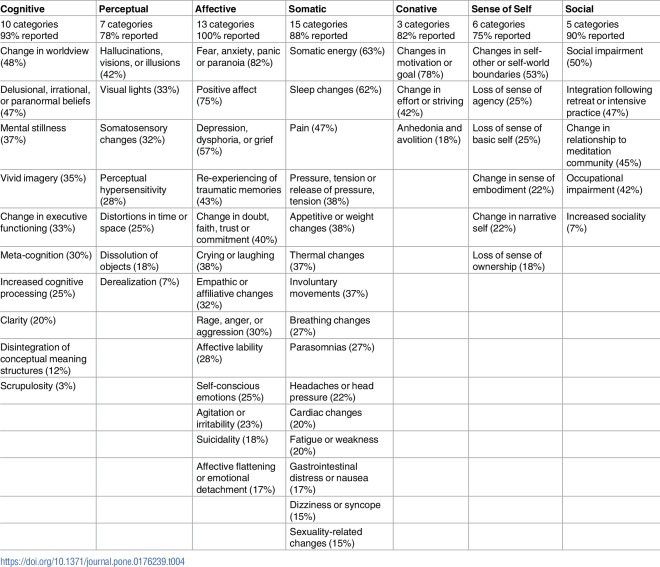
side effects of meditation cognitive, perceptual, affective, somatic, sense of self, social

It’s fascinating to note that nearly 50% noted a change in worldview. Open mind, new philosophy – fair enough. I would be on the fence about saying that I have a different world view because of meditation. It’s clearer, it’s calmer, it’s more adaptable, but it’s not really changed. Thus, it is possible that people who try to meditate are often looking for a new worldview or are quite suggestible.

Nearly the same number of people reported delusional, irrational and paranormal beliefs! I guess this is all based on Buddhism and there is a strong religious element to it. However, people were clearly made uncomfortable by it. I certainly experienced this: this is why I tread carefully when I go exploring meditation resources. A huge number of them are zealous, either for reasons of unquestioning devotion, or commercial ones. Snake oil requires faith.

Again, over 40% reported hallucinations. Just as a reminder – delusions and hallucinations are the key ingredients of psychosis and good reason to admit someone to a psychiatric ward. Obviously, these must not be quite as persistent as those associated with psychiatric disease, but if I had seen this table before starting mindfulness, I would have thought much more carefully. In this sample, 32% of people had a prior psychiatric history. This doesn’t explain how common all these DSM-sounding symptoms are among them.

Fear, anxiety, panic or paranoia came up for over 80% of people. I think is more a reflection on the sample than on meditation. Why to people meditate? Often they come upon it as a cure for anxiety. Indeed, in my experience, besides actually getting rid of the anxiogenic stimulus, meditation is a great method to deal with it. Depression was very common too at over 50%. Anhedonia and avolition – being unable to experience pleasure and not having any desire to do anything – are hallmarks of depression and were experienced by 18%. Personally, anxiety has always accompanied meditation in some way or another, but not in a bad way. It’s a little bit like saying that exercise cause shortness of breath. However, panic and paranoia are step to far.

Where there are mood changes, there are autonomic function changes and indeed they seem to have been affected too: level of energy, quality of sleep, appetite, etc. It’s unfortunate to note that many of those changes were negative with common reports of fatigue and pain.

As expected, 75% of meditators had their mind bent by Buddhist approaches to the self. We also know from MRI studies, that the anatomical self, seated in default mode network is modified by meditation, so this is expected.

Clarity, meta-cognition and increased cognitive processing – that’s our thinking clearly box ticked.

What does all of this mean?

To meditate or not? Meditate, but proceed with caution, a healthy balance of open-mindedness and scepticism – and preferably with supervision. In the words of Dr Walsh, it’s important to be challenged, but not overwhelmed.

As for me, I often take breaks from meditation. If it’s not happening, I don’t force myself too much. Thirty seconds of mindfulness is better than ten minutes of desperate striving effort and then feeling exposed, lonely and inadequate. To give it a Buddhist twist, we can think of the experience as if it is the weather. You may have decided that you are jogging today, but if it is stormy outside, it’s better to be a bit more adaptable, stay at home and practice your planks. Same here.

Reference:

Lindahl JR, Fisher NE, Cooper DJ, Rosen RK, Britton WB (2017) The varieties of contemplative experience: A mixed-methods study of meditation-related challenges in Western Buddhists. PLoS ONE 12(5): e0176239. https://doi.org/10.1371/journal.pone.0176239

P.S. Have a look at this Christian blogger explaining the emotional conflict she experienced when exploring yoga. It’s not important to be religious to understand that imposing one system of beliefs over another, whatever it may be, can be highly distressing.


negative effects of meditation
Just a picture of Dublin in the sun


The neuroscience of creativity

As my readers will have noticed, I don’t publish as much any more. That’t not to say my commitment to this blog has lessened (I have big plans for it!) Having gone through a period of stress, I realised just how damaging it is to creativity. I blame my reduced creative output on my increased adrenal output. It is well known that the “rest and digest” (parasympathetic), not the “fight or flight” (sympathetic) system is associated with complex cognition and creative problem solving.

Where else would my brain then lead me other than to research the neuroscience of creativity?

neuroscience of creativity

1. Listening to happy music

Gene Rowe et al used a sort of a verbal IQ test and had the subjects listen to either happy music, sad music or read a bunch of neutral facts. The participants’ mood was predictably affected by the music. Indeed, the test performance was correlated with the mood level.

I am not sure whether this will get me to delete the Amy Winehouse tracks off my Spotify account, but as far as my n=1 observations go, there is indeed a relationship between one’s ability to function at a given time and a playlist.

There will some people who will want to discredit this study, but I want to note that there is nothing in this study to say that getting out of a bad mood with happy music will lead to creativity.

Indeed, I would say that listening to happy music when you’re sad can be awful. I would say that something energetic rather than cheerful is in order. I guess I will be working on a playlist in the next while.

Interestingly, a test used to assess the ability to focus yielded the opposite results when it came to music: results were improved with sad music and worsened by happy music. The proposed explanation is that happy music broadens our perception and makes us consider alternative solutions which is so important for creativity.

The interesting lesson here is that being creative means being distractible, not focused.

My encounters with people with bipolar affective disorder and schizophrenia come to mind: there is often no keeping them on topic when they aren’t well. The people who suffer with these are also known for their creativity.

I’ve been taught that distraction is a menace. Studying to be a doctor involves a lot of hours in silence, pouring over books, where the only distractions are laziness and loss of the will to carry on. Menace. The job, incidentally, is nothing but distraction. In a hospital, it is impossible to even walk down a corridor without getting five different requests from patients and staff. And it’s no excuse that you’re in the middle of something. In a world obsessed with focus and productivity, it seems anything that seems to be a distraction is disallowed. Maybe, sometimes it pays to chase our distractions.

what makes your brain more creative

2. Walking

I am surprised by the robustness of the finding, though not the finding itself: walking is associated with boosting happiness and creativity. Marily Oppezzo got participants to carry out a creative task while sitting in a chair, standing, walking inside or outside, or being pushed in a wheelchair. Walking won.

I would imagine that sports would also help with being creative. N. N. Taleb also mentioned that he walks a lot and went so far as to say that he gets x amount of pages per y amount of walking (something like 1000 words per mile?) My two cents are that sometimes I feel compelled to go walking. It’s the endorphins, the fresh air, the change of scenery. In fact, whatever it is, it works.

3. Variety

The more varied the participants’ typical activities, the higher they score on tests of creative thinking. People who are in a routine aren’t usually associated with creativity. It has become en vogue to say that everything is a habit, that the best writers have a strong discipline, that Anthony Trollope got up and wrote for 3 hours every morning… There is a difference between emphasising the importance pushing yourself to create and saying that the pushing itself produces creation.

It’s pretty obvious that creativity is the secret sauce, not the bread and butter of actually creating something.

Finding a new connection between two pieces of information (i.e. being creative) will only occur if the two areas of the brain that hold those two pieces of information are active at the same time. The more variety there is in the activation pattern of one’s brain, the higher the chance of a new connection forming.

making your mind more creative

4. REM Sleep

‹REM sleep is that part of the sleep cycles when we see dreams. It seems to be particularly important for memory formation and creation of associations, the direct input of creativity.

Denise Cai got a bunch of sleep-deprived participants to do IQ-like tests focusing on associations and analogies. The participants did some questions, but the real test started after the break. The break was different for the participants who were split into 3 groups: 1) those who got to sleep and enter REM. sleep, 2) those who got to sleep but not enter REM sleep and 3) those whom didn’t get to sleep. When all the participants returned to answer more test questions, the REM sleep group did significantly better than the other two.

This also explains why sleep deprivation results in a functional but lacklustre existence. When we sleep for 8 hours a night as opposed to 6, we get disproportionately more REM sleep. This is because REM periods get longer as you spend more time asleep. So when we cut down on sleep from 8 to 6 hours, we may only lose 2/8= 25% of our entire sleep, but we lose a much bigger percentage of our REM sleep.

A few remarks on the anatomy of the eureka moment

Mark Beeman’s studies focus on moments of insight when trying to solve complex problems. He used fMRI and EEG to reveal that a particular region in the anterior superior temporal gyrus became active shortly before a person reported having an insight. Interestingly, this region is associated with associating distant verbal relations or finding connections between information that is only loosely related.

Pulling it all together

All of the above studies are using crude proxies to creativity. Figuring out what French, cork and list have in common isn’t really creativity (it’s wine, by the way). On a personal level, I feel many of the above tips are useful. Let me know what has worked for you in the comments!

P.S. WordPress tells me I have over 1,000 followers. Thanks so much guys: I really enjoy the company 🙂

Lessons from the May challenge: all about anxiety

How did the 16 days in May challenge go? Not to the discouragement of my readers, I admit defeat.

16 day mindfulness challenge

This really was a challenge, and I am not that happy with how it went. Why? Life got in the way. I was under a lot of pressure to get a project done with lots of codependencies and lots hinging on it. During the early days of the challenge, I received fairly disconcerting feedback, so everything else went on hold. Anxiety took over.

A lot of people suffer with anxiety. Many refer to a small study that was done among the elderly and asked them what their biggest regret in life was. Many said that they worried too much. Well, of course! With the benefit of hindsight, that’s easy to declare.

A lot of people also say that anxiety isn’t going to help the outcome. Of course it will, otherwise we wouldn’t have evolved it. Naturally, there is pathological anxiety – and I am not talking about that, but in these days of overmedicalising feelings strong anxiety is seen as needing to be gotten rid of.

Maybe the problem isn’t the anxiety? Maybe the problem is the thing that’s causing anxiety? Genius thought, I know. But it seems to be denied any viability in our society. [Then they ask how did we all turn out to be special snowflakes. Hmm.]

Well, I didn’t get rid of my anxiety or try to suppress it. Once I just admitted to myself that I was anxious, a weight came off my shoulders. This is that classic acceptance thing they talk about in mindfulness. Anxious. So what? It’s not a crime. It’s not a defect. It’s just my experience and right now, in this moment, it’s not actually that bad at all. Acceptance of reality gave me the opportunity to work on the underlying cause of the anxiety.

Right, closer to the point:

1. A day without assumptions

OMG. How do you live without assumptions? Occam’s Razor: the simplest answer is usually correct. When I got my worrying feedback, I immediately started mind-reading, mitigating the worst case scenario, assigning probabilities to possible outcomes and acting. Acting is such a drug against anxiety. The problem is of course that directionless hustle isn’t necessarily better than inaction. It’s exhausting and it is possible to do damage like a bull in a china shop.

2. A walking meditation

Definitely a win. Interestingly, it was my olfaction that work up by doing this. I spent most of my life living in a city and that’s not the sort of place where you want to expose yourself to smells. Also, a walking meditation is kind of more lighthearted than the more perfectionist sitting meditation.

3. Get one thing that you have been putting off done

I’ve emailed a bunch of people about a project we all committed too, but all left it to stagnate. Two of the three recipients were very helpful in moving it forward and now, somehow, we have a fourth, who just contacted me out of the blue. Coincidence? Providence?

4. Make a list of your habits

I was too nervous to do that with all my stress. What if I exposed something so disappointing or annoying that I would be too upset? I simply didn’t have the reserve to do it at this time. I will add it to my list (guess that’s a habit…)

lessons learnt from mindfulness

5. Ask: Why am I doing this?

W was easy. I know what I consider meaningful. I also know that this changes. I know why I am doing what I am doing though sometimes I wish the routes were straight lines. Ultimately, we have to adapt to our environment and respect the peninsulas of circumstance that we navigate around.

6. Wear the worst clothes you own

Haha, well that led to a clearout! (Anyone of eBay?) It wasn’t so bad at all. Where I live, in Dublin, clothes aren’t as much of a status symbol as they are in some places – like Russia, or I imagine China, or even the UK. I am very grateful for that.

7. Spend the day on your own, no social media

Fail. I can spend the day on my own, but social media – that’s tough. I have this sensation that I am about to get some kind of interesting news via social media. All it is in reality is a trained dopamine-mediated habit. I need to get out of it. It’s not that hard, but once again, it may expose things. For example, it can expose just how lonely I feel sometimes. And then, if I commit to not having social media, at least on certain days, then I am leaving myself to confront the loneliness. As a teenager, I used to travel a lot – and it would always be a connection flight. Sometimes, the connection would be 4 or 5 hours. This was before the kind of engaging social media we have now and certainly before widespread free wifi. I just remember that horrible mix of boredom and loneliness and I don’t ever want to feel it again. Having said that, I always say I come up with some of my best realisations in transit. Maybe then, I should just take the bandage of and be alone with myself, whatever may bubble up.

8. Write down the things that annoyed you

Fail once again. I was worried that it would put me in a foul mood. That’s quite presumptuous and possible wrong. It remains on the to-do list.

9. Go through the notification settings on your phone

Done. Much less distraction now. Best decision ever.

10. Try some mindful cooking

I couldn’t really do that. I was worried that I don’t have the time with my project. It also felt a bit wrong to be messing around with new recipes when things are shaky. Once again, pretty presumptuous, but hey, all I can do is all I can do.

11. Note how much of the stuff you do isn’t for you

This turned out to be a surprise. Even from a Machiavellian points of view, I can easily argue that everything I do for others is done as an investment into a relationship.

12. Look back at where you came from and see where you are now

What a magical thing to do. I thought of my parents, of where I was born, of where I started, of the role I had to play in where I am here today. I think so many of us get upset as we feel that life happens to us and that we don’t have any real control. To any human being, it is very upsetting to not be in control. But is it true? On the one hand, in the grand scheme of things we are small and insignificant. But in the context of our own lives, we are a big deal. Just like the Stoics would argue it’s important to focus on what you do or think as a person. Circumstances aren’t always a form of feedback about how well or poorly we are doing. Looking back at how we navigated our circumstances, even back when we were younger and much more naive, is bound to generate some feelings of pride and invigorate the perception of who we are people.

13. Pay attention to the people in the shop queue

Well, let’s just say I was dragged shopping in IKEA during this time. There was a lady in front of us in the queue who changed her mind on what she was going to buy and was hiding the goods she was going to just dump at the cashier under a pile of bags. Before sneaking the stuff away, she looked over at us a bit like a poorly trained dog looks at people passing by when it’s eating. But I really couldn’t be bothered judging. Maybe she has too much sense to just buy 3 French presses (that don’t filter anything by the way)?

14. Check email only twice a day

Fail. What if something super important happens and I don’t even know?! I need to work on this.

15. Look back at the last 5 purchases you made and whether you needed them

They were all quite optional. I’ve learnt the lesson of not having useless clutter a long time ago (moving dorm rooms every year in college will teach that fairly quickly). However, I was quite surprised at how I could have gotten away without having a lot of these things.

16. Thank yourself for trying so hard

This is a lot like looking back at where you came started. Yes, sometimes the seas part, the light shines, the lucky break happens and we should be endlessly grateful for these blessings. However, we should thank ourselves for working so hard and having faith even when things don’t look good.

lessons learnt from mindfulness challenge

Happy May Day

Happy May Day all.

Here are a few reasons to love May:

  • It’s actually warm and the days are long
  • The first of May is a day of celebration – no matter the reason, everyone finds something to celebrate on 1st May. I wonder if we could extrapolate this attitude…
  • Exams usually end in May and freedom begins
  • The most memorable Bond girl/villain is called May Day
  • … 1,000 other reasons
  • (I am biased because my Birthday is in May)

I have made a little gift for everyone. A gift and a challenge. I find 30 day challenges a little scary, so this is a 16 day challenge!

A list of reminders drawing on mindfulness, Stoic philosophy and just general common sense urging us to be more present.

I hope you enjoy it. Print it out and see how you get on. I will report on how I got on on 16th May.

16 day mindfulness challenge

The successniks of Silicon Valley learn philosophy, but search for the secret sauce continues

‘Men work together,’ I told him from the heart,
‘Whether they work together or apart.’
– Robert Frost

“Practical philosopher” Andrew Taggard disabuses founders, executives, and others in Silicon Valley of the notion that life is a problem to be solved, and happiness awaits those who do it:

“Philosophers arrive on the scene at the moment when bullshit can no longer be tolerated,” says Taggart. “We articulate that bullshit and stop it from happening. And there’s just a whole lot of bullshit in business today.”

Taggart seems to preform a sort of CBT on CEOs. This article also features the term successnik when talking about the Silicon Valley execs. What a gem.

But wait, maybe we have the secret sauce after all?

Harvard/MassGen “psychiatrist, psychoanalyst and Zen priest” Robert Waldinger draws an interesting conclusion to one of the longest studies on happiness, carried out at Harvard…

Now, before we get all excited, it is an observational study of a small-ish bunch of Boston men, so go easy on the extrapolation. But here is the said sauce:

“So what have we learned? What are the lessons that come from the tens of thousands of pages of information that we’ve generated on these lives? Well, the lessons aren’t about wealth or fame or working harder and harder. The clearest message that we get from this 75-year study is this: Good relationships keep us happier and healthier. Period.”

I asked a similar question of Dr John McBurney – and his answer was community as well. Other research points out that when it comes to relationships, the absence of the negative is far more important than any grand gestures or unbelievable highs in determining whether these relationships will last.

successniks of silicon valley learn philosophy

Given that for millions of years our very survival has been predicated on our tribe much more so than on our personal achievements, it makes sense that we weight it so highly. Evolution carved us out for survival and not for happiness.

So perhaps, somewhere between the first and second step of the Maslow pyramid (that is physiological needs and safety), we’ve been missing community. In today’s society we can pay for the fulfilment of both of those – and that’s where most people are stuck.

Why do people want to be successful? Because it solidly ticks off the bottom two steps of the pyramid. If you are more cynical, let me phrase it this way: hedonism is step one, narcissism is step two.

Maybe the hack is in the fact that having a community provides both physiological and safety cover. Furthermore, unlike money in an of itself, it also let’s us into the higher up steps of the pyramid. I am calling it a “hack” because few people consciously feel community is that important.

Why don’t more people invest into community?

1. “I want to be special”

Blending in with a community is no fun. If you didn’t figure it out on your own, is it worth the same to you? All the cool guys seem to have done it one their own. We know that’s not true, of course.

However, it is hard to have a lot of impact if all you ever do is comply with the unspoken traditions of your community. So in a sense, it does prevent personal accomplishment. It’s important to clarify that you can’t make do with any sort of community: it has to be supportive. A conflicted community (or family) is probably more harmful than being alone based on what Dr Waldinger discussed.

2. “You can’t trust no one”

Indeed, communities do have a way of ostracising people – and generally being poisonous when things aren’t going well. All of a sudden your neighbour of yesterday is making a business out of your misery. We have all heard the stories from wars and famines that illustrate people’s disregard for the life of another in extreme circumstances.

This fact doesn’t stand alone of course. We’ve also all heard stories of altruistic sacrifices around those same wars and famines. And – what if you had been working in an individualistic rather than a community-centred manner: this isn’t a guarantee either because you’ve invested into things that may not have any value in extreme circumstances.

In the extreme, banks collapse, property gets nationalised, political regimes choose new heroes and scape goats… Less extremely, industries rise and fall, changing laws and regulations present new challenges.

If you want to be pragmatic about it, think of community as a diversification strategy. It seems that trusting your own accomplishments over trusting the community is a false path to success – whatever for you feel you need it.

harvard happiness stud role of community

The spiritual aspects of mindfulness through an evidence-based lens

I’ve spoken about mindfulness to numerous psychiatrists, those that I’ve worked with and experts from various out-postings of the Western world. Completely unprompted, they all converge on one point:

We should pay more attention to what the Eastern philosophy already knows about the body and mind.

As Western doctors, we are trained in the evidence-based tradition. We hate nonsense treatments that are painfully common. Glucosamine. Cough remedies. None of them are better than placebo.

Then there is a rake of stuff that isn’t useless per se, but useless because it is irrelevant:”X reduces the risk of Y 10 times”… but they never tell you that it reduces risk from 0.001% to 0.01%. I call all of this snake oil, and I am passionate about doing what I can to protect the audience.

I am conflicted however: it seems that it’s impossible to address certain issues using an evidence-based approach. There is simply no way to do a randomised-controlled trial on certain things.

Whenever some esoteric group get something right, I tell myself that even a broken clock is right twice a day and if predictions are general enough, they cannot be proven wrong, a bit like a horoscope.

However, all of these renowned people trained in the evidence-based tradition are saying that much of these robust observational findings by Buddhists tend to get confirmed by our methods, such as fMRI, now, hundreds of years later. What a seductive proposition!

john mcburney neurologist mindfulness

Dr John McBurney spoke to me about this in detail:

“I recently attended the International Symposium of Contemplative Studies ran in conjunction with the Society for Neuroscience annual meeting. This is an outgrowth of the dialogues between the Dalai Lama and the neuroscience community that began in 1987 and resulted in a satellite meeting at the annual Society of Neuroscience meeting in 2005 entitled “The Science and Clinical Applications of Meditation”. Out of these interactions an entire field of neuroscience has emerged: contemplative neuroscience.

What bothers me the most about the popularisation of mindfulness is that it is seen as an end instead of a means. This has the potential to deepen our self-absorption and even to become an exercise in narcissism.

Mindfulness is both fully embodied and relational. In other words mindfulness is a  fundamental practice for getting in touch with our true selves. That true self or true nature is fully embodied.

In other words, it doesn’t just exist in our conscious thinking minds; it encompasses our full being including our somatic awareness, gut, heart and breath. But this must also extend beyond our bodies to others to achieve its full significance. In this way what arises out of mindfulness is what matters the most. This is the relational part. So mindfulness fully realised is not just within us, but also between us.

The Dalai Lama says that if everyone in the world meditated, there would be no more war. The reason for that is the fundamental goodness of human nature. Human infants are born genuinely helpless. Most people have a fundamentally positive attachment experience – or they don’t survive.

This is reminiscent of Harlow’s experiments in which baby monkeys were deprived of maternal interaction and were either developmentally devastated or died. So without the interaction with the mother the baby is like the seed that does not  germinate..

So when we “get out of our own way” as Judson Brewer talks about in his TED talk, what emerges is our nature that is inherently good and compassionate, seeking to address suffering in ourselves and other people.

To my mind, mindfulness is the first step in realising that nature. It is a necessary, but non-sufficient condition. Mindfulness is a start, but ultimately it comes down to what we do with it. Some people have severe, traumatic attachment experiences, in some ways like Harlow’s monkeys.

This results in severe disruption in personality development. They may have borderline features and don’t have a strong sense of self or feeling of right or wrong, but for most of us this thankfully doesn’t apply. For most of us, all we need to do is to get out of our own way to realise the beauty of our own nature.

Into the Magic Shop: A Neurosurgeon's Quest to Discover the Mysteries of the Brain and the Secrets of the Heart

There is a lot of discussion about the popularisation of mindfulness and the misdirection that the general public is getting. It is possible for it to become too simplified, so that it becomes harmful. For example, Shinto Buddhism was misused in Imperial Japan and atrocities were committed because of that or in our times lets look at the ethical dilemma posed by the mindful sniper. It’s not just practice that makes perfect.

It is perfect practice makes perfect. It is really a value judgment that comes out of mindfulness. Which is reflected in our relationship with others and the world.  It this way mindfulness becomes mindfulness in the service of others through compassion which in a way is a superpower. Just look at this article from CNN posted a few days ago.

One of the people I’ve crossed paths with is James Doty. Now, he is a professor of neurosurgery in Stanford. He is an amazing human being. He and I were residents together and became good friends. He went on to accomplish great things.

He says that he was misapplying the mindfulness skills that he was taught as a child. He learnt to concentrate in a very profound way. Back when we were residents  he struck me as an uncompromisingly focused person, at times arrogant, and always hilarious. But as he now admits he hadn’t had his bowl filled with compassion.

Into the Magic Shop James Doty review

He was very mindful and amazingly effective. Since then he has gone on to do truly amazing things that were directly born out of his becoming mindfully compassionate. He has done philanthropic work on the back of CyberKnife success. He founded a journal club at Stanford where they would read the latest studies in contemplative neuroscience and wondered if the Dalai Lama would find this interesting.

He was able to network through to Thupten Jinpa, Dalai Lampa’s English translator, and as he describes in his bestseller (Into the Magic Shop) soon found himself meeting with the Dalai Lama! Out if this The Center for Compassion And Altruism Research And Education (CCARE) was started at Stanford University. His memoir, Into the Magic Shop: A Neurosurgeon’s Quest to Discover the Mysteries of the Brain and the Secrets of the Heart, is a tremendous resource in that it is both a first person account and sort of a manual on how to develop mindfulness and compassion.

Mindfulness is but the vessel in which the full contents of our consciousness is held.”

You may also like my recent interview with Dr McBurney: A downward facing doc explains the brain wiring behind mindfulness

The wheat from the chaff: philosophy vs self-help

There is something cringy about the notion of self-help. Yet blogging in the philosophical rambling genre invariably has a whiff of it. Even more generally, be it the Bible, Seneca, Leo Tolstoy, Viktor Frankl, Daniel Kahneman or Oprah, or in fact, any autobiography, aren’t they all essentially trying to answer the same question, namely how to make the most of our time here?

what is the difference between philosophy and self-help

Where do we draw the line?

Some writers, psychologists and philosophers have been using a quagmire of specialist terminology to warden off any suspicion of belonging to the self-help family. Religion is many things to many people, but it definitely ticks all the self-help boxes. What about picking up a new hobby? Is that a self-help action? What about ringing up a friend? What about going to the gym to get some endorphins? While we usually draw the line at solitary activities, preferably done alone, by overweight single middle-aged single women called Bridget in the company of Ben and Jerry… But being serious, it isn’t clear how to actually draw the line between legitimately working on oneself and being the gullible victim of charlatans.

Following a discussion on a wonderful Facebook group, Scott Brizel suggested an interesting approach: the problem is solved by noting the distinction between philosophy and ‘wisdom traditions’, even though wisdom traditions are (possibly wrongly) often called philosophies. Wisdom traditions propose strategies for living well, while philosophy is a method of inquiry into the meaning of ideas. Despite the loose use of ‘philosophy’ with respect toward it, Buddhism, for example, is a wisdom tradition, not ‘philosophy’ nor even ‘religion’. Religions tell creation stories, yet they may attempt to add value by establishing an associated wisdom tradition. The three ideas are often conflated, with some systems being both religions and wisdom traditions, but if you note the distinctions I draw, it will be easy to distinguish them.

Why people buy self-help books

The biggest predictor of whether a person will buy a self-help book is whether they have bought one before.

It is possible that the soothing feeling people get from buying and/or reading literature in the self-help genre is simply the reassurance that there is a solution to the problem.

As human beings, we have a profound desire to affect the world around us. This even applies to very young children, who can be taught to pedal a bike. While they don’t understand the significance of pedalling, the fact that the wheels are turning seems to motivate them to do more of it. Seeing tangible results of our actions gives us the feeling of control.

The feeling of control, the belief that our actions will deliver an impact, is probably our number one motivator. So no wonder people buy these books: by buying a book, they are buying equity in the belief that they can change themselves or even the world around them.

why people buy self-help books

Anyone who questions the ability of self-help methods to genuinely address the problem they aim to address seems like a party pooper who is stealing our dream of control. Indeed, Maslow’s hierarchy of needs, safety and security, in this case it is the belief that there is an answer and a role model to guide hold our hand, is more important than the need for self-actualisation.

Self-help books give a sense of safety and certainty. Placebo and religious texts have this in common too.

The authors inevitably portray themselves as a role model for whom these rituals have worked. Indeed, studies done on laboratory animals in helpless positions try to do things that are somehow associated with a reward or schedule. It’s an anxiety-defying ritual, not a solution to the problem per se.

As a child I spent a lot of time in Russia where books were very cheap and ubiquitous – and in the pre-internet era, well, they were the internet. Fiction never really did it for me, unless it was detective stories, and they, as we know, tend to be less than well written for the most part. Encyclopaedias were a bit hit with me, but also books on psychology.

As Western culture came flooding in, so did Dale Carnegie, Tony Robbins and their friends becoming an instant hit with a society turned upside down. My peers and I read some of these books, and they’ve left a negative impression congruent with the aftertaste of much of the rest of Western culture with its endless brands: the obvious repackaged and presented as a revolutionary discovery.

By the time The Secret came around, I was starting college. It wouldn’t occur to me to read that. I got a summer job in a book shop (the shopkeeper suggested I take the academic section, hmm, wonder why). The manager, when he wasn’t schooling me for being late, was perplexed at the proverbial middle-aged women who buy The Secret merchandise: he wasn’t sure how an adult could be convinced that by writing their wishes in a notebook that says The Secret on it (€7.99) as opposed as normal writing pad (€1.99) is better. I guess he just didn’t get why people buy things.

Years later I saw the film Little Miss Sunshine that I would highly recommend to anyone who wants to forget that they’ve held a self-help book in their hands.

why self-help doesn't work

What does the self-help obsession tell us about the society we live in?

Based on my reading of Durant’s The Lessons of History, the rise of the self-help genre is nothing unusual: whenever the role of religion diminishes in society, we flee to other sources of wisdom, or surrogate wisdom as the case may be.

For most millennials I see around me, our moral word seems to be a quilt of Christianity, Western liberalism with a touch of yoga-driven mysticism. I often think that it’s better to be confused and forced into questioning values than to unconditionally accept a bunch of dogma.The wishful thinking of self-help puzzled me for a long time. Is it really that different to a prayer? As a professor of psychology Rami Gabriel puts it:

Popular psychology comes with a message about the possibility of surmounting obstacles through the free will of the almighty self, as well as continual exhortations to practise hopeful optimism and disable despair and hopelessness: in all, a reflection of an individualistic, even narcissistic, culture in the contemporary US.

I would change US to the West. The cultural shifts in the US may be modulated as the cross the Atlantic, but Europe feels the reverberations of these developments for decades. I strongly agree with the narcissistic piece: all of this literature proclaims that you can change the world by changing yourself. While it may seem humble at first, it is actually enragingly self-centred. Of course, the purpose isn’t to be self-centred. It is to keep building the sense of control that would (in theory) allow one to rise above whatever circumstances that are holding them back.

So what is the difference between philosophy and self-help?

Self-help is hedonistic: do this and life will get better. Philosophy doesn’t aim to change one’s life, only to understand it.

Philosophy doesn’t provide any real recommendations. Self-help is bursting with answers: it is prescriptive. I guess the reason I am even asking this question is because if I hear someone say “don’t think about the negative”, I am keen to think of what the reasons and implications are, in other words, I think of the philosophy of the recommendation. To me, self-help is a truncated philosophy, though it doesn’t try to be.

Philosophers don’t tend to solve problems, they tend to ask and sometimes try to answer questions. Self-helpers have all the solutions. In fact, they tend to only have one solution, for all ills.


Want to be great at something? You simply need to like it

A lot of the literature in psychology, especially the type read by people not trying to get a Ph.D., is focused on success. How to be successful. What do successful people do. You know. It gets quite tiring after a while, especially because for the most part it is a thinly veiled sales pitch or click bait.

Inspiration or perspiration?

I’ve gone through the non-click bait writing/research on the matter and noticed some interesting patterns.

First, I will define success as being in the top 1% of something: swimming, earning money, cutting out adenoids… whatever floats your boat.

It appears that in the majority of cases, someone’s success in a particular field is mostly related to experience and practice, not to innate ability.

I’ve been very fortunate to have gone to school with some incredibly talented people. As we were growing up, I watched their motivations change: some people would get by on raw talent, after all school was never designed to be difficult, while some, who were mediocre to start, became unbeatable.

This observation of mine is echoed in the literature. Even if one’s first attempts at something are poor, it is bears no relationship to the overall outcome. Obviously, there are some factors at play, but they tend to be obvious: like, to be a jockey or a ballerina you simply have to be light.

However, when the mission is a little more intangible, such as becoming a good writer or being good at maths, the impact of practice greatly outweighs that of talent. This dynamic is also congruent with the idea that a mindset of believing in one’s improvement is fundamental to motivation (as distinct from the belief that one’s ability is fixed which ultimately leads to learned helplessness).

how to get good at anything

Aptitude tests show aptitude, not outcomes

Consider aptitude tests. I would argue that they need to be scrapped as they predict nothing at all. Research doesn’t support the assertion behind aptitude tests, namely that the X-factor is present in a person before they put in the work required in a particular field. I also want to prevent anyone from conflating the ideas of practice outweighing talent vs nurture being more important than nature, but I will come to that later.

I like to observe people. I especially keep a mental chart for anyone who I flag as having a high IQ or a high EQ. All of these people consistently make bad decisions in their respective fields of prowess when they aren’t paying enough attention. My musings are once again congruent with available data: SAT scores explain 9% of the variance in first year college grades.

Interest is far more important than aptitude.

Even if you have the aptitude, you still need to focus on what it is exactly you are doing to actually perform well. For example, I did well in my (what you would call equivalent to) SAT’s and in first year of college. But not in fourth year: I was only around 75% centile. Why? I lost interest, didn’t like it, stopped paying as much attention and didn’t put in as much time into the specific subject.

do aptitude tests matter when choosing career

What is the relationship between accomplishment and practice?

Can you max out your practice? Sort of: you can reach 100% in a test, but in reality practice always leads to improvement. There is of course, such a thing as inappropriate practice: overtraining, staying up at night to study instead of sleeping, but you get the point.

Anders Ericsson did some great research in this area. He confirmed a few interesting things:

  • Improvement is subject to diminishing returns. In other words, one makes more progress in the first 1,000 hours practicing something than they do in their most recent 1,000 hours.
  • Interestingly, he found that these diminishing returns often create the illusion of a plateau, however, progress continues as evidenced by a ton of studies.

is it important to like your career

What is deliberate practice?

Ericsson uses the term deliberate practice to differentiate junk hours from practice that will actually make a difference in one’s level of achievement, and this is how he defines it:

1. Focus your attention on the work with the intention to improve.

2. Your practice should be targeted to your current level of skill. 

3. After you attempt something, you should get to immediate, informative feedback until you have complete clarity in relation to what you did right and what you did wrong.

If practice is all I need, how do I motivate myself to practice?

All of this sounds very laborious: having to chip away at something, constantly look for feedback and address endless mistakes. There is only one way to avoid this hell: to like what you are doing. They say that if you pick a job you like doing, you won’t have worked a day in your life. It is sort of true.

My parents’ generation nearly all switched jobs. My parents, being Russian, were in their 30s when the USSR collapsed and so were forced to find a new way to make it. My generation is also constantly changing jobs. I know so many young doctors, nurses, solicitors, accountants who end up changing their field of work: however, they aren’t forced by harsh economic perturbations. They are forced by the discrepancy between what they were taught would be good for them as a career versus what is it actually like.

Aptitude tests and risk-averse parents had aspiring accountants believe they will be good at their job. They are good at it, but they soon realise they are ambivalent about it.

And it is hard to get up early in the morning 5 days a week when you are ambivalent. This is the reason so many people who were so “promising” end up having lacklustre careers: if you don’t like doing what you’re doing, you’re not going to find it easy to practice and if you don’t find it easy to practice, the competition will quickly leave you behind.

I recall taking a deep breath in and out to simply refocus as I was writing a note in a patient’s chart towards the end of a 14 hour shift in the emergency department, the last 9 of those without any breaks. The nurse sitting beside me took this to be a sigh of desperation and said: “It’s just another half hour until you’re finished.” Clearly, this nurse has been in a place where she was literally counting the minutes until she can go home. She was being supportive and relating to an experience she thought I was having. I was just tired. The way she said it was: “I know how much you don’t want to be here; I feel the same”. I bet there was a time when she was really excited about her work. She is good at her job. But she will never get better. And because lack of progress causes tremendous unhappiness in and of itself, she is likely to leave that job.

practice beats talent

What if I like something that I can’t turn into a career?

I think that that’s just a story we tell ourselves. Wearing a suit and going to work 5 days a week isn’t a career. Or maybe it is, but in that case we don’t all need a career. It’s hard for me to guess what people need, but I hypothesise that people need meaningful impact. And in this case, it is possible to make an impact doing virtually anything. Is it possible to make a living out of it? I would argue that it is. It requires some creativity, but with the internet people have been able to find their tribe much more easily. By listening to the audience, it will soon become obvious how to make what you are good at extremely useful to people – and monetise it. You don’t have to be an entrepreneur, you can be a freelancer, or even an employee. As for security, I also believe that that’s more of a story. Corporations collapse, technology makes professions irrelevant, cheaper labour elsewhere leads to job losses… Employment is far riskier that it is made out. 

The point is that it is being good that sells.

If you manage to get amazing at something odd (break-dancing, why not), you are at least as likely to sell it as if you’re mediocre at something for which there is a lot of demand (accounting). I will let you judge the level of happiness attained through these two routes for yourself.

It’s not all that simple of course. If you’re relying on being the best at something, you need to constantly put in the practice or create systems around you that will allow you t grow, e.g. creating things that last like organisations and leveraging other people. If you are relying on being mediocre where there is high demand, you will probably get away with it for the rest of your less-than-happy life.

What if I don’t know what I like?

You do, but it’s hard to be honest with yourself because it may lead to a lot of uncomfortable conclusions.

I’ve always liked writing, but I was always told it is a road to nowhere. Of what use is writing? When you’re 17, you listen to adults and trust them. Having said this, I liked science just as much. However, my interest in science was encouraged, but my interest in writing wasn’t.

It can also feel like it’s a very individualistic thing to say: “I like X”, X being piano, fashion, philosophy, whatever. We’re taught that it’s not about liking things, it’s about finding a good solid field where you can be successful. Whatever that means. So saying “I like X” is immediately contrary. There is an implicit “it doesn’t matter what you like, the choice you make it about your future! This isn’t a game!”

This kind of attitude plants a lot of doubt of course: what if X is just an infatuation? What if in 3 years’ time I am sick of painting and all I want is to start a family which is far easier to do if I become an accountant? It’s a risk, I guess, but I’ve never met anyone who really liked something and actually got sick of it. They may have been repeatedly rejected, something bad may have happened that became associated with X – but I’ve never met anyone who just lost their passion from first principles.

It can even cause guilt: doing something that you like feels like it isn’t work and is therefore not valuable. The insight here is that it feels like work to most people. 

It’s also important to remember that we like things we are good at. It’s therefore good to at least try and differentiate between positive feedback and genuine interest.

should-i-do-what-i-like-or-what-makes-money

How are accomplished people’s brains different?

Isabelle Gauthier and Michael Tarr created a new field of study: Greebles. These are a family of 3-D structures, they are made up, none of the participants of their studies knew anything about them and had to learn from scratch.

As the participants practiced identifying and classifying these ridiculous Greebles, Gauthier and Tarr observed the developments in their brains using fMRI. When participants were first learning about Greebles, a huge portion of their brains was active. As they practiced more and more, fewer regions showed activity, but they ones that remained active became more active. Greebles are a nice example, but there are a number of studies like this that all point that brain activation gets more precise and efficient.

The meaning of meaningful glances

I also like to observe experienced doctors. Every morning, a senior physician would do a round and be presented with the case details of the patients who were admitted through the emergency department overnight. A lot of these presentations are really vague, that’s just the nature of the activity. The experienced senior physicians have a way of narrowing it down effortlessly: and most of the time they are correct. There is one minor detail that I noticed: they tend to fixate on something for a few seconds before they pronounce their verdict on the working diagnosis. It’s like they aren’t really here. The transient but significant fixation is especially juxtaposed with the hustle and bustle of the emergency department.

It turns out that that’s a thing that experts do. Studies of eye-tracking movements of by Joan Vickers call it the quiet eye.‹ Ordinarily, our eyes jump from one object to another, about 3 times per second. The movements are controlled without our conscious involvement. As we focus on a task, these movements become more deliberate. Especially accomplished people tend to stop their eye movements for as much as a whole second as they are about to act (or make a decision). Once again, we are looking at precision and efficiency: limiting the information input to be able to focus on what is relevant. This seems to be the real skill behind being accomplished at something (incidentally, it is also the skill that is directly trained though mindfulness meditation). 

Having reviewed the mechanics of being good at something, it is obvious that it comes at an obvious cost. By going in for the kill each time, the accomplished performer is likely to miss something in plain sight simply because their optimised equation didn’t factor it in. There is valuable flexibility in being a novice.

You may also like:

Paul Graham: What Doesn’t Seem Like Work?

FT: How a ‘no-plan’ plan launched a career at Facebook

The darker side of mindfulness: being overwhelmed, side effects and the difficulty of finding a good teacher

It was my pleasure to speak to Dr Chris Walsh, an Australian mindfulness pioneer since the 1980’s and a respected psychiatrist. Dr Walsh has trained with leading Western mindfulness figures such as Jon Kabatt Zinn, Mark Williams, Kristin Neff and Daniel Siegal. Dr Walsh and I spoke about the darker side of mindfulness.

As with any area experiencing such strong growth, mindfulness is surrounded by myths and misconceptions. What is one that you feel particularly strongly about?

It’s used by business to make people work harder. It’s not so much a myth, it’s just the way it is being used.

People think it’s a relaxation technique. This is tricky to address. Mindfulness does help people to relax, but that’s not the main game. It’s about training your awareness.

You cannot count on mindfulness to make you relax.

If occasionally mindfulness doesn’t help you relax, you will feel that it’s not working and are missing out on an opportunity to learn to hold an unpleasant feeling. This can be destructive.

Chris Walsh mindfulness expert tips

Mindfulness can bring out negative emotions, especially during the initial stages. How would you recommend that a person deals with that?

The first thing is to have a good teacher. It’s a delicate balance and it can be hard to know when to lean into the negative emotion and when to stand back from it.

The basic principle is that it is ok to feel challenged, but it’s not okay to feel overwhelmed.

With any kind of learning, including learning to be mindful, it is normal to oscillate between feeling comfortable and feeling challenged. If you’re never challenged, especially with something experiential like mindfulness or a sport, the learning isn’t in its optimal state. Getting overwhelmed in mindfulness is the equivalent of getting injured when training, and this sets back the progress.

I have a few tricks on how to deal with being overwhelmed during mindfulness.

  • The feeling of being overwhelmed is most likely to occur when doing a body scan, especially when focusing on the chest and abdomen as this is where we tend to feel anxiety. I encourage people to find “safe places” where they are less likely to feel this anxiety: such as the resting one’s attention on the sensation of breath in their nose. Even this can be too much for some people.
  • Awareness of sounds can also help, as the attention is then focused on something outside the body.
  • Allowing oneself to move can also help to deal with the sense of being overwhelmed. In the Tibetan mindfulness tradition you can move; in the Zen tradition you are meant to be still no matter how much one’s knees hurt. This stillness doesn’t work for people with a lot of agitation. Doing walking mindfulness or exercising before doing mindfulness can help greatly. Some people think that this is an avoidance behaviour. I believe, it is taking a distance, while still still remaining present to the difficult experience.
  • Sometimes it is okay to let one’s mind wander off. When I run classes with inpatients, I tell them that it’s okay to daydream if it gets too much. The important thing is: come back because this way you can learn what has changed. This is very empowering: we don’t always have to do something to change things. They change by themselves.

These tips work for patients with mental health issues, e.g. PTSD, as well as people with no mental health issues.

the darker side of mindfulness chris walsh

Have you ever had any experiences when mindfulness had side effects? The “decentering” in mindfulness may impact an individual’s concept of the “self”. There are anecdotal reports of some vulnerable individuals developing dissociation and psychosis after reading self-help books or attending seminars – and more recently after practicing mindfulness. Do you see any risks in “trying it at home” when it comes to mindfulness?

It is damaging when people use mindfulness to dissociate or disconnect in some way. Two patients I encountered were attached to ecstatic states.

The first was a man with a background of heroin and alcohol addiction. He was able to stay away from drugs and alcohol for 10 years and then relapsed – which is when he came to me. He told me he was using mindfulness to stay away from his addictions and meditated for 8 hours a day! Just before the relapse he got a job: this stopped him from meditating for 8 hours a day, and so he relapsed.

When I questioned him about his mindfulness practice, he told me that he would just got into a blissful state for 8 hours, never experiencing any negative emotions.

I asked him to deliberately call to mind some unpleasant experiences while practicing mindfulness and pay attention to how it felt in his body rather than holding on to these blissful states. The lesson here is to get comfortable with feeling uncomfortable. In Tibetan Buddhism, they talk about samadhi. It is a blissful state – and sometimes people get addicted to this state. Some people this is enlightenment, but the Buddhist teachers say that that’s a delusion, an unhealthy attachement to something.

The second case that comes to mind was of a man with schizophrenia. Many of my patients with schizophrenia derived a great benefit from mindfulness. This man was having a Kundalini experience, where energy was going up and down his spine. They talk about it in the Hindu tradition. He would go through this experience for many hours a day and it made him more delusional and psychotic. It was very hard to persuade him to do less meditation!

I wouldn’t’ call either of these experiences mindfulness, as they weren’t this open, non-judgemental states. This is why having a teacher is important: so that you can reflect on your experience and receive some guidance.

how to choose mindfulness teacher

How should one go about choosing their mindfulness teacher?

There are no absolute guarantees. I am aware of some highly trained psychiatrists who teach mindfulness, but don’t practice it. They say they do, but by talking to them, you quickly realise they don’t: they have a kind of striving attitude.

For people with psychiatric conditions, it is better to have someone who understands both the Western and the Eastern traditions. If you have a teacher, a psychologist or psychiatrist, who comes from the Western tradition only, it is important that they practice mindfulness themselves. It’s important for a teacher to be able to tune into the problems that arise for people as they go through their mindfulness journey rather than sticking to a rigid program.

does mindfulness have side effects

There is a one size fits all approach to mindfulness among the public at the moment. Do you feel that that it’s appropriate for someone to use an app or should they find a teacher?

In my classes, I have a handout that reviews the apps and advises my patients to beware of any apps that tell them what to feel or that they should relax. People can play with apps – it gives them experiential information that allows them to commit to go to a class. Some people learn a lot from the apps. I haven’t seen the good apps causing any harm. Headspace is quite good. Buddhify is great for getting past the idea that mindfulness only happens on a cushion and has lots of shorter meditations that people like. Insight timer has nice mindfulness bells and nice soundtracks. Some are a bit New Age-y, so people need guidance in choosing the right ones. iTunes U UCLA meditations are quite good too. I send people to my website as I have some soundtracks there.

how to deal with feeling overwhelmed during mindfulness

What are your thoughts on transcendental meditation? It became commercialised quite quickly once it reached the West. Do you worry that mindfulness is headed in that same direction?

I did TM for a few years and found it helpful. I studied Buddhist meditation before that and it gave me the impression that the mind has to be completely quiet – which caused a lot of agitation. TM helped me to get past that as it involved returning to the mantra without trying to eliminate thoughts. TM also taught me about preliminary practices such as exercise.

In the East, mindfulness is used to investigate the mind as well as everything else. A lot of the insights of Buddhist psychology are now being confirmed using Western methods, such as fMRI. I believe this aspect of the Eastern tradition doesn’t get enough attention. However, we need to separate the psychology, philosophy and the religion. Those who say that Buddhism isn’t a religion are lying: it is a religion, but as well as that there are psychological and a philosophical components. These can be separated out, just like has happened in the West.

The tradition in the East is 2,500 years old, so we run into a lot of interpretation and translation problems. The Eastern languages have changed in meaning and nuance in that time just as much as Western languages have. Jus think how much trouble we have interpreting Shakespeare and his writing was only 500 years ago. Furthermore, Buddhist psychology is based on  human investigation that has evolved over time, so it’s not like the Bible that has been “handed down” and and passed on as some kind of unchanging truth. The Eastern mindfulness tradition, in fact, has a lot in common with the Western scientific tradition. This tradition has evolved from the Socratic tradition which is based on debate and questioning. rather than prescriptive rote learning. I believe that if we start paying more attention to what is already known in the East our progress in understanding the mind will be accelerated and our meditation practices will become even more effective.

Dr Walsh’s own website contains a lot of case studies and blog articles on mindfulness that I would highly recommend: mindfulness.org.au