12 tips for thinking more clearly and making better decisions

This is one of those articles that I wrote for myself: for those mornings when the only things you want to do are browse Facebook and watch BBC1, or at least you think you do. Then you remember that you’ve about 20 problems to solve that day and get that feeling in your stomach like both your adrenal glands just emptied their contents into your bloodstream.

1. Enter into deep work mode

Wall off some distraction free time. The phone goes on airplane mode. Close all the tabs you don’t need.

Let’s be honest, if you are reading this, you are probably dealing with quite challenging and cognitively demanding.

These things require extreme levels of focus and uninterrupted immersion for an effective resolution.

As such, the goal is to enter into a state of flow. It is a paradoxical mix of mindfulness and being very goal-directed at the same time. Flow, also known as the zone, is the mental state of operation in which a person performing an activity is fully immersed in a feeling of energised focus, full involvement, and enjoyment in the process of the activity.

how to think more clearly deep work

2. Do a brain dump

If you are at a loss, the thoughts are messy and you don’t know where to start, an unstructured flow of consciousness style “brain dump” is required. It straightens out circular ruminations and allows the writer to identify what is really wrong. There is something liberating about getting things down on paper. You can always throw it out. Nobody has to see it. It is only for you to see.

In the best possible way, it lowers expectations and gives you the licence to be really honest.

I am putting my money where my mouth is with this tip: a lot of this blog is really me writing for me. I often reread what I have written because it answers questions that bother me (and catch a few typos on the way!) It turns out that the same questions bother a lot of people, hence our little community.

3. Draw a spider diagram

Difficulties in solving problems often arise from the fact that problems are interdependent, they are not isolated. Drawing a spider diagram (a mind map) is a very good way to figure out what’s going on.

how to think clearly

As a one-time medical student in the rather fundamentalist anatomy department, I had to learn everything about the brachial plexus (pictured above).  The structure was just the starting point of what I needed to know. The the origins at the spine and the muscle activation were at least as complex on top of that. I drew a spider diagram.

When my father was splitting from his second wife and I arrived home to find my stuff packed away in boxes by the latter, well, I also drew a spider diagram. Because I needed to understand what’s going, what everyone is thinking and where to move (not just literally) from there.

This approach to thinking is resonant with the structure of our brain with its nodes and links.

4. Make a to-solve list (not a to do list) and tell a story

Lists are great, says the ENTP. Even checklists. They really are great because they give us a sense of control. I have studied motivation in great detail as I deal with students doing their final school exams to get into college. They keep asking me about motivation. These 17 year olds have the most fine-tuned BS filter on the planet, so I really need to try hard. I finally found a solution for them, which is: a sense of control.

Feeling in control is the key to being motivated.

There is a mountain of evidence about this. However, a small study done on nursing home residents really illustrates it best. Some people who go into nursing homes don’t do well and fade away in less than 6 months. Others seem more alive than any of us. What’s the difference? Well, as one of the lively 85 year olds explained: “I trade my chocolate desert for a piece of fruit from one of the other guys at every dinner”. Why? Doesn’t he like chocolate? The answer lies in the fact that now he has control: in an environment where you are told when to sleep, where to sit and when to take your tablets, it is crucial to eke out a sense of control by being in charge of something small like that.

How do you structure a list? There are two great ways:

  • list of problems to solve
  • a chronological story-plan

A plain to-do list just makes you feel like you are doing chores. A list of problems to solve automatically gives both purpose and perspective.

As for the story plan, there is something about our brains that makes us dead set of prioritising stories over any other kind of information. It is therefore important to tap into that. A fair portion of NLP is snake oil, but their emphasis on story-telling is right on. Things seem far less daunting if you write them down on a piece of paper as bite-sized steps. For example, recently, I have been moving between countries. It’s an overwhelming amount of paper work, a complex process with many catch-22’s to machete through like you need a lease to set up utility bills, and a utility bill to set up a bank account and a bank account to set up a lease. By writing it down, it is easier to see solutions and the impossible soon becomes possible. There are 2 reasons for this:

  • we find it difficult to store long sequences in our heads, so a written down prop is key (this is mentioned a lot in Thinking Fast and Slow and GTD)
  • by going through the steps required to build out the story, we think of the entire contexts – the things we would have otherwise forgotten about

think more clearly write things down

5. Snap out of being on rails by getting perspective

It’s precisely when we are “on rails”, when we have some kind of contagious emotion unfolding in us, when we want to “just get this done”, that we need to pause and switch to something else. Ideally, we would go straight to taking 10 minutes to be mindful, but for most of us mortals that just seems impossible. Instead, it is a good idea to think of something completely different.

Let’s say there is an enraging email that you can’t wait to respond to so as to make it go away. Mindfulness? Now? No!…

To ease yourself out of the hijacked state, think of something completely different, preferably something even more challenging, that makes the original issue seem like nonsense.

Recently, I was dealing with an unruly real estate agent who just wouldn’t listen and kept sending me emails with unreasonable demands. I thought to myself: there are lots of people who don’t have this problem – because they simply cannot afford to live on their own. It’s not even that it made me feel grateful and empowered, that’s not the point, but it gave me perspective and an ability to deal with the tyrant in a way that accomplished my aims rather than just telling them “for the n-time, will you…”

6. Take 10 minutes to meditate

It is when we are busiest that we need to take the time to be mindful.

I recall Ray Dalio talking about it. Yes, the guy is filthy rich, but I can just imagine him losing a billion bucks (it happens in that business) and going into his office to do his TM routine. What else would he do? Shout at the researchers for not seeing into the future? The traders for not getting out of the trade earlier? There is no point. It is much better to get centred again and then do what is actually going to help the situation.

7. Have a cup of matcha, or any good green tea

I’ve always loved green tea. However, after my trip to Japan, it became clear to me that there is something quite magical about certain varieties of green tea. I am a big fan of Ippodo and specifically Ummon-no-mukashi.

Like salbutamol opens the bronchioles, this stuff clears the head.

For those who aren’t keen on concentrated green goo, a cup of Hosen Sencha will do wonders too. The way the Japanese drink tea is more or less an exercise in mindfulness, so I would make use of that aspect too. It is part of my morning routine. It is especially something that people who can’t drink coffee should consider. Unlike coffee, matcha doesn’t give you a jolt of energy and then a come down, but a steady state of clarity.

thinking more clearly mindfulness meditation

8. Listen to some upbeat classical music you’re not very familiar with

Listening to something you know well calls in all kinds of associations and other hardcoded Pavlovian nonsense we don’t always need.

Thankfully, there is so much classical music out there, we’re unlikely to ever be stuck. Some may prefer house music. Sometimes house music has lyrics or distracting sexy sounds. My personal recommendation would be listening to Béla Bartók or anything played by Lang Lang, a virtuoso pianist. You may also like some great apps for mindful focus.

9. Jump in for a very short burst of exercise

Even two minutes of HIIT or a quick few sets of sun salutations are likely to be quite refreshing. In an upcoming post, a neurologist will explain that

our adrenal medulla – the seat of the flight-or-fight response, the ultimate thinking and creativity saboteur, is controlled more by the motor cortex than it is by the conscious decision making centres.

10. Don’t even attempt it if you are tired

Sleep is massively undervalued in today’s society. Sleep deprivation has incredibly significant effects. Not that much sleep deprivation at all will give you the insulin resistance of a type 2 diabetic.

All the most intelligent people I know sleep at least 8 hours a night and don’t even attempt anything cognitively taxing unless they are refreshed.

This is obviously challenging for people with young children, for example, but if you can work to put yourself in a situation where you can be refreshed, it will really pay off.

11. Have a shower

Special troops are told to prioritise staying clean even in extreme circumstances. It raises morale. There is something life-affirming about water and cleanliness. The chemical changes, such as an oxytocin increase, is likely to have a positive effect on one’s emotional state.

12. Talk to a human being

We are social animals: that is just how we’ve evolved. Not all problems need to be attacked by the entire tribe, but calling in help is required sometimes because other will help us navigate through our weaknesses, see new perspective and just feel like a human being again.

think clearer mindfulness meditation deep work

Steal my checklist and stop feeling overwhelmed in the mornings

When I hear the word checklist, I think of bored looking men with clipboards standing by conveyor belts, doing quality control in a soulless brave new world factory worshipping Henry Ford. However, things changed when I first had to actually use one – during a flying lesson. It didn’t seem that bad at all, providing reassurance and a sense of completion. The negative reinforcement of doing 2g must have kept this thought dormant for a long time, but I decided to revisit these beacons of productivity that I imagine all the perfect people from Instagram tick off every day.

checklist to use in the morning
My first flight was out of Biggin Hill near London with flirty Irish-Italian instructor who insisted on doing 2g straight away

There are things that are inherently hard to do.

Realistically, getting out of bed is something that comes easily to a very select few – and these select few change every day, depending on what they expect from their day.

For those of us, who are less than euphoric on most mornings (i.e. slightly less than 100% of people, the slightly less bit accounted for mostly by people in acute mania or still high from the night before), a checklist could be a good way to ease the drift towards existential questions or reflection on the pressure of a brand new day, another attempt to achieve, another day to seize and make the most of, squeezing out the last drop where anything that wouldn’t make NutriBullet engineers blush simply isn’t enough.

That’s the real Nutribullet challenge. I cannot emphasise the usefulness of waking up at the same time every day. I use the iPhone Bedtime feature for this. It’s generally good for the circadian rhythm and creates a sense of control.

how to use checklists to make mornings easier
Sometimes you have to be on autopilot to enjoy the view

How do I keep up with being a doctor, an editor, a blogger, travel, house-hunt, read Nietzsche and get 8 hours of sleep? Well, my success rate is a little volatile.

In order to stay moving ahead, there are certain things that I simply must do every day. I have a startup checklist – things I do every morning – and things I do throughout the day. I use an app called Checklist+, or sometimes I just print it on a page.

My morning checklist achieves one main purpose: it takes out the need to make decisions.

Decisions are extremely consuming for our metaphorical RAM, especially when it is the morning and the possibilities seem so vast. It’s not like I will forget to brush my teeth if I don’t look at the checklist. It is that I don’t have to figure out: “what do I do first?” which can be extremely taxing when I just wake up.

checklist for the morning for a girl
There is something life-affirming about pink Edwardian letters

The alternative, on many mornings, is feeling out of control as I rush to work and resent having other people’s checklists imposed on me, or going straight to the laptop, surrounding myself with green tea paraphernalia and snacks, only to realise by midday that I haven’t actually done much other than worked in a virtual mailroom. The loss of productive time however, doesn’t stop there. It dictates how the rest of the day will unfold. It is the mood setting that matters:

You see the 10 push ups in the checklist? Do they build any real muscle? Hardly. What they do is they set me up to feel healthy and capable of overcoming challenges.

I am much less likely to go creeping on a former classmate’s Facebook page or drinking hot chocolate after doing even a few pushups than I would be if I had just spent the morning lazying around in my pyjamas. It’s that phenomenon of consistency that Cialdini talks about.

My next item on the agenda is the domino piece.

… As distinct from the Domino’s slice from yesterday’s dinner. The domino piece is the most important item on my work to-do list or the one that makes all other pieces irrelevant. I deal with the thing I resist the most first. Perhaps this is why I find mornings so cognitively taxing. [I will insert a proper reference for this soon]. However, having spent years chiselling out this productive approach, I wouldn’t trade it for anything else.

My 2nd checklist is the one for the day. It allows me to move forward. This isn’t work related, and it doesn’t change day to day.checklist for a successful dayMindfulness helps me to stay in touch with reality. Walking is simply good for us human beings, as N.N. Taleb says. He can nearly match a word count of his essay writing to his miles walked. It’s near impossible to stay cognitively refreshed unless one reads. Exercise goes without saying.



I have lots of other, more specific checklists. It’s an ENTP thing. We like lists. I don’t get them done perfectly everyday, but it is a good guide.

I mentioned the sense of control a few times here. The point isn’t to be a control freak.

One of the most important lessons I learnt from dealing with my own students is that a sense of control is the ultimate source of motivation and agency. It is the natural predator of learnt helplessness – which is far more pervasive in our lives than we think.

Checklists allow us to remain in control without investing expensive cognitive RAM – because they are our checklists, not Henry Ford’s.

Dearest reader, if you’ve read this far, you know what to do.

  1. Pick a wake-up time (or let your child pick it for you).
  2. Make your own checklist. Just one.
  3. Drop your expectations and keep it very simple.
  4. Do it for 10 days and reward yourself for doing it. Does Pavlov ring a bell?

You may also like: Top 5 music apps for mindful focus

Why non-judgment and non-striving are misinterpretations of mindfulness

I am mesmerised by the robust evidence for the neurological, biochemical and behavioural benefits of mindfulness. I am working hard to figure out the philosophy behind it, that seems very foreign to me with its “acceptance” and “emptiness”.

For this I interviewed Bob Stahl, PhD. He is a certified mindfulness-based stress reduction teacher with over 25 years of experience. His PhD is in philosophy and religion. How exciting is that?! Bob sheds light on some of the philosophical conundrums of mindfulness that have preoccupied me here. He knows what he’s talking about, having founded 7 mindfulness-based stress reduction programs in medical centres in California and having written a number of books on mindfulness. In addition, Bob runs insight meditation and convergence retreats too. Clearly, I simply couldn’t pass up the opportunity to talk to him. [If, for whatever reason, you’re wondering, this is not a sponsored post.]

non-attachment non-judgement non-striving mindfulness

You are an expert at mindfulness-based stress reduction. How has it evolved since its inception by Prof. Jon Kabat-Zinn?

I began teaching in 1991, a bit before the big wave of interest in mindfulness that predominantly sparked by Bill Moyer’s series Healing and the Mind and Jon Kabat-Zinn’s work. The mindfulness-based stress reduction (MBSR) programme hasn’t really changed much over the years. The core principles remain. The training of the mindfulness teachers has grown and advanced tremendously, however.

MBSR is secular. Do you think this is more of a benefit or a hindrance to most people starting it?

MBSR is sacred rather than secular. The sole purpose of MBSR is to alleviate suffering.
MBSR is not religious, but it is spiritual.
Secular implies a cold kind of separation. Having said that, MBSR can be delivered in a hospital, which is obviously non-sectarian and open to people of different religious traditions and views. It is indeed not associated with any one organised religion, but it has many underpinnings that MBSR. There are the teachings in Buddhism and Buddhist psychology. There are also the underpinnings of the wisdom traditions of non-duality, stress physiology, neuroscience and group experiential education. The underpinnings come from the wisdom found cross-culturally.

MBSR was designed to help with specific issues. What are the most common problems that people come to you with?

There are 3 main interrelated categories: stress, physical pain and illness. This can be related to a chronic or terminal disease, stress at work, or a desire to improve one’s wellbeing.

mindfulness based stress reduction bob stahl interview

You teach mindfulness to physicians, nurses and other healthcare professionals. What are some of the main challenges and lessons in mindfulness for this group?

First of all, they are not immune to the human condition that includes ageing, illness, death and separation.
Compassion fatigue, processing the pain of those whom they serve, burnout, anxiety, addiction, depression and insomnia are the most specific problem that affect the people belonging to healthcare professions.

There is strong culture of success in our world. We spend our lives striving for accomplishment in a goal-directed manner. It is quite counterintuitive, if not scary, for a person conditioned like this to engage in a practice of non-striving, non-reactivity, non-attachment and non-judgment. “If I stop striving, will I still be able to accomplish?” Could you comment on this apparent contradiction?

Mindfulness often gets confused with non-striving, non-attachment and non-judgment. People think they are not supposed to feel or have those feelings – and this is actually a misnomer that causes confusion.
Mindfulness is about being present and aware of what’s actually happening and acknowledging it. It is best to leave out words like “without attachment or striving” because many people actually discover how filled they are those feelings.

Could this confusion be arising from our interpretation of Buddhism?

I’ve been a student of Buddhism for many years and lived in a Buddhist monastery for over 8 years. The word for mindfulness is sati.
There’s nothing in the definition that talks about being non-judgmental or non-striving. It’s all about being present, being aware of what’s actually happening in the present moment.
Perhaps, we could say though that non-striving and non-attachment are attitudes that can be brought into mindfulness practice that serve to help us to see more clearly where we are stuck with either grasping or aversion.  Let us remember that the sole goal of the mindfulness practice is freedom.

what is an insight meditation mindfulness retreat like bob stahl

What is the most common misconception about MBSR?

I am very excited about the exponential growth of mindfulness. As with all things that are popular, there are some fads. There is some commercialisation of mindfulness.
There’s also confusion between mindfulness and positive thinking: “You’re saying negative things, you’re not being mindful.” We should be mindful of rage, sadness, anger and fear. That’s just part of the practice. Mindfulness does not mean being positive. It means being aware, present and acknowledge it.
There’s also another apparent contradiction.
Mindfulness is both very personal and completely impersonal.
On one level, mindfulness is incredibly personal. We are really getting into our loves, joys, fears, hates, etc.
We cannot psychologically or spiritually bypass our personality.
Our personality is what we need to work with to grow. We need to understand where it is that we get caught and cannot see clearly, what stories do we tell ourselves, etc. It is incredibly personal. On the other hand, mindfulness is incredibly impersonal. The body is doing its thing, it doesn’t ask us. Mind states come and go out. Whose mind is it anyway?
In Buddhist psychology, there are 6 sense organs: the mind is the sixth.
What does it do? It experiences thoughts and emotions. Just like the nose experiences smells and the ears experience sounds, the mind experiences thoughts and feelings.

In your experience, are there any therapies that MBSR is most synergistic with?

Mindfulness-based cognitive behavioural therapy was developed out of MBSR. It has been shown to be very effective, especially in treating relapses of depression. Furthermore, a variety of programmes, such as mindfulness-based childbirth and parenting, were developed based on mindfulness.

What stops most people from practicing mindfulness every day, given that it can time as little as a few minutes a day?

This is something that comes up a lot. We encourage people to sit with the resistance: what’s there?  It could be a number of things. We have such a longing to feel good, but doing preventative things requires a deep commitment.
If you’re really committed to knowing the truth about where you’re stuck, practice becomes a way of life.
Your whole orientation turns towards freedom. It helps people to get inspired.
Sitting and meditating isn’t as important as whether you’re aware of what’s going on inside you, is it coming from some old conditioning, etc.

vajiana tibetan mindfulness meditation retreat bob stahl interview

Could you explain what is involved in a mindfulness retreat?

Retreats are very important.
How can we be with others if we haven’t been with ourselves?
 A silent retreat is the time to dive deep into our own life, our own story, where we’re holding on and where we’re pushing away. Retreats can be in the insight meditation tradition, Zen tradition or Tibetan tradition. In the insight tradition, we teach the four foundations of mindfulness, the three marks of existence, the four noble truths.
MBSR stemmed from a retreat. Jon Kabat-Zinn got the idea while on an insight meditation retreat. He left the meditation centre, applied to start a programme – and the rest is history.
I do a lot of retreats on how Dharma informs mindfulness-based approaches. Many people entering into mindfulness don’t have a lot of experience with meditation. We help people to have the experience of the practice and to understand what informs mindfulness approaches.
You sit for 45 minutes, walk for 45 minutes, sit for 45 minutes, walk for 45 minutes… It starts at 6 in the morning and stops at 9 at night. Instruction is given once a day to clarify the teaching. There’s usually a talk in the evening to help guide the meditations. It’s a progression through the four foundation of mindfulness. We also offer group and individual practice discussions to check in with the students.
Bob suggested that I go on a retreat. I am very tempted. He travels all over the world, though he is usually found in sunny California. You can find out more about his centre here.

Five philosophical myths about mindfulness that are sabotaging your practice

From a useful superstition with medical benefits to a deeply spiritual practice, mindfulness has seen a variety of labels. Together with Nguyên Giác, we put together a list of common misplaced attitudes towards mindfulness, so that you don’t sabotage your practice. [Watch video instead]

Mindfulness has become quite popular and seems to be gaining further momentum. It is set to soon be mainstream.

As is often the case with explosive popularity, there are some misconception and misinterpretations about mindfulness making the rounds among bloggers and on social media. 

1. Mindfulness is a Buddhist concept

It’s not uniquely Buddhist. Mindfulness has roots going back to Christianity. More that that: wherever humans have existed, they have discovered mindfulness. Many traditions poke around the mindfulness bush, some more directly than others. Why? Because mindfulness is healthy. It makes sense, evolutionarily. A mindful population will thrive. A population lacking mindfulness will have a hard time propagating the memes (Richard Dawkin’s meme, not the funny picture, meme.. although they are related) and genes that define its character.

Christianity has elements of mindfulness practice present in ritual and scriptural form (both within and outside of the canon).

There are a number of passages that obviously point to the practice of mindfulness, and there are many others that, when understood in context, point to mindfulness practice.

Whenever you have people that are practicing awareness of what they are doing in that moment, you have mindful people. When people know they are washing dishes, they are mindful dishwashers. Christians who are mindfully carrying candles, passing out bread and wine, and consciously delighting in each other’s company are Buddhist Christians – they are increasing awakeness in the world.

As Thich Nhat Hanh says,

“‘Buddhism is a practice. Like Yoga’. It is not a ‘religion’ in the way that Christianity is a religion. There are no gods. No required beliefs.. Nothing to take ‘on faith’.”

It is an open-handed teaching, hiding nothing, encouraging actual practice, letting you realise things without forcing it. The labels of “Buddhist” and “Christian” can be hindrances. It is nice to respect our spiritual ancestors, but it is foolish to isolate ourselves within the confines of some set of teachings. Old “maps” may not accurately represent the present territory.

Some people make the claim that there is an actual historical link between Jesus and Buddha. Indeed, there were Mahayana Monks in Egypt during Jesus’ lifetime. But, with or without the causal connection, Buddha/Gnosis is one – the message is the same. People can happen across the same spiritual truths in totally separate cultural contexts. The historical connection would be interesting and exciting, but it is not necessary.

So, in conclusion, there are some big chasms to cross as one journeys between world views, but if we look within we will find one human experience– we are unique, but we share common ground. It is beautiful. If we can learn to gently share our ideas with respect and give credit where credit is due, this era of history can be an amazing one.

Naturally, mindfulness occurs in religions other than Christianity and Buddhism, we shall try to address that another time.

myths and misconceptions about mindfulness
Sure, who wants an article on mindfulness without a picture of a woman meditating?

2. Mindfulness is about detachment and emptiness

Buddhist terminology also presents some problems for the Western Mind.

The translators of yore did not have the proper conceptual tools to work with the subtle ideas generated by Buddhist genius. And, still, people are hung up on ideas of “nonself”, “emptiness”, “detachment”, etc.

The Christian West has to do some serious psychic judo to make sense of these things without experiencing intense fear and trembling.

There are many potential points of conflict, but, let’s focus on non-self. Anatman. Anatta. No atman. This seems to have been one of the Buddha’s big ideas. There is no independently existing ego, or self-sustaining identity, anywhere in existence. All is dependent on all. Every square inch, square centimetre, every atom is as significant as the largest star. Look at “Indra’s Net”. It’s a nice way to visualise emptiness, or non-self: emptiness and non-self are the same idea. Interdependence is a better word. So when you read, “non-self”, “emptiness”, “voidness”, etc… just remember interdependence.

In the West, largely populated with traditional Christians, many have trouble with all this. There is this idea of “something out of nothing” that the Christian must accept in order to fall in line with dogma. It is totally illogical. Therefore, the Christian declares that faith is necessary. The question, “what was before the beginning?” will never be answered. Those who try to convince you that they have answered that question are liars or fools. Asserting that “God did it” is dangerous, the priests who make such assertions are “like dogs in the cattle manger, they can’t eat and they won’t let the cattle eat”. And, this is what Jesus is implying in the Gospel of Thomas when he encourages us to ignore those who claim to know “the way to heaven”.

On a more comforting note, the Jesus of the Gospel of Thomas also recognises this truth of non-self, which is very closely related to the truth of impermanence, another central Buddhist idea.

He also declares that all things that come together will fall apart. Everything will change.

Gospel of Thomas, 11:

Yeshua said / This heaven will pass away / and the one above it will pass away. / The dead are not alive / and the living will not die. / During the days when you ate what is dead / you made it alive. / When you are in the light, what will you do? / On the day when you were one / you became two. / But when you become two, what will you do?

Some people want to hide in their meditation halls, with their tibetan loving-kindness mantras – that’s fine… However, the Bodhisattva (the being tending toward awakening) engages the world and meets people where they are at. By helping others in real life, the Bodhisattva also develops her own Buddha Nature.

what we get wrong about mindfulness meditation

3. Mindfulness is part of the positive thinking / law of attraction world view

Many have come to view mindfulness as a close cousin of positive thinking. This is a misconception.

Mindfulness cultivates non-judgement – which the exact polar opposite of insisting on only ever dignifying positive thoughts with our attention.

A concept seemingly resonant with positive thinking/ law of attraction appears in the Dhammapada, one of the primary collections of teachings attributed to Siddhartha Gautama:

Mind precedes all mental states. Mind is their chief; they are all mind-wrought. If with an impure mind a person speaks or acts suffering follows him like the wheel that follows the foot of the ox.”

However, mindfulness emphasises the value of accepting things as they come.

Yes, we “create our own reality”, but we certainly don’t do it alone.

Reality is seen from a fundamentally different viewpoint in the philosophy underpinning mindfulness. The Bodhisattva does not proclaim that things are either positive, negative or neutral– Buddha abides “beyond good an evil” – beyond positive and negative and neutral.

In many Buddhist schools, there is this idea of the Five Skandhas. The Five Heaps. The Five Collections or Aggregates. Instead of a self-sustaining ego, Buddha spoke of these components – the Five Skandhas – that make up a personality.

The sensory experience, contact with sense objects through one of the sense doors (light / eye, sound / ear, chemical / taste and smell, pressure and heat / touch, thought / mind), is either positive, negative or neutral.

There is an event, and there is a knee-jerk reaction to it that is either good, bad, or not good or bad.

The Five Skandhas are empty”. They are interdependent. Sensation is just one of these heaps. Sensation depends on form, perception, mental formations, and consciousness. And – positive, negative and neutral are also empty!

There is no positive without negative or neutral, and the same is true for negative and neutral.

Our strength is not found in forcing reality to remain “positive”. We are considered accomplished because of the strength we have to endure the snaky shifting of Samsara. We endure the ups and downs, we remain in this mind system with these sentient beings, unperturbed by the positives and negatives and neutrals. We are beacons of peace and stability in this chaotic ocean.

4. Mindfulness is a natural remedy for anxiety

People want to talk about mindfulness like it’s some miracle pill. Despite what we so often hear, this practice of mindfulness is not always roses and cotton-candy. The practice of mindfulness may reveal things one has been been avoiding. This can be painful. This is the real work though! Learning to see clearly requires deep compassion for oneself and for all sentient beings. Gentleness can smooth over those scratchy rough spots.

Mindfulness meditation is work, but it is healthy, soothing work.

New things will be noticed. New things can cause fear. If new things aren’t being noticed, if fear isn’t arising, it is probably a good idea to refocus the practice. But how?

The goal is not to be rid of negative emotions.

Mindfulness meditation teaches us to put harsh feelings into context and not become totally overwhelmed by their presence. The goal is not to become a tranquil yuppy – it is to become present, aware and in touch with actual bold faced reality.

Yes, there are benefits. Mental and physical health benefits.

Breathing meditation can bring calm. “Negative” feelings can also arise – they are as real as “positive” feelings.

During practice, all of these arising positive and negative thoughts are gently touched – and like the fragile bubbles they are, they pop. It is not difficult. There is no strain. However, it is work. Perfectly paradoxical.

You may also like: Mindfulness is pointless – and that’s the point

what we misunderstand about mindfulness

5. Mindfulness is a medical treatment

Here in the West, the main drive for the explosion of mindfulness practice seems to be coming from the medical community. This is awesome. As always, medicalising normal processes is dangerous. It is especially common these days when people look to science for answers – rather than to religion. However, difficulty arises when science, which is much more about questions than it is about answers, becomes scientism, or high priests with Ph.D.’s handing out evidence-based dogma.

There is a lot of cultural appropriation going on around here. Doctors are not far off taking credit for practices that have already been employed for thousands of years. On the surface, this is all fine and dandy, but looking deeper we can see that it’s part of a larger pattern. We Westerners have not been so kind to our friends around the world. We take and take and take. The practice of mindfulness cannot be “owned”, but it seems to me that we should be giving more credit to it’s Eastern roots. Indeed, those roots extend beyond the Buddhist tradition. There are things to be learned from the cultures that have grown up with these practices.

Instead, it looks to me like as Westerners, we are trying to distill the “useful” practices from what we consider to be “superstition”.

Our sciences are constantly revealing a stranger and stranger reality. We would do well to hold our verdicts on what is and is not superstition.

philosophical misconceptions about meditation mindfulness

Four reasons why daydreams scare off mindfulness

Complex problems have simple easy to understand wrong answers.

Henry Louis Mencken

I have recently been very interested in what it is that makes mindfulness feel quite difficult at times.

Up to 96% of adults daydream every day.

I am using the term daydreaming in the broadest possible way. There are ways in which it is positive (visualisation, rehearsal, creativity), but we all know that it can get out of hand very easily.  These so called self-generated thoughts (SGTs) interfere with external task performance and can signal unhappiness and even mental health issues. They also occupy our thoughts for upwards of half of the time. In appropriate contexts, SGTs

  • allow us to connect our past and future selves together,
  • help us make successful long-term plans and
  • can provide a source of creative inspiration.

Given the time dedicated to the task, it seems natural to suggest that there must be an evolutionary advantage to being preoccupied with a daydream.

Contrary to the mindfulness rhetoric, daydreams can be seen as a mechanism for the consciousness gain freedom from the here and now – reflecting a key evolutionary adaptation for the mind.

There is evidence that  SGTs are normal and may even be beneficial, so our natural inclination  to dismiss mind-wandering – and recent odes to the benefits mindfulness – are perhaps oversimplifying the problem.

mindfulness slipping into daydream

For the moment, however, I will focus on the negative aspects of daydreaming.  In 2016, the Journal of Conscious Cognition did a study on self-identified “maladaptive daydreamers”. These guys had more daydreams that involved fictional characters and elaborate plots and spent 56% of their waking hours fantasising.

Maladaptive daydreaming caused significant distress to the affected and was associated with higher rates of ADHD and OCD.

Another study echoed the findings and showed that the daydreams were typified by complex fantasised mental scenarios that were often laced with emotionally compensatory themes involving competency, social recognition, and support.

Of note, solitude is required for elaborate daydreams – worsening any existing social dysfunction.

Mind-wandering is situations when attention is required is obviously negative: it can signify performance disruptions, cognitive problems, risk taking or low motivation to perform a task. At the same time, the question arises: how do we define a situation that requires attention?  The resolution here is obvious. The capacity to regulate the occurrence of SGTs so as to reduce the risk of derailing on-going task performance is a marker of properly functioning, well-adjusted cognition. It is context-dependent – and requires self-awareness. Indeed, a brain trained with the practice of mindfulness would seem better equipped to recognise appropriate situations and adapt more quickly.

On a more philosophical note, however, what’s to say one isn’t missing out on some important unknown unknown in an apparent “safe-to-daydream zone”?

Based on some research and a preliminary Twitter poll, I have come up with 4 main feelings that trigger daydreams.  If none of the four describe what it is like for you, please do comment, I am very keen to find out!

maladaptiveday dreaming mindfulness

Mindfulness in a difficult situation 2/2

This is the sequel to part 1 . In short, I inadvertently scared a cat, she ran onto the road and was hit by a car.

What a relief

The cat spent a few days on a drip. Despite the initial suspicion based on the symptoms, her bladder was intact. As well as that, she was able to move her feet and so we knew the spine was OK. In order to be able to know whether she’d make it, we needed to X-ray her. As we all know, X-ray presupposes that the object doesn’t move – and for an animal that means sedation. As she was quite unwell after the accident, they delayed the X-ray. Those 2 days were pretty hard for me.

The morning of the X-ray, my mother and I went up to the clinic as soon as it opened. The exhausted post-call vet did the X-ray. It transpired that her pelvis is broken as is the distal femur. The femur fragment was more aligned with the tibia than it was with the femur…

By the cage-side, the vet asked me: “What do you want?” English isn’t his native tongue. He was asking me whether or not I wanted for him to operate (as distinct from putting her down). I didn’t understand what the X-ray findings implied at this point.

The vet explained that within about 2 weeks she will be back walking – and fully recovered within 6. A light shined somewhere inside of me.

The cat was asleep still with the X-ray sedative. Her surgery is booked for Monday.

mindfulness dealing with a difficult situation
“Why am I here?”

Some thoughts pass by

As I stand there, petting the poor cat, I hear a number of people crying inconsolably in the examination area. I instantly think: “That’s a very intense reaction in the context of a pet.” How could I possibly think this? Seconds after finally finding out the cat will get better after narrowly escaping death, after spending 3 days on the verge of tears, for that short moment their whaling seemed incomprehensible.

The Buddhists say that thoughts are like the weather: they aren’t really ours or anyone’s. What makes the difference is what we do with those thoughts.

I was certainly letting that particular thought dissolve.

It is interesting to note how quickly one can become unempathetic once their own pain subsides.

In that same vein, my guilt felt much diminished all of a sudden.

Guilt is confusing. In theory, it should be related to our actions, in reality, it is closely related to consequences beyond our control.

My actions could have lead to the cat’s immediate death – or her needing to be put down due to injuries that the veterinary medicine couldn’t help with. Now that I know that the cat will get better, I feel that my efforts over the last few days paid off – and the guilt is melting away. It’s not gone, but it is smaller. Feelings are, by definition, irrational – and all the more interesting to observe.

Trying to regain focus

On Monday, I am angsty – and it’s a bit difficult to hold it together in the office. I think I have a low grade fever. In my job as an editor of a healthcare publication, my mind kept shifting to the cat at each hiatus. I both do and don’t want to think about the cat. I do – I am naturally drawn to thinking about the poor creature. I don’t – I know that there’s nothing to gain by obsessing at this point. While focusing is hard, it is also pleasant because it takes my mind away from replaying the events of the last few days, perhaps, being a bit self-destructive.

This self-inflicted limbo is the standard MO for many of us. Just as we approach any fears, hopes or potentially unpleasant realisations – we look away and shift out attention on to our phones, our emails, work, whatever.

I made a conscious effort to focus by reminding myself to be here and taking a few deep breaths to interrupt the distraction.

I rang twice to see whether she’d had her surgery. These conversations are awkward as the receptionist keeps asking for the cat’s name – but the cat doesn’t have one. I didn’t name her because I felt it wasn’t my place. However, at this point this was clearly a vanity in the way of the cat’s welfare as it was interfering with communication. The vet referred to her as Tiger-cat because of her fur colour. I decided that will be her “working-title” name now, Tiger. I was told that the surgery will take 2 hours and is planned for 3 pm. Good luck, little kitty.

When I arrived to see her, she was just waking up. She was well though dizzy as the anaesthetic was wearing off. Over the last few days, she’s been improving. Her appetite is huge. She’s going to get better. I think I am repeating that too much.

mindfulness dealing with guilt
“When is that Dutch fella coming to paint me? Oh, and get me more fish when you’re coming”

Lessons in guilt

  • Guilt causes dangerous self-hatred.

Rationality and the survival instinct kick in to say that it is important to forgive myself.

  • Guilt caused me to not judge the situation as good or bad.

I see myself as part of the chain of events that caused so much pain for this innocent creature. All that was relevant was what I could do now to make things better – and what I could learn from the experience.

  • Guilt reminds me to be grateful by making me more aware.

This story reminded me of how transient and fragile we are. I am second guessing my decisions more too.

  • Imagining the world from the point of view of an animal is an incredibly good way to activate one’s empathy.

Words don’t matter here. There’s no explaining what happened, no blaming – action is the only meaningful thing.

  • The conscience screams that I ought to do everything I can to make it better for the victim.

It also questions whether I am labouring to alleviate my guilt – or help the victim, as those two things aren’t the same. Guilt evolved so as to minimise the consequences of a “bad” action for me, not for the victim.

  • Guilt is a strong motivator.

After realising my poor judgement and various ways I was incompetent, I was still able to mobilise my resourcefulness so as to do the most I could.

  • Guilt makes the rest of the world appear unempathetic and self-obsessed – until of course it subsides.

Then one is left wondering how they were so passionately involved and how people in similar situations are so overwhelmed. Genuine empathy cannot be consistently sustained.

  • Shame is part of guilt.

It is evolution’s way to minimise the consequences of our mistakes. It’s another reason why people write fiction and express experience in parables.

For work, I had to email an academic at a Catalonian hospital called Sant Pau – his email address ended in @santpau.cat. All I could think of was the cat and her paws…

I hope this story helps someone learn from my mistakes. I will certainly be rereading it time and time again to make sure I learn.

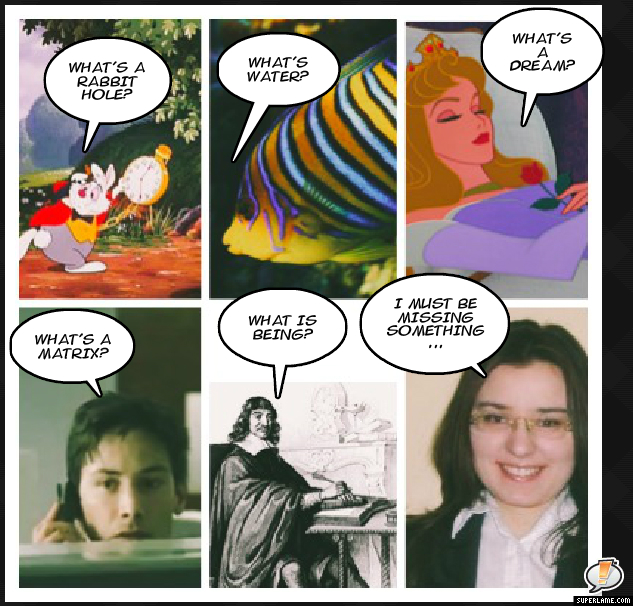
“What… is water?” asks the fish

A huge percentage of the stuff that I tend to be automatically certain of is, it turns out, totally wrong and deluded.

David Foster Wallace

I got into a merry debate with the lovely Pink Agendist about choosing day-dreaming versus being in the moment that ultimately elicited that we broadly agree: reality is a hugely interesting topic. In his touching speech, David Foster Wallace says :

The alternative is unconsciousness, the default setting, the “rat race” – the constant gnawing sense of having had and lost some infinite thing.

In a disarming manner, he admits that he isn’t saying anything ground-breaking. His point, however, is that it is so hard to keep the important thoughts in front of us that they are worth repeating. It seems that from Buddhists to Seneca to Darwin, the main philosophical thought that resonates with me is: be aware and adapt. Even in his seemingly grim Letter 61, Seneca says:

Let us set our minds in order that we may desire whatever is demanded of us by circumstances, and above all that we may reflect upon our end without sadness.

Few concepts send my mind into a spin like this. Part of me resists: humans accomplished what they’ve accomplished by defying their odds, not by accepting what is demanded of them. Siberia demands that you freeze to death or leave, for example. However, I think it is a misinterpretation on my part. Seneca is instead saying: find a way to use this situation. What is demanded is that one figures out how to chop wood and sustain a fire, so one has to manage themselves in such a way that they could do this eagerly and well. This one sentence explains the nature of cognitive behavioural therapy used today: changing one’s mind will change one’s emotions – and how one behaves. The point isn’t to idolise Seneca. I am sure that many generations of John the Caveman said it before him. The point is that the concept is as relevant today as it ever was.

Another part of me says: what are the circumstances – and what do they demand? I made a little graphic to show the nature of my confusion. Understanding the circumstances may require the sort of insight that I am not even aware exists.

developing self awareness though mindfulness

I haven’t figured out another way to get closer to understanding any of the above other than through mindfulness and reading the works of philosophers that stood the test of time. Even then, reading a philosopher’s thoughts is secretly wishing that someone else has it all figured out. This is another brilliant point that David Foster Wallace brings up: even if one doesn’t think that they have a religion, they still worship something – and have some kind of default setting:

In the day-to-day trenches of adult life, there is no such thing as atheism. There is no such thing as not worshipping. Everybody worships. The only choice we get is what to worship… The insidious thing about these forms of worship is not that they’re evil or sinful; it is that they are unconscious. They are default settings.

Just like Pema Chodron explains, it is part of human nature to assume that someone else has the answer. After all, that is what we are conditioned to believe as children through the behaviour of adults – they always know best. When we ourselves become adults, that void is then filled with some kind of worship. The only way to snap out and have the ability to choose again, even for a moment, seems to be by being in the moment.

I am tangentially involved in game development and recently came across a game called The Stanley ParableIt involves a corporate employee and his choices. The game is incredibly philosophical, touching on the concept of choice and free will – and I couldn’t do it justice here. However, if you have nothing to do on a dark January night, it will rock your world.

Have a mindful weekend, everyone.

Don’t change the channel

Mindfulness is effective in treating many mental health problems and psychiatric conditions. For those who don’t suffer from the above, it seems to still be beneficial in terms of focus, mood, relationships and results – based on many people’s personal experiences. Why then, is it so difficult at times? It is difficult for the same reason than escapism is easy. I am not Bill Murray’s biggest follower, but in one interview he said:

I would like to be more consistently here… I would like to see what I could get done if I didn’t cloud myself with automatic [thoughts]… If I were able to not change channels in my mind and body.

everyday mindfulness not day dreaming

He didn’t say anything ground-breaking, but his channels analogy really struck home with me. Having listened to this interview in the morning, I was on an uncomfortable journey between two cities today. To the right of me was a morbidly obese gentleman who sprawled himself across about three seats in an unorthodox position rarely seen in public. To the left – a lady who evidently led a lifestyle that didn’t involve too much personal hygiene. Having sneakily moved to another seat, I was putting my headphones in, prepared to sail away into a safe and pleasant day-dream. However, in my mind, I could hear the echo of the interview: don’t change the channel. Some voice of cognition questioned what I could possibly gain by being present when the present is like this? I wasn’t sure. What did I have to gain by being in a day-dream? A mindfulness devotee would surely say: nothing. Well, if people never day-dreamed, we would still live in caves. If we didn’t rehearse situations, ruminate, “mind-read” and obsess, the world would be different. I guess some may even argue it would be better. I am not sure.

I wish it was clear cut. I wish this story had an elegant twist where being present resulted in some kind of miraculous revelation. Instead it made me more aware that it is as easy to slip into the mindfulness cult as it is into a day-dream.

Ironically, Spotify shuffled to a nice house remix of R. Kelly’s Bump and Grind. As my mind was indeed very distinctly telling me “No“,  I took my headphones out. I could feel so much resistance. It angered me and made me sad that instead of floating off into a day-dream, I righteously deemed it necessary to stay in the present moment. I felt a bit like a Brave New World character without her soma. It felt necessary to stay present though. I ended up just being aware – of a storm inside.

Now, at the end of this mindful day, I can’t proudly declare that I feel at peace. There was no external conflict whatsoever, but I feel like I’d been in a blazing row for hours. With it though, there’s a certain exhausted clarity, like everything has been unreservedly said and it is all out in the open.

Faced with a choice like this again, I will probably choose mindfulness over the day-dream – again. I will stick with this channel called Reality, as we know it, rather than If I were with my friends or some other blissful escape route to rainbows and unicorns. Being honest, in part it is because I “read it in a book” and the high priests say it’s good for me. However, in part it is because I appreciate just how rarely I am even present enough to make this choice.

The day-dreams will happen regardless, the awareness won’t.

how to stop daydreaming

Waves and ideology

When I went for my jog by the sea this morning, I noticed that it was unusually stormy. It reminded me of a story told by my uncle.

Years ago, his friend and he went for a swim – in the dark – in a storm – after a few pints. Yeah, as you do. They barely made it out alive. My uncle credits his survival to one strategy – and he made sure to emphasise this lesson to me:

The waves are in charge, not you, so your job is to stop resisting the waves and work with them instead by allowing them to move you, slowly and iteratively, towards the shore.

As I ran along, I thought, isn’t that just a great metaphor in general – rather than just a “how to” for when you’re drunkenly getting out of a stormy sea?

philosophy of ideology

It then hit me that it is – for some people. However, there are some people for whom it really isn’t. As I discussed in my WordPress treatise on good advice vs bad advice, for advice to be useful, it has to be contextual. For over-ambitious people, the wave metaphor is great – as it bring them closer to reality. Their standard belief is that they can resist and accomplish, so the metaphor helps to remember that that’s not always the best strategy. However, for over-laid-back people, this metaphor is a disaster – for obvious reasons.

The whole point of these metaphors is that they allow one to see a side of things that they’re currently not seeing. In other words, heuristics need to be tailored to the specific unhelpful beliefs of a given individual.


I would argue that the point of metaphors, pondering advice and addressing one’s beliefs is to bring oneself closer to reality – and away from stereotypes and patterns that have stopped being useful.

All too often, however, these metaphors grow into ideologies. What’s worse is that people are generally drawn to ideologies that resonate with their off-kilter beliefs and idiosyncrasies, and so strengthen them – rather that being interested in ideologies that could take them out of their confusion and bring them closer to reality.

This happens through our intuitive confirmation bias, attentional bias, producing an even more biased closed minded echo chamber. This is one of the reasons why I am moving away from ideologies. An ideology is a fantasy loosely based on reality that is applicable only under a certain set of circumstances. This may still be called an ideology, but for me, observing nature – in the broadest sense of the word – is all we’ve got as our teacher.

choosing an ideology

Words or empathy?

Words. Words can change how we feel in an instant, they can prime us to act in a certain way without us knowing – but they also can completely misfire.

It seems very obvious now, but it took me ages to figure this out: people don’t always mean what they say.It’s not necessarily because they are lying, but a lot of the time it is because they lack insight and communication skills.

What really hammered it home to me was when a consultant psychiatrist was explaining to me how to handle the “admit-me-or-I-will-kill-myself” kind of presentation. He asked me a very simple question: “If you wanted to kill yourself, would you go to a hospital to inform the doctor?” I’ve no intention of trying to simplify the complex issue of suicide, but there is certainly a type of patient who honestly believes they want to kill themselves and come to hospital, still. Why??? Because the words are misfiring. The words they are saying are: “I want to kill myself”. What (some of them) mean is that they are in so much emotional pain that they have no idea how to get out of it, but they would really like help. It can be, strangely, easier to identify the desire for suicide as the problem because it is a bit more external – at least compared to one’s coping skills.

The moral of the story was: people don’t always mean what they say – and they may not even know it.

This disconnect between words and insight is well known among international relations officials. Here what is said is just as important as what it is left unsaid. The people who answer questions at conferences (e.g. press conferences at the White House) aren’t the officials and military generals actually who know the most. The spokespeople are briefed in a very specific way and believe the things they say. It is too difficult to have insight into how you will be understood, so they get people who specifically understand the exact right stuff.

The significance of precise language is well known in Hollywood.

The production team of Gone with the Wind fought long and hard just to be allowed to have Rhett say “Frankly, my dear, I don’t give a damn.”

Damn was a vulgar word and the censors weren’t happy. However, “I don’t care” just doesn’t provoke the same emotions. Also, it is often said that the word frankly was an unscripted improvisation by Clark Gable – it wasn’t. It’s just different from the book, but that’s how it was in the script.

Nassim Nicholas Taleb said it well here:

when one of these [Salafi] fundamentalists talks to a Christian, he is convinced that the Christian is literal, while the Christian is convinced that the Salafi has the same oft-metaphorical concepts to be taken seriously but not literally –and, often, not very seriously.

empathy and suicide

What got me reminiscing about this was a post by FJ of The Pensives about critical thinking as an antidote to manipulation. FJ identifies reading people (and empathy) as a key part of examining one’s true intentions. FJ’s insight certainly resonates with my own – that there is meaning way beyond words. I think context needs to be examined. Incentives need to be looked at. FJ’s argument is that putting oneself in someone else’s shoes is important. Maybe he is saying the same thing in different words – no pun intended, but there’s also a potential caveat here. It’s best expressed by Nicholas Epley wrote in his fabulous book Mindwise:

Reading body language and trying to take on the other’s perspective doesn’t seem to help to understand the person better. What does help is creating situations where people can openly tell you what they think – and listen carefully.

Obviously, that’s not always possible. However, the point I am trying to make is that while empathy has become an increasingly popular concept, we shouldn’t envisage it as an antidote.

You may also like:

Cognitive curiosities: what our minds do without telling us