Randomness as seen by Nassim Taleb

“Probability is not about the odds, but about the belief in the existence of an alternative outcome, cause, or motive”

Disappointed by Ayn Rand’s overfitting of consequences onto causes, I moved on to the book I’ve been meaning to read for a long time: Fooled by Randomness by N.N. Taleb.

What is Fooled by Randomness about?

Taleb is pretty clear on that:

“This book is about luck disguised and perceived as non-luck (that is, skills) and, more generally, randomness disguised and perceived as non-randomness (that is, determinism)”

This has to be one of my favourite paragraphs in modern non-fiction:

“It [determinism] manifests itself in the shape of the lucky fool, defined as a person who benefited from a disproportionate share of luck but attributes his success to some other, generally very precise, reason.”

Rand would argue that that’s intellect and taking responsibility. Instagram tells you it’s positive thinking. Richard Branson would tell you that it’s looking after your people and taking risk – though I’ve never had the “pleasure” of properly familiarising myself with his wisdom. Ryan Holiday would argue that it is one’s ego that gets in the way.

Life is more random than we care to admit

“... Just as one day some primitive tribesman scratched his nose, saw rain falling, and developed an elaborate method of scratching his nose to bring on the much-needed rain, we link economic prosperity to some rate cut by the Federal Reserve Board, or the success of a company with the appointment of the new president “at the helm”. Bookstores are full of biographies of successful men and women presenting their specific explanation on how they made it big in life (we have an expression, “the right time and the right place” to weaken whatever conclusion can be inferred from them).”

“Symbolism is the child of our inability and unwillingness to accept randomness; we give meaning to all manner of shapes; we detect human figures in inkblots.”

I find this very funny as I am the author of “Cliff notes” on Ireland’s secondary school poetry course. I enjoy looking for patterns where there are possibly none. My job as a doctor is right about the same: fit symptom A with symptom B and develop a list of differentials. While endless creativity is helpful with the Cliff notes, the situation with diagnoses is quite different. Taleb would argue that the conclusions I come to are more of a reflection on me than the material I am reflecting on.

“European intellectual life developed what seems to be an irreversible taste for symbolism – we are still paying its price, with psychoanalysis and other fads.”

Taleb table of confusion fooled by randomness

If there is one cause for this confusion between the left and the right sides of our table, it is our inability to think critically – we may enjoy presenting conjectures as truth.

“We are flawed beyond repair – at least for this environment.”

But it is only bad news for those utopians who believe in an idealised human kind.

He describes utopians (Rousseau, Godwin, Payne) as people who believe that knowing what is good for us will lead to that choice. So for example, telling people that obesity leads to health risks would lead people to lose weight according to this group.

On the other hand, he regards the likes of Popper, Hayek, Friedman, Adam Smith, Tversky and Kahneman, Soros, etc as people who see the world as it is and subscribe to scientific fallibilism.

Taleb advocates going around emotion rather than rationalising them:

“Ridding ourselves of our humanity is not in the works; we need tricks, not some grandiose moralizing help”

Taleb on happiness

Taleb calls upon Plutarch’s Lives:

“The observation of the numerous misfortunes that attend all conditions forbids us to grow insolent upon our present enjoyments, or to admire a man’s happiness that may yet, in course of time, suffer change. For the uncertain future has yet to come, with all variety of future; and him only to whom the divinity yet to come, with all variety of future; and him only to whom the divinity”

The modern equivalent has been no less eloquently voiced by the baseball coach Yogi Berra, who seems to have translated Solon’s outburst from the pure Attic Greek into no less pure Brooklyn English with “it ain’t over until it’s over”, or, in a less dignified manner, with “it ain’t over until the fat lady sings”.

fooled by randomness taleb key points
Now entering Wicklow

Taleb, not unlike Rand, believes in thinking hard, but reminds us to not take our own conclusions too seriously:

“Trading forces someone to think hard; those who merely work hard generally lose their focus and intellectual energy. In addition, they end up drowning in randomness. Work ethics draws people to focus on noise rather than the signal.”

I was very comforted to read the following on clarity vs correctness from Taleb. He spends this entire book fighting against the temptation to oversimplify and overexplain”

“Beware the confusion between correctness and intelligibility. Part of conventional wisdom favours things that can be explained rather instantly and “in a nutshell” – in many circles it is considered law. Having attended a French elementary school, a lycee primaire, I was trained to rehash the popular adage: Ce qui se congoit bien s’enonce clairement Et les mots pour le dire viennent aisement (What is easy to conceive is clear to express/Words to say it would come effortlessly)… Borrowed wisdom can be vicious. I need to make a huge effort not to be swayed by well-sounding remarks. I remind myself of Einstein’s remark that common sense is nothing but a collection of misconceptions acquired by age 18. Furthermore: what sounds intelligent in a conversation or a meeting, or, particularly in the media, is suspicious.”

He gives many examples of things that were genuinely new and good, but rejected when they originally were presented. This supports the whole “makes sense instantly” notion:

“Any reading of the history of science would show that almost all the smart things that have been proven by science appeared like lunacies at the time they were first discovered.”

Having worked with startups, I’ve always been told that one should be able to explain what your company does in one sentence. I just want to remark that this is for the “benefit” of investors alone.

Not everything is worth trying to explain

“I have a trick to know if something real in the world is taking place… The trick is to look only at the large percentage changes. Unless something moves by more than its usual daily percentage change, the event is deemed to be noise. Percentage moves are the size of the headlines. In addition, the interpretation is not linear; a 2% move is not twice as significant an event as 1%, it is rather like four times. The headline of the Dow moving by 1.3 points on my screen today has less than one millionth of the significance of the serious 7% drop of October 1997… We cannot instinctively understand the nonlinear aspect of probability.”

Confidence intervals are more important than the estimate

This point is related to the importance of variance as well as averages:

“Professionals forget the following reality. It is not the estimate or the forecast that matters so much as the degree of confidence with the opinion. Consider that you are going on a trip one fall morning and need to formulate an idea about the weather conditions prior to packing your luggage. If you expect the temperature to be 60 degrees, plus or minus 10 degrees (say in Arizona), then you would take no snow clothes and no portable electric fan. Now what if you were going to Chicago, where you are told that the weather, while being 60 degrees, will nevertheless vary by about 30 degrees? You would have to pack winter and summer clothes. Here the expectation of the temperature carries little importance concerning the choice of clothing; it is the variance that matters. Your decision to pack is markedly different now that you are told that the variability would be around 30 degrees. Now let us push the point further; what if you were going to a planet where the expectation is also going to be around 60 degrees, but plus or minus 500 degrees? What would you pack?”

taleb tricks to deal with being fooled by randomness
Just one track!

Consistency as path dependence

Taleb argues against the compulsion to keep our opinions the same and expect the same of others. From a logical stand points he is completely right. From a psychological one – we suffer greatly when we have to deviate from consistency and we simply don’t trust people who change their opinions. He gives the example of G. Soros, a man her described as “complicated”. He attributes at least some of Soros’ success to this ability to not be married to his views:

“They are totally free from their past actions. Every day is a clean slate.”

Taleb goes on to explain that we have evolved this for obvious reasons:

“Think about the consequences of being a good trader outside of the market activity, and deciding every morning at 8 a.m. whether to keep the spouse or if it is not better to part with him or her for a better emotional investment elsewhere.”

Stoicism as seen by Nassim Taleb

“It is the attempt by man to get even with probability.”

I think that’s a very curious interpretation! A slightly escapist one, but interesting all the same.

“The only article Lady Fortuna has no control over is your behaviour.”

We probably cannot overcome our biases

The epiphany I had in my career in randomness came when I understood that I was not intelligent enough, nor strong enough, to even try to fight my emotions. Besides, I believe that I need my emotions to formulate my ideas and get the energy to execute them.

The good news is that there are tricks.

Avoid eye contact to avoid an emotional response

Psychopathy central, I know. But sometimes, it’s better to prevent motional contagion, for example, in a road rage situation:

One such trick is to avoid eye contact (through the rear-view mirror) with other persons in such encounters as traffic situations.

Don’t listen to people who aren’t definitely worth listening to

Taleb argues that it is best to not engage in reading comments and reviews from people who don’t have a lot of credibility as their comments are more about them then they are about the work supposedly being reviewed. My personal experience certainly agrees with this. This is one of the most important lessons of the book. It’s also a very good thing to remember when asking advice (or, God forbid, getting unsolicited advice). This point subtly arises from the confidence interval point mentioned above.

Manage your exposure to things that have a strong emotional impact on you

Yet I have experienced leaps of joy over results that I knew were mere noise, and bouts of unhappiness over results that did not carry the slightest degree of statistical significance. I cannot help it, but I am emotional and derive most of my energy from my emotions. So the solution does not reside in taming my heart. Since my heart does not seem to agree with my brain, I need to take serious action to avoid making irrational trading decisions, namely, by denying myself access to my performance report unless it hits a predetermined threshold. 

This certainly resonates with me. As I mentioned, I have an online venture. Whenever a sale happens, I get an email about it. In the early days, I used to get so excited when someone made a purchase – it was great! Then I found that if I opened my emails, but the inbox did not contain any such notifications, I would feel a bit disappointed. Furthermore, if a sale was made, I didn’t feel compelled to work quite as hard! If it wasn’t – I was there thinking outside the box of what I could do better. I quickly learnt to only check that email account once a day.

One of the most irritating conversations I’ve had is with people who lecture me on how I should behave. Most of us know pretty much how we should behave. It is the execution that is the problem, not the absence of knowledge.

And the bit that is lacking from most awareness campaigns.

I am tired of the moralising slow-thinkers who pound me with platitudes like I should floss daily, eat my regular apple and visit the gym outside of the new-year resolution… We need tricks to get us there but before that we need to accept the fact that we are mere animals in need of lower forms of tricks, not lectures.

I am not sure I agree. I am quite allergic to these tricks because quite often just like the lecturing, they do not work. However, unlike the lectures, they are held to a lower standard of evidence.

We are not designed for schedules

Our ancestors didn’t work to deadlines. In the second edition of the book, Taleb goes on about how we are designed for randomness: we are more like firemen meditating between calls. Optimising everything may be a very poor decision that will take away the very things that we are trying to achieve – as far as the big picture is concerned.

We favour the visible, tangible and narrated – and scorn the abstract. Maybe I should turn to writing fiction?


nassim nicholas taleb randomness tips to avoid biases
Just a pink house with a gladiolus. How random…

“There are no evil thoughts except one: the refusal to think”

Shortly after I finished my medical degree, I pursued a master’s degree in finance. The 2008 market crash was pretty terrible for Ireland – and I was curious to find out get out of the medical bubble and learn about the world. After 5 years of medicine, everyone who wasn’t a doctor seemed well-rounded, but one of the most well-rounded wonderful friends I made during that masters suggested that I read Principles by Ray Dalio back in the day.

Dalio is the founder of (probably) the most successful hedge fund. Unlike all those 10-steps-to-success type books by various billionaires, Principles lacks the motivational element and has lots of cold rational logic. I found it to be a fascinating read.

You will find lots of free pdf copies of Principles online. The paid (expanded) version is a recent development. The book was in open access for years. The fact that it’s free is one of the things that made it different to books written by the likes of Richard Branson. I wonder what Dalio is up to with the paid version. The capitalist in him must be rebelling against giving out free stuff, I guess…

More recently, Dalio mentioned that reading Ayn Rand would be key to understanding the mindset of Trump era economics and politics. I poked around a few articles about Rand and was surprised to find that her philosophy was rejected by critics and academics. I’d never heard of these words in the same sentence. What does it mean to reject a philosophy? Turning to a family member beside me with this naive question, I received a less than naive answer: it is a situation where a philosophy isn’t politically expedient. Oh dear.

Nevertheless, her thoughts reminded me of Nietzsche. I don’t think he spoke about economics very much, but if he had, I am sure he would have said exactly what Rand had to say.

So I started with Atlas Shrugged.

Ayn Rand philosophy reviewed Atlas Shrugged

Is Atlas Shrugged a pleasant read?

Just like Brave New World, Atlas Shrugged a philosophical book dressed up as a novel. For the more analytical among us, it’s definitely a stimulating read. The characters are a little flat and improbable, but that’s just the nature of these type of works. A few cringy sex scenes. A touch of naive feminism.

Rand writes in impossibly long sentences and can seem excessively intellectual-for-the-sake-of-being-intellectual. Over 1,000 pages of that can get tiring.

Is Atlas Shrugged a worthwhile read?

The book addresses some issues we face today in the West in a way that nobody would ever dare in this day and age. We can barely take a breath without getting a licence, insurance and paying tax on it. We’re not actually free to speak our mind out here, even though we pride ourselves on it. There has been a lot of violence in US universities against right wing groups citing social justice as a legitimate justification.

In such a world, Rand’s writing is a breath of fresh air – but not for long. The discerning reader soon realises that Rand painted an impossible utopia, just like the communists she so hates, and that she is simply wrong in many of her sweeping statements.

What’s Atlas Shrugged about?

It’s about a (slightly) dystopian United States with a touch of sci fi. Prepare for a lot of talk about railways, oil, steel and trains. A government nationalises the major corporations in a fever of extorting socialism. You can hazard a guess where she got her inspiration.

Who is Ayn Rand?

She was an atheist woman of Russian Jewish bourgeoisie origins. As a 20 year old, she left the USSR and settled in the US. Interestingly, she became an atheist before it was cool strongly recommended by the Soviets. Her father was a businessman. He was stripped of his fortune during the Revolution of 1917. Legend has it that the first book she purchased in the US was Thus spoke Zarathustra. 

Incidentally, it is thought that she is an INTJ, so our ENTP crowd are likely to like her style.

Atlas Shrugged Ayn Rand objectivism philosophy explained

What did Ayn Rand believe?

1. Rand believed that religion and socialism are evil

Rand isn’t just against religion, she believes that socialists are basically Religion 2.0.

Both [religion and socialism] demand the surrender of your mind, one to their revelations, the other to their reflexes. No matter how loudly they posture in the roles of irreconcilable antagonists, their moral codes are alike, and so are their aims: in matter—the enslavement of man’s body, in spirit—the destruction of his mind.

Neither religion nor socialism welcome questioning:

The purpose of man’s life, say both, is to become an abject zombie who serves a purpose he does not know, for reasons he is not to question… Both kinds demand that you invalidate your own consciousness and surrender yourself into their power.

2. Rand rejected true world theories

Although Rand herself said “The only philosophical debt I can acknowledge is to Aristotle”, this is more or less straight out of Nietzsche:

[Religion and socialism] claim that they perceive a mode of being superior to your existence on this earth. The mystics of spirit call it ‘another dimension,’ which consists of denying dimensions. The mystics of muscle call it ‘the future,’ which consists of denying the present.


3. Rand thought that reality and perception are completely separate

Shakespeare said that nothing either good or bad, but thinking makes it so. Rand begs to differ:

They want to cheat the axiom of existence and consciousness, they want their consciousness to be an instrument not of perceiving but of creating existence, and existence to be not the object but the subject of their consciousness—they want to be that God they created in their image and likeness, who creates a universe out of a void by means of an arbitrary whim. But reality is not to be cheated.

A savage is a being who has not grasped that A is A and that reality is real. 

The fact that we can perceive things that aren’t what they initially seem doesn’t take away from the separation of reality and perception:

The day when he grasps that the reflection he sees in a mirror is not a delusion, that it is real, but it is not himself, that the mirage he sees in a desert is not a delusion, that the air and the light rays that cause it are real, but it is not a city, it is a city’s reflection—the day when he grasps that he is not a passive recipient of the sensations of any given moment, that his senses do not provide him with automatic knowledge in separate snatches independent of context, but only with the material of knowledge, which his mind must learn to integrate—the day when he grasps that his senses cannot deceive him, that physical objects cannot act without causes, that his organs of perception are physical and have no volition, no power to invent or to distort, that the evidence they give him is an absolute, but his mind must learn to understand it, his mind must discover the nature, the causes, the full context of his sensory material, his mind must identify things that he perceives—that is the day of his birth as a thinker and scientist. (Note that this is all one sentence!)

4. Rand postulated that a contradiction is the marker of a mistake

A touch of Aristotle:

Contradictions do not exist. Whenever you think that you are facing a contradiction, check your premises. You will find that one of them is wrong.

Emotion that isn’t congruent with thought indicated an unresolved conflict:

An emotion that clashes with your reason, an emotion that you cannot explain or control, is only the carcass of that stale thinking which you forbade your mind to revise.

5. Rand believed that refusing to think is a crime

Much as I disagree with Rand on many points, I do agree with this:

There are no evil thoughts except one: the refusal to think. 

To varying extents, we are all guilty of this – and our parents are, of making us trust authority over our own judgement:

A mystic is a man who surrendered his mind at its first encounter with the minds of others. Somewhere in the distant reaches of his childhood, when his own understanding of reality clashed with the assertions of others, with their arbitrary orders and contradictory demands, he gave in to so craven a fear of dependence that he renounced his rational faculty.

If you’ve given up on thinking, emotion is all that’s left:

From then on, afraid to think, he is left at the mercy of unidentified feelings. His feelings become his only guide, his only remnant of personal identity, he clings to them with ferocious possessiveness—and whatever thinking he does is devoted to the struggle of hiding from himself that the nature of his feelings is terror.

It’s not possible to be rational while only being rational about certain things:

Whenever you committed the evil of refusing to think and to see, of exempting from the absolute of reality some one small wish of yours, whenever you chose to say: Let me withdraw from the judgment of reason the cookies I stole, or the existence of God, let me have my one irrational whim and I will be a man of reason about all else—that was the act of subverting your consciousness, the act of corrupting your mind.

Resorting to mysticism means an inability to convince:

Every dictator is a mystic, and every mystic is a potential dictator… A mystic craves obedience from men, not their agreement.

If anyone wonders what it would be like to be Antichrist, just post the below on Instagram:

To a savage, the world is a place of unintelligible miracles where anything is possible to inanimate matter and nothing is possible to him.

6. Religion is a racket according to Rand

I went to an uber-Catholic school at one point. I recall my teacher telling me with great conviction that Jesus died for us. This thing we hear all the time is actually quite a confusing statement, so I asked why he had to die for us. The teacher proceeded to explain the concept of the original sin – and all I was thinking of, sure what have I to do with that? If forgiveness is more or less the ultimate virtue in Christianity, how come God is still holding Adam and Eve’s mischief against us? Rand seems to be of the same opinion:

The name of this monstrous absurdity is Original Sin. A sin without volition is a slap at morality and an insolent contradiction in terms: that which is outside the possibility of choice is outside the province of morality. If man is evil by birth, he has no will, no power to change it; if he has no will, he can be neither good nor evil; a robot is amoral.

Here is her summary of how religion rose to power:

For centuries, the mystics of spirit had existed by running a protection racket—by making life on earth unbearable, then charging you for consolation and relief, by forbidding all the virtues that make existence possible, then riding on the shoulders of your guilt, by declaring production and joy to be sins, then collecting blackmail from the sinners.

7. Universal basic income has no place in a Randian world

Rand is pointing out the Ponzi scheme in UBI:

They proclaim that every man born is entitled to exist without labor and, the laws of reality to the contrary notwithstanding, is entitled to receive his ‘minimum sustenance’—his food, his clothes, his shelter—with no effort on his part, as his due and his birthright. To receive it—from whom? Blank-out.

8. Decisions: make them or die, says Rand

Rand advocates extreme responsibility. It one of the main virtues to her. A person who doesn’t take responsibility doesn’t deserve to live:

Calmly and impersonally, she [the main character], who would have hesitated to fire at an animal, pulled the trigger and fired straight at the heart of a man who had wanted to exist without the responsibility of consciousness.

9. Trade is the ultimate human relationship

There is a lot of worshipping of the dollar in the book. Rand says that trade is great because it is consensual and it creates value for both parties:

Money rests on the axiom that every man is the owner of his mind and his effort. Money allows no power to prescribe the value of your effort except the voluntary choice of the man who is willing to trade you his effort in return. Money permits you to obtain for your goods and your labor that which they are worth to the men who buy them, but no more. Money permits no deals except those to mutual benefit by the unforced judgment of the traders. Money demands of you the recognition that men must work for their own benefit, not for their own injury, for their gain, not their loss—the recognition that they are not beasts of burden, born to carry the weight of your misery—that you must offer them values, not wounds—that the common bond among men is not the exchange of suffering, but the exchange of goods.

Money demands that you sell, not your weakness to men’s stupidity, but your talent to their reason; it demands that you buy, not the shoddiest they offer, but the best that your money can find. And when men live by trade—with reason, not force, as their final arbiter—it is the best product that wins, the best performance, the man of best judgment and highest ability—and the degree of a man’s productiveness is the degree of his reward. 

But what about love, I hear you ask? Her views on love are all about self-interest. Ultimately, love is a deal people make.

The Randian Ubermensch:

  • unconditionally loves life
  • has infinite belief in himself
  • is driven by intellect and self-interest
  • doesn’t wallow in weakness
  • takes responsibility for absolutely everything that happens to him
  • does not sacrifice and takes the oath: “I swear by my life and my love of it that I will never live for the sake of another man nor ask another man to live for mine.”

ayn rand objectivism is wrong

Holes in Rand’s philosophy

1. Rand doesn’t address the issue of chance

Rand says:

As there can be no causeless wealth, so there can be no causeless love or any sort of causeless emotion. 

There are all of these things in real life. Not for good reason, but they do exists. This is the main reason her philosophy isn’t useful: Rand doesn’t address the issue of chance.

Very often people who succeed overdefine their successes (and failures). It’s almost like survivor’s guilt: “I made it because I tried. If you haven’t made it, it’s because you didn’t try hard enough.” We all know that that’s not how things are in reality. In the long term, yes, Fortune favours the bold – or so I tell myself.

Most of the main characters appear to have inherited their fortune. John Galt, the real hero of the story, the inventor of the marvellous engine, didn’t. He wouldn’t have risen to the top by inventing an engine in real life. His invention would have been coopted by the owner of the huge corporation he worked for. He would probably get a gift voucher at the Christmas party. Where is the guy who invented the internet now? “It wasn’t one person.” True. But it wasn’t one person who made computers, smartphones, Facebook or whatever – yet we can put a name to these things because someone managed to make it into their own business.

Ayn Rand opposes that horrible Soviet-like “Equalisation of Opportunity” act in her novel, but this is why her philosophy has done little to address the downsides of socialism: she doesn’t address their main concern – that chance plays a large part in one’s life.

2. Rand looks for patterns where there aren’t any

A closely related point is that Rand believes that everything can be made into science.

The links you strive to drown are causal connections. The enemy you seek to defeat is the law of causality: it permits you no miracles.

Causality is a very ambitious concept to manoeuvre with. During my study of statistics I understood that causality is all smoke and mirrors. All we have are some intuitive concepts of what causes what. There is no real way to prove causality.

Looking for patterns in randomness has always been a hobby of the human race. Rain is caused by the generous sacrifices to the goddess of agriculture in the previous years. Investment returns are caused by prior results. A successful career follows from great interview performance. No. They aren’t. Some things are just random. Rand didn’t understand that.

3. Rand rejects the idea that there are things outside of our control

…it cannot be done to you without your consent. If you permit it to be done, you deserve it.

Here is more of Rand’s blame-the-victim philosophy. In certain contexts, the above is true, but it’s not quite as black and white as Rand makes out. What if your parents are addicted to drugs and you are addicted now too. Did you deserve it? Were you wrong to trust the people who gave you life and basically were your life for a long time?

This is how people get to be neurotic in the modern world: beating themselves up for not being able to control things… that they cannot possibly control. Rand rejects the idea that there are things outside of our control.

4. Rand confuses useful assumptions and absolutes

‘We know that we know nothing,’ they chatter, blanking out the fact that they are claiming knowledge—’There are no absolutes,’ they chatter, blanking out the fact that they are uttering an absolute—’You cannot prove that you exist or that you’re conscious,’ they chatter, blanking out the fact that proof presupposes existence, consciousness and a complex chain of knowledge: the existence of something to know, of a consciousness able to know it, and of a knowledge that has learned to distinguish between such concepts as the proved and the unproved.

Socrates got a beating there. To my mind, Rand is overambitious. A reasonable human being will operate on her assumptions, but they will not take them to be the only possibility.

5. Rand forgets the darker side of trade

To trade by means of money is the code of the men of good will.

What about selling heroin, Ayn?

And, Ayn, if you don’t hire me to be your security guard, I will break your windows.

It’s not just the Church that blackmails people.

6. Rand believes we live in a meritocracy of irreplaceable minds

In Atlas Shrugged, the brightest, most industrious people escape into a hidden world one by one as their creations get nationalised. This leads to a failed state; everything comes to a stand-still. Would this happen in reality?

This assumes that we live in a meritocracy. I believe in the power of genetics more than most people, but not everyone who inherits their parent’s empire is going to be as good as them. Rand acknowledges this fact in her character Jim Taggart, but seems to imply that the best will still rise to the top.

I don’t think that the world would be quite so helpless without its aristocracy. Every significant change of power in history has led to the destruction of the previous regime’s nobility. They just kept going anyway though: new nobility found its feet pretty quickly. When Atlas gets tired, he just adjusts his grip.

7. Rand states that happiness is the purpose of life

What a nice and simple formula. Only it is as foggy as dividing by zero. What does it mean to be happy, Ayn?

ayn rand nietzsche philosophy

What is my verdict on Rand’s philosophy?

I do agree that reality exists without our consciousness (this is the central idea of objectivism).

I admire her love of life, reality, intellect and industrious creation of value.

I think she simplified the complex and destroyed her credibility.

Her work is more of an ideology with defined values than a philosophy that helps to understand the word.


Lessons from the May challenge: all about anxiety

How did the 16 days in May challenge go? Not to the discouragement of my readers, I admit defeat.

16 day mindfulness challenge

This really was a challenge, and I am not that happy with how it went. Why? Life got in the way. I was under a lot of pressure to get a project done with lots of codependencies and lots hinging on it. During the early days of the challenge, I received fairly disconcerting feedback, so everything else went on hold. Anxiety took over.

A lot of people suffer with anxiety. Many refer to a small study that was done among the elderly and asked them what their biggest regret in life was. Many said that they worried too much. Well, of course! With the benefit of hindsight, that’s easy to declare.

A lot of people also say that anxiety isn’t going to help the outcome. Of course it will, otherwise we wouldn’t have evolved it. Naturally, there is pathological anxiety – and I am not talking about that, but in these days of overmedicalising feelings strong anxiety is seen as needing to be gotten rid of.

Maybe the problem isn’t the anxiety? Maybe the problem is the thing that’s causing anxiety? Genius thought, I know. But it seems to be denied any viability in our society. [Then they ask how did we all turn out to be special snowflakes. Hmm.]

Well, I didn’t get rid of my anxiety or try to suppress it. Once I just admitted to myself that I was anxious, a weight came off my shoulders. This is that classic acceptance thing they talk about in mindfulness. Anxious. So what? It’s not a crime. It’s not a defect. It’s just my experience and right now, in this moment, it’s not actually that bad at all. Acceptance of reality gave me the opportunity to work on the underlying cause of the anxiety.

Right, closer to the point:

1. A day without assumptions

OMG. How do you live without assumptions? Occam’s Razor: the simplest answer is usually correct. When I got my worrying feedback, I immediately started mind-reading, mitigating the worst case scenario, assigning probabilities to possible outcomes and acting. Acting is such a drug against anxiety. The problem is of course that directionless hustle isn’t necessarily better than inaction. It’s exhausting and it is possible to do damage like a bull in a china shop.

2. A walking meditation

Definitely a win. Interestingly, it was my olfaction that work up by doing this. I spent most of my life living in a city and that’s not the sort of place where you want to expose yourself to smells. Also, a walking meditation is kind of more lighthearted than the more perfectionist sitting meditation.

3. Get one thing that you have been putting off done

I’ve emailed a bunch of people about a project we all committed too, but all left it to stagnate. Two of the three recipients were very helpful in moving it forward and now, somehow, we have a fourth, who just contacted me out of the blue. Coincidence? Providence?

4. Make a list of your habits

I was too nervous to do that with all my stress. What if I exposed something so disappointing or annoying that I would be too upset? I simply didn’t have the reserve to do it at this time. I will add it to my list (guess that’s a habit…)

lessons learnt from mindfulness

5. Ask: Why am I doing this?

W was easy. I know what I consider meaningful. I also know that this changes. I know why I am doing what I am doing though sometimes I wish the routes were straight lines. Ultimately, we have to adapt to our environment and respect the peninsulas of circumstance that we navigate around.

6. Wear the worst clothes you own

Haha, well that led to a clearout! (Anyone of eBay?) It wasn’t so bad at all. Where I live, in Dublin, clothes aren’t as much of a status symbol as they are in some places – like Russia, or I imagine China, or even the UK. I am very grateful for that.

7. Spend the day on your own, no social media

Fail. I can spend the day on my own, but social media – that’s tough. I have this sensation that I am about to get some kind of interesting news via social media. All it is in reality is a trained dopamine-mediated habit. I need to get out of it. It’s not that hard, but once again, it may expose things. For example, it can expose just how lonely I feel sometimes. And then, if I commit to not having social media, at least on certain days, then I am leaving myself to confront the loneliness. As a teenager, I used to travel a lot – and it would always be a connection flight. Sometimes, the connection would be 4 or 5 hours. This was before the kind of engaging social media we have now and certainly before widespread free wifi. I just remember that horrible mix of boredom and loneliness and I don’t ever want to feel it again. Having said that, I always say I come up with some of my best realisations in transit. Maybe then, I should just take the bandage of and be alone with myself, whatever may bubble up.

8. Write down the things that annoyed you

Fail once again. I was worried that it would put me in a foul mood. That’s quite presumptuous and possible wrong. It remains on the to-do list.

9. Go through the notification settings on your phone

Done. Much less distraction now. Best decision ever.

10. Try some mindful cooking

I couldn’t really do that. I was worried that I don’t have the time with my project. It also felt a bit wrong to be messing around with new recipes when things are shaky. Once again, pretty presumptuous, but hey, all I can do is all I can do.

11. Note how much of the stuff you do isn’t for you

This turned out to be a surprise. Even from a Machiavellian points of view, I can easily argue that everything I do for others is done as an investment into a relationship.

12. Look back at where you came from and see where you are now

What a magical thing to do. I thought of my parents, of where I was born, of where I started, of the role I had to play in where I am here today. I think so many of us get upset as we feel that life happens to us and that we don’t have any real control. To any human being, it is very upsetting to not be in control. But is it true? On the one hand, in the grand scheme of things we are small and insignificant. But in the context of our own lives, we are a big deal. Just like the Stoics would argue it’s important to focus on what you do or think as a person. Circumstances aren’t always a form of feedback about how well or poorly we are doing. Looking back at how we navigated our circumstances, even back when we were younger and much more naive, is bound to generate some feelings of pride and invigorate the perception of who we are people.

13. Pay attention to the people in the shop queue

Well, let’s just say I was dragged shopping in IKEA during this time. There was a lady in front of us in the queue who changed her mind on what she was going to buy and was hiding the goods she was going to just dump at the cashier under a pile of bags. Before sneaking the stuff away, she looked over at us a bit like a poorly trained dog looks at people passing by when it’s eating. But I really couldn’t be bothered judging. Maybe she has too much sense to just buy 3 French presses (that don’t filter anything by the way)?

14. Check email only twice a day

Fail. What if something super important happens and I don’t even know?! I need to work on this.

15. Look back at the last 5 purchases you made and whether you needed them

They were all quite optional. I’ve learnt the lesson of not having useless clutter a long time ago (moving dorm rooms every year in college will teach that fairly quickly). However, I was quite surprised at how I could have gotten away without having a lot of these things.

16. Thank yourself for trying so hard

This is a lot like looking back at where you came started. Yes, sometimes the seas part, the light shines, the lucky break happens and we should be endlessly grateful for these blessings. However, we should thank ourselves for working so hard and having faith even when things don’t look good.

lessons learnt from mindfulness challenge

The successniks of Silicon Valley learn philosophy, but search for the secret sauce continues

‘Men work together,’ I told him from the heart,
‘Whether they work together or apart.’
– Robert Frost

“Practical philosopher” Andrew Taggard disabuses founders, executives, and others in Silicon Valley of the notion that life is a problem to be solved, and happiness awaits those who do it:

“Philosophers arrive on the scene at the moment when bullshit can no longer be tolerated,” says Taggart. “We articulate that bullshit and stop it from happening. And there’s just a whole lot of bullshit in business today.”

Taggart seems to preform a sort of CBT on CEOs. This article also features the term successnik when talking about the Silicon Valley execs. What a gem.

But wait, maybe we have the secret sauce after all?

Harvard/MassGen “psychiatrist, psychoanalyst and Zen priest” Robert Waldinger draws an interesting conclusion to one of the longest studies on happiness, carried out at Harvard…

Now, before we get all excited, it is an observational study of a small-ish bunch of Boston men, so go easy on the extrapolation. But here is the said sauce:

“So what have we learned? What are the lessons that come from the tens of thousands of pages of information that we’ve generated on these lives? Well, the lessons aren’t about wealth or fame or working harder and harder. The clearest message that we get from this 75-year study is this: Good relationships keep us happier and healthier. Period.”

I asked a similar question of Dr John McBurney – and his answer was community as well. Other research points out that when it comes to relationships, the absence of the negative is far more important than any grand gestures or unbelievable highs in determining whether these relationships will last.

successniks of silicon valley learn philosophy

Given that for millions of years our very survival has been predicated on our tribe much more so than on our personal achievements, it makes sense that we weight it so highly. Evolution carved us out for survival and not for happiness.

So perhaps, somewhere between the first and second step of the Maslow pyramid (that is physiological needs and safety), we’ve been missing community. In today’s society we can pay for the fulfilment of both of those – and that’s where most people are stuck.

Why do people want to be successful? Because it solidly ticks off the bottom two steps of the pyramid. If you are more cynical, let me phrase it this way: hedonism is step one, narcissism is step two.

Maybe the hack is in the fact that having a community provides both physiological and safety cover. Furthermore, unlike money in an of itself, it also let’s us into the higher up steps of the pyramid. I am calling it a “hack” because few people consciously feel community is that important.

Why don’t more people invest into community?

1. “I want to be special”

Blending in with a community is no fun. If you didn’t figure it out on your own, is it worth the same to you? All the cool guys seem to have done it one their own. We know that’s not true, of course.

However, it is hard to have a lot of impact if all you ever do is comply with the unspoken traditions of your community. So in a sense, it does prevent personal accomplishment. It’s important to clarify that you can’t make do with any sort of community: it has to be supportive. A conflicted community (or family) is probably more harmful than being alone based on what Dr Waldinger discussed.

2. “You can’t trust no one”

Indeed, communities do have a way of ostracising people – and generally being poisonous when things aren’t going well. All of a sudden your neighbour of yesterday is making a business out of your misery. We have all heard the stories from wars and famines that illustrate people’s disregard for the life of another in extreme circumstances.

This fact doesn’t stand alone of course. We’ve also all heard stories of altruistic sacrifices around those same wars and famines. And – what if you had been working in an individualistic rather than a community-centred manner: this isn’t a guarantee either because you’ve invested into things that may not have any value in extreme circumstances.

In the extreme, banks collapse, property gets nationalised, political regimes choose new heroes and scape goats… Less extremely, industries rise and fall, changing laws and regulations present new challenges.

If you want to be pragmatic about it, think of community as a diversification strategy. It seems that trusting your own accomplishments over trusting the community is a false path to success – whatever for you feel you need it.

harvard happiness stud role of community

The wheat from the chaff: philosophy vs self-help

There is something cringy about the notion of self-help. Yet blogging in the philosophical rambling genre invariably has a whiff of it. Even more generally, be it the Bible, Seneca, Leo Tolstoy, Viktor Frankl, Daniel Kahneman or Oprah, or in fact, any autobiography, aren’t they all essentially trying to answer the same question, namely how to make the most of our time here?

what is the difference between philosophy and self-help

Where do we draw the line?

Some writers, psychologists and philosophers have been using a quagmire of specialist terminology to warden off any suspicion of belonging to the self-help family. Religion is many things to many people, but it definitely ticks all the self-help boxes. What about picking up a new hobby? Is that a self-help action? What about ringing up a friend? What about going to the gym to get some endorphins? While we usually draw the line at solitary activities, preferably done alone, by overweight single middle-aged single women called Bridget in the company of Ben and Jerry… But being serious, it isn’t clear how to actually draw the line between legitimately working on oneself and being the gullible victim of charlatans.

Following a discussion on a wonderful Facebook group, Scott Brizel suggested an interesting approach: the problem is solved by noting the distinction between philosophy and ‘wisdom traditions’, even though wisdom traditions are (possibly wrongly) often called philosophies. Wisdom traditions propose strategies for living well, while philosophy is a method of inquiry into the meaning of ideas. Despite the loose use of ‘philosophy’ with respect toward it, Buddhism, for example, is a wisdom tradition, not ‘philosophy’ nor even ‘religion’. Religions tell creation stories, yet they may attempt to add value by establishing an associated wisdom tradition. The three ideas are often conflated, with some systems being both religions and wisdom traditions, but if you note the distinctions I draw, it will be easy to distinguish them.

Why people buy self-help books

The biggest predictor of whether a person will buy a self-help book is whether they have bought one before.

It is possible that the soothing feeling people get from buying and/or reading literature in the self-help genre is simply the reassurance that there is a solution to the problem.

As human beings, we have a profound desire to affect the world around us. This even applies to very young children, who can be taught to pedal a bike. While they don’t understand the significance of pedalling, the fact that the wheels are turning seems to motivate them to do more of it. Seeing tangible results of our actions gives us the feeling of control.

The feeling of control, the belief that our actions will deliver an impact, is probably our number one motivator. So no wonder people buy these books: by buying a book, they are buying equity in the belief that they can change themselves or even the world around them.

why people buy self-help books

Anyone who questions the ability of self-help methods to genuinely address the problem they aim to address seems like a party pooper who is stealing our dream of control. Indeed, Maslow’s hierarchy of needs, safety and security, in this case it is the belief that there is an answer and a role model to guide hold our hand, is more important than the need for self-actualisation.

Self-help books give a sense of safety and certainty. Placebo and religious texts have this in common too.

The authors inevitably portray themselves as a role model for whom these rituals have worked. Indeed, studies done on laboratory animals in helpless positions try to do things that are somehow associated with a reward or schedule. It’s an anxiety-defying ritual, not a solution to the problem per se.

As a child I spent a lot of time in Russia where books were very cheap and ubiquitous – and in the pre-internet era, well, they were the internet. Fiction never really did it for me, unless it was detective stories, and they, as we know, tend to be less than well written for the most part. Encyclopaedias were a bit hit with me, but also books on psychology.

As Western culture came flooding in, so did Dale Carnegie, Tony Robbins and their friends becoming an instant hit with a society turned upside down. My peers and I read some of these books, and they’ve left a negative impression congruent with the aftertaste of much of the rest of Western culture with its endless brands: the obvious repackaged and presented as a revolutionary discovery.

By the time The Secret came around, I was starting college. It wouldn’t occur to me to read that. I got a summer job in a book shop (the shopkeeper suggested I take the academic section, hmm, wonder why). The manager, when he wasn’t schooling me for being late, was perplexed at the proverbial middle-aged women who buy The Secret merchandise: he wasn’t sure how an adult could be convinced that by writing their wishes in a notebook that says The Secret on it (€7.99) as opposed as normal writing pad (€1.99) is better. I guess he just didn’t get why people buy things.

Years later I saw the film Little Miss Sunshine that I would highly recommend to anyone who wants to forget that they’ve held a self-help book in their hands.

why self-help doesn't work

What does the self-help obsession tell us about the society we live in?

Based on my reading of Durant’s The Lessons of History, the rise of the self-help genre is nothing unusual: whenever the role of religion diminishes in society, we flee to other sources of wisdom, or surrogate wisdom as the case may be.

For most millennials I see around me, our moral word seems to be a quilt of Christianity, Western liberalism with a touch of yoga-driven mysticism. I often think that it’s better to be confused and forced into questioning values than to unconditionally accept a bunch of dogma.The wishful thinking of self-help puzzled me for a long time. Is it really that different to a prayer? As a professor of psychology Rami Gabriel puts it:

Popular psychology comes with a message about the possibility of surmounting obstacles through the free will of the almighty self, as well as continual exhortations to practise hopeful optimism and disable despair and hopelessness: in all, a reflection of an individualistic, even narcissistic, culture in the contemporary US.

I would change US to the West. The cultural shifts in the US may be modulated as the cross the Atlantic, but Europe feels the reverberations of these developments for decades. I strongly agree with the narcissistic piece: all of this literature proclaims that you can change the world by changing yourself. While it may seem humble at first, it is actually enragingly self-centred. Of course, the purpose isn’t to be self-centred. It is to keep building the sense of control that would (in theory) allow one to rise above whatever circumstances that are holding them back.

So what is the difference between philosophy and self-help?

Self-help is hedonistic: do this and life will get better. Philosophy doesn’t aim to change one’s life, only to understand it.

Philosophy doesn’t provide any real recommendations. Self-help is bursting with answers: it is prescriptive. I guess the reason I am even asking this question is because if I hear someone say “don’t think about the negative”, I am keen to think of what the reasons and implications are, in other words, I think of the philosophy of the recommendation. To me, self-help is a truncated philosophy, though it doesn’t try to be.

Philosophers don’t tend to solve problems, they tend to ask and sometimes try to answer questions. Self-helpers have all the solutions. In fact, they tend to only have one solution, for all ills.


Friday’s cognitive curiosities: a trip to the book shop in the age of unenlightenment

My first curiosity is an essay from the Financial Times. I have mixed feelings about the FT. It’s pretty impossible for a paper like that to be neutral, but the FT doesn’t even try. I am constantly disappointed with its sneaky political undercurrent. At the same time, I cannot find a news outlet that would be as well presented and lack the dogma. Anyway, the essay is titled The age of unenlightenment, written by Robert Armstrong.

The author is thinking of why it seems that we are getting dumber.

the age of unenlightment robert armstrong
Spring is in the air, finally. West Pier, Dún Laoghaire Harbour

I used to think that older generations always denounce younger ones because it is a kind of tradition. However, given that the human brain is indeed getting smaller (and chances are we aren’t getting smarter), maybe there is some merit to their nagging?

A book by Sloman and Fernbach entitled The Knowledge Illusion: Why We Never Think Alone offers clever demonstrations of how much we take for granted, and how little we actually understand. An example: try drawing a picture of a bicycle, with the chain, all the bits of the frame, and the pedals all in the correct place. It is not so easy. In an experimental setting, half of people set this task fail it. If that’s too basic, explain how a flush toilet works. Easy? Well, unless you described how a trapway creates a siphoning effect, you got it wrong.

Granted, I am trained as a doctor, however I knew 80% of the basics about how the body functions before I went in to college. It never fails to impress me that most people haven’t a clue about how their body works, but they really think they do. Women endlessly discuss what’s good for their skin, but seem to miss the crucial detail that virtually non of the miracle co-enzymes and ultra-proteins in their creams get absorbed past the epithelium. Guys in the gym would authoritatively discuss the benefits of “fast carbs” immediately after a gym session and how to prevent “knots” forming in muscle tissue, but ask them about insulin or myosin – and they haven’t a clue. And I don’t mean they don’t know the terms, but they just don’t understand the basics. A much more florid and familiar example is of people who love talking about geopolitics. They rarely know where the “enemy” actually is on the map.

Robert Armstrong continues:
Technology has encouraged us to confuse access to information with knowledge. Education treats teachers as customer-service professionals rather than people who know things that students don’t, and offers students inflated grades, meaningless credentials and a false sense of their own wisdom. Journalists are encouraged to give their audiences what they want, rather than telling them what they need to know.

I agree with all of the above. There is a sense in the above lines that it was different in another time. I sincerely doubt that it was. However, I do feel that the rate at which raw information is becoming available is rising. Still, as few people know what to do with it as back in the proverbial day. It seems Mr Armstong’s conclusion is that the books he has read on the matter (listed below) focus more on the problem than on proposing solutions. Frankly, I’ve never read a book that was any good that proposed solutions. Observing what’s going on in plain sight and asking the right questions is usually more than enough. Here are the books:

  • The Knowledge Illusion: Why We Never Think Alone, by Steven Sloman and Philip Fernbach, Macmillan
  • The Death of Expertise: The Campaign Against Established Knowledge and Why it Matters, by Tom Nichols, Oxford University Press
  • #republic: Divided Democracy in the Age of Social Media, by Cass Sunstein, Princeton University Press
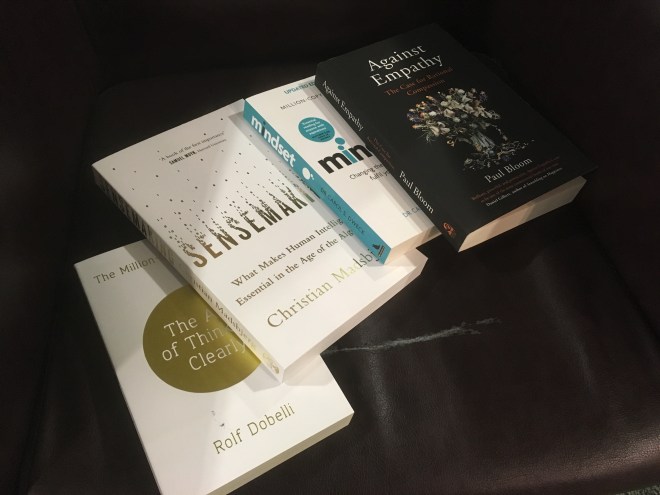
The Art of Thinking Clearly by Rolf Dobelli review
A fine Friday afternoon in Dublin

While we are speaking about books, I’ve been into the book shop and looked over the newest books in the psychology section. I sat in Hodges and Figgis’ leather chair and flicked through a few books. I always do that before I decide to read a book: I’ve bought too many “recommended” books that turned out to be either poor quality (as in, I couldn’t even finish them) or insidiously venomous making me wish I hadn’t come across them at all. In any case, I tend to really engage with the books I read, so there is a courtship ritual before I commit to reading the entire work. It went like this:

  • The Art of Thinking Clearly by Rolf Dobelli

“The Art of Thinking Clearly by world-class thinker and entrepreneur Rolf Dobelli is an eye-opening look at human psychology and reasoning — essential reading for anyone who wants to avoid “cognitive errors” and make better choices in all aspects of their lives.”

Mmm, it’s a very practical rewrite of Daniel Kahneman’s and Nassim Taleb’s thoughts. I would have thought that the former were practical enough. The back of the book featured praise by Sam Harris. I found Harris interesting initially but soon was uncannily repelled from his lopsided philosophy. I would be more careful in my choice of allies than Mr Dobelli. Could be a light read for someone unfamiliar with cognitive biases, but if you have any respect for your little grey cells, go straight to Kahneman. My (binary) rating for this book is: Nay.

Mindset : Changing the Way You Think to Fulfil Your Potential by Carol Dweck review
The sun setting over Howth
  • Mindset : Changing the Way You Think to Fulfil Your Potential by Carol Dweck

“After decades of research, world-renowned Stanford University psychologist Carol S. Dweck, Ph.D., discovered a simple but groundbreaking idea: the power of mindset. In this brilliant book, she shows how success in school, work, sports, the arts, and almost every area of human endeavor can be dramatically influenced by how we think about our talents and abilities. People with a fixed mindset—those who believe that abilities are fixed—are less likely to flourish than those with agrowth mindset—those who believe that abilities can be developed”

Psychology classics retold – and not in a very compelling way. Nay.

  • Against Empathy: The Case for Rational Compassion by Paul Bloom

“We often think of our capacity to experience the suffering of others as the ultimate source of goodness. Many of our wisest policy-makers, activists, scientists, and philosophers agree that the only problem with empathy is that we don’t have enough of it.

Nothing could be farther from the truth, argues Yale researcher Paul Bloom. In Against Empathy, Bloom reveals empathy to be one of the leading motivators of inequality and immorality in society. Far from helping us to improve the lives of others, empathy is a capricious and irrational emotion that appeals to our narrow prejudices. It muddles our judgment and, ironically, often leads to cruelty. We are at our best when we are smart enough not to rely on it, but to draw instead upon a more distanced compassion.”

I thought there was some merit in this book, but Daniel Goleman said a lot of the same stuff better. It may seem that he proposes the opposite to what this book is about, but that’s only an illusion. Perhaps, given the denigration of the intellectual and analytical approaches in the media, this books attempts to restore the balance and say that a quest for empathy isn’t going to solve our problems? It’s a nay from me, though the tone of the book is pleasantly contrarian.

Against Empathy: The Case for Rational Compassion by Paul Bloom review
Hopefully, I will find a yay in my next book shop trip

P.S. If you want to see some beautiful nature photos and are interested in travel, my friend Charis blogs about the island I was recently on – Cyprus. I was there with her for some of the trips she describes. I will write more about my escapade to the Eastern Mediterranean at some stage.

Can we live without evil?

Black or white?

What you label as evil essentially depends on which side of you are on.

Being directional, having a goal, being in pursuit involves labelling things and people as allies or obstacles. In pursuit of our goals, we do many things which we may think are perfectly okay, but somebody else will thinks are evil. I am typing this on a MacBook Air. If I were a Chinese person, I would probably have good reason to consider Apple evil. As I am on the consumer side here, I feel somewhat overcharged and not having a lot of options beside MacBook, nonetheless meaning that they are my ally. Good and evil, all at once.

My actions inadvertently lead to the death of the cutest and friendliest cat you can ever hope to meet. This made me see myself as someone who can do evil, even though it was never my intention to do evil. Whenever someone else did evil previously, I felt they were, well, evil. Bad. Shouldn’t exist. This experience has taught me to see things differently.

Another throwback to my 1990s Russian childhood: there were some Roma people around. They have vanished since; I’ve no idea where they’re gone. I guess that’s just part of the lifestyle of those people I witnessed. The unfortunate prejudice was that you need to hold on to your wallet when one is in sight. Indeed, on occasion, I would witness some cursing shopkeeper shouting as a Roma woman was running away. As a child, I recall wondering what stimulates these particular women to live this life. It is really quite clear and much more relatable when you are an adult.

Indeed, a lot of the the men and women whom we may regard as criminals are in pursuit of their goals: they have babies to feed, bills to pay, whatever. We may feel that it is unfair for them to rob what we’ve earned with our hard labour (as if robbing isn’t labour). They may feel it is unfair that we sit in a comfy office pushing paper (as if pushing paper is that easy). Our motivations are actually quite similar.

I really don’t like that variety of philosophy that ends up telling you that white is black and black is white. So I am not doing that. All I am saying is that good and evil are subjective and transient.

how do you tell good from evil
Grim but beautiful. Wicklow mountains

A Darwinian life

Any kind of goal-directed behaviour is likely to result in someone else’s suffering. Maybe, in fact, it isn’t even the goal-directedness of our behaviour, but the fact that nature makes us compete. Are win-win situations really that great when you consider the wider context? Tesco (a kind of British Walmart) not only allows residents of small towns to purchase goods cheaper, but it also creates jobs in the small town: someone has to pack the shelves, look after the purchasing decisions, etc. It is also well known that whenever the likes of Tesco move into a small town, for every job they create, they kill two jobs (who wants to buy from the butcher now that you can get the “same” stuff cheaper). Whether it is good or bad on balance, it is Darwinian and it causes suffering for the butcher.

Or consider my poor moths. I lived in a carpeted apartment for a while. Mid-plank I noticed that some bits of the carpet were bare and then found that there were moths living under it. I had to commit absolute genocide against them. Three rounds of poisonous chemicals. They must have “thought” I was evil. But did I really have a choice? Again, a Darwinian reality of them versus me.

In an insect’s mind, the most important life on this planet is an insect’s life. It’s all the insect has – nAot unlike us, though some of us think of life in a more abstract manner.

In a Darwinian world, is it possible to never do evil? How about a better question: is it that clear what good and evil is? Doesn’t it all depend of perspective?

why can't we live without evil
You can have perspective even when its cloudy. Kerry mountains.

Happiness and accomplishment

This is why being terribly obsessed with goals and accomplishment is so disturbing: it relies on a concrete framework of wanted and unwanted events. For those who are especially interested, the 1996 Mount Everest disaster is a great example of how being goal-directed can cloud one’s perception of good vs bad.

A lot of readers indicated that they wish to hear more on the subject of happiness. Read the fable “Blessings in disguise” in this context. Events that we see as undesirable could well be good. I sometimes look back at my failures. In what now seems like a former life, I was interviewed with McKinsey. After what seemed like 17 000 rounds of interviews, I received a phone call from the partner. As he greeted me, I assumed I had it in the bag. Why else would he call me? No, it was a kick in the stomach. I went digging and found out that some slightly younger guy with a reasonably unremarkable CV got it instead of me. I couldn’t figure out the conundrum for ages (I naively believed I could). I now feel that it was a lucky escape.

I even look back at some of the events I then labelled as successes and think: I wonder where I would be now if I hadn’t gone down that rabbit hole.

My working hypothesis is that to feel happiness one need to experience or perceive change and have perspective. Perspective is largely a set of cognitive judgements. I don’t want the reader to think that absolutely any event can be rationalised into being perceived as good when it was first thought of as bad or evil.

I want to simply highlight that some of our judgements about good and evil are completely off the wall.

I recall one scientist tell me that he won’t consider his career successful until he gets a paper published in Nature as a first author. Even if we ignore the needy narcissism, what a miserly contract to make with yourself! This is what I call off the wall.

Furthermore, everything is a chain of events.

If my aunt hadn’t suffered a medical negligence case, I wouldn’t have had the chance to go in on a rescue mission and reconnect with her, something that was way overdue. At the time of course, it all seemed like a bad dream.

can we live without evil
Grey’s a happy colour. Mizen Head


An age-old fable that teaches self-esteem

One day a young man came to the Teacher and said:

“I came to you because I feel so pathetic and worthless that I do not even want to be alive. Everyone around me is saying that I’m a loser, a useless idiot. I need your help, Teacher.”

The Teacher, glancing at the young man, hurriedly responded:

“I’m sorry, but I’m very busy right now, so I can not help you. I need to urgently settle a very important matter.” He added: “But if you agree to help me in my quest, then I will gladly help you in yours.”

how to have higher self esteem

“With … with pleasure, Teacher,” he muttered, noting with bitterness that he was once again being treated as less important.

“Very well,” said the Teacher. He removed from his left little finger a small ring with a beautiful stone.

“Take the horse and ride down to the market square! I need to urgently sell this ring to pay a debt. Try to get as high a price as you can get and do not agree to the price lower than a gold coin under any circumstances! Head down and return as soon as possible!”

The young man took the ring and rode away. Arriving at the market square, he began to offer the ring to the merchants. At first, they looked upon the ring with interest.

asian wisdom fable abut self-esteem

However, when they heard about the gold coin, they immediately lost all interest in the ring. Some openly laughed in his face, others simply turned away, and only one elderly merchant kindly explained to him that a gold coin is too high a price for such a ring and that only a copper coin, or at the very most a silver one, can be gotten for it.

Hearing the old man’s words, the young man was very upset because he remembered the Teacher’s order was not to lower the price below a gold coin. The young man tried again. He went around the whole market offering the ring to a good hundred people. Defeated, the young man once again saddled his horse and returned. Feeling like a failure, he approached the Teacher.

“Teacher, I was not able to complete your assignment,” he said sadly. “At best, I could have gotten a pair of silver coins for the ring, but you ordered not to settle for less than gold! I don’t know whether this ring is worth a gold coin.”

“You just said very important words, son!” replied the Teacher. “Before trying to sell the ring, it would be nice to establish its true value! Well, who could do that better than a jeweller? Ride down to the jeweller and ask him how much he will offer us for the ring. Only, whatever he tells you, do not sell the ring. Come back to me.” The young man again jumped on his horse and went to the jeweller.

how to develop high self-esteem

The jeweller took his time examining the ring through a magnifying glass. He then weighed it on small scales and, finally, turned to the young man:

“Tell the Teacher that I can not give him more than fifty-eight gold coins at this time.” But, if he gives me two days, I’ll buy the ring for seventy, given the urgency of the matter.

“Seventy coins?” the young man laughed happily. He thanked the jeweller and rushed back in full gallop.

“Sit down here,” said the Teacher, listening to the young man’s animated story. “And know, son, that you are this very ring. Precious and irreplaceable! Only a true expert can appreciate you. So why are you walking around the bazaar, expecting the first person to do this?”

~

The fable doesn’t address the existence of incompetent or fraudulent jewellers, but you get the point. It is to find the right assessor, a jeweller. I like the fable, but I don’t really use this view of self-esteem. It is always a recipe for unhappiness to rely on someone else to tell you your worth, whoever the proverbial jeweller may be: a loved one, a boss, a child, whoever.

For me personally, self-esteem is something that comes free with being alive. I take a Nietzsche-like view on it: to be alive in an of itself is valuable, here and now. No need to wait for a heaven or an enlightenment, no need for approval from other entities. You are responsible for your actions and adaptations, but that’s all you can do. Something somewhere conspired to create the reader and me despite the seemingly omnipresent entropy of the world. Isn’t that enough proof for the fact that we’re worth a lot?

This logic breaks down if you look around and see other people as being worthless. Thing is, I don’t. That’s not to say that I’ve never met anyone I don’t like, but I genuinely see every living creature as worthy (though for some of them, I prefer that they exercise their worthiness somewhere away from me, for example, the family of carpet moths that infested my living room a few years ago. I wish I could let them live, but alas, it was them or me.)

So my answer is that we have to be our own jewellers. Moreover, we should spend most of our time purifying the metal and finding the clearest and most precious stones for what we bring to the world rather than worrying whether we can sell for one, 58 or 70 coins.

Two obscure but important reasons why it so hard to feel happy

I recall a certain Prof. T., a psychiatrist I worked with and whom I regard highly, recount how he very nearly left psychiatry soon after joining when the writers of the ye old DSM considered including happiness as a psychiatric condition, being the opposite of depression. How very understandable. Happiness is often touted as the purpose of life and the most important thing, the most important condition to fill: “Sure, so long as you’re happy“, as they say in Ireland. I am tempted to go on a rant how the goal-directed pursuit of happiness has made us unhappy, but I think everyone knows that anyway. My discussion with Terraustralis* revealed an interesting attitude:

Happiness isn’t necessarily the point, but it sure is a good survival strategy. It is easier to get through life when you can see the bright side.

It always seems like a barrier to entry and an annoying obfuscation when a person responds to a question by needing to define the terms of the question. However, as I get older, I find myself joining this school of question-dissection.

What is happiness and why do we need it?

I don’t plan to get too metaphysical here. All I want to say is that there are two things commonly discussed using this term:

  1. The concrete sensation of being happy, such as when

a loved one gets you exactly the present you wanted for Christmas, or

you get an acceptance letter from a purchaser, an employer, a journal, etc, or

you notice the colourful sunset and feel at peace, or

you notice that your coffee is particularly nice

or indeed, you think of examples of when you were happy and your brain isn’t that sure what is real and what is a memory.

2. The abstract greater, non-provoked satisfaction, fulfilment or harmony that represents the bottom line of your emotional climate.

I will discuss happiness (1), of the concrete variety – because I feel that the abstract happiness (2) is a product of concrete happiness (1). If concrete happiness (1) is the weather, abstract happiness (2) is the climate. Abstract happiness is probably more often a subject of rationalisation and by its nature, it is more difficult to get a grip on, so we’ll start small(er).

Happiness is a chemical reaction.

Then again, so is everything else.

However, happiness is very directly a chemical reaction, unlike let’s say someone’s well-considered political views. They too are a series of reactions, perhaps even facilitated by the dopamines and serotonins of this world, but they lack the binary nature of the sensation of happiness.

Sorry for dropping the tone, but is happiness that different from an orgasm? Most of us know not to expect that to last forever.


happiness depends on expectations biases and change
A full moon over Dublin Bay as seen from Dun Laoghaire East Pier. It reminds me of the time I spent abroad, where it was sunny and warm. Should that make me sad? Not at all: I am all the happier to be here.

Reason 1: Happiness only exists in response to a change

There is no happiness when there is no change, real or perceived. Lack of volatility takes away the opportunities to feel happy.

As Sigmud Freud put it:  “What we call happiness in the strictest sense comes from the (preferably sudden) satisfaction of needs which have been dammed up to a high degree.”

This is why learning makes us happy: we see progress (or change). Furthermore, we get to control the change to a large degree. This enhances the happiness. This is also why ambitious people tend to be happier (my observation, do you agree/disagree?) It is like they have the activation energy to take the first step to learn something, to start on something. It is the mildly philosophical who are depressed, but they haven’t thought of the South East Indian history. Or how to start a petrol station. Expanding one’s horizons always leads to happiness (it may not be pure, but it is net positive). Some may call it distraction – and that would explain why we love clicking on stupid links shared on social media**. On the bright side, however, it is a form of learning, seeing new opportunities and changing one’s understanding of the world. Happiness comes free with that.

Daniel Kahneman’s book “Thinking, Fast and Slow” has influenced me greatly. His economically-related theories, the ones that got him the Nobel prize, are of little interest to me. I am much more concerned of his background work on general psychology that led him to the conclusions he reached regarding our buying/selling decisions. His discussion of happiness is particularly interesting.

how anchoring bias affects happiness
You know the old song by Wham! called “Everything She Wants” where George Michael sings with much anguish: “Why do I do the things I do? I’d tell you if I knew”? Daniel Kahneman knows. Imagine if Machiavelli spoke like Pavlov, they guy with the dogs? This is it.

“For an example, take the following scenarios:

Today Jack and Jill each have a wealth of 5 million.

Yesterday, Jack had 1 million and Jill had 9 million.

Are they equally happy?

… Jack is elated and Jill despondent. Indeed, we know that Jack would be a great deal happier than Jill even if he had only 2 million today while she has 5… The happiness that Jack and Jill experience is determined by the recent change in their wealth, relative to the different states of wealth that define their reference points (1 million for Jack, 9 million for Jill). This reference dependence is ubiquitous in sensation and perception. The same sound will be experienced as very loud or quite faint, depending on whether it was preceded by a whisper or by a roar.”

According to Kahneman, there isn’t just one happiness because there isn’t just one self (the one that resides in our talkative default mode network). There is the experiencing self, a kind of present moment aware self, and the remembering self, including the ruminating sort we so dislike.

The remembering self will focus on the peak and the end of an experience, where the experiencing self, will be, well, experiencing every moment of it. Here is an example:

“People who recently married, or are expecting to marry in the near future, are likely to retrieve that fact when asked a general question about their life. Because marriage is almost always voluntary in the United States, almost everyone who is reminded of his or her recent or forthcoming marriage will be happy with the idea. Attention is the key to the puzzle.

what determines how happy you feel
People’s level of life satisfaction as a function of time surrounding their wedding. Source: “Thinking, Fast and Slow” by Daniel Kahneman, page 398

The figure shows an unusually high level of life satisfaction that lasts two or three years around the event of marriage. However, if this apparent surge reflects the time course of a heuristic for answering the question, there is little we can learn from it about either happiness or about the process of adaptation to marriage. We cannot infer from it that a tide of raised happiness lasts for several years and gradually recedes. Even people who are happy to be reminded of their marriage when asked a question about their life are not necessarily happier the rest of the time. Unless they think happy thoughts about their marriage during much of their day, it will not directly influence their happiness. Even newlyweds who are lucky enough to enjoy a state of happy preoccupation with their love will eventually return to earth, and their experienced well-being will again depend, as it does for the rest of us, on the environment and activities of the present moment.”

how to feel happy all the time anchoring bias
An nice and heavy anchor is Dun Laoghaire harbour, Dublin


Reason 2: Happiness is tied to an anchor bias

What is anchor bias?

Anchoring is a cognitive bias that describes the common human tendency to rely too heavily on the first piece of information offered (the “anchor”) when making decisions.

For example:

“If you are asked whether Gandhi was more than 114 years old when he died you will end up with a much higher estimate of his age at death than you would if the anchoring question referred to death at 35.”

My own tale is that the first “anchor” I’ve thrown was in 1990s Moscow.

I still pause nervously at the thought of the things I avoided. I was very shielded, yet the echo of the various brands of social unrest that surrounded me reached me enough to know I have to watch out. You know how your mother probably taught you to not speak to strangers and not get into a lift (elevator) with people you don’t know? Most of us use discretion with these rules and only put our guard up when something is tangibly “up”. I am used to using these rules verbatim. I still don’t speak to strangers unless I am in a crowded and well-lit place. I still move whenever someone sitting beside me is coughing a lot: you never know, it could be TB. Whenever I am in Moscow, to this day, I always have my guard up. It sounds sinister, but it’s not actually.

It is as if I am constantly anticipating that someone will try to swindle me in some minor way. In a queue, you well get skipped unless you’re paying attention. The florist will inevitably “accidentally” charge for a higher priced bouquet and reissue the invoice once questioned. The radiographer will forget to take the standing X-ray having taken the lying one unless you double check. It’s a mix of carelessness and minor fraud that arises from low wages in a cynically unequal society. This happens everywhere of course, but it is quite consistent in Moscow, or at least is was, in the very turbulent 1990s. You have to be very aware, prepared to stand up for yourself and presume the worst of people. I don’t enjoy being like that. Just to be clear, I don’t hate where I come from or have some sort of overly dramatic story. These are just observations.

Having this 1990s Moscow “anchor”, most places I go to remind me of the pages of a fairy tale book. I may be exaggerating a little, but that’s the crux of the emotion I feel every day. Every day someone is polite to me, I remember that it wouldn’t have been like that back in the proverbial old country.

Whenever things happen without me having to double check that everyone has done their job, I automatically get this wave of bliss, gratitude and a sense of that concrete happiness. It’s like drinking water after a 10 K run. It’s like escaping capture by an enemy.

Why? Because I am anchored to believe that things going smoothly isn’t the norm. Elaborating on Ray Dalio’s formula,

Happiness = reality – expectation (regarding a given event or change in circumstances).

The specific anchor I have is quite low down in the expectation ocean, so happiness is often a positive value. Does it mean I actually have low expectations and take sh*t from people? Somehow it doesn’t. It just makes it easier to be happy. The fact that this isn’t just some idea, but an actual anchor I have been fortunate enough to form makes me see everything though that filter. Biases aren’t always bad.

If I had been reading, not writing this, I would probably think: here goes, be grateful, bla bla, game your mind until you feel happy even though you shouldn’t really. It doesn’t feel like I am forcing this at all. It’s a lucky idiosyncrasy. Can it be extrapolated to other things? So that we can feel happy more effortlessly? Very soon an overzealous extrapolation approach turns into “there are children starving in <remote location>, so you have to value what you have”, which inevitably causes resentment and a feeling of pointless self-fraud over time.

The point is that looking back at our own anchors  and expectations (not those of deprived children in a less-developed country) can help to explain how happy or unhappy we feel.

Understanding that happiness is only achieved through change, it helps to think of our lives as a continuum of present moments rather than an efficient emotionless journey from A to B, where B is full of yummy dopamine***.  It is just another way to understand the context, gain perspective or whatever other fancy term you may want to use for all those things hidden in plain sight.

In short, happiness is fundamentally decided by:

  • presence of change (real or perceived)
  • expectations

It’s also affected by temperament (e.g. the weight one attaches to negative events) and genetics – and I will talk about this another day.

 * A gentleman who comments in English, but blogs in Polish here.

** Procrastination is an avoidance behaviour, but it does make us happy in a short term concrete way. I believe it makes us happy using the same mechanism as learning, though on balance, of course, it is a saboteur.

*** Actually, it is the anticipation of B that releases the dopamine.

Friday’s 5 cognitive curiosities journal club

A weekly trail mix of thought-provoking essays and research.

1. The madness of mindfulness

From The Financial Times

Lately, there’s been more and more of a backlash against mindfulness. It’s only natural given the rate it is growing at and the unscrupulous many who try to earn some cash riding this wave and promising mindfulness as the true path to the moon and the stars.

An understandably overwhelmed mother standing amidst Lego pieces gets a push notification on her phone that it is time to be mindful. This seems to have been the straw that broke the camels back. She goes on a rant about the appful pursuit of happiness. Caustically, she remarks on the passive aggressive nature of the simplicity of the mindfulness proposition and the real-life difficulties of its application. Of course, the article isn’t about mindfulness, it is about the cult of commoditised mindfulness and its many apps. It is quite overwhelming indeed – if you are the kind easily gets swayed by trends.

2. Time will show – and only time

From N.N. Taleb

N.N. Taleb, the closest thing we have to a popular philosopher today, brings some seemingly obvious, yet profound, insights:

…Actors gossiping about other actors discovered that Broadway shows that lasted, say one hundred days, had a future life expectancy of a hundred more. For those that lasted two hundred days, two hundred more. The heuristic became known as the Lindy Effect. The Lindy effect is one of the most useful, robust, and universal heuristics I know…

Being reviewed or assessed by others matters if and only if one is subjected to the judgment by future –not just present — others

Academia can become a ritualistic publishing game

3. Music works the same way as heroin

From Nature Scientific Reports

Music’s universality and its ability to deeply affect emotions suggest an evolutionary origin. The research shows that endogenous opioids are critical to experiencing both positive and negative emotions in music, and that music uses the same reward pathways as food, drug and sexual pleasure. Our findings add to the growing body of evidence for the evolutionary biological substrates of music.

4. The internet and our brains are more similar than we think

From Neural Computation

The Internet relies on not being overloaded in order to work. The solution involves controlling information flow such that routes are neither clogged nor underutilised. To accomplish this, the Internet employs an algorithm called “additive increase, multiplicative decrease” (AIMD) in which your computer sends a packet of data and then listens for an acknowledgement from the receiver. If the packet is promptly acknowledged, the network is not overloaded and your data can be transmitted through the network at a higher rate. With each successive successful packet, your computer knows it’s safe to increase its speed by one unit, which is the additive increase part. This process is quite similar to our brain’s long term potentiation, i.e. memory formation. But if an acknowledgement is delayed or lost your computer knows that there is congestion and slows down by a large amount, such as by half, which is the multiplicative decrease part. This is called long-term depression (nothing to do with clinical depression).

5. The “bouba-kiki”effect: words sound sharp or soft on a subconscious level

From Psychological Science

The “bouba-kiki” effect, originally reported over 85 years ago and replicated many times since, shows that people consistently pair the soft-sounding nonsense word “bouba” with soft-looking, round shapes and they typically pair the sharp-sounding nonsense word “kiki” with spiky-looking, angular shapes.One may argue this is good old onomatopoeia, however, the researchers did a series of curious visual experiments showing people the nonsense word in a congruent (bouba-circle) or non-congruent (bouba-angular) shape. The images were shown in one eye, while the other eye was shown flashy distracting images. The congruent pair was noticed first, indicating that participants perceived and processed the relationship between word and shape before they were consciously aware of the stimuli.

Have a great weekend everyone.