Thinking about thinking (known as metacognition) is hugely important for adaptation, however, little is known about it. The results of this study demonstrate that the information used to make the initial decision differs from the information that is used in metacognitive judgments.
From The Quarterly Journal of Experimental Psychology
Obesity could play a part in the development of neurodegenerative diseases such as Alzheimer’s Disease. It appears that the relationship is a two-way street: being overweight or obese impacts memory function, then the memories of eating experiences change and thus affect future eating behavioural patterns.
It appears that individuals with mental illness – regardless of the diagnosis – have abnormalities in their limbic system responses to various tasks. The limbic system is associated with emotion.
Put simply, the fMRI of a depressed person isn’t different to the fMRI of a person with a (seemingly) completely different disorder schizophrenia.
This could be a reflection on insufficient sample sizes. It could also be a reflection on the worry of going into an MRI scanner. A number of studies emerged recently showing that we’re possibly misinterpreting the findings of fMRI.
From Addressing Reverse Inference in Psychiatric Neuroimaging: Meta-Analyses of Task Related Brain Activation in Common Mental Disorders
Individuals suffering from obesity who self-stigmatise may be at an increased cardiometabolic risk. Physiological and psychological mechanisms linking weight bias internalisation and metabolic syndrome warrant further research.
One of the researchers commented:
“There is a common misconception that stigma might help motivate individuals with obesity to lose weight and improve their health,” Pearl said. “We are finding it has quite the opposite effect.
When people feel shamed because of their weight, they are more likely to avoid exercise and consume more calories to cope with this stress.”
Tara Brach humorously talks about the relationship between biases, emotion, beliefs and thinking. Emotions can subside in 90 seconds unless we generate cycles of thinking that re-trigger and reinforce them.
It seems that the focus of many bloggers and mindfulness advocates is to promote mindfulness as yet another miracle fix on the way to flat abs and a yacht. Mindfulness isn’t a shortcut to effortless positive thinking.
The fact that the 440×220 pixel Twitter platitudes with a stock sunset background and a quote from a Buddhist have become so popular reflects the growing misunderstanding surrounding mindfulness.
While mindfulness does help with depression, anxiety and other difficult mental states, achieving a certain mental state – or indeed happiness – isn’t the purpose of mindfulness. While it isn’t necessary to buy into the philosophy behind mindfulness to practice it, it’s important to understand what it is one’s getting themselves into.There’s nothing at all wrong with “secular” mindfulness, the kind pedalled by corporations, promoted to children, etc. Indeed, I am in no way a Buddhist. However, I believe that hiding from this philosophy and still expecting to get experience mindfulness to the full is futile. The philosophy states that…
At the root of all suffering is attachment.
Non-attachment is a key tenet of the Buddhism. Attachment is our attempt to deny the fact that everything is impermanent, hence is causes a dissonance between reality and perception ultimately resulting in suffering. The concept seems at odds with out common view of happiness that involves the strife to get through a checklist of experiences and things – and walk of into the sunset in permanent bliss. However, the concept of non-attachment is echoed in the philosophy of Stoicism, the thoughts of Friedrich Nietzsche and modern talking therapies such as CBT and REBT. Indeed, I struggle with the concept again and again. It seem that Buddhism advocates that we live our lives a bit like plants: accept everything that comes our way and adapt.
Using mindfulness as some kind of trick to accomplish certain goals just doesn’t make sense.
Born at Google and based on brain science, SIY uses the practices of mindfulness to train Emotional Intelligence skills, leading to resilience, positive mindset, and centred leadership. In the midst of complexity, it’s about finding the inner capacity to create, to thrive, to lead. And it’s surprisingly fun. Backed by some of the world’s leading experts in neuroscience and mindfulness, SIY is changing thousands of lives in over a dozen countries.
Here’s a book they propose. I haven’t seen the inside, but if I may judge by its cover, I find it wanting.
Indirectly, insights into how to achieve goals may be precisely the result of the practice. However, a realisation of the irrelevance of those goals may also be the outcome. Being in the moment involves not knowing how it will all turn out. Barry Magid is an American psychiatrist who went against the current. He argued against using meditation as yet another vehicle en route to the conventional happiness prescription, i.e. maximum pleasant feelings and thoughts, minimum unpleasant feelings and thoughts.
Magid’s understanding of mindfulness is that it is a way to stop trying to “fix” ones’ experience of things.
His argument is somewhat routed in mythology: struggling to escape one’s demons is what gives them their power.
The fight for a vision of happiness is the cause of the problem, not the solution to it.
Freud’s seemingly basic idea of our psychology was that we seek pleasure and avoid pain (and we avoid pain much more than we seek pleasure). He argued that our subconscious was a big long list of everything we avoid. The Buddha confronted suffering, he didn’t move away – he moved into the pain – and that is how he became free.
As a doctor, I know that it’s very worrying when a patient doesn’t flinch away from a painful stimulus. I am starting to come around to the idea that for our higher cognition, the non-reflex, non-fight-or-flight, it is better to not flinch away from mental pain.
That’s how I understand mindfulness. It’s not sitting there thoughtless. In fact, trying hard to fix the busy mind is yet another trap. The way I understand it is that it is necessary to observe it without clinging or fleeing. Like I discussed with Bela,
For me the experience of mindfulness is a bit like being on a tight rope: the abyss of clinging to the left and of fleeing to the right. Sometimes of the past to the left and of the future to the right. Just like it takes a lot of awareness to remain on the tight rope, flexing the right muscles, adjusting to the wind, it takes the same kind of awareness to stay in the moment.
Seneca, Freud, the Buddha – and our new friend the living psychiatrist Magid all seem to think that flinching away from suffering is what makes it worse.
The Abhidhamma, a central text for Buddhism, teaches that the mind is a bit like a sense organ. Thoughts and feelings come in just like smells, sounds and tastes. Recently, I observed a thought that seemed completely extraneous to me: having relaxed after non-stop worrying about a sick animals, I found it strange how someone else would get so upset about a pet in hospital. Not every thought and emotion belongs to us. Why do certain songs cling to our minds? In what way are they ours?
We could consider the inescapable nature of the smell of cigarettes – or the taste of toothpaste every morning as a way to understand the presence of certain thoughts and feelings.
It gets a little bit “meta” – as we are more abstractly thinking (one may say observing non-judgementally) of regular thinking (to do list, he said, she said, itchy, hungry, Never mind I’ll find someone like you, and other assorted circular randomness) – and saying that regular thinking is just like an organ of perception. What does that say about abstract thinking? Is that the “real” thinking? Somewhat over-simplistically, I suspect that this abstract thinking is a process of the prefrontal cortex, while the regular thinking is carried out by more basic circuitry we share with many animals.
Observing the clouds pass by without chasing them
In this vein, not being able to get the motivation to do something because one’s sad doesn’t make sense. One needn’t feel pumped to do work. If thoughts and feelings are like smells and sounds, one can still muster the agency to do what needs to be done. The Stoics would argue like this also.
In a sense, this still means that mindfulness is a route to happiness, only I changed the goal posts of what happiness is. In a sense, mindfulness is a fight to stay on the tightrope of the present moment – and thus a fight for happiness. This is all difficult to state in words, but I think you all know what I mean.
Mindfulness doesn’t have a purpose, except perhaps to reconcile perception and reality – which is so obvious, it is a bit embarrassing to state as a purpose.
Man cannot endure his own littleness unless he can translate it into meaningfulness on the largest possible level
Ernest Becker
Fear of the passage of time
I recently came across the term chronophobia in the context of people doing exams: knowing that exam day is ever closer makes people anxious. Chronophobia was defined as an experience of unease and anxiety about time, a feeling that events are moving too fast and are thus hard to make sense of, in “Chronophobia: On Time in the Art of the 1960s” by Pamela Lee.
Chronophobia isn’t a formal diagnosis, neither does it feature in scientific literature. In other words, it’s not really a phobia. It is more of an unpleasant feeling – one that is often expressed in art.
It is common in prison inmates, students in long academic programs and the elderly. When one is anxious, it is not only possible to be anxious about the event, but also its inescapable approach. Chronophobia is less about the doom and more about it being impending.
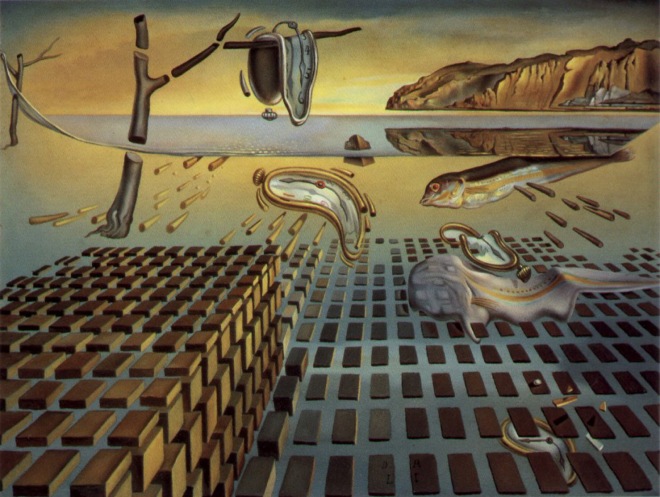
Salvador Dali: The Persistence of Memory, 1931. The melting clock describes the feeling of chronophobia rather well
Chronophobia appears to be connected with heightened awareness of the passage of time that is inherent in distant deadlines for significant events.
This morning during my 10 minutes of mindfulness, something interesting bubbled up. I randomly remembered myself on an airplane travelling back to Moscow to visit family about 2 years ago. I felt a strong urge to be that person again, a bit like when I’m on vacation and towards the end, with a sigh, I think back to how liberating the first day off felt. Or when I reach the last bite of some dopamine-explosive dessert, I think back to how happy I felt when it was just put in front of me. We all love vacation and desert. However, my wish to be 2 years younger makes little sense. I was in the throes of a challenging 70-80 hours per week medical rota. It took much ingenuity to carve out enough time to travel. Is it regret? It wouldn’t be fair to say that the last 2 years were somehow a waste of time in any regard. Why do I feel so drawn to the thought of going back in time?
Salvador Dali: The Disintegration of the Persistence of Memory, 1954. Dali saw the fish as a symbol of life
Fear of opportunity cost
Aged 27, I frequently contemplate what it would go back to a previous point in time. I think it’s the understanding of the limited nature of time. I also worry about opportunity cost. In economics, there is the term opportunity (alternative) cost is the value of the option that we don’t choose when making a decision. [If I have 1 euro and buy a 1 euro can of Coke, I would have to forego the 1 euro Mars bar in order to have it. I would thus potentially worry about what it would have been like if they got a Mars bar instead.] The feeling is different to decision-anxiety. It’s not even about second guessing one’s choice, but more about imagining alternative paths.
The word decision literally means the cutting off – of other options. Thinking of the alternatives always reminds us of the unyielding nature of choice and how we really can’t literally “have it all”.
Robert Frost’s famous (infamous?) “The Road Not Taken” is a brilliant and often misinterpreted examination of the nature of choice. It is important to recognise the speaker’s deliberation: he says the roads are much the same: “just as fair”, “really about the same”, “equally lay”.
“The Road Not Taken”, a frequent feature of post-card philosophy, is often oversimplified to say that the speaker chose the less travelled road – and, woohoo, that’s amazing. It’s more complex than that.
The speaker admits that he left the first road “for another day”. While he knew he would never go back, the torment of admitting the final nature of choice is just too much.
One can get very detailed when describing their particular fear. I certainly don’t support the idea of including “fear of opportunity cost”, “fear of the passage of time” or even “fear of choice” as phobias into the DSM. Indeed, this is perfect ground for thinking by induction. Is there a common thread here?
Hans Holbein the Younger: The Ambassadors, 1533. Note the anamorphic skull in the foreground. It surely is a reminder of death
Boiling down fears to a common denominator: could it be death?
Why does chronophobia affect students? Time forces them to deal with events that will affect serious aspects of their lives such as their future careers – and thus even more permanent things like social class, the kind of people they will be likely to marry and so on. Exam results’ effects are by no means definitive, but probabilistically they are significant.
It has become popular to say that there are only 2 human emotions: fear and love.
Everything negative is a form of fear. It kind of makes sense: anger is a way of defending one’s point of view, property or whatever other boundary. Being sad is a fear that one will never be as happy as they were before as a result of an event (not talking about depression here). Disgust is a fear that something will negatively impact one’s existence. You get the gist.
The other popular thought is that all fear is a form of the ultimate fear – of death.
Going back to chronophobia again, why does it affect the elderly? Time threatens the existence of the elderly. It threatens all of our’s existence, but the elderly are more aware of it – mostly for social and cultural reasons. Now, none of us are deluded enough to actually think we’re not going to die. However, as Ernest Becker points out:
we have 2 ideas of the self: the physical and the symbolic.
In my opinion, our rationality only extends as far as the physical self. We are preoccupied with ways to immortalise our symbolic self. As per the “Mahabharata”:
“The most wondrous thing in the world is that although every day innumerable creatures go to the abode of death, still man thinks that he is immortal”.
Salvador Dali: Metamorphosis of Narcissus, 1937. Dali had an interest in psychiatry
The recent debate that followed my discussion of the role of validation in our self-esteem sparked some follow on thoughts. In short, it showed that people with narcissistic tendencies experience much emptiness or even self-hatred – and validation is used to take the edge off. However, as all creatures who make choices, people with narcissistic tendencies are subject to avoiding pain and seeking pleasure (thank you, Dr. Freud). Clearly, they find narcissism more tolerable that the alternative. How could this be?
What if those who crave validation to feel good about themselves chose to be this way because the alternative – knowing that one is inherently valuable, without any validation – makes the thought of inevitable death absolutely intolerable? If one feels that they’re not that valuable, dying isn’t quite as scary or tragic.
Realising that a person is valuable, getting attached and then letting go is much harder than never getting attached – in this case to your self, as is the case with death. This devaluation allows people to cope with the fear of death. At the same time, the person with narcissistic tendencies maintains the upside of being able to work on “their immortality projects”, like winning medals and getting promotions. This is just a hypothesis of mine. I understand that I have no idea what Steve Jobs was really like. A lot of people say that he was an obnoxious narcissist. He said this, which happens to be congruent with my hypothesis:
Remembering that you are going to die is the best way I know to avoid the trap of thinking you have something to lose. You are already naked. There is no reason not to follow your heart.
There are other psychologically sneaky ways that we deal with the fear of death that have stood the test of time (well, since 1974 or so when “Denial of Death” was published):
Becker argues that everything we do: writing books, starting businesses, having children are all ways to transcend – and not have to deal with – death.
It makes sense too: the thought that everything one ever does will disappear into oblivion is so hard to accept that in order to keep going we find ways to defy death’s erasure of our existence by leaving a legacy.
One’s own death is hard to imagine. It is as if we believe we will still be alive on some level after we die, but unable to act on our dreams and stuck reminiscing of the time we were alive and lamenting we didn’t do more.
If leaving a legacy isn’t an option, then one can choose to believe in the afterlife to help themselves cope with the concept death.
Paradoxically, dying may be a way to transcend death. Physical death could be a route to symbolic immortality. Just think of war heroes.
...what dreams may come, when we have shuffled off this mortal coil…
Constant reminders of death were common all throughout the last millennium: having a skull on one’s desk was kind of like having sticky notes or an extra mouse. An experiment where people were asked to write about death before they were asked about their country’s war efforts showed that thinking of death made people more enthusiastic about war -as it adds meaning, purpose, a sense of belonging, a feeling of impact…
The purpose of my reflection isn’t to say we shouldn’t fear death, and it will all be fine. It is more of an inquiry into what behaviours of ours are motivated by the fundamental, underlying fear, which so far appears to be that of death. However,…
It’s not death we fear, it is not having an impact
Is it really death we fear? I think a better way of putting it is that we fear that we’re inconsequential, insignificant, that we made no difference through our existence.
For those who insist that it is a fear of death: it’s that of the symbolic self. For those who insist that our biggest fear is to not be loved: to have someone love one is probably the biggest impact one can have on another human being. Perhaps, it is the ultimate, or the one that really count. I am not sure. However, my point remains: it is about impact.
It could just be a millennial’s take on it. With a lesser role of traditional religion in today’s society, millennials have the unfulfilled need for meaning – and have a habit of finding it in the most peculiar places.
My recent discussion of meaning according to Nietzsche prompted many to comment that the fact that we die and that the universe will ultimately end (something to do with the Sun and physics) implies that there could be no meaning in our lives. I don’t follow this argument. To me, it is like saying there’s no point in eating because you’ll get hungry again. Clearly though,
for a lot of people death is the ultimate enemy in a game rigged against them.
I used the word impact above for a reason. I could have said consequence or meaning, but something stopped me. Both of those words are overused and call to mind all kinds of associations. Furthermore, I thought of animals. They are driven largely by the same evolutionary forces as we are, and I think we overestimate the extent to which animals are different. They may not have insight, but they are a reflection at least of how nature intended things. To illustrate, I will use an example I recall from watching a BBC documentary on giraffes. Two massive male giraffes were fighting for a female. How on earth do giraffes fight, I hear you ask. Well, they violently swing their entire necks to strike. The force of the swing is enough to shatter their skulls. The battle went on to the point of near death… for the sake of a female. The giraffes decided/were driven by nature to go that far just to reproduce – so death is less important than an opportunity to have impact, which, for giraffes I think is reasonable to assume, is to have progeny.
I don’t think that the fear of not having an impact is the same as the fear of failure. One can fail, but still achieve a lot and have an impact. Failure is defined in terms of a percentage of the way to realising a dream. Impact, or lack thereof, is much more real.
I feel that a human being on their death bed is likely to think of what impact they have had, not where they ranked compared to their dream.
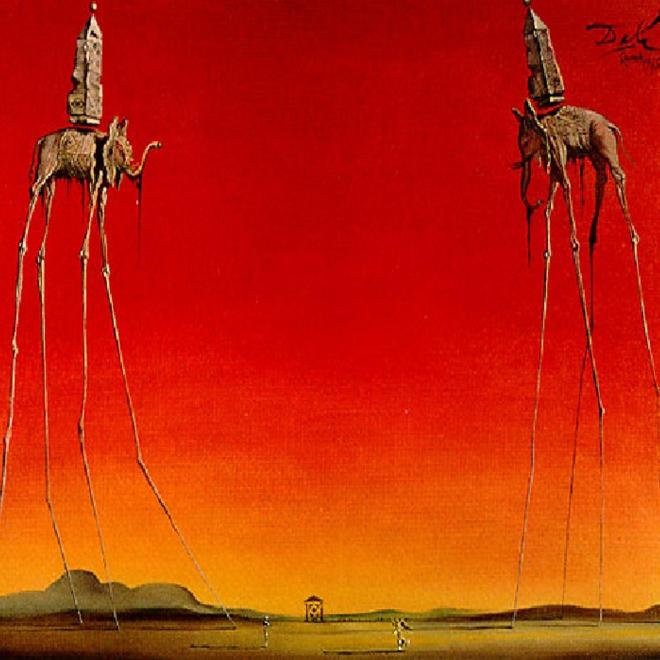
Salvador Dali: The Elephants, 1948. Not quite giraffes, but close enough
On the bright side…
There is a “cure” for fear of choice
Going back to my own ENTP-torment of being more interested in talking about choices rather than actually making them, I am looking for some kind of resolution. N. N. Taleb, a favourite writer of mine, is popularising the concept of optionality. He argues that having options is a great thing:
Optionality is the property of asymmetric upside (preferably unlimited) with correspondingly limited downside (preferably tiny).
It’s not really a way to get out of making choices. Instead, it is a way to do what you were going to do anyway, but leaving cheap enough nets here and there to see if one day something nice washes up in one of them such that covers the cost of having had the nets n times over.
He argues against specialisation (i.e. going down too far in the decision tree of choices or going down to the end of just one branch). We are all familiar with specialisation success stories. The Nobel Prize goes to the person who studied a particular enzyme for 30 years. The startup that solves a specific problem in one particular niche is the one that does well. Kim Kardashian has one thing going for her, and she’s taken over the world…
Taleb reminds us that there are cemeteries of specialised ventures and people. Just because the successes that make into the media are specialised, doesn’t mean all of them are. Specialisation comes from the propensity to make choices. It is not the only way to achieve something. Hence, it is possible that the act of making choices is overvalued.
Richard Branson has over 400 companies. Is it because he is greedy – or perhaps because he understands that specialisation is a dangerous game to play? Venture capitalists and angel investors back things in a non-specialised way. All financial investors do. It may look like it is specialised on the surface, but it really isn’t. Biotech, or robotics, isn’t a specialisation. These are incredibly broad fields. It’s like saying blogging is a specialisation. Investors take directional bets once is a while, i.e. ones that really require a choice, but they do so in a way that for every 1 euro they invest, they stand to gain 10, and only invest a tiny fraction of their euros into these schemes. This is exactly congruent with Taleb’s definition of optionality.
I have fabulously rationalised away the pressure to make choices here. However, the real work is in putting oneself into situations where optionality can be exercised.
The older I get, the more I realise that there’s quite a lot of engineering involved in all of this. It’s not so much about going after specific visions, but creating situations where visions can flourish – and ultimately have an impact.
Maybe, the millennial/Gen Y variety of man (and woman) are a bit different…
Anthropologists have long known that when a tribe of people lose their feeling that their way of life is worthwhile they […] simply lie down and die beside streams full of fish.
Ernest Becker
What is nihilism?
Nihilism is a confusing term. It can mean rejection of societal norms (political nihilism). This is not what I am going to discuss here.
I will talk about Nietzsche’s definition of nihilism: the radical rejection of value, meaning* and desirability.
I think this communicates the most important concepts. Of course, there are more specific definitions, so I will get them out of the way here. There is moral nihilism that says that there is no right and wrong. Epistomological nihilism says there is no universal truth or meaning. Existential nihilism rejects meaning in life.
Stoicism vs nihilism
Stoicism is really en vogue these days. Seneca’s writings have grabbed my attention early last year and haven’t really let go. First, his Moral Letters are incredibly easy to read – compared to most undigested original philosophical texts (e.g. A. Schopenhauer). Second, they make one feel good, a bit like after watching Pulp Fiction. I was starting to wonder – what’s the catch? My “too good to be true” radar was going off.
Here’s a short summary of Seneca’s views:
life is set in circumstances that we’ve no control over;
it is possible to get through life by working on our response – not on the circumstances;
there is no need to fear death because
it is just like the blissful nothingness that came before we were born;
it would, so to speak, “end the heartache and the thousand natural shocks that flesh is heir to”;
we didn’t earn life – it was given to us by circumstance. Hence, we cannot expect to hang on to it.
This doesn’t sound so bad. In fact, it is quite resonant with the ultimate optimist Viktor Frankl: “When we are no longer able to change a situation, we are challenged to change ourselves” and more or less the basis of modern day talking therapies like CBT and REBT.However, Seneca is quite pessimistic. Having re-read his letters a number of times, I picture him as a man who barely endured his life.
Any modern psychiatrist would say Seneca had a passive death wish.
It’s also interesting to remember that he was one of the wealthiest people of all time. Here’s a telling quotation from Letter 65:
“The wise man, the seeker after wisdom, is bound closely, indeed, to his body, but he is an absentee so far as his better self is concerned, and he concentrates his thoughts upon lofty things. Bound, so to speak, to his oath of allegiance, he regards the period of life as his term of service. He is so trained that he neither loves nor hates life; he endures a mortal lot, although he knows that an ampler lot is in store for him.”
Nietzsche famously pointed out that Christianity is nihilistic in the sense that it is denying the value of one’s current existence and instead placing it on a dream of a better afterlife.
By that same logic, Seneca too seems nihilistic. One might argue that in the context of Seneca thinking of death – it is kind of hopeful.
Nonetheless, Seneca belittles the value of the current life, encourages escapism and hope for, essentially, life in heaven after death.
At the same time, Seneca repeats that we have limited time on Earth and we better use it wisely. Just like Christianity, this philosophy appealed to all strata in society. Using either philosophy, anyone could be a hero by thinking themselves so. In a sense, one is less responsible for their actions as this world doesn’t really matter. Certainly, making the right choices matters – as it will be assessed for the purposes of a heaven vs hell decision, but it presents life as something that happens to a person – and the person has little agency. Having said that, much of what Seneca demands of Lucilius could safely be called overcoming-oneself, a cardinal virtue according to Nietzsche.
Meaning by school of thought
Unbound by any aspiration to philosophical scholarship, I have taken the liberty of making these one liners on how different schools/philosophers viewed meaning:
Stoics: there is meaning, it is to be wise and kind;
Schopenhauer: there is meaning; awareness of suffering and death create the need for meaning;
Buddhists: there is meaning, but it is ambiguous;
Hinduism: there is meaning; it is to shed the illusion and realise the unity of the universe;
Christianity: there is meaning; the meaning is to live so as to attain entry into a superior world;
Nietzsche: there is meaning; meaningful suffering is sought after, meaningless suffering is a curse – more on this later;
Nihilists: there is no meaning.
A nihilist’s escape routes
Being a bone fide nihilist is intolerable: there’s nothing to wish for, nothing makes a difference – like the tribes that encountered Western culture described by E. Becker in the epigraph, one may as well lie down and die. It’s a state fundamentally indistinguishable from severe and enduring depression.
Those who proclaim they are nihilistic and still go on about their lives as if nothing’s wrong are probably hedonistic, or have some kind of meaning they simply don’t call meaning. Or, they are like Anony Mole who appears to think that meaning is a psychological hack to staying motivated to live on, but ultimately hypothesising that there is no meaning at all.
For someone who doesn’t see meaning in life there’s another option, however. It is to defer meaning to one’s next life. In this sense, Christianity is a form of escapism away from nihilism.
In Christianity, the purpose of life is to live one’s current life in a certain way and attain entry into an alternate, “real and true” world – heaven. At first glance, it would seem that Nietzsche is overreacting by accusing Christianity of being nihilist. Christianity is full of ways that make this life meaningful. On closer reflection, the motivation behind acting according to the tenets of Christianity is that someone, from a place that we all really belong in, said that it is the right thing to do. This life is only a smoke and mirrors version of the blissful life in heaven. Nietzsche rejected true world theories as nonsense. He demonstrated that it was an assumption of his – and ultimately unknowable. Richard Dawkins says it’s intellectual cowardice to not come down on one side or the other. I think it is intellectual cowardice to not admit that there are certain things that we just don’t have a way of knowing.
Despite his rejection of true world theories, Nietzsche understood that they are the fabric that holds people’s lives together.
Of course, there are many more true world theories than Christianity, but it is the one that dominates the Wester world today. For example, Marxism is a true world theory – yearning for a future utopia. Nietzsche also argued that a Christian heaven helps the human sense of self: it is kind of validating to know that, really, one belongs in a special true world – not here.
Pema Chodron wrote about the psychology of our need for such a world in an accessible way. [There’s a funny story to go with that. I was sitting on the beach right after reading Chodron, reflecting on the ways in which we’re conditioned to want a fatherly God. An elderly man approached me and wondered if I was OK – I guess I must have looked distraught. It’s rather unusual for a man in his 80s to approach a random person on a beach, so I was wondering what’s going on. He didn’t say much, just asked again if I was ok and if I like reading. He reached to hand me a brochure – looking directly at me – and said only this one thing: “Oh, and there is a God”. I thanked him, mind-boggled. After he walked away, I looked at the brochure – turns out he was a Jehovah’s witness. I didn’t know they mind read.]
Besides turning to true world theories, there is another way to avert the pain of nihilism.
Science slowly becomes scientism and provides explanations for things it can and cannot explain. Following a political movement gives a sense of belonging. Our culture is a kaleidoscope of options for all tastes.
Searching for meaning is nihilistic
Nietzsche argued that asking the question “What is the meaning of life” and demanding an external answer by some superhuman authority diminished the value of the person asking – as if it comes from a lack one’s faith in their own ability to figure it out.
Nietzsche argued that nihilism arises when people get disillusioned with their default set of beliefs – let’s say beliefs that are inherent in one’s cultures – and take this disillusionment to more generally mean that no beliefs could ever be satisfactory.
This view of nihilism is once again almost indistinguishable from depression. Nietzsche expressed it best here:
“A new pride my ego taught me, and this I teach men: no longer to bury one’s head in the sand of heavenly things, but to bear it freely, an earthly head, which creates a meaning for the earth.”
Prof. Nietzsche’s meaning of life
So what did Nietzsche himself think the meaning of life was? It was to realise one’s inner potential.
Nietzsche believed in radical responsibility: it is only ourselves who we have to blame if we miss our life’s calling.
To him, we weren’t all born human. We become human by realising our potential. This is what he meant when he said “become who you are”. Fear and laziness are our ultimate enemies. Incidentally, this sounds like it is straight out of Seneca’s writings. Nietzsche claimed there was a higher self, a kind of will that dragged us to become who we are. To me this is terribly reminiscent of a true world theory albeit one confined to the self and to this life. His method was through setting difficult goals pursuing which elevates the soul. Congruent with the traditions of Buddhism, Nietzsche argued that suffering isn’t inherently bad – and one doesn’t need to immediately try and fix it or worse, distract oneself away from it. It is an opportunity for growth and wisdom, according to Nietzsche.
I guess it comes down to awareness, adaptability and agency again. This whole piece makes me sound like a Nietzsche fan girl. In a sense, it’s true, but he was a bit too anti-social, self-contradicting and melancholic for my liking. I will put that in more analytical terms at a later stage.
*[To be clear, we’re talking about meaning to a given person, not some universal, objective meta-meaning because ultimately an attempt at identifying this universal meaning will always be the meaning to the person thinking about it, or a projection thereof. This is one of the reasons humans are so naturally self-centred. David Foster Wallace describes it well here. As seen above, none of the major philosophies really even try to answer what the ultimate meaning of the universe is. This is probably because the question isn’t asked very often. This author is more interested in the tangible psychology of it – than the unknowable philosophy].
Mindfulness is effective in treating many mental health problems and psychiatric conditions. For those who don’t suffer from the above, it seems to still be beneficial in terms of focus, mood, relationships and results – based on many people’s personal experiences. Why then, is it so difficult at times? It is difficult for the same reason than escapism is easy. I am not Bill Murray’s biggest follower, but in one interview he said:
I would like to be more consistently here… I would like to see what I could get done if I didn’t cloud myself with automatic [thoughts]… If I were able to not change channels in my mind and body.
He didn’t say anything ground-breaking, but his channels analogy really struck home with me. Having listened to this interview in the morning, I was on an uncomfortable journey between two cities today. To the right of me was a morbidly obese gentleman who sprawled himself across about three seats in an unorthodox position rarely seen in public. To the left – a lady who evidently led a lifestyle that didn’t involve too much personal hygiene. Having sneakily moved to another seat, I was putting my headphones in, prepared to sail away into a safe and pleasant day-dream. However, in my mind, I could hear the echo of the interview: don’t change the channel. Some voice of cognition questioned what I could possibly gain by being present when the present is like this? I wasn’t sure. What did I have to gain by being in a day-dream? A mindfulness devotee would surely say: nothing. Well, if people never day-dreamed, we would still live in caves. If we didn’t rehearse situations, ruminate, “mind-read” and obsess, the world would be different. I guess some may even argue it would be better. I am not sure.
I wish it was clear cut. I wish this story had an elegant twist where being present resulted in some kind of miraculous revelation. Instead it made me more aware that it is as easy to slip into the mindfulness cult as it is into a day-dream.
Ironically, Spotify shuffled to a nice house remix of R. Kelly’s Bump and Grind. As my mind was indeed very distinctly telling me “No“, I took my headphones out. I could feel so much resistance. It angered me and made me sad that instead of floating off into a day-dream, I righteously deemed it necessary to stay in the present moment. I felt a bit like a Brave New World character without her soma. It felt necessary to stay present though. I ended up just being aware – of a storm inside.
Now, at the end of this mindful day, I can’t proudly declare that I feel at peace. There was no external conflict whatsoever, but I feel like I’d been in a blazing row for hours. With it though, there’s a certain exhausted clarity, like everything has been unreservedly said and it is all out in the open.
Faced with a choice like this again, I will probably choose mindfulness over the day-dream – again. I will stick with this channel called Reality, as we know it, rather than If I were with my friends or some other blissful escape route to rainbows and unicorns. Being honest, in part it is because I “read it in a book” and the high priests say it’s good for me. However, in part it is because I appreciate just how rarely I am even present enough to make this choice.
The day-dreams will happen regardless, the awareness won’t.
I’ll drop my glove, to prove his love; great glory will be mine.
Leigh Hunt
Vanity and fair are simple words. However, it was only recently that I understood what these words mean together. In more contemporary English, it means an exchange of validation between two people. What got me thinking about it is the book I recently read by Robert Cialdini called Influence. It describes the mechanics of how easily people’s need for validation can be used to play them in a Machiavellian way.
Validation is always a treat. We must be wired for it. Given that humans are social animals, it makes sense to yearn for validation as it increases one’s chances of survival. If one is part of a tribe (i.e. accepted/validated by the tribe), he/she is less likely to get eaten by a sabre-toothed tiger. However, it seems that this pathway gets hijacked an awful lot.
I think the best way to explain this is by looking at an extreme example: narcissism, because the logic is the same no matter where someone is on the spectrum. I grew up with and subsequently encountered some florid narcissists – though I didn’t always know it at the time. While the full blown narcissistic personality disorder is relatively uncommon, traits thereof appear quite ubiquitous. I will loosely use the word narcissistic here to signify anyone with traits of the disorder. During my late teens I loved high-achieving people and hated arrogance. It made no sense to me why somebody would act so unpleasantly. I thought that arrogant people believe they are better and that I am not worth their time. It turns out that’s only half-true.*
I subsequently figured out – through a mix of psychiatry training and reading (Daniel Goleman’s Emotional Intelligence is brilliant for this) – that arrogance is a form of insecurity. However, the exact same insecurity can be revealed through being super friendly (hence, not all narcissistic people are arrogant**).
Much of it boils down to the source of one’s self-esteem. I hypothesise that a self-esteem based on external circumstances is one of the factors that contributes to much unhappiness and perhaps even the poorly understood personality disorders – such as narcissistic, histrionic and emotionally unstable.
What does that actually mean? What is it like to be narcissistic (or a person with some narcissistic traits)? Most people think they are deluded with their own glory. This can be true – if the narcissistic person doesn’t have insight into just how hooked they are on validation. Sadly, having insight doesn’t instantly cure it. If the person with narcissistic traits does have insight, it’s a never ending cycle of feeling high from validation, feeling pathetic for being like that and seeking more validation to take the edge of. New Insights Into Narcissistic Personality Disorder highlights their fragility, internal vulnerability and external self-enhancement, their attempts to regulate insecurity by numbing emotion, especially in interpersonal contexts and their preoccupation with blame, and criticism.
For some, it is “I think therefore, I am”. For people with narcissistic tendencies, it is “I produce a good reflection, therefore I am worth existing.”
Interestingly, patients with narcissistic personality disorder have intact cognitive empathic ability and can identify with thoughts, feelings, and intentions of others. However, their capacity for emotional empathy is compromised, especially their ability to care about and share feelings of others.
Having one’s self esteem decided by external factors is hugely painful. It’s like waking up every morning and feeling awful about oneself – and yearning to encounter something or someone in the world that will prove that one’s actually worth something. No amount of proof will ever stop this feeling of emptiness for very long.
This proof could be likes on a social media post, getting any sort of good news, a reassuring friend, attention from a member of their desired sex – anything that reminds them that they aren’t near worthless (which is the default setting). This is also why so many narcissistic people are high achievers. Actually “being the best” is sometimes the only way to get rid of the pain.
If one’s self-esteem is only lifted from the depth of despair by accomplishments (validation), then he/she will do anything to accomplish – and ease the pain.
If one’s self-esteem is set externally, validation is like an addictive drug. If it’s set internally, validation is like an occasional glass of wine. These two types of self-esteem are also knows as contingent and non-contingent.
However, what does that even mean, “set internally”? Having an interest in mindfulness, I often come across things like loving-acceptance, unconditional positive regard, etc. Maybe the reader understands them better, but more often than not, they make me feel like there’s something fake there. To me, an internally-controlled self-esteem means answering the question: is a person proud of his/her actions.
It’s impossible to hold oneself fully responsible for one’s circumstances. Yes, over time, patterns emerge that reflect the small decisions made everyday. However, there is so much beyond our control that one needs to be cautious making conclusions about themselves based on results. As all of these kind of musings, this is specific to the person in question. Some people are perhaps too laid back about how much they control and others – too intensely determined to control everything. (See this post on how to find good tailored advice.)
I think that one has to always learn from their results, but it isn’t always true that their results are a reflection of their actions. Even learning from results is tough because it is so hard to attribute results to causes.
So to bring one’s self-esteem back to being internal, one can only judge whether he/she is happy with their actions and decisions given the information they had at the time.
…I have a single definition of success: you look in the mirror every evening, and wonder if you disappoint the person you were at 18, right before the age when people start getting corrupted by life. Let him or her be the only judge; not your reputation, not your wealth, not your standing in the community, not the decorations on your lapel.
Taleb says that by his definition, he’s not successful. Fair enough. However, he doesn’t strike me as the kind of person who lacks in self-esteem. This goes back to how different people use the same words to mean different things. Obviously, to Taleb being successful is a kind of a luxury, not a must-have. Otherwise, if one looked in the mirror and resented themselves everyday, that’s a shortcut to despair.
I wonder what it’s like for other people. For me, my 18 year old self had no clue about how the world works, so I can’t adopt this definition of success – it’s pretty useless to me. Maybe though, that’s Taleb’s point – that one should think back to their idealistic self and see what they would think. I probably shouldn’t say what my 18 year old self would think of me now, but I do wonder what Taleb got up to so that he doesn’t approve of.
I think that’s it though – reconnecting with one’s internal self-esteem is an uncanny exercise of separating oneself into two people and getting one to judge the other’s decision and actions – not their results.
* Whether a narcissistic person believes they are better depends on their insight into the need for validation and their actual achievements. However, narcissists do prefer to associate with people they see as being worthy of surrounding them.
** Some narcissistic people are sweet and charming. Different people use different strategies to feel special and seem worthwhile to others.
Recently, I’ve come across a few useful and captivating talks. Many of these aren’t classed as psychology, but I am using a broad definition.
Generally, I am not a massive fan of TED/TEDx talks. There are certainly many that are superb, but many desperately oversimplify the problems they discuss in order to reach a wider audience – defeating the purpose of the TED project. Their so called new ideas are generally not new at all. Here are my highlights:
In short, he talks about a number of popular misunderstood statistics and experiments. Interestingly, he talks about how men and women’s psychological differences are grossly overblown.
How did it come to be? Well, it sells. Cosmopolitan & co. made a business out of explaining to women that men are a different species – and I am sure, there are equivalent resources for men. I often wondered about this before I heard this talk. Ambridge doesn’t really go into the specifics of the differences except where there is hard data to show that the differences are marginal.
My own hypothesis here is that emotionally men and women are much more similar than they are different – certainly more similar than pop culture has us believe.
We have these memes, a complex Marge and primitive Homer, an overthinking ruminating woman and a direct man. Not so, I believe.
This couldn’t be further from the truth as a generalisation
He also talks about how it is impossible to spot a liar. I think that with the popularisation of the concept of emotional intelligence, those who don’t think that they have a lot of it, think that there are those who can see right through other people. My own impression is that some people are better than others, but nobody gets it right consistently. I have seen people get it so unbelievably right, I began to think of them as having genius-level EQ, if there is such a thing. Observing these people more closely, I have seen them make terrible faux pas in social settings that really weren’t consistent with exceptionally high EQ. My guess is that a lot in EQ, or at least being able to effectively apply it, boils down to how much attention one are paying to the people around them.
One of the top TED talks of all time. Cuddy has popularised the concept of power poses. Her main message is that body language isn’t a one way street from the brain to the body. Instead, the body signals things to the brain – and, it can be gamed to our advantage.
This is a practical demonstration of what I call cognitive curiosities relating to attention. This eerily charming individual (you will know what I mean by the end of the talk) doesn’t go into any of the fancy science – he just shows how attention works. It made me feel both entertained and vulnerable.
I would be happy to expand this list, so your suggestions are welcome. If you are new to cognitive curiosities, this is a good (and hilarious – if you watch till the end) starting point: Michael Shermer: The pattern behind self-deception
Deloitte is looking into brain chemistry – and how they can apply what they learnt in neuroscience to management. Some of the quotes from management consultants sound like they need a bit more time in the oven: “Neuroscience would be saying you need more neural pathways to make people think differently.”
I think Thinking Fast and Slowshould be read by every management consultant and leader. I wonder what these guys will have to add on top of this. Paul Zak, the neuroscientist that the FT quotes, talks about trust as an “economic lubricant”. Isn’t that Marketing 101? In fact, I doodled about it here. Ok, they mention a few chemicals that most management consulting folk and their clients probably haven’t heard of before like oxytocin. In management consulting, a new name usually means a new sales pitch, so I can see why they are excited. Another management consultant references the idea that we are more irrational when we are in fight or flight mode. I mean, I wouldn’t be surprised that in some boardroom some CEO of a gargantuan business is signing off on a contract with a management consultancy that just presented this – but really, it does sound like plain common sense.
There is one very interesting idea in the article: predictive hiring.
Instead of relying upon CVs and interviews, they ask applicants to play 15 or 20 computer games designed with the aid of neuroscience — revealing a cognitive and emotional profile. The result is matched against the gaming profile of high-performers in the role to be filled. Combined with techniques such as machine-learning and trawling social media profiles, this approach opens the way to hiring based on capability. “Companies won’t worry where they went to school or what their grades are”…
I think that games that seeing how a person takes decisions is a great way to understand their personality. It is the basis of psychological tests. However, if, instead of trying to go into the reasons why a person is like this and what they can do about it, we could simply use this information for what it is, I think it would really help to match people with certain jobs. It’s like a decision making genome that you can then marry with a job description – of course only after you accumulate enough data.
Words. Words can change how we feel in an instant, they can prime us to act in a certain way without us knowing – but they also can completely misfire.
It seems very obvious now, but it took me ages to figure this out: people don’t always mean what they say.It’s not necessarily because they are lying, but a lot of the time it is because they lack insight and communication skills.
What really hammered it home to me was when a consultant psychiatrist was explaining to me how to handle the “admit-me-or-I-will-kill-myself” kind of presentation. He asked me a very simple question: “If you wanted to kill yourself, would you go to a hospital to inform the doctor?” I’ve no intention of trying to simplify the complex issue of suicide, but there is certainly a type of patient who honestly believes they want to kill themselves and come to hospital, still. Why??? Because the words are misfiring. The words they are saying are: “I want to kill myself”. What (some of them) mean is that they are in so much emotional pain that they have no idea how to get out of it, but they would really like help. It can be, strangely, easier to identify the desire for suicide as the problem because it is a bit more external – at least compared to one’s coping skills.
The moral of the story was: people don’t always mean what they say – and they may not even know it.
This disconnect between words and insight is well known among international relations officials. Here what is said is just as important as what it is left unsaid. The people who answer questions at conferences (e.g. press conferences at the White House) aren’t the officials and military generals actually who know the most. The spokespeople are briefed in a very specific way and believe the things they say. It is too difficult to have insight into how you will be understood, so they get people who specifically understand the exact right stuff.
The significance of precise language is well known in Hollywood.
The production team of Gone with the Wind fought long and hard just to be allowed to have Rhett say “Frankly, my dear, I don’t give a damn.”
Damn was a vulgar word and the censors weren’t happy. However, “I don’t care” just doesn’t provoke the same emotions. Also, it is often said that the word frankly was an unscripted improvisation by Clark Gable – it wasn’t. It’s just different from the book, but that’s how it was in the script.
when one of these [Salafi] fundamentalists talks to a Christian, he is convinced that the Christian is literal, while the Christian is convinced that the Salafi has the same oft-metaphorical concepts to be taken seriously but not literally –and, often, not very seriously.
What got me reminiscing about this was a post by FJ of The Pensives about critical thinking as an antidote to manipulation. FJ identifies reading people (and empathy) as a key part of examining one’s true intentions. FJ’s insight certainly resonates with my own – that there is meaning way beyond words. I think context needs to be examined. Incentives need to be looked at. FJ’s argument is that putting oneself in someone else’s shoes is important. Maybe he is saying the same thing in different words – no pun intended, but there’s also a potential caveat here. It’s best expressed by Nicholas Epley wrote in his fabulous book Mindwise:
Reading body language and trying to take on the other’s perspective doesn’t seem to help to understand the person better. What does help is creating situations where people can openly tell you what they think – and listen carefully.
Obviously, that’s not always possible. However, the point I am trying to make is that while empathy has become an increasingly popular concept, we shouldn’t envisage it as an antidote.
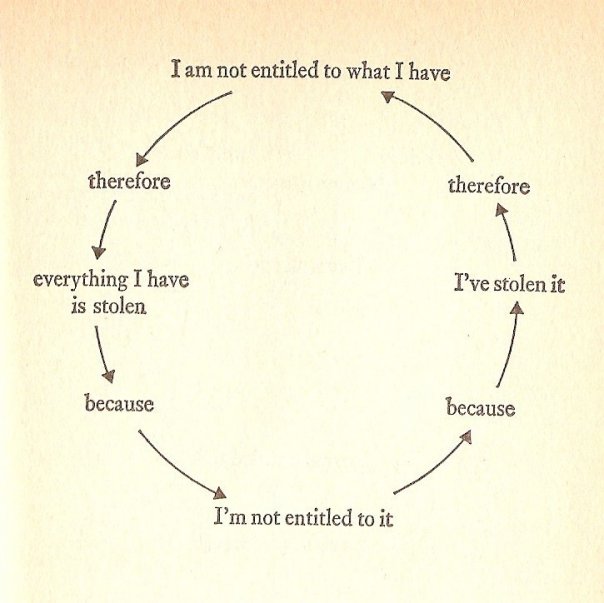
I was reminded of R.D. Laing’s book Knots, which is a gleefully brusque collection of various traps of thinking.
Here are some of my own examples. This one is from my time on the medical wards:
Patient’s family: “We don’t agree with your diagnosis. Do some more tests”Me: “Did you have any specific alternative diagnoses or additional tests in mind?”Patient’s family: “Don’t ask us. You’re the doctor!”
Source: Knots – an absolute gem of a blog on psychiatry



































 A millennial's musings