The New Year forces us to do a reality check. Accomplishments. Failures. Expectations. Sage books. Bad politics. Mistletoe. The CO2 from sparkling wine hitting you in the nose. Deep breaths and realisations. Shy wishes for the future.
The light and exciting feeling of starting something big pushes me on.
Coming to conclusions reminds me of herding cats. In a big dark room.
Conclusions lead to learning. I want to learn. Learning means order and understanding. Sometimes, stormy randomness prevents linear learning. What was it all for then I wonder? Just to be lived?
A sarky friend of mine calls this “the syndrome of searching for deeper meaning”, a disorder more prevalent in women. One step away from calling me a conspiracy theorist, the sneaky fk!
Why do I want to learn? To feel less pain by stepping on the same rake, as the Russians would say? I prefer the more subtle term, adaptation.
I resolve this by looking for ways to tame uncertainty. Work around it. Turn anxiety into excitement. Think probabilistically. Find people who have the same thoughts and dreams. Remember that I can always rely on myself.
My temptation to justify, to over-explain, to over-plan and catch that finer insight comes from a heightened, unhealthy sense of personal responsibility.
Aged 5, I fell and hurt myself during play. Nothing major. My grandmother came over. I expected her to help me up and console me. Hold me and tell me it’s all ok. She lifted me alright, but then gave out to me for not looking where I was going.
I think I am still running on that software. I always look for ways in which I caused what happened to me.
In some ways, it’s helpful. In others, I am Atlas with the weight of the world on my shoulders. Why haven’t I given up that horrible mentality?
Personal responsibility motivates like nothing else. It’s the fuel of making dreams come true, so it’s hard to give it up.
My learning from this is that feeling like Atlas is frighteningly egocentric. I am not Atlas, nor was meant to be. The world will keep on turning without my help.
What makes me want to bang my head against the wall is the obviousness of it all. Again and again, I arrive at these thoughts. However, it seems that understanding what is within my control is a daily exercise. Thinking about it every day is vital to being productive and at peace.
Meanwhile, I am building up my progress report from September to the end of November. Be ready with yours for 1 December 😉
Mood: T.S. Eliot
And indeed there will be time
For the yellow smoke that slides along the street,
Rubbing its back upon the window-panes;
There will be time, there will be time
To prepare a face to meet the faces that you meet;
“I weep because, each time he knelt beside my banks, I could see, in the depths of his eyes, my own beauty reflected.”
I came across the idea that our self-esteem is equal to our opinion of others.
Sounds esoteric, but I reflected on it and there may be something to it.
Assumption:
A mentally well person accepts that she is an ordinary human being and that most people who surround her are ordinary human beings.
Hence,
a) if she is highly critical of most ordinary human beings, on an average day she is critical of herself
b) if she is accepting of others’ faults,on an average day she accepts her own faults
Doesn’t this add up?
I sort of talked about this when I hypothesised that people criticise others for the things they hate about themselves. Reading over it, it seems naive and slightly needy, but I still think there was a grain of truth in it.
“Yet another reason to not be a demanding pig”, I gently remind myself.
I took the day off yesterday. For the first time in I don’t know how long.
Being a bit of a rebel, I chose the day that bookings start for a course I run.
Contrary to my expectation, my email wasn’t full of people wondering where I was. After all, how dare I not get back to them within 30 minutes?
I did have about 110 unread emails, but nothing unmanageable.
It’s good to be reminded that the life goes on without me trying to control it.
When you put it like that, I can see the appeal of nihilistic thinking. But even if I am a lowly non-flaggelated bacterium living on the eye of a blue-eyed giant, I want to be good at being such a bacterium.
According to my family, interactions with me felt qualitatively different today, now that I was rested. A remark I didn’t specifically seek out.
I also slept much longer than I normally do, suggesting that I was able to break out of fight or flight. (Alternative explanation: Merlot).
The morning was a haze: I dreamt of being with my friends, who travel to places man hasn’t really spent much time in, occasionally interrupted by some more frontal part of my brain reminding me of items from my list, concerning appointments and credit card details.
I also realised just how little time I actually spend producing anything. Instead, I expend a huge amount of energy on being in that anticipatory stressed state. Like Rocky waiting to be punched in the stomach.
Music profoundly changes our emotions. Sound has the potential to turn our feelings inside out.
In September, I committed to bringing my mother to the theatre. Local theatres do a lot of film screenings, I found with disappointment. Among them, I spotted The Graduate. I don’t understand why, but I love the film.
The events and characters are grim. The atmosphere is anxious. The ending is certainly filled with angst. But that’s not the aftertaste it leaves.
I rooted out The Graduate in college. Third year of medicine, a year dedicated to learning ginormous amounts of information, weighed heavy on my mind.
It was the weekend. Alone, I had nothing to do other than study and the mood dwindled. Somehow The Graduate lifted me out of melancholy.
In an essay filled to the brim with reference to science, a music cognition scientist (yes, that’s a thing), says:
We never just hear music. Our experience of it is saturated in cultural expectations, personal memory and the need to move.
The revelation reminded me of something a friend said. She shocked me with a simple truth: you start having sex long before you enter the bedroom.
So yeah, our perception runs away from reality at the first chance it gets. I am sitting here imagining: in a film about Macbeth, what soundtrack would I choose? And when you think about it like that, you see that music manipulates emotion like nothing else.
Continuing the discussion of ideologies that silently grow into our lives and take hold, I will admit to my own.
I was brought up in a culture where education was the centre piece of the altar. I think this is still the case for a lot of people. In theory, education is the answer to a lot of problems, but difficulties come to the fore when you realise that there is big difference between education and formal education. I suppose the difference is analogous to the difference between morality and organised religion. Even when you go to educate yourself, the authority-loving methods learnt during formal education betray us. It took me a long time to start reading books without looking for ready-made answers to life’s problems.
When I got a little older, I went on a major health kick, only to realise that humans did not evolve to be orthorexic with a regular HIIT exercise schedule. I rejoice at articles like this.
In my late twenties, my ideological difficulties centre around the subjects of family and meaningful work. Family has always been a confusing subject for me. I think that families are fascinatingly different. Second wave feminism was going strong as well when I was a child and I am sure it affected me. I was recently reading a memoir of a woman who lived in the Ukraine during the October Revolution. It seemed that nothing really mattered to her so long as she had her family. I also read a lot of essays by secondary school (high school) students and interestingly the film Juno is on the curriculum. Most students conclude that your friends are your real family, not your biological relatives – and not just from Juno, but in their personal essays as well. Is that just a sign of the times?
One thing I learnt is that it’s dangerous to become too focused on just one aspect of life, even if it is the most virtuous thing you can think of.
Anyway, I am more interested in hearing about ideologies that you lived through and debunked.
I managed to make it back to Moscow for a short stint. It has changed a lot and I am quite fascinated by its many contradictions. I also couldn’t help but notice that it’s been almost exactly 100 years since the October revolution, so it’s interesting to take snapshot of where this society is after its big experiment with socialism.
Of course, the Revolution actually happened in what we would call November, but all the same, there was nothing about it. No banners, no meetings, nothing on TV. Just the odd weathered sculpture of Lenin here and there.
1. People are surprisingly chilled out
Compared to 10 years ago, people on the street have an air of calm about them. It could be that I spent a lot of my time going to touristy places, but it seems to be more than that. One’s mind immediately goes to the economic situation as the explanation — but that just doesn’t add up.
In the naughties, with oil prices firmly above $100 and more favourable international politics, you had to always keep your guard up. As in, you had to watch what is going on around you or you would have to fight to get things done right. You would get skipped in the queue, you mightn’t get the right change, one of the apples in the bag you bought at the market would be gone off – minor stuff, but it’s very draining. I remember approaching a shop door as a 13 year old girl. It was a glass door, so I could see that on the other side a man was nearing it too, much faster than I was. Then he stopped and just stood there. I opened the door to go through and he nearly knocked me off my feet with the words “How can people be so slow!” What the actual fk?! Anyway, that’s just anecdote to illustrate what I mean when I say you have to keep your guard up.
The naughties, however, was a time when the country was swimming in money. Now, with the sanctions, the rock bottom oil prices, the exchange rate the way it is, with the last remnants of unreplaced Soviet industry disintegrating, it seems that the macro economic situation is very gloomy. Somehow the people don’t mind. Maybe there is less inequality among the people who have lived there for a long time? As in, everyone’s life is worse, but there is less flashiness that grates on people’s nerves? I don’t honestly know. Talking to taxi drivers is always a good way to guage what’s current, only in Russia they’re not very talkative…
2. The silent but telling taxi drivers
A 40 km ride cost me 15 euro.
40 km. 15 euro. That’s 24 miles for $17.
How?! In Ireland, it would cost at least 50 euro.
The answer is as follows.
1. Petrol is much cheaper. In Ireland, unleaded petrol is 1.36 euro. In Moscow, it’s 0.68 euro. That’s exactly half price. And it’s not just selling below market price, Irish prices attract duties and taxes and whatever else.
2. Labour is much cheaper. You know where this is going…
Russian demographics are very difficult to figure out. People don’t trust the census gatherers, so many just wouldn’t participate in the census. The 2010 official population of “natives” is 10.5 million. Plus 1.8 million legally resident immigrants. The estimated number of undocumented immigrants is a million.
My feeling (that’s very subjective, I know, but still) is that the number of people from the former Soviet republics has grown exponentially in the last two years. I have taken seven YandexTaxi rides and six times I had a driver who had clearly moved here within a year or two. They don’t really talk to you — they’re there to do a job. They visibly rely on the satnav lady. I fear to consider how much they are paid.
At one point we were passing a metro depot and there was an advert for the vacancy of a cleaner. The staring salary was 22,000 rubles a month. That’s 325 euro or $385. Per month. I asked my mam about it and she wasn’t even sure that people get paid the nominal amount even, which brings me onto accounting tricks…
3. Fine cuisine with a side of accounting tricks
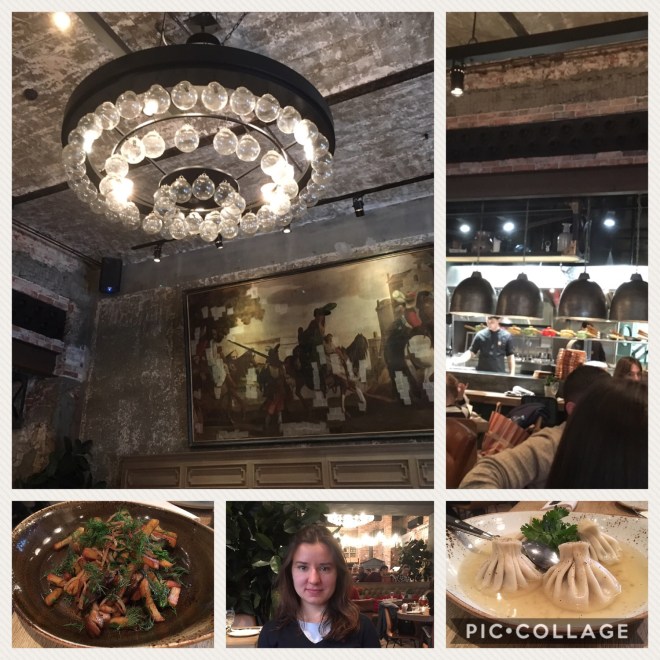
If you happen upon a restaurant in Moscow and it’s in any way decent, chances are it belongs to a man by the name of Arkadi Novikov. It’s actually scary how many restaurants he holds. They are all themed and well decorated. The food is generally very good. And for what they are, they are very cheap.
Georgian Hinkali, Harcho soup and Harachapuri went down very wellCharacteristically, about half of the floor staff strike me as recent additions to Moscow’s population, coming from those same couple of countries.
The accounting trick isn’t really a trick at all, it’s just stealing. We were brought a bill for 2000 roubles and got a receipt for 500 roubles. The super friendly central Asian man must have been counting on our tiredness and fondness for beer to not notice. Mr Novikov, I am sure, will notice. I guess if you are attracting clients with low prices and that comes from low extremely low labour costs, you have to expect this kind of thing to go on. A far cry from socialism…
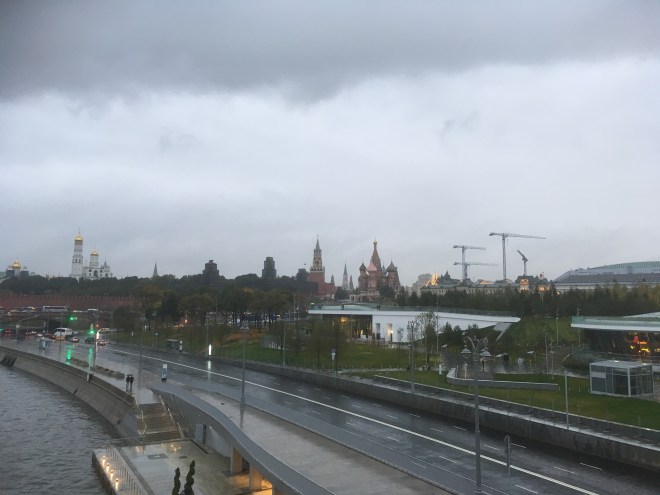
4. Zaryadye Park: 350 million euro gone where exactly?
The most recent addition to the Kremlin area is a park. It has a pretty cool floating bridge. A bridge that brings you where you came from – you can reflect on the metaphor…
There used to be an old hotel where the park is now. The original budget for the park was approximately 90 million euro, but it ended up costing 350 million (converted based on the Russian Wikipedia page). I am not much of an architect or developer, but I really struggle to see how they spent so much money on a park… More accounting tricks? It did, of course, underwhelm me given the amount of publicity it got. I also heard that the translations are all wrong. The sign for Red Square is in Russian, English and Chinese. The Chinese translation apparently reads Red Sausage. Oh well.
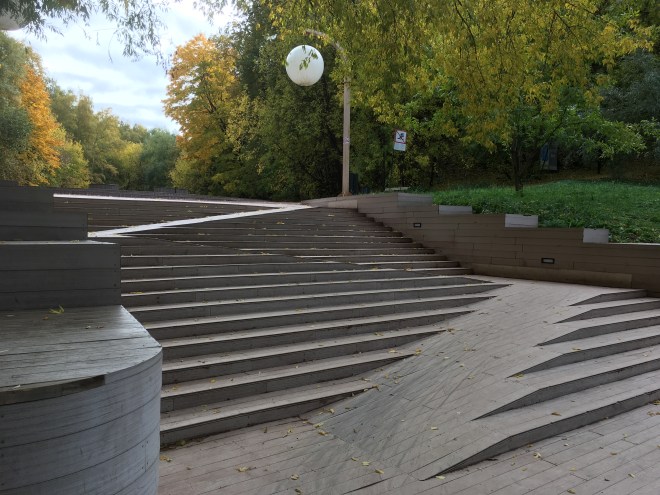
On the other hand, I was very impressed with this feat of Russian design and engineering (not in Zaryadye, it’s in a park called Neskuchnii Sad):
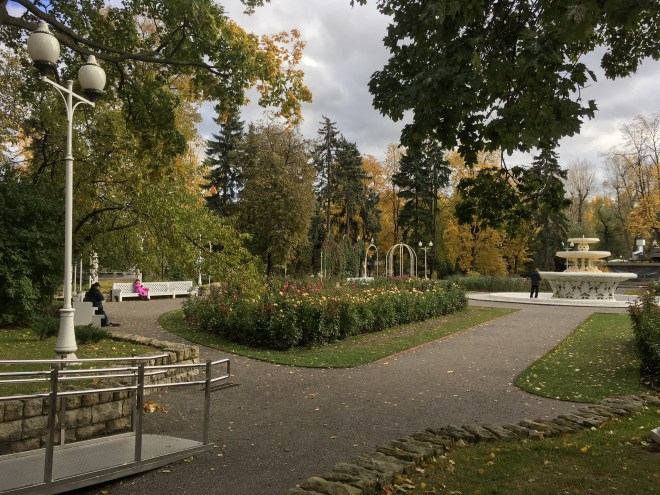
You wouldn’t want to have poor depth perception walking down this stairs and I am not sure how functional it would be when it’s covered in ice in winter, but the idea is pretty cool. And then there are hardy Russian roses that manage to blossom in cold October:
5. There is a wake boarding station right off the Red Square
The wake boarders do impressive stuff to blasting rap music a few hundred metres from comrade Lenin’s tomb. Interesting changes.
6. Red squirrels are doing well
They come over and ask for food. How cute. People must be treating them kindly then. I didn’t see any of this 10 years ago. Red squirrels are native to Ireland, but were outcompeted by the more adapted Grey squirrel. Most Irish people won’t have seen a red squirrel, but if they can do well in the middle of Moscow, I am reassured they will do just fine.
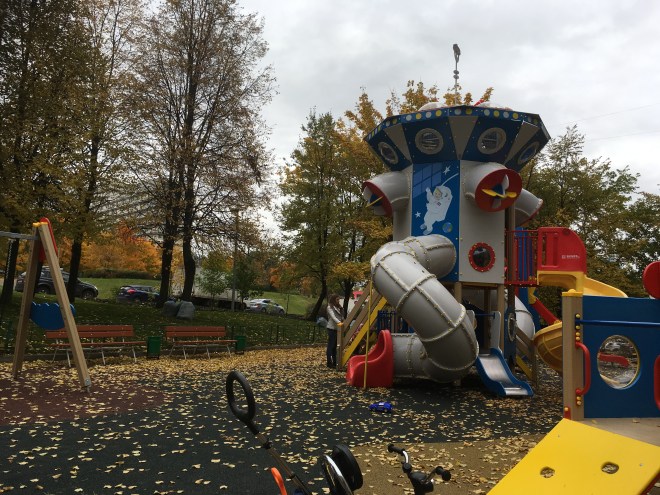
7. Cosmonauts are still in high esteem
A random children’s playground. There was a little banner to say that this was built after a “mini-referendum”: as in people voted on the theme of their local playground.
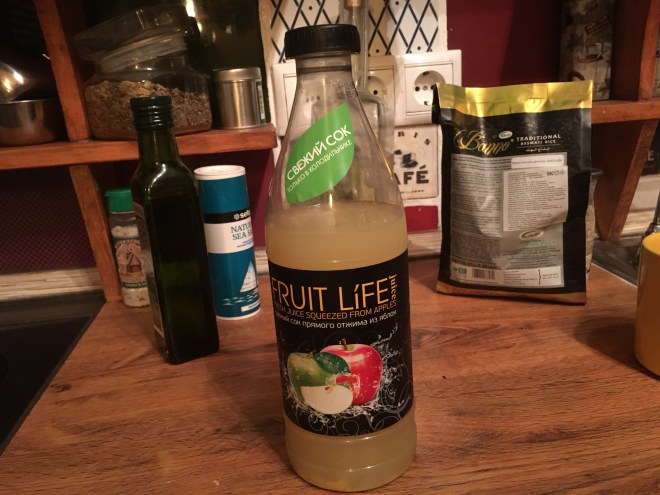
8. There is no fresh juice anywhere
I really struggled to find not from concentrate juice anywhere. I struggled to find this bottle and it had a security tag on it in the shop! I wanted orange juice, but could only get apple or pineapple. You can get actual fresh juice, but bottled fresh juice is a rare find. A business opportunity for any busy beavers, though I do recall Tropicana being available some years ago. I wonder what made them leave.
Ostrich eggs and escargot, on the other hand, are an occupied niche:
What to make of it all?
As we can see, capitalism is hard at work despite the socialist dream. The most disadvantaged people of 1917 were the native peasants and factory workers. In 2017, they are more ethnically diverse and still powering the economy.
…
I have also travelled out towards the Volga and saw some interesting things I will describe soon!
And so we continue our search for the meaning of life. Robert Solomon’s The Passionsoffered an interesting take on this question. He proposed the idea that emotions are the meaning of life: as in they add the meaning in a life; emotions add meaning to our experience the world.
When I first came across this idea, I thought it was strange, but really it does make sense. Emotions have a strong effect of perception. Perception heavily influences our understanding of reality and thus has an impact on the meaning we attribute to things, life itself being one of those things.
Emotions are probably the strongest mental phenomena, built of thoughts and feelings – and very importantly, ultimately resulting in action, as the name suggests. Emotions are the driver of behaviour. My entrepreneurial soul was quite impressed when I heard that every sale is a promise of a future state. Emotions rule us, so we may try to be a little bit more aware – and perhaps less disrespectful to them.
Solomon argues that emotions are judgements rather than plain feelings arising from bodily reactions. Emotions tells us whether something matters – or is meaningful. Solomon also argues that emotions are in a sense chosen, sort of along the lines of stoic philosophy. As with beliefs, emotional judgements are often unintentional and unconscious, but we are still responsible for evaluating and changing them if that’s warranted.
According to Matthew Ratcliffe, Solomon sees emotions as the ‘meaning of life’, in the sense that they are a precondition for the intelligibility of all our goal-directed activities. If no actual or possible states of affairs were ever judged by us to be preferable to any other, we would have no grounds for action. Without emotions, we could have no projects, nothing to strive for, no sense of anything as worth doing:
“I suggest that emotions are the meaning of life. It is because we are moved, because we feel, that life has a meaning. The passionate life, not the dispassionate life of pure reason, is the meaningful life.”
Everything looks better in the sun
As someone who has spent some time studying emotions, I occasionally hold out hope that one day science succeeds in transcending the prism of bias and emotion and we are able to see the world without the emotional projections. Being that little bit pragmatic though – and seeing people like N. Taleb do it, I realise that we have to give up on overintellectualising and accept our limitations – or rather break up with our illusion that we are so above our lowly emotions.
The interesting thing about Solomon’s writing is that he emphasises the existential aspect of emotions: this our experience of being present.
The other interesting aspect is how neuroplasticity affects our perception: any time we experience an emotion a certain pathway gets potentiated and the next time we perceive similar inputs, the fact that we experienced an emotion relating to it previously will have changed the way we see the world. There is positive feedback here.
Neuroplasticity affects everything, but a lot of it is mediated through emotion. My personal working theory is that the meaning of life is the impact that you have (appreciating that that’s very vague, but the point here is that it’s different to the en vogue “the meaning of life is happiness”). But how do I decide what is full of impact? I need to feel that it has meaning. The exact values I consider to be full of impact may in theory be independent of emotion, but in reality they are completely affected by emotion. That warm feeling of satisfaction and accomplishment has to flow through me to know that what I am doing is meaningful. I usually only arrive there through what would look to an outside person as a silent CBT session with myself, so it isn’t entirely detached from intellectualising, but it has to feel right in order for me to know that it is right.
What if I do find something meaningful? It is going to invoke strong emotions. The common denominator of meaning does seem to be emotion.
Solomon drew a lot of Martin Heidegger’s concepts of mood. Mood is probably a more more precise word for what Solomon was talking about. The weather (emotion) matters less than the climate (mood) when we decide on the meaning of things around us. Our moods probably invoke the exact brands of biases and focuses of those biases that will allow us then to form our ideas on the meaning of what we see. Heidegger has an interesting definition for mood: it is a background sense of belonging to a meaningful world. That’s kind of like saying that I, as an object, have a relationship with all these other objects and I am trying to evaluate the condition of that relationship. “Sun’s out, so everything is good” or “Nobody is replying to my emails, so I feel like sh*t”. This certainly describes my mood a lot of the time, but then I slap myself and go back to a more Stoic/Nietzschean attitude to evaluating my own actions rather than the world’s response to me.
Reality is real no matter how we perceive it, but meaning is pretty personal.
…
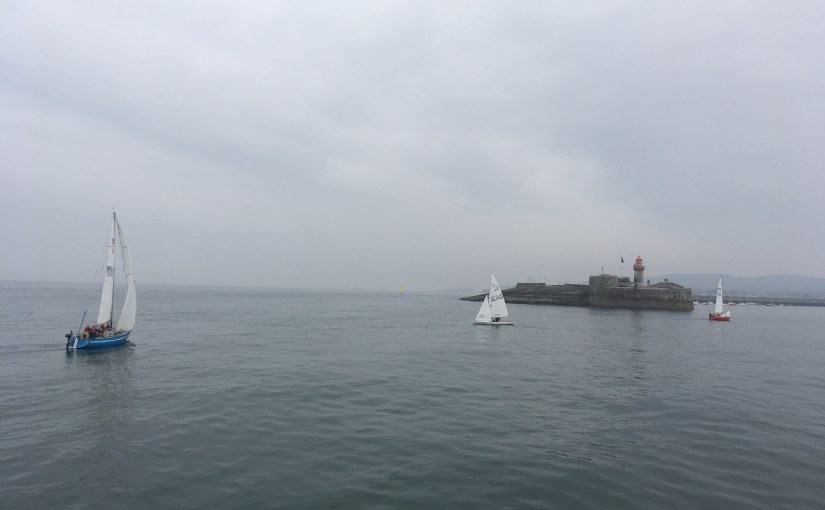
P. S. I wrote a Haiku while sitting on a beach in Dublin:
An old dog, once black, now wiser, at sunset.
Here is the culprit:
…
P. P. S. I also drew something mighty odd. Feel free to indulge in the madness mindfulness and colour it in.
How did the 16 days in May challenge go? Not to the discouragement of my readers, I admit defeat.
This really was a challenge, and I am not that happy with how it went. Why? Life got in the way. I was under a lot of pressure to get a project done with lots of codependencies and lots hinging on it. During the early days of the challenge, I received fairly disconcerting feedback, so everything else went on hold. Anxiety took over.
A lot of people suffer with anxiety. Many refer to a small study that was done among the elderly and asked them what their biggest regret in life was. Many said that they worried too much. Well, of course! With the benefit of hindsight, that’s easy to declare.
A lot of people also say that anxiety isn’t going to help the outcome. Of course it will, otherwise we wouldn’t have evolved it. Naturally, there is pathological anxiety – and I am not talking about that, but in these days of overmedicalising feelings strong anxiety is seen as needing to be gotten rid of.
Maybe the problem isn’t the anxiety? Maybe the problem is the thing that’s causing anxiety? Genius thought, I know. But it seems to be denied any viability in our society. [Then they ask how did we all turn out to be special snowflakes. Hmm.]
Well, I didn’t get rid of my anxiety or try to suppress it. Once I just admitted to myself that I was anxious, a weight came off my shoulders. This is that classic acceptance thing they talk about in mindfulness. Anxious. So what? It’s not a crime. It’s not a defect. It’s just my experience and right now, in this moment, it’s not actually that bad at all. Acceptance of reality gave me the opportunity to work on the underlying cause of the anxiety.
Right, closer to the point:
1. A day without assumptions
OMG. How do you live without assumptions? Occam’s Razor: the simplest answer is usually correct. When I got my worrying feedback, I immediately started mind-reading, mitigating the worst case scenario, assigning probabilities to possible outcomes and acting. Acting is such a drug against anxiety. The problem is of course that directionless hustle isn’t necessarily better than inaction. It’s exhausting and it is possible to do damage like a bull in a china shop.
2. A walking meditation
Definitely a win. Interestingly, it was my olfaction that work up by doing this. I spent most of my life living in a city and that’s not the sort of place where you want to expose yourself to smells. Also, a walking meditation is kind of more lighthearted than the more perfectionist sitting meditation.
3. Get one thing that you have been putting off done
I’ve emailed a bunch of people about a project we all committed too, but all left it to stagnate. Two of the three recipients were very helpful in moving it forward and now, somehow, we have a fourth, who just contacted me out of the blue. Coincidence? Providence?
4. Make a list of your habits
I was too nervous to do that with all my stress. What if I exposed something so disappointing or annoying that I would be too upset? I simply didn’t have the reserve to do it at this time. I will add it to my list (guess that’s a habit…)
5. Ask: Why am I doing this?
W was easy. I know what I consider meaningful. I also know that this changes. I know why I am doing what I am doing though sometimes I wish the routes were straight lines. Ultimately, we have to adapt to our environment and respect the peninsulas of circumstance that we navigate around.
6. Wear the worst clothes you own
Haha, well that led to a clearout! (Anyone of eBay?) It wasn’t so bad at all. Where I live, in Dublin, clothes aren’t as much of a status symbol as they are in some places – like Russia, or I imagine China, or even the UK. I am very grateful for that.
7. Spend the day on your own, no social media
Fail. I can spend the day on my own, but social media – that’s tough. I have this sensation that I am about to get some kind of interesting news via social media. All it is in reality is a trained dopamine-mediated habit. I need to get out of it. It’s not that hard, but once again, it may expose things. For example, it can expose just how lonely I feel sometimes. And then, if I commit to not having social media, at least on certain days, then I am leaving myself to confront the loneliness. As a teenager, I used to travel a lot – and it would always be a connection flight. Sometimes, the connection would be 4 or 5 hours. This was before the kind of engaging social media we have now and certainly before widespread free wifi. I just remember that horrible mix of boredom and loneliness and I don’t ever want to feel it again. Having said that, I always say I come up with some of my best realisations in transit. Maybe then, I should just take the bandage of and be alone with myself, whatever may bubble up.
8. Write down the things that annoyed you
Fail once again. I was worried that it would put me in a foul mood. That’s quite presumptuous and possible wrong. It remains on the to-do list.
9. Go through the notification settings on your phone
Done. Much less distraction now. Best decision ever.
10. Try some mindful cooking
I couldn’t really do that. I was worried that I don’t have the time with my project. It also felt a bit wrong to be messing around with new recipes when things are shaky. Once again, pretty presumptuous, but hey, all I can do is all I can do.
11. Note how much of the stuff you do isn’t for you
This turned out to be a surprise. Even from a Machiavellian points of view, I can easily argue that everything I do for others is done as an investment into a relationship.
12. Look back at where you came from and see where you are now
What a magical thing to do. I thought of my parents, of where I was born, of where I started, of the role I had to play in where I am here today. I think so many of us get upset as we feel that life happens to us and that we don’t have any real control. To any human being, it is very upsetting to not be in control. But is it true? On the one hand, in the grand scheme of things we are small and insignificant. But in the context of our own lives, we are a big deal. Just like the Stoics would argue it’s important to focus on what you do or think as a person. Circumstances aren’t always a form of feedback about how well or poorly we are doing. Looking back at how we navigated our circumstances, even back when we were younger and much more naive, is bound to generate some feelings of pride and invigorate the perception of who we are people.
13. Pay attention to the people in the shop queue
Well, let’s just say I was dragged shopping in IKEA during this time. There was a lady in front of us in the queue who changed her mind on what she was going to buy and was hiding the goods she was going to just dump at the cashier under a pile of bags. Before sneaking the stuff away, she looked over at us a bit like a poorly trained dog looks at people passing by when it’s eating. But I really couldn’t be bothered judging. Maybe she has too much sense to just buy 3 French presses (that don’t filter anything by the way)?
14. Check email only twice a day
Fail. What if something super important happens and I don’t even know?! I need to work on this.
15. Look back at the last 5 purchases you made and whether you needed them
They were all quite optional. I’ve learnt the lesson of not having useless clutter a long time ago (moving dorm rooms every year in college will teach that fairly quickly). However, I was quite surprised at how I could have gotten away without having a lot of these things.
16. Thank yourself for trying so hard
This is a lot like looking back at where you came started. Yes, sometimes the seas part, the light shines, the lucky break happens and we should be endlessly grateful for these blessings. However, we should thank ourselves for working so hard and having faith even when things don’t look good.
The first of May is a day of celebration – no matter the reason, everyone finds something to celebrate on 1st May. I wonder if we could extrapolate this attitude…
Exams usually end in May and freedom begins
The most memorable Bond girl/villain is called May Day
… 1,000 other reasons
(I am biased because my Birthday is in May)
I have made a little gift for everyone. A gift and a challenge. I find 30 day challenges a little scary, so this is a 16 day challenge!
A list of reminders drawing on mindfulness, Stoic philosophy and just general common sense urging us to be more present.
I hope you enjoy it. Print it out and see how you get on. I will report on how I got on on 16th May.
There is something cringy about the notion of self-help. Yet blogging in the philosophical rambling genre invariably has a whiff of it. Even more generally, be it the Bible, Seneca, Leo Tolstoy, Viktor Frankl, Daniel Kahneman or Oprah, or in fact, any autobiography, aren’t they all essentially trying to answer the same question, namely how to make the most of our time here?
Where do we draw the line?
Some writers, psychologists and philosophers have been using a quagmire of specialist terminology to warden off any suspicion of belonging to the self-help family. Religion is many things to many people, but it definitely ticks all the self-help boxes. What about picking up a new hobby? Is that a self-help action? What about ringing up a friend? What about going to the gym to get some endorphins? While we usually draw the line at solitary activities, preferably done alone, by overweight single middle-aged single women called Bridget in the company of Ben and Jerry… But being serious, it isn’t clear how to actually draw the line between legitimately working on oneself and being the gullible victim of charlatans.
Following a discussion on a wonderful Facebook group, Scott Brizel suggested an interesting approach: the problem is solved by noting the distinction between philosophy and ‘wisdom traditions’, even though wisdom traditions are (possibly wrongly) often called philosophies. Wisdom traditions propose strategies for living well, while philosophy is a method of inquiry into the meaning of ideas. Despite the loose use of ‘philosophy’ with respect toward it, Buddhism, for example, is a wisdom tradition, not ‘philosophy’ nor even ‘religion’. Religions tell creation stories, yet they may attempt to add value by establishing an associated wisdom tradition. The three ideas are often conflated, with some systems being both religions and wisdom traditions, but if you note the distinctions I draw, it will be easy to distinguish them.
Why people buy self-help books
The biggest predictor of whether a person will buy a self-help book is whether they have bought one before.
It is possible that the soothing feeling people get from buying and/or reading literature in the self-help genre is simply the reassurance that there is a solution to the problem.
As human beings, we have a profound desire to affect the world around us. This even applies to very young children, who can be taught to pedal a bike. While they don’t understand the significance of pedalling, the fact that the wheels are turning seems to motivate them to do more of it. Seeing tangible results of our actions gives us the feeling of control.
The feeling of control, the belief that our actions will deliver an impact, is probably our number one motivator. So no wonder people buy these books: by buying a book, they are buying equity in the belief that they can change themselves or even the world around them.
Anyone who questions the ability of self-help methods to genuinely address the problem they aim to address seems like a party pooper who is stealing our dream of control. Indeed, Maslow’s hierarchy of needs, safety and security, in this case it is the belief that there is an answer and a role model to guide hold our hand, is more important than the need for self-actualisation.
Self-help books give a sense of safety and certainty. Placebo and religious texts have this in common too.
The authors inevitably portray themselves as a role model for whom these rituals have worked. Indeed, studies done on laboratory animals in helpless positions try to do things that are somehow associated with a reward or schedule. It’s an anxiety-defying ritual, not a solution to the problem per se.
As a child I spent a lot of time in Russia where books were very cheap and ubiquitous – and in the pre-internet era, well, they were the internet. Fiction never really did it for me, unless it was detective stories, and they, as we know, tend to be less than well written for the most part. Encyclopaedias were a bit hit with me, but also books on psychology.
As Western culture came flooding in, so did Dale Carnegie, Tony Robbins and their friends becoming an instant hit with a society turned upside down. My peers and I read some of these books, and they’ve left a negative impression congruent with the aftertaste of much of the rest of Western culture with its endless brands: the obvious repackaged and presented as a revolutionary discovery.
By the time The Secret came around, I was starting college. It wouldn’t occur to me to read that. I got a summer job in a book shop (the shopkeeper suggested I take the academic section, hmm, wonder why). The manager, when he wasn’t schooling me for being late, was perplexed at the proverbial middle-aged women who buy The Secret merchandise: he wasn’t sure how an adult could be convinced that by writing their wishes in a notebook that says The Secret on it (€7.99) as opposed as normal writing pad (€1.99) is better. I guess he just didn’t get why people buy things.
Years later I saw the film Little Miss Sunshine that I would highly recommend to anyone who wants to forget that they’ve held a self-help book in their hands.
What does the self-help obsession tell us about the society we live in?
Based on my reading of Durant’s The Lessons of History, the rise of the self-help genre is nothing unusual: whenever the role of religion diminishes in society, we flee to other sources of wisdom, or surrogate wisdom as the case may be.
For most millennials I see around me, our moral word seems to be a quilt of Christianity, Western liberalism with a touch of yoga-driven mysticism. I often think that it’s better to be confused and forced into questioning values than to unconditionally accept a bunch of dogma.The wishful thinking of self-help puzzled me for a long time. Is it really that different to a prayer? As a professor of psychology Rami Gabriel puts it:
Popular psychology comes with a message about the possibility of surmounting obstacles through the free will of the almighty self, as well as continual exhortations to practise hopeful optimism and disable despair and hopelessness: in all, a reflection of an individualistic, even narcissistic, culture in the contemporary US.
I would change US to the West. The cultural shifts in the US may be modulated as the cross the Atlantic, but Europe feels the reverberations of these developments for decades. I strongly agree with the narcissistic piece: all of this literature proclaims that you can change the world by changing yourself. While it may seem humble at first, it is actually enragingly self-centred. Of course, the purpose isn’t to be self-centred. It is to keep building the sense of control that would (in theory) allow one to rise above whatever circumstances that are holding them back.
So what is the difference between philosophy and self-help?
Self-help is hedonistic: do this and life will get better. Philosophy doesn’t aim to change one’s life, only to understand it.
Philosophy doesn’t provide any real recommendations. Self-help is bursting with answers: it is prescriptive. I guess the reason I am even asking this question is because if I hear someone say “don’t think about the negative”, I am keen to think of what the reasons and implications are, in other words, I think of the philosophy of the recommendation. To me, self-help is a truncated philosophy, though it doesn’t try to be.
Philosophers don’t tend to solve problems, they tend to ask and sometimes try to answer questions. Self-helpers have all the solutions. In fact, they tend to only have one solution, for all ills.


















 A millennial's musings