January results of the Image Experiment

What I learnt working on my image this January:

  • expensive products commit you to putting in more effort, hence, you look better
  • when you do as you’ve been told by Andie MacDowell since you were 5, you feel like you are part of the club
  • the people who market to you don’t expect you to have even a rudimentary understanding of the scientific method or statistics, or any critical thinking really
  • you can use these lotions and potions in a mindful way

See the backstory here.

In early January, Santi brought me two things I had been contemplating getting myself:

1. Revitalising Fresh Shampoo by L’Occitane

The revitalising shampoo tingles lightly when you leave it on for over a minute, which is very relaxing. I guess for the oils and whatever else to work, you really need to give it a little time. What made me laugh was this on their website:

why do women love cosmetic products
Does this offend your intelligence? I hope it does. Also this.

What I found was that it was great for relaxing in a mindful way. The tingle draws your attention to your scalp – a place you don’t often concentrate on otherwise.

Did it make much of a difference to my hair compared to the normal run of the mill L’Oreal shampoo? Not really. But I think that I spent more time brushing my hair and was more diligent when blowdrying it. In other words, having spent a bomb on shampoo, my brain tells me to be consistent and dry my hair in manner that’s becoming of a woman who spends a bomb on shampoo.

2. Repairing Hair Mask by L’Occitane – also brought by Santi

I wasn’t a fan of the smell, it reminds me of some yucky Soviet herbal shampoo. Chances are that they both contain a herb I don’t like. Effect? As above with the shampoo. They used to have an olive oil range that was excellent, but this product didn’t have that miraculous effect.

Santi was thoughtful enough to throw in some samples of L’Occitane face cream all of which are 10/10, except the rose-scented one that was overpowering with its perfume.

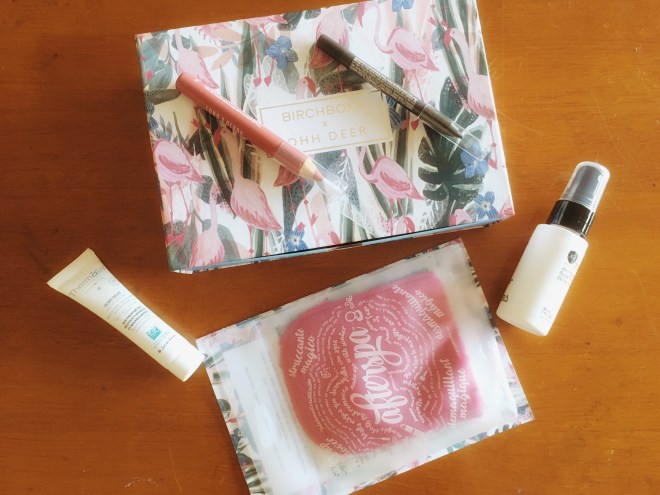
Then my first Birchbox (affectionately known as Bitchbox in my household) arrived. From Sweden!

It contained

1. The Sand & Sky Brilliant Skin™ Purifying Pink Clay Mask

All the way from the land down under. How exciting.

It tingles very gently and dries very soon after you put it on. I got out an old Mac brush to put it on which made it feel all the more glamorous and added 100% to the fun of this peculiar ritual .

There is a warning on the back of it that you can’t use it with oral vitamin A without consulting a doctor. In other words, it was full of retinoids, which do actually work when applied topically – something I know from the dermatology lectures of my youth.

My boyfriend who is ultraskeptical of the cosmetics industry noticed a difference. That’s as reliable a fact that it works as can be. Go Australia (and retinoids). (As always, this is not medical advice!)

2. Kebelo Clarifying Shampoo

This really intrigued me: a shampoo to be used once or twice a month in order to give your hair a really thorough clean. I used it after a swim in the hope that it may wash out the chlorine that little bit better. I was kind of worried that it would make it all fall out be very harsh, but it was fine and my hair was actually lighter, much easier to brush and much shiner after using it.

3. Baija Gommage Festin Royal Miel Caramélisé

Which was ridiculous! A jar of marmalade with solidified sugar to be used as a scrub! Anyway, it’s not actually edible (the auld benzyl alcohol is that little bit toxic). Kinda nice, kinda felt stooopid using a jar of marmalade though.

It also contained a lipstick that made me look older and a synthetic brush that I have no use for. And – a discount if I had wanted to sign up to Virgin Wines as a subscription box too! Clever bstrds know all about marketing.

I also picked up a L’Oreal pre-shampoo clay mask! Oooo. As in, you put it on before you use shampoo. It’s cheap, but less than cheerful in a really artificial blue colour with strong perfume.

I didn’t notice any difference to my hair, despite using a myriad new products, except with the paintstripper Kebelo use-once-a-month potion, that didn’t come from just paying more attention to it.

How do I know this? Well, when I have something big coming up and don’t have the heavy artillery to hand, I spend more time dolling myself up with ordinary products and come out looking the same as with all these products.


I also was religious in terms of the cleanse-tone-moisturise skincare routine. I do it anyway, but I am ordinarily a bit sporadic (lazy) with it. This month, I learnt just how difficult it is to actually exfoliate your skin properly. I more or less have to go to the sauna to make it happen. Good exfoliation appears to be what gives skin this beautiful shimmer that people adore. And it makes sense because the surface are isn’t interrupted by the rough dead cells, hence the light forms a nice continuous reflection.

Furthermore, it’s a slightly strange ritual to take off all the skin’s natural sebum, forcefully, and to replace it with moisturiser, but that’s what the cosmetics industry preaches.

Did I feel much different? No. More confident? No, but maybe more grown up, because following a skin care routine is adulting. More girly or feminine? No, but I felt that I was part of some invisible club – and that made me feel better – and probably more confident in a way I didn’t perceive. Did I notice a different reaction from people? No.

“People are suffering and dying under the torture of the fantasy self they’re failing to become.”

Ten. Billion. Dollars. A year.

That’s how much the self-help industry makes. That is actually more than make up.

A lover of books, I stopped looking at the best-sellers sections of book shops because they inevitably contain self-help books, about how to optimise this and maximise that. I spoke about books I regretted reading and definitely anything like self-help is in that category.

A reflection of our time for sure, with their “aspirational narcissism” and “predatory optimism”:

Where success can be measured with increasing accuracy, so, too, can failure. On the other side of self-improvement, Cederström and Spicer have discovered, is a sense not simply of inadequacy but of fraudulence. In December, with the end of their project approaching, Spicer reflects that he has spent the year focussing on himself to the exclusion of everything, and everyone, else in his life. His wife is due to give birth to their second child in a few days; their relationship is not at its best. And yet, he writes, “I could not think of another year I spent more of my time doing things that were not me at all.” He doesn’t feel like a better version of himself. He doesn’t even feel like himself. He has been like a man possessed: “If it wasn’t me, who was it then?”

The New Yorker article itself is a bit self-helpy, ironically, but has a few gems and a review of the literature, if it may be called that.

I think that for many people, improving yourself is happiness: seeing progress, seeing results of your work and what you have become as a consequence. So in theory we shouldn’t deride self help.

I don’t know what bothers me the most about it: the feeling of constantly being sold to? The relentless inward focus when a lot of these problems are better solved with the help of those closest to you? The idea of a cheap shortcut to “radical change”? All of the above and many more. In my view, self-help is definitely not the best way to improve yourself.

I also think that the generation below us aren’t going to go for it anymore. They prefer “not giving a fk” to getting rich and thin or dying trying. Of course, this won’t reduce the amount of money spent on the genre as it is highly adaptive in telling people what they want to hear.

What would your friends buy from you?

I did a 5 hour exam seminar today and one of the things that the students perked their ears up at was the idea of writing not for readers, but for a reader.

This was half way across the country (it’s snowing here). On the train home, in a bout of nostalgic tiredness, I flicked through the blogs of people who I followed 10 years ago and something occurred to me. A lot of bloggers ended up having some kind of successful business, often hingeing on a personal brand. I found an interesting correlation between their business and their friends. It’s painfully obvious, but for me it has been hidden in plain sight for a long time.

They sell the things their friends would buy from them.

And by friends, I don’t mean people who follow them, I mean friends. Real life friends.

So to rephrase the writing canon:

Don’t sell to followers, sell to a follower. 

The concept of selling to your friends seems a bit odd at first, but it’s the perfect litmus test of whether what you’re selling is worth buying. I think some people rely on the vastness of the internet to find their product and end up making spammy things that don’t sell, where in reality it’s probably not going to take off unless their friends would buy it from them.

The publisher has been the supplier of good books for her friends. The photographer who became popular has been taking her friends’ photographs for a long time. The lad who has a web development studio developed his friend’s sites. The girl with the jewellery store has been the to-go to person for nice jewellery before she had a bona fide store. My personal experience is congruent with this.

I think it’s a good way to think about small business. Think of a friend: what would you buy from them? What would you sell to them? I had a think of my friends and all they are good for is professional advice and good alcohol. Oh dear, rofl.

The social/economic mechanics of this are obvious and not worth chewing over, but it’s just a good way to think for some people who are thinking of monetising something.

What would your friends buy from you?

“In today’s innovative world…”

The teenagers whose essays I read think we live in a phenomenally innovative time. Smartphones. Computers. The internet.

Yes, this all happened in the last 50 years.

In the 50 years before that we landed on the moon, split the atom, came up with the bomb, made cars and film widely available and saved countless lives with penicillin.

The Joke’s on Me

So much love.

boomergirl47's avatarKaleidoscope

So I’m sitting down to meditate, and as is sometimes the case, being still brings up emotions that I’m too distracted to deal with when I’m busy.  If it’s really bad, I defer the meditation for a few minutes, and talk to the Universe. God, Spirit, Cosmos. Whoever or Whatever’s listening.

This morning I let the Universe have it between the eyes. No holds barred. I had complaints.  Justifiable complaints. Complaints about unfairness, about things in my life that are NOT going according to plan. Things that are a great annoyance, inconvenience and downright WRONG. Things that I don’t have a f***ng clue how to deal with.  Things that make me feel helpless. I was wound up!

As I was almost at the end of my diatribe, I heard some sand hill cranes in flight squawking their heads off. They have a honking squawk you can hear a mile away.

View original post 39 more words

Why do women love cosmetic products and how I plan to find out

I.

Why do women wear make up? (1)

I asked my near 60 year old mother and she had no qualms: make up is ultimately to attract men. A bit of a thought crime in our modern days, isn’t it? The Last Psychiatrist wrote this gem on the subject:

When they say, “it’s a woman’s choice” what they mean is “it’s not a man’s choice, it is thoroughly stupid to wear make up just for men, the only acceptable reason is if you do it for yourself, if it makes you feel better about yourself.”

Hear, hear.

Everyone knows you shouldn’t judge a book by its cover, now you’re saying the cover of the book influences how the book feels about itself? 

This got me thinking.

II.

Apart from when I am trying to get someone’s attention, I am the content way over form type of gal.

Like really. I take pleasure in the fact that I haven’t bought most anything I didn’t actually really want or need in the last 2 years or so. In the fact that there is no clutter on my bedside locker. If I do buy something, it’s either evidence-based or very well reviewed. And I am not stingy or spartan. I buy it if I want it and don’t mind if it’s pricey. I just don’t like useless things.

I’ve always laughed at the people who get this massage and that massage in their attempts to look younger and fitter  – in wonder – when the obvious thing to do is go to the gym and eat well. The people who rub coenzyme Q10 and hyaluronic acid into their skin when it’s so darn obvious that it will only sit on the surface.

I was always curious about the thought processes of those who are really into their image. I had the privilege of reading an opinion piece from a schoolgirl who loves fashion and wants to explain why it’s substantial. (4) To my mind, it was rather a circular argument: fashion for the sake of fashion. Maybe I will find another reason?


III.

I am not so sure why women wear make up. Because they were told that they should, mostly? (2)

When I just joined the workforce, I wore a lot of make up (by my standards). I wanted to fit in with other girls, who I knew would invariably be wearing make up. It signals a number of things: a desire to be liked, a desire to fit into the female tribe – and a certain social class.

I also think that I am more liked when wearing make up. Perhaps the relationship is actually the inverse: on days I am particularly interested in approval, I wear make up and look for people to like me. I don’t really know. I guess make up is a particularly effective counterweight to the things that make me appear more serious than I am (being Russian and just a little nerdy).

IV.

Then I thought: content and form aren’t actually separate. The tech innovators of the last 20 years made a lot of money out of this less than obvious idea. They call form design and it works for them.

So if form is image and content is character, by working on one’s image, does one change their character?

If so, could it be for the worse? Are the people who look invariably perfect always shallow?

No, definitely not, in my experience.

What Dr. Last Psychiatrist really brings out, when he compares us to books with covers, is that we are social animals. What others think of us is hugely important and does influence what we think of ourselves. My question is how does our perception of ourselves change when we work on our image?

I thought long and hard about it. It’s unusual for women to wear make up at home, when there is no one around, at least in the same way as they do when they go outside. So it is about signalling to others. It is about others. That doesn’t mean that our perception of ourselves isn’t influenced by working on our image. Indeed, when we signal to others, we signal to ourselves, just a little bit.

What do we signal though? In my experience, there is something life-affirming about skincare. It makes me feel clean and creates a little isle of order in an otherwise chaotic world. It could also signal that we are not good enough to go out as we are, but that only happened to me when eyeliner wouldn’t go on right the first time or my skin was too dry for foundation and flaked.

If keeping a gun in the house made me feel good, it would be because at least on some level I felt I am safer with it. Similarly, make up enhances beauty – which, importantly, means higher status. Higher status leads to not only approval, but also safety. People are less likely to challenge those who look healthy, strong and of high status. This is where Azazel and deception come in. Make up builds up status and it’s a fake it till you make it operation that deceives us into believing that we’ve got it. Hence, more confidence.

V.

Does that mean women are so unbelievably needy and shallow that they pay 8 billion dollars a year to deceptively jack up their status in society?

Partly. But it’s a hobby too. It’s of entertainment value.

Like the guys who collect guns, women buy way more make up than they need because it’s a collection of toys. I wrote on a related topic previously and one of the comments was “I dress for myself… it’s about pride in appearance, not date bait” (Patti‘s blog). I completely believe her and, in my view, she is a hobbyist (I take the liberty of using dress and make up as very related concepts). It’s not that the concept of trying to impress specific people with your appearance is unfamiliar to me, but I genuinely don’t think it is the driver for most women, especially given that women continue to maintain their appearance once they are “spoken for”.

So there, most people who like make up are hobbyists.

For some reason this is a revelation to me. I guess I am a goal directed type, so I don’t really engage in too many hobbies. Reading is a hobby, but really it has the goal of understanding how people think. Blogging is a hobby, but really it serves as a chronicle and a place to bounce of likeminded individuals.

I think the closest thing I have to a hobby is food and drink – and the way I feel about a nice bottle of Chianti is similar to how I feel about a Dior eye cream.

VI.

Why am I worried about all this?

Well, I got it into my head that I want to learn about the concept of image this year, in a sort of New Year’s resolution.

Why? Because it seems that I am less concerned about it than a lot of people I hang around with.

This involves all kinds of 3-step routines and other rituals, so I became curious as to why millions of people bother when for me it is a conscious effort.

VII.

On a practical level, I buy make up and end up not using it because I get excruciatingly bored with the smell, so I gave into Facebook’s targeted advertising, for the first time in my conscious memory, and signed up for Birchbox (misspelt this as Bitchbox at first OMG ROFL.) My experience so far has been very positive and I plan to remain subscribed all year.

I shall also follow religious quotidien routines, exfoliate like my life depends on it and document any insights I gather on the way. I will update you no more frequently than once a month, so don’t unfollow just yet.

For the scientific method sticklers, here are my quasi-scientific details:

Null hypothesis: for a woman with no obvious image problems, there is no benefit in working on her image by using popular make up routines.

H1: for a woman with no obvious image problems, there is a benefit in working on her image by using popular make up routines.

Another question that’s on my mind is whether there is a qualitative difference to skincare vs make up proper in the value I would derive from it – all with a proud n=1.

why do women love cosmetic products


1. Azazel taught women the art of deception by ornamenting the body, dyeing the hair, and painting the face and the eyebrows, we are told. The art of deception. Interesting take.

2. It’s painful to watch how easy it is to convince someone of something and have the person believe that they independently arrived at that conclusion. And so when we are repeatedly told that we are worth it, we buy it. We buy the association between worth and looking great. Which, in a way, exists, to be fair.

3. “Нет на свете прекрасней одёжи, чем бронза мускулов и свежесть кожи” – В. Маяковский. This is from a poem and roughly translates as “There is nothing more beautiful in the world than the bronze of muscles and freshness of skin” by Vladimir Mayakovsky

I’ll tell it to you straight —

Did you realise that rectify, rectangle, direction, correct, etc – are all related?

The penny dropped for me when as a first year medical student, in an anatomy lecture, I heard that the word rectum signifies the straight shape of that part of the bowel.

Had to be told about the origin of the word Ukraine as the borderlands – and not quite sure I buy it.

Bored Elon Musk, nutritionist edition

My inner bored-Elon-Musk says:

we need an app that spits out the number of calories in food using the camera through optical recognition, like Facebook analyses faces.

Then we would all be fit and trim, right?…

P.S. My IG stories mostly consist of pictures of food 🙂