A little thought experiment

You’re about to open results of psychological tests comparing atheists and agnostics. What do you expect to find?

I wonder if agnostics are more conflict averse, better at abstract thinking and have a sense of humour.

Also, how do atheists who have children deal with the concept of Santa? Santa is a real world conspiracy theory – and possibly a much more pagan one than a Christian one. I imagine that there has to be a “herd immunity” for the concept of Santa to survive in creches and primary schools. Do religious parents arrive at the door step of atheists and be like, stop your child from spreading heresy!..

P.S. It is snowing in Ireland. I was in the Midlands today and it’s a Winter Wonderland.

IMG_7942


Turning wine into water

I was watching Troy with somebody who happens to know a lot of useless things (his words, not mine). The Trojans and the Greeks were having a feast and he mentioned that they used to dilute their wine.

So we read into it. The natural max alcohol content in wine is 15%. Apparently, the Greeks used to dilute it up to 9:1, as in 9 parts water, 1 part wine!

I decided to try it with a 13% Montepulciano to get that full-bodied Mediterranean taste that opens sweet and ends earthy. We decanted it for an hour.

diluting wine with water
50 ml wine in each, 2:1, 1:1, pure

As a baseline, it was rich, sweet, with an astringent end-note.

At 1:1 (1 part water, 1 part wine), it was very sour with the astringent aftertaste.

At 2:1, it was sour, like pink grapefruit juice, the astringent aftertaste was lighter.

At 4:1, it was like lemon water with a mind astringent end-note. Sort of refreshing.

At 6:1, I couldn’t tell there was alcohol in it.

I don’t think I will be trying it with red again. I think white will come out more with the dilution.


Appearance vs reality

Sometimes I get tired  and retreat into a safe echo-chamber where everything will agree with me. On that note, I downloaded The Black Swan and bought a paper copy of The Bed of Procrustes.

Perhaps my expectations were too high, but The Black Swan seems dated and overly reliant on Kahneman’s Thinking Fast and Slow.

I will share some gems from The Bed of Procrustes when I am done, but for the most part it doesn’t have the insight porn quality that I was looking for.

On another note, I noticed some autumnal waistline creep and decided that I should take measures.

During a moment of intense boredom with a hint of sadness, I complained that had I not been watching what I eat, I could have had a chocolaty pick-me-up, alas I am on a diet, so I will just sit here and be sad.

I was and am fully aware of how pathetic that is, but I figured sharing my feelings is better than comfort eating.

The reason I am sharing with you now is the response I got, which was:

How will food make it better?

It hit me like a ton of bricks.

I guess normally I would have said, it would make me feel better. However, I was just after writing an essay on appearance vs reality in Macbeth and the idea that the reality won’t be better crystallised for me.

The world weighs a little heavier since that realisation, but maybe I won’t.


On a scale of 0 to Christmas, how much alcohol do you drink?

December is a month when people drink a lot.

Ireland and Russia are countries where people drink a lot.

These two things have a multiplicative effect. So just for my own information I decided I would track how much alcohol I drink in December. Then I gathered it would be nice to share my method.

You can go though life thinking that you only have the odd drink, but then you look at this calendar and realise that drinking a glass of wine on a Wednesday, Friday, Saturday and a cocktail at a Sunday brunch means you drink most of the time!

I made 2 versions. Download, print, colour in. Or indeed write in the number of units…

December Alcohol Tracker Wine

PDF: December Alcohol Tracker

December Alcohol Tracker

PDF: December Alcohol Tracker 2

Cool, as of 1528

Sprezzatura [sprettsaˈtuːra] is an Italian word originating from Baldassare Castiglione‘s The Book of the Courtier, where it is defined by the author as “a certain nonchalance, so as to conceal all art and make whatever one does or says appear to be without effort and almost without any thought about it”. It is the ability of the courtier to display “an easy facility in accomplishing difficult actions which hides the conscious effort that went into them”.

Sprezzatura has also been described “as a form of defensive irony: the ability to disguise what one really desires, feels, thinks, and means or intends behind a mask of apparent reticence and nonchalance”. (Wikipedia)

The word has entered the English language; the Oxford English Dictionary defines it as “studied carelessness”.

It would be the Italians who would come up with something like this and it would be in Oxford that they would make it sound so lame… Why couldn’t they just say cool?

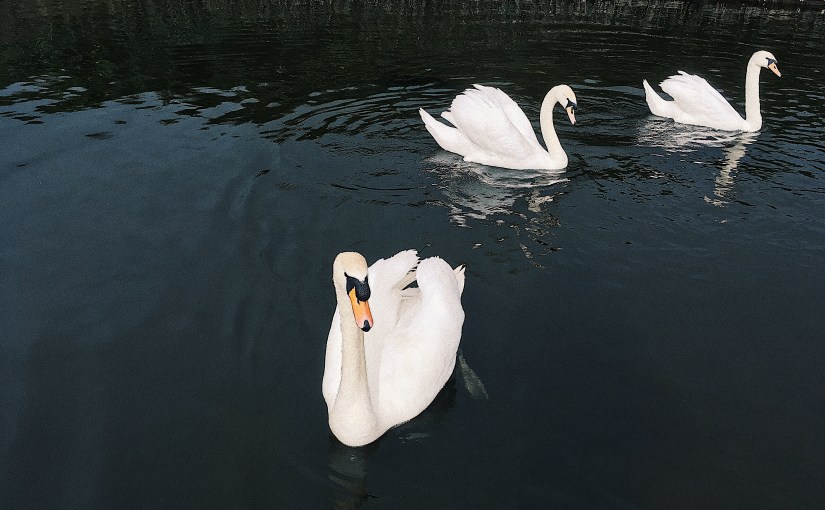
I think swans have a significant amount of sprezzatura.

Sprezzatura is my excuse for not publishing the results of how I got on with the plans I set in September. It is also one of the great things I learnt from Taleb’s The Bed of Procrustes. I recommend it.

P.S. An existential question for WordPress bloggers. Why WordPress and not Instagram or Facebook? Why not Medium?


Is it a man’s world?

Kitchens aren’t designed for men.
The average Irish man is 14 cm taller than the average Irish woman. The sinks are too low for them, the cupboards open straight in their faces – and who can get down low enough to see what is in the freezer compartment…

Clearly, it is men who build kitchens.

In very old buildings, men just built things without a 100 considerations. I would find it difficult to reach things from the top shelf in the GMB, for example. In other words, 100 years ago, kitchens were designed by men, for men. Not on purpose, of course.

Later, women became in charge of their household spending and builders started building for their target audience. He who pays the piper…

A strategic error and failure to consider n-order consequences.

Inbox Clogging Friday

Every store I ever visited sent me an email today. Or so it feels.

I don’t even have to make a list of places I may want to unsubscribe from.

The thing is that the average “European” doesn’t have a bull’s notion about Thanksgiving or Black Friday. If anything, Black Friday sounds akin to Bloody Sunday.

We never had Black Friday in Europe up until about 2 years ago. It’s just marketing and no apologies.

Are email and meetings actually a waste of time?

I recently discovered this fantastic blog by Paul Graham. Like so many others, he mentions that email is a digital time sink:

Some days I’d wake up, get a cup of tea and check the news, then check email, then check the news again, then answer a few emails, then suddenly notice it was almost lunchtime and I hadn’t gotten any real work done. And this started to happen more and more often.

He decided he would have one computer to browse the web and another to work:

My rule is that I can spend as much time online as I want, as long as I do it on that computer. And this turns out to be enough. When I have to sit on the other side of the room to check email or browse the web, I become much more aware of it. Sufficiently aware, in my case at least, that it’s hard to spend more than about an hour a day online. Source

check email or browse the web – wtf?

A huge amount of my work is done through email. Because some work involves other people, putting things in writing and communicating quickly.

How have the internets, including some of the founding fathers, deemed email so useless?

The Guardian rants:

In the Harvard Business Review, three consultants from Bain report the results of an exercise in which they analyzed the Outlook schedules of the employees of an unnamed “large company” – and concluded that one weekly executive meeting ate up a dizzying 300,000 hours a year. Which is impressive, given that each of us only has about 8,700 hours a year to begin with. Including sleep.

And The Washington Post weighs in:

Any cubicle drone with a corporate email address knows this well already, of course, but a new report from Adobe describes the problem with some pretty startling numbers. According to its data, which is sourced from a self-reported survey of more than 1,000 white-collar workers in the country, we spend an average of 4.1 hours checking our work email each day. That’s 20.5 hours each week, more than 1,000 hours each year, more than 47,000 hours over a career.

In that time, you could have learned two dozen languages. Or hiked the Appalachian Trail 100 times! Instead, you were tapping out gems like “plz acknowledge receipt, ty” and “ok sounds good, let’s meet at nine.”

Yeah… so it takes a lot of time. That doesn’t mean it’s a time waste.

Yes, you can do it all wrong and waste time, but you can do anything wrong.

I doubt Paul Graham gets less important email than I do. Yet he still calls it “not work”.

It’s actually kind of rude to the people who send you email to say that email is a waste of time.

It sounds so much like just another quick fix from the “productivity” industry, but it seems unlikely that a dude like Paul Graham would get trapped by that.

The only reasonable answer is that your work is something solitary. Same with “meetings” that people so hate. You can call yourself a team player all you want, but if you think email, or to use plain English, communicating is a waste of time, maybe you just aren’t?

When you’re browsing the web, no one cares. But when you don’t answer your emails or don’t turn up to/pay attention in meetings, somebody does.


Notes on The Last Psychiatrist

I love few things more than a great blog. My latest find: The Last Psychiatrist, an archived blog, mostly about narcissism.

I was so excited to learn his insights… I made notes.

What follows are his finest insights about narcissism and my comments.

Imagine a crowded subway, and a beautiful woman gets on. Hyper-beautiful, the kind of woman who can wear no makeup, a parka, earmuffs and a bulky scarf and that somehow makes her look even prettier. A handsome man about her age in an expensive suit gets up and says, “please, take my seat.” She smiles, and hastily sits down.

TLP (The Last Psychiatrist), as the author refers to himself, gives us two options as to how the woman should think about this:

  1. This was a sexually motivated act as far as the man was concerned
  2. He was just being nice

If you think of narcissism as grandiosity you miss the nuances, e.g. in her case the problem is narcissism without any grandiosity:

she is so consumed with her identity (as not pretty) that she is not able to read, to empathise with, other people’s feelings. Source

In another post, TLP explains why narcissism isn’t necessarily about grandiosity. This is a blatantly obvious point that escapes most people, unfortunately.

Being the main character of your own film isn’t necessarily grandiose. It is narcissistic though because all the other characters are only important because they help the viewer to understand the main story line.

Here are some less obvious traits of narcissism TLP outlined:

Shame over guilt (I think this is because shame is an emotion directed at the self, whereas guilt is an emotion directed at your victim)

envy over greed (greed would be a primary reason to look for something, whereas envy is only a desire to catch up because otherwise otherwise it’s a bad reflection on you. I liked how this was called “existential agency” here.)

He [the narcissist] thinks the problem is people don’t like him, or not enough, so he exerts massive energy into the creation and maintenance of an identity: if they think of me as X… (and that’s one of the reasons why we love brands)

The narcissist feels unhappy because he thinks his life isn’t as it should be, or things are going wrong;  but all of those feelings find origin in frustration, a specific frustration: the inability to love the other person.

And this really brings it back to the original myth that TLP broke down beautifully here:

Narcissus mother took him to a clairvoyant who said, “He’ll have a long life as long as he never knows himself.

Narcissus kept rejecting people who fell in love with him because they weren’t good enough.

One rejected lover was furious and begged Nemesis, the goddess of vengeance, for retribution.  “If Narcissus ever falls in love, don’t let the love be returned!”

Nemesis  heard the prayer and caused Narcissus to fall in love with himself: he was lead to a  pool of water, and when he looked into it, he fell in love with what he saw.  And what he saw wasn’t real, so of course it couldn’t love him back.  But Narcissus sat patiently, forever, hoping that one day that beautiful person in the bottom of the pool was going to come out and love him.

Because he never loved anyone, he fell in love with himself. That was Narcissus’s punishment.

This brings up an interesting point: how are you meant to feel about yourself?

Let’s first look at what we want. What we pay for. A huge portion of marketing directly helps us to be in love with ourselves, because we’re worth it. They’re not even trying to hide that the feeling of being in love with yourself is what they’re selling. And it’s not punishment as we see it – otherwise we wouldn’t buy it. I suppose it’s a psychic equivalent of putting a person on heroin. You mightn’t feel it’s a punishment, but it is.

Then there are the more subtle “intellectual” publications that help you love yourself (see the distinction from being in love with yourself? Cause that would be shallow.) I wonder how many pages were dedicated to helping people see Narcissus’ infatuation as Buddhist acceptance or some other high and mighty concept.

There isn’t really anywhere that would tell you that you’re meant to not love yourself.

What happened to Narcissus doesn’t really sound so horrible in today’s culture. Maybe he wouldn’t have even retaken a selfie if he lived today and been happy with the first shot? That level of self-acceptance is just enviable! He’s winning at life by millennial standards!… Indeed, TPL calls narcissism “a generational pathology”.

TLP goes on to discuss Narcissus’ parents’ role, which I thought was priceless:

He will have a long life, if he never knows himself.

Forget about whether the prophecy is true.  Ask instead, “what would the parents have done once they heard it?”…

Next time I feel insignificant and weak, maybe I need to hold on to that feeling, because my culture will obviously infuse me with my own grandiosity without me ever trying.

TLP has another explanation for why Narcissus stayed looking at the primordial selfie lake though.

He didn’t stay there for years because the reflection had pretty hair.  He stayed because daydreaming takes a lot of time.

In other words, Narcissus didn’t recognise himself and spent all that time conjuring up images of how wonderful life would be with that person in the reflection…

And the DSM says exactly that, only it adds a grandiose twist: “preoccupation with fantasies of unlimited success, power, brilliance, beauty, or ideal love”.

I am confused now.

Narcissus fell in love with himself, only he didn’t know if was himself.

So, as far as Narcissus was concerned, he was genuinely in love with another human being – only they were unreachable. Their personality was entirely a figment of his imagination…

Wait, that’s not Narcissus, that’s Gatsby! (Who also dies in a body of water, fair dues to FitzGerald).

Narcissus’ crime wasn’t being in love with himself at all. Phew, it’s ok to let L’Oreal and #positivethinking to get money and likes.

Narcissus’ crime was not knowing himself.

Actually, no, again.

TLP puts it better:

The moral of the story of Narcissus, told as a warning for the very people who refuse to hear it as such, is that how Narcissus came to be is irrelevant.  What was important was what he did, and what he did – was nothing.

And that’s his main crime: he never cared about anyone real. To me that’s all one ever needs to know to understand narcissism.

TLPs advice on how to not be a narcissist is to fake it. I think what TLP’s getting at is that your behaviour is much more important than your identity.

The ROI of beauty

Empirically, the most accomplished, intelligent people I know couldn’t give two fks about beauty standards.

All the same, it is super popular and desired. Being beautiful seems to serve a purpose beyond health and attraction. I am wondering what that is.

I followed Jessi Kneeland a few years ago after seeing a recommendation on Greatist. Obsessed with HIIT, the fitness-junkie in me rejoiced at finding her, fit as a tennis ball.


In the last year, she switched from being a fitness guru to a body image coach:

“Here are some of the boxes which a modern woman must check in order to be hot. (You’ll notice that many of these are actually “achieved” through effort, skill, time, and money, rather than inborn):
➡️A thin/toned hourglass body
➡️Big perky breasts
➡️Long femme smooth hair
➡️Youthful appearance
➡️Big doe eyes
➡️Kardashian level makeup
➡️Smooth and hairless skin
➡️Well-fitted clothing and high heels
➡️A particular way of moving, speaking and posture.” Source

I think this is a really interesting point: hotness is down to the amount of energy you put into it. My personal experience would be congruent with her ideas.

“Women were taught that our purpose in life was to be desirable enough to “snag” a good partner.”

That is certainly the idea being thrown around by “empowering” publications. I think any woman who was told this and bought it already had issues with her self-respect.

I went through a rebellious phase when I was around 12. Sporting short hair with a touch of pink, I was asked to stay behind after class. The teacher didn’t bring up anything academic. She told me that she does not approve of my image and that women ought to have lovely long hair.

I told her that I don’t subscribe to her standards of what women “ought” and could she please refrain from biting into my after school time unless absolutely necessary.

Being a rebellious teenager seems to be like chicken pox. It’s better to get over it when you are a teenager.

I’m not immune from societal expectations. I do admit to feeling a little ill when seeing some of the casual modelling that goes on on Instagram.

But if I were to feel bad when watching the Oscars for not being a movie star or feel bad when going to a gallery for not being an artist, that would be silly.

It’s best not to confuse societal expectations and your own. But this is where it gets interesting:

“Beauty standards got invented to help women be more competitive in the man-snagging market, and the whole thing escalated endlessly until we all have to look like airbrushed celebrities in order to be “good enough”.

Indeed, what is the point of beauty standards if not to attract a partner?

“I wondered if women who aren’t attracted to men might worry less about looking “hot,” since the whole women-as-beautiful-sex-objects thing was made by and for men, right?”

Basically, she asked LGBT women. As an experiment, this didn’t control for the “looking for a partner” aspect, only for “looking for a male partner”.

“The feedback I got proved this shit has nothing to do with men at all: being gay does *not* seem to offer ANY freedom from the pressures of the male gaze, beauty standards, or insecurities…

It’s not for men. So then what are doing this all for?”

What if we tried to control for “looking for a partner”? Ask married people? Well, they still have to “maintain a parter”, so that’s out.

So why do women do it?

A lot of men do the male equivalent, but it seems that that’s not quite as common.

Is it literally being gullible? These standards are floating out there, so we adapt them with the idea that… That what? It will make us better people? Plug holes in our self-esteem?

Or is it literally just down to being a more attractive partner? But that doesn’t add up because (from what I can tell) a lot of men don’t like women who fulfil the “hotness standards” outlined above.

So, either the purpose of looking hot is to find/maintain a partner, only the method is miscalculated, or there is some other reason. Let’s consider proving your worth as a reason.

Traditionally, men had other ways of proving their worth, e.g. their work. That’s increasingly popular with women. In that case, looks should be less important in today’s society than they were 200 years ago. I have no way whatsoever of testing that.

It’s well known that beautiful people are assumed to be more persuasive, trustworthyintelligent and generally better.

The question then arises: is it worth it?… Cause it is hard work – as Jessi has shown us above.

Curious as to what you think!

UPD: This is a really interesting perspective on gender issues.